


Die Kluft der Führungskompetenzen in der Hotellerie im Jahr 2026
Die Lücke in den Führungsfähigkeiten im Gastgewerbe ist eine Divergenz zwischen zwei Raten und nicht ein Mangel an Menschen. Hier ist, aus was sie besteht und wie sie geschlossen wird.


Die Hotellerie Führungskompetenzenlücke Es wird als Engpass beschrieben, als ob es einen begrenzten Pool qualifizierter Personen gäbe und die Branche erschöpft wäre. Diese Darstellung ist bequem, denn ein Engpass ist ein Problem von jemand anderem. Sie ist auch falsch.
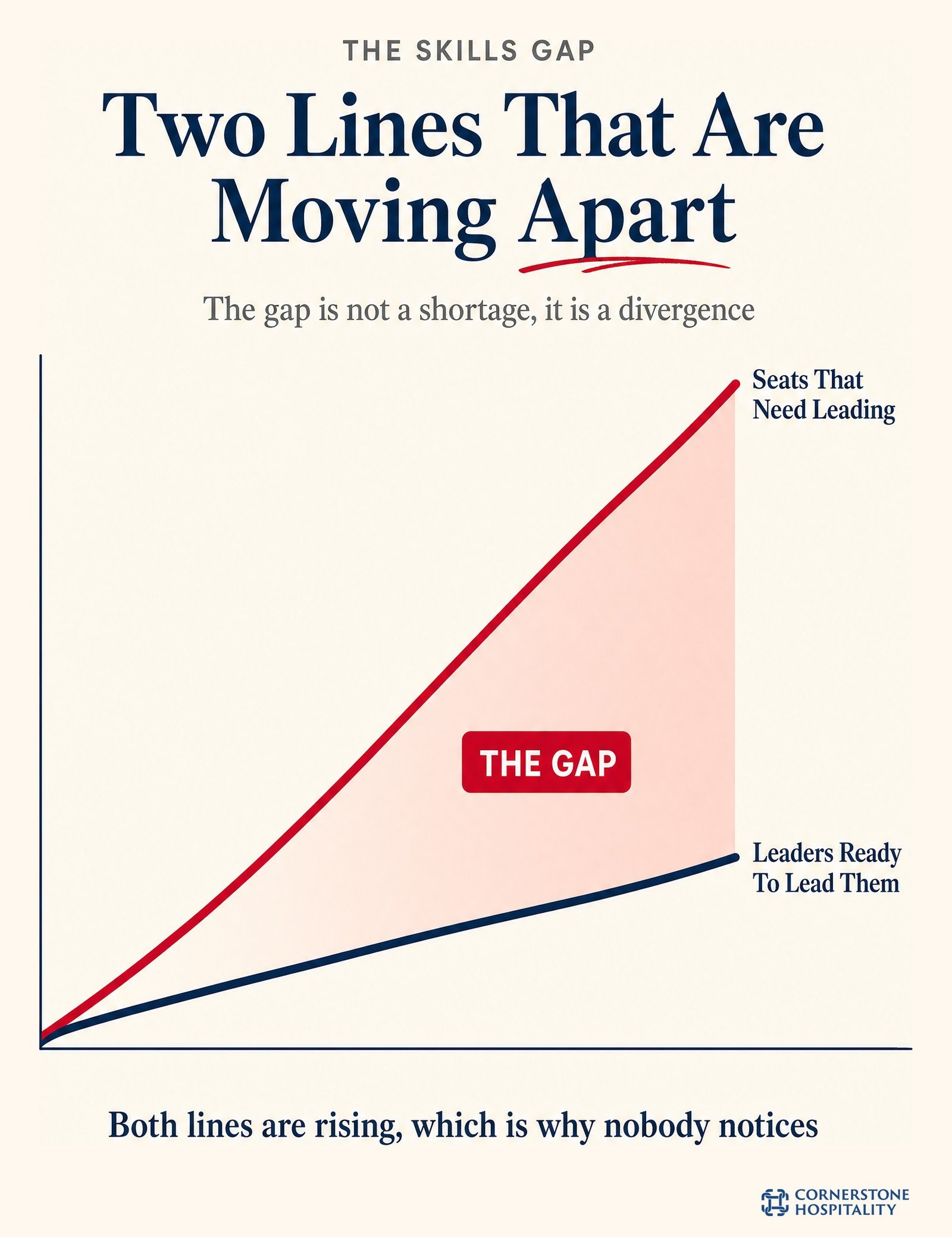
Was die Zahlen tatsächlich beschreiben, ist eine Divergenz. Die Nachfrage nach Führung wächst schnell in einem Sektor, der voraussichtlich 376 Millionen Arbeitsplätze im Jahr 2026 unterstützen wird und über das kommende Jahrzehnt hinweg fast 89 Millionen weitere hinzufügt. [1]. Das Angebot an Personen, die bereit sind zu führen, wächst langsam oder überhaupt nicht. Beide Linien steigen, weshalb niemand den Abstand zwischen ihnen bemerkt, bis ein Platz frei wird.
Dieses Stück legt dar, aus was die Lücke tatsächlich besteht, warum sie sich im Gastgewerbe auf diese Weise verhält, was sie in einem für den Aufsichtsrat verständlichen Kostenrahmen kostet und was sie schließt. Wir führen Suchmandate für diese Positionen durch. Daher ist der Blick hier der auf den Punkt im Prozess, an dem die Lücke unverkennbar wird: der Moment, in dem jemand ernannt werden muss.
Die Einsätze, was die Forschung sagt
Was die Kluft der Führungskompetenzen in der Hotellerie tatsächlich misst
Nehmen Sie zuerst die Nachfragelinie. Reisen und Tourismus werden voraussichtlich 2026 12 Billionen Dollar zur Weltwirtschaft beitragen, was etwa 9,9 % des globalen BIP entspricht, und werden 376 Millionen Arbeitsplätze unterstützen, etwa einer von neun weltweit. [1]. Im nächsten Jahrzehnt wird prognostiziert, dass fast 89 Millionen Jobs hinzugefügt werden, etwa ein Drittel aller netto neuen Jobs in der gesamten globalen Wirtschaft. [1]. Jedes Hotel, Restaurant und Reiseunternehmen in diesem Wachstum benötigt jemanden, der dafür verantwortlich ist, und jemanden, der für die Person verantwortlich ist, die die Verantwortung trägt.
Jetzt die Lieferkette. Nur 20% der HR-Leiter berichten von Führungskräften, die bereit sind, ihre kritischsten Rollen zu besetzen, und 80% der Organisationen haben kein Vertrauen in ihre Führungsebene. [6]. Interne Kandidaten können nur 49% der kritischen Positionen sofort besetzen, in Organisationen, von denen 75% sagen, dass sie interne Beförderungen priorisieren. [6]. Die Führungsbereitschaft in diesem Datensatz nimmt seit 2011 ab, mit nur einem leichten Anstieg im letzten Jahr.
Setzen Sie die beiden zusammen und die Form ist klar. Die Nachfragekurve wächst jährlich um etwa 3,6 %, also 1,5 mal schneller als die breitere Wirtschaft. Die Angebotskurve ist weitgehend stabil. Das ist in keinem sinnvollen Sinne ein Mangel. Es sind zwei Trends, die sich in verschiedene Richtungen bewegen. Dies führt zu einer Lücke, die sich jedes Jahr vergrößert, unabhängig davon, ob irgendjemand etwas dagegen unternimmt.
Warum der Rahmen wichtig ist
Ein Engpass impliziert eine externe Einschränkung, und die sinnvolle Reaktion darauf besteht darin, zu warten, bis der Markt sich lockert. Eine Divergenz ist ein Problem der Rate, und die sinnvolle Reaktion besteht darin, zu bauen. Die Einordnung ist es wert, frühzeitig festgelegt zu werden, da sie bestimmt, wie weit im Voraus die Arbeit vor einer Vakanz beginnen muss.
Warum die Führungskompetenzen in der Hotellerie eine Divergenz, nicht einen Mangel darstellen
Es gibt vier Mechanismen, die die beiden Linien auseinander treiben, und nur einer von ihnen betrifft den Arbeitsmarkt.
Drei der vier sind Entscheidungen, die jährlich getroffen werden
Beachten Sie, dass nur das erste davon ein Arbeitsmarktphänomen ist. Die anderen drei sind Entscheidungen, die jährlich innerhalb der Unternehmen getroffen werden, die dann das Ergebnis als Mangel beschreiben.
„Jede Gruppe, mit der wir arbeiten, kann den Platz benennen, den sie nicht besetzen können. Sehr wenige können die Entscheidung, drei oder vier Jahre zuvor, benennen, die bedeutete, dass niemand intern bereit dafür war. Diese Entscheidung war fast nie dramatisch. Es war normalerweise eine Dehnung, die in sicherere Hände ging, weil das Quartal eng war.“
Florian Kittler, geschäftsführender Gesellschafter, Cornerstone Hospitality
Die fünf Kompetenzen, die im Führungskompetenzgap der Hotellerie fehlen
Es ist wichtig, genau zu sein, denn „Führungsfähigkeiten“ als Kategorie ist zu breit, um darauf zu reagieren. Bei den Suchanfragen, die wir durchführen, kommen in ungefähr dieser Reihenfolge die gleichen fünf Fähigkeiten als fehlend hervor.
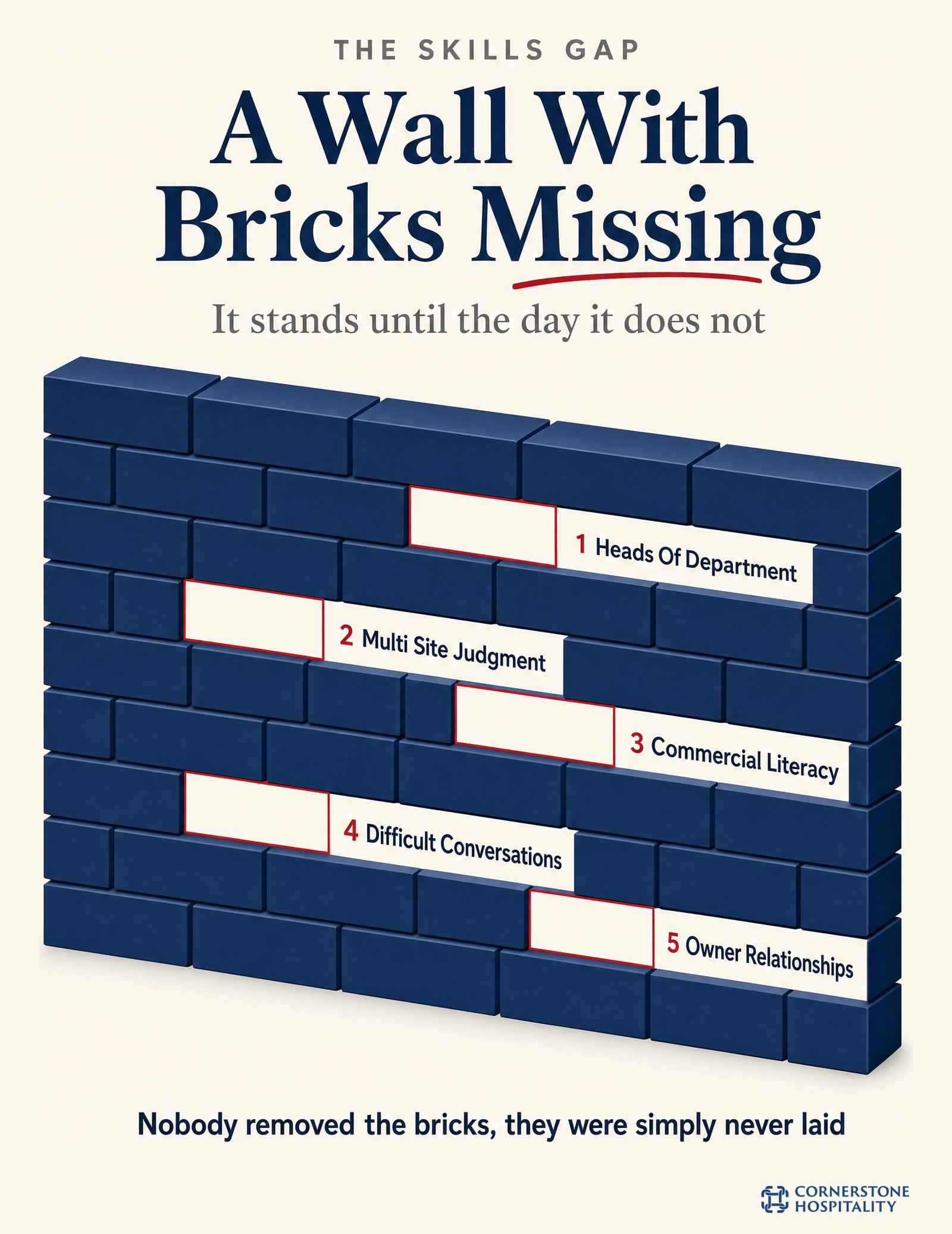
Das erste ist die Leitungsebene, die fast überall unterentwickelt ist. Es ist die letzte Stufe, an der jemand noch die Arbeit verrichtet und die erste, bei der sie für andere verantwortlich sind. Gallups Forschung unter 27 Millionen Mitarbeitern und mehr als 2,5 Millionen Arbeitsgruppen zeigt, dass Führungskräfte mindestens 70 % der Varianz in den Engagement-Score von Mitarbeitern in den Geschäftseinheiten ausmachen. [8]. In einem Sektor, der drei Viertel seiner Abgänge freiwillig verliert [2], ist diese Ebene die Retentionsstrategie, egal ob sie als solche behandelt wird.
Der zweite Punkt ist das Multi-Standort-Urteil. Eine Immobilie gut zu führen und einen Standard über sechs aufrechtzuerhalten, sind zwei verschiedene Aufgaben. Der Übergang zwischen diesen ist der Punkt, an dem die meisten regionalen Ernennungen scheitern. Die Fähigkeit ist nicht Delegation, die jeder beansprucht zu haben. Es ist zu wissen, worauf man achten muss, wenn man das Gebäude nicht sehen kann, und zu wissen, welcher der sechs wöchentlichen Berichte Ihnen etwas mitteilt, was die Immobilie nicht laut gesagt hat. Es wird durch schlechtes Doing unter Aufsicht erlernt. Das ist genau die Art von Erfahrung, die am schwierigsten in einem echten Unternehmen zu bezahlen ist.
Das dritte ist kommerzielle Kompetenz über die Abteilung hinaus. Ein Direktor für F&B, der eine Zimmerprognose nicht lesen kann, oder ein Zimmerdirektor, der die Margenstruktur des F&B nicht versteht, kann nicht in einen Platz befördert werden, der beides umfasst.
Die Kluft, die wie ein Finanzthema erscheint, anstatt wie ein Führungsthema
Diese Lücke ist völlig behebbare und wird fast nie angesprochen, da sie sich eher wie Finanzen als wie Führung anfühlt.
Das vierte ist das schwierige Gespräch. Dies ist die Fähigkeit, deren Fehlen am teuersten und am wenigsten sichtbar ist. Coachability macht 26 % der Misserfolge bei Neueinstellungen aus, und emotionale Intelligenz weitere 23 %, im Vergleich zu 11 % für technische Kompetenz, in einer Studie von über 20.000 Neueinstellungen in 312 Organisationen. [10]. Fast neun von zehn Fehlschlägen sind eher attitudinal als technisch.
Der fünfte Punkt ist die Beziehung zum Eigentümer. Niemand wird dafür ausgebildet, und sie entscheidet über Karrieren. Ein Hoteldirektor, der kein schwieriges Gespräch mit einem Eigentümer führen kann, wird letztendlich den Platz an jemanden verlieren, der dies kann, unabhängig davon, wie gut die Immobilie abschneidet. Der Mechanismus ist selten dramatisch. Es handelt sich um eine Reihe kleiner Hinaussetzungen. Jede für sich genommen sinnvoll, die sich anhäuft, bis der Eigentümer nicht mehr erwartet, etwas Unangenehmes von der Immobilie zu hören, sondern es stattdessen von woanders zu hören beginnt.
| Fähigkeit | Wo es entwickelt wird | Warum es normalerweise fehlt |
|---|---|---|
| Die Ebene darunter führen | Am Boden, unter Druck, mit Unterstützung | Niemand finanziert die Unterstützung, also wird sie zufällig oder gar nicht gelernt |
| Multi-Site-Beurteilung | Eine zweite Immobilie oder ein regionaler Ausbau | Erfordert einen konkreten Auftrag, der operationale Risiken birgt |
| Kommerzielle Kompetenz | Einblick in die gesamte P und L | Als ein Finanzthema behandelt, anstatt als ein Führungsthema |
| Schwierige Gespräche | Coaching und wiederholtes Üben | kann nicht im Klassenraum gelehrt werden, und die große Mehrheit der Einstellungsfehler sind attitudinal |
| Eigentümerkontakte | Im Raum sitzen, wiederholt | Der Zugang wird von der Person geschützt, die ihn derzeit innehat |
Wie die Kluft der Führungskompetenzen in der Hotellerie eine Vakanz in vier verwandelt
Die Lücke zeigt sich nicht als Lücke. Sie zeigt sich als Kaskade, und die Kaskade ist der Grund, warum die Kosten so konstant unterschätzt werden.
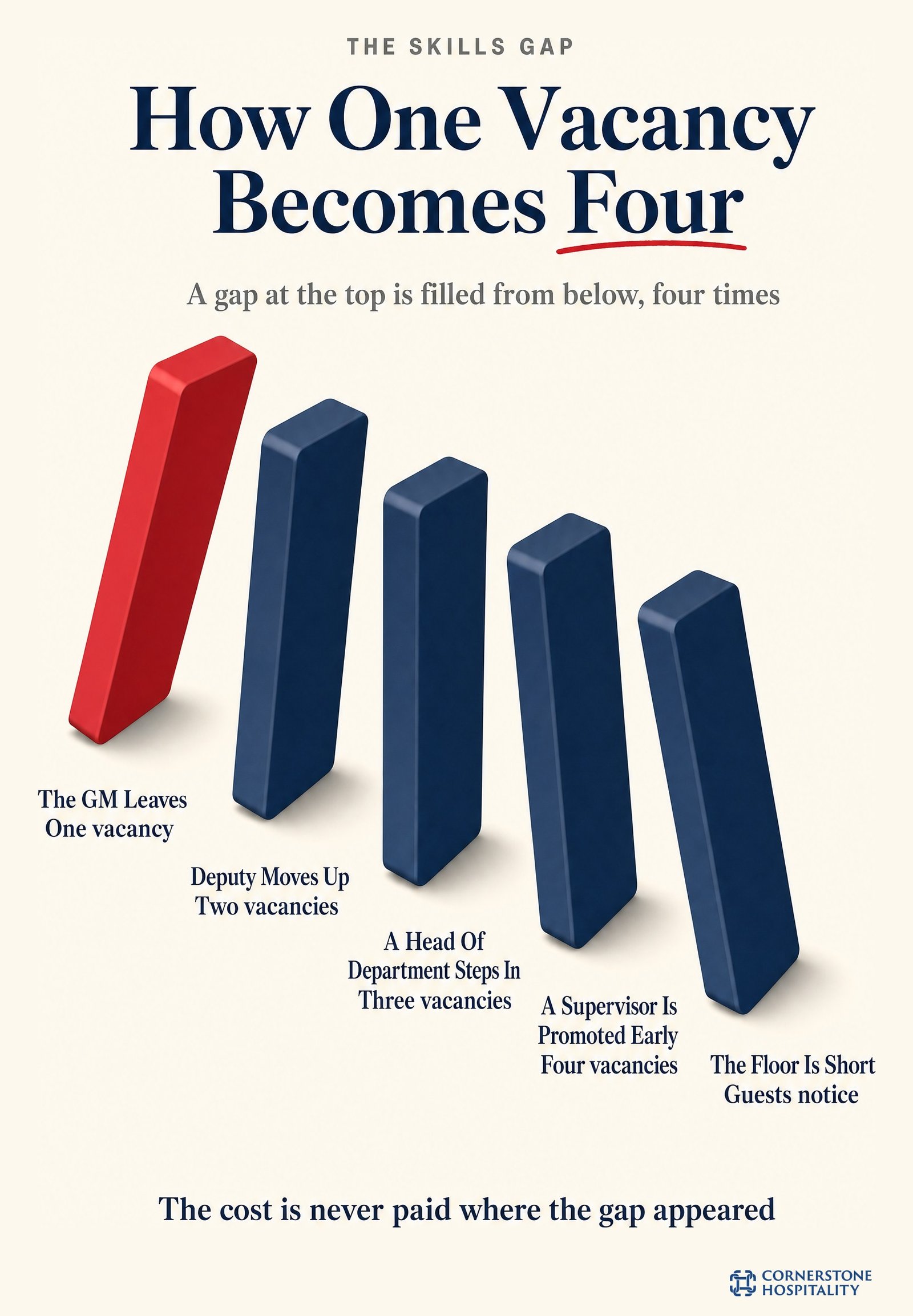
Ein Hoteldirektor verlässt. Das ist eine Vakanz. Der Stellvertreter rückt auf, was zwei ergibt. Ein Abteilungsleiter übernimmt die Rolle des Stellvertreters, was drei ergibt. Ein Supervisor wird frühzeitig in den Platz des Abteilungsleiters befördert, was vier ergibt. Und ganz unten in der Kette fehlt es, wobei der Gast es bemerkt, und die Gästebewertung sinkt.
Jeder dieser vier Schritte ist eine Person, die eine Aufgabe macht, die leicht zu groß für sie ist, gleichzeitig im selben Gebäude, ohne die Unterstützung, die normalerweise mit einer Dehnung einhergeht. Drei der vier hatten keine Bewertung und keine Vorbereitung. Das ist kein Talentproblem. Es ist eine strukturelle Folge des Fehlens einer Bank.
Die finanzielle Rechnung verstärkt es. Die Kosten für die Ersetzung eines einzelnen Mitarbeiters liegen zwischen dem halben und dem doppelten Gehalt, was von Gallup als konservative Schätzung beschrieben wird. [9]. Multiplizieren Sie diese Zahl mit vier anstelle von eins, und die Kosten für einen einzigen unvorhergesehenen Abgang im Management werden zu einer wirklich materiellen Zahl, bevor irgendeine Überlegung des externen Suchprämien.
Der Teil, den die Berichterstattung trennt
Ein Kaskadeneffekt von vier wird normalerweise als vier separate Posten über zwei Budgetperioden in drei verschiedenen Kostenstellen aufgezeichnet. Die Verbindung zwischen ihnen ist real, und die Struktur der Berichterstattung hält es verborgen. Deshalb überlebt die zugrunde liegende Kluft jede Kostenüberprüfung.
Was das Führungskompetenzgap in der Hotellerie kostet, in Zahlen, die ein Aufsichtsrat erkennt
Vier Kosten, in aufsteigender Reihenfolge der Größe und absteigender Sichtbarkeit.
Das erste ist der externe Aufpreis. Externe Einstellungen erhalten etwa 18 % bis 20 % mehr als vergleichbare interne Beförderungen, und die einstellenden Manager bestätigen, dass sie normalerweise einen Aufpreis von 10 % bis 20 % zahlen, um jemanden aus einer sicheren Position zu bewegen. [12]Eine Gruppe ohne Nachrücker zahlt dies bei jeder senioren Vakanz dauerhaft.
Das Zweite ist die Zeit bis zur Leistung. Externe Neueinstellungen benötigen etwa zwei Jahre, um das Niveau einer internen Beförderung in denselben Job zu erreichen. [12]. In einem Geschäft, das monatlich gemessen wird, sind zwei Jahre acht vierteljährliche Überprüfungen mit reduzierter Leistung. Dies wird niemand der Ernennung zuschreiben, denn bis dahin ist es normalisiert worden.
Das Dritte ist die Misserfolgsquote. Im Datensatz von Leadership IQ scheiterten 46 % der Neueinstellungen innerhalb von 18 Monaten und nur 19 % erreichten uneingeschränkten Erfolg. [10]. Eine Gruppe, die extern in drei Führungspositionen pro Jahr einstellt, sollte, basierend auf diesen Grundraten, erwarten, eines dieser Suchmandate innerhalb von zwei Jahren erneut durchzuführen.
Das vierte ist das, was niemand quantifiziert. Das Teamklima macht bis zu 31 % der Variation im Engagement auf Teamebene aus. Die richtigen Führungsmerkmale können das Engagement um bis zu 42 Perzentilpunkte erhöhen. [15]. Eine schwache Ernennung erfüllt nicht einfach nicht die Anforderungen. Sie verschlechtert das Klima der gesamten Einheit, solange sie dauert, und das zeigt sich in der Fluktuation Monate später, die etwas anderem zugeschrieben wird.
Was tatsächlich die Kluft der Führungskompetenzen in der Hotellerie schließt
Drei Dinge, in dieser Reihenfolge. Keines davon ist ein Programm, und die Reihenfolge ist wichtiger als der Inhalt.
Die Rechnungsänderung, die den Rest zum Funktionieren bringt
Es gibt eine vierte Sache, die schwieriger als Schritt zu schreiben ist, da es mehr eine Frage der Buchhaltung als der Praxis ist. Eine Einrichtung, die jemanden entwickelt und ihn dann durch einen Gruppenwechsel verliert, hat investiert und nichts erhalten. Bis dieser Transfer in die Bewertung, wie die Einrichtung beurteilt wird, einbezogen wird, wird kein vernünftiger Hoteldirektor es zweimal tun. Die Lücke wird bestehen bleiben, unabhängig davon, wie viel für Programme ausgegeben wird.
Es ist erwähnenswert, was ihn nicht schließt. Die US-Ausgaben für Schulungen erreichten 2025 102,8 Milliarden Dollar, ein Plus von 4,9 %, bei durchschnittlich 874 Dollar pro Lernenden, während die durchschnittliche Schulungszeit pro Mitarbeiter auf 40 Stunden von 47 fiel. [14]. Steigende Ausgaben, während die Stunden sinken, ist kein Bild eines Problems, das mit Geld gelöst wird. Es ist ein Bild von Geld, das am falschen Ort ausgegeben wird.
Was ist anders im Jahr 2026
Drei Dinge haben in den letzten zwei Jahren die Form dieser Situation verändert. Alle drei machen es schwieriger, die Lücke zu schließen, anstatt einfacher.
Das erste ist, dass die Führungskräftepopulation selbst unter Druck steht. 71 % der Führungskräfte berichten von einem signifikanten Anstieg des Stresses, seit sie ihre Rolle übernommen haben. 40 % von ihnen haben darüber nachgedacht, die Führung zu verlassen, und das Vertrauen in die unmittelbaren Manager ist auf 29 % gefallen, ein Rückgang um 37 % seit 2022. [7]. Die Personen, die Führungslücken schließen, sind Führungskräfte. Eine erschöpfte Führungsebene schließt sie langsamer.
Das zweite ist, dass die Hochpotenzialpopulation mobiler geworden ist. Die Absicht zu wechseln unter hochpotentiellen Einzelbeitragsleistenden stieg von 13 % im Jahr 2020 auf 21 % im Jahr 2024, und hochpotentielle Talente haben eine 3,7-fach höhere Wahrscheinlichkeit, innerhalb eines Jahres zu wechseln, wenn ihr Manager nicht regelmäßig Wachstumsmöglichkeiten bietet. [7]. Die Reserve wird nun eher abwandern, bevor sie genutzt wird.
Das dritte ist, dass das Personalbild darunter sich nicht vollständig erholt hat. 65 % der befragten Hotels berichten weiterhin von Personalengpässen, die Hotellerie liegt fast 10 % unter den Beschäftigungszahlen vor der Pandemie. 71 % der Betriebe haben offene Stellen mit einem Durchschnitt von sechs bis sieben pro Betrieb.
Wo die Staffing-Zahlen im Jahr 2026 liegen
Mehr als die Hälfte der Hotels beschreibt sich als etwas oder stark unterbesetzt, wobei Personalmangel eine der größten Sorgen für 42 % darstellt. [5].
Die eine ermutigende Zahl
Trotz allem sagen 72 % der befragten Hoteliers, dass die Karrieremöglichkeiten in der Hotellerie besser sind als je zuvor. [4]. Dieser Glaube ist das Rohmaterial, aus dem eine Pipeline aufgebaut wird. Sie übersteht viel, aber sie übersteht nicht, als hochpotenziert bezeichnet und dann zwei Jahre allein gelassen zu werden.
Ein weiterer Punkt. Das Vertrauen in aufstrebende Führungskräfte ist nirgendwo hoch: nur 13 % der Führungskräfte äußern Vertrauen in die aufstrebenden Führungskräfte in ihren Unternehmen, ein Rückgang von bereits niedrigen 17 % vor drei Jahren, und nur 24 % der Führungskräfte in Unternehmen mit Hochpotenzialprogrammen halten diese Programme für erfolgreich. [11]. Die Hotellerie ist nicht ungewöhnlich in Bezug auf diese Lücke. Sie ist ungewöhnlich darin, wie schnell sich die Lücke vertieft, aufgrund des hohen Personalwechsels.
Glossar
- Divergenz
- Zwei verwandte Größen, die sich im Laufe der Zeit auseinander entwickeln. Unterscheidet sich von einem Mangel, der eine feste Beschränkung impliziert und nicht einen Unterschied in der Rate.
- Cascade
- Die Reihenfolge, in der eine vakante Führungsposition mehrere nach sich zieht, da jeder nachfolgende Platz aus der darunterliegenden Ebene besetzt wird.
- Das 70-20-10-Muster
- Die Erkenntnis, dass Entwicklung ungefähr zu 70 % aus herausfordernden Erfahrungen, 20 % aus entwickelnden Beziehungen und 10 % aus Kursen besteht. [13].
- Multi-Site-Beurteilung
- Die Fähigkeit, einen Standard über Standorte hinweg zu halten, an denen ein Führer nicht physisch präsent ist. Unterscheidet sich von Delegation.
- Externe Prämie
- Die zusätzlichen Kosten für die Einstellung von außen im Vergleich zur Beförderung von innen, etwa 18 % bis 20 % nur bei der Vergütung. [12].
- Bank
- Die benannte, bewertete Gruppe, die innerhalb eines definierten Zeitrahmens einen kritischen Platz einnehmen könnte. Namen ohne Bewertung sind eine Wunschliste.
Häufig gestellte Fragen
Ist das Führungskompetenzgap in der Hotellerie wirklich schlimmer als in anderen Sektoren?
Die Kluft selbst ist nicht ungewöhnlich. Was ungewöhnlich ist, ist die Geschwindigkeit, mit der sie sich vergrößert. Denn die Fluktuation in diesem Bereich ist die höchste aller Branchen: eine monatliche Kündigungsrate von 4,3 % im Vergleich zu einem Durchschnitt von 2,2 % im privaten Sektor. [2], und 76% jährliche Fluktuation [3]. Der gleiche zugrunde liegende Unterschied vergrößert sich hier schneller.
Welche Fähigkeit sollten wir zuerst verbessern?
Die Abteilungsebene. Sie hat den größten gemessenen Effekt auf das Engagement und daher auf die Fluktuation, da Manager für mindestens 70% der Engagement-Variation in ihren Einheiten verantwortlich sind. [8]. Es ist auch die günstigste Ebene, die zu entwickeln ist, und die, die die meisten Gruppen am wenigsten finanzieren.
Können wir es uns leisten, Leute einzustellen?
Teilweise, und teuer. Externe Neueinstellungen werden 18 % bis 20 % besser bezahlt und benötigen etwa zwei Jahre, um die Leistung einer internen Beförderung zu erreichen. [12], und 46% der Neueinstellungen scheitern innerhalb von 18 Monaten bei den allgemeinen Basisraten [10]. Externe Einstellungen sind ein legitimes Werkzeug. Es ist ein schlechter Ersatz für einen Nachrücker.
Wie lange dauert es, um abzuschließen?
Drei Jahre, bevor sich die interne Besetzungsquote ändert, etwa neun Monate, bevor die führenden Indikatoren dies tun. Alles, was ein schnelleres Ergebnis verspricht, beschreibt ein Programm und nicht einen Fähigkeitswechsel.
Ist es wert, Menschen zu entwickeln, die wahrscheinlich sowieso gehen werden?
Ja, bei der Mathematik. Die Alternative besteht darin, für jeden Platz für immer einen externen Aufpreis zu zahlen. Es ist auch erwähnenswert, dass hochpotentielle Personen 3,7 Mal wahrscheinlicher den Arbeitgeber wechseln, wenn der Manager kein Wachstum bietet. [7], weshalb es keine neutrale Entscheidung ist, sie nicht zu entwickeln.
Unser Schulungsbudget ist bereits groß. Warum ändert sich nichts?
Meistens wegen des Budgets und nicht, wie groß es ist. Etwa 70% der Entwicklung stammen aus herausfordernden Aufgaben und nur 10% aus Kursen. [13], und die Ausgaben für Schulungen in den USA stiegen 2025 auf 102,8 Milliarden Dollar, während die durchschnittlichen Stunden pro Mitarbeiter von 47 auf 40 fielen. [14]. Mehr Geld in die 10 bewegt nicht die 70.
Was ist die einzelne Zahl, die verfolgt werden soll?
Interner Ansatz für kritische Stellen über einen Zeitraum von drei Jahren. Es ist langsam, unvorteilhaft und unmöglich zu manipulieren, weshalb es genau das nützlich macht, um es einem Eigentümer vorzulegen.
Zusehen, wie die Kluft größer wird und nicht sicher, wo man anfangen soll?
Eine ehrliche Einschätzung, wo Ihr Talentpool tatsächlich steht, dauert etwa sechs Wochen. Keine Verpflichtung, keine Kosten.
Quellen
- World Travel & Tourism Council: Das Wachstum im globalen Reise- & Tourismusmarkt wird die breitere Wirtschaft im nächsten Jahrzehnt um das 1,5-fache übertreffen: veröffentlicht am 12. Mai 2026 mit Forschungspartner Oxford Economics, prognostiziert, dass der Sektor „weltweit 376 Millionen Arbeitsplätze im Jahr 2026 unterstützen wird, was einem von neun Jobs weltweit entspricht“ und „12 Billionen USD zur Weltwirtschaft beitragen wird, was 9,9 % des globalen BIP entspricht“. Im nächsten Jahrzehnt wird eine Schaffung von „fast 89 Millionen neuen Arbeitsplätzen weltweit projections, die etwa ein Drittel aller neuen Arbeitsplätze ausmachen werden, die im weiteren wirtschaftlichen Zusammenhang erwartet werden: wttc.org/news/global-travel-tourism-growth-to-outpace-wider-economy-by-1-5-times-over-the-next-decade
- OysterLink-Analyse der JOLTS-Daten des U.S. Bureau of Labor Statistics: Mitarbeiter im Hotel- und Gastgewerbe kündigen in höheren Raten als in jeder anderen Branche in den USA: stellt fest, dass „die Kündigungsrate im Bereich Unterkunft und Verpflegung im März 2026 4,3 % erreichte, die höchste unter allen Branchen“ und „fast doppelt so hoch wie der Durchschnitt des Privatsektors von 2,2 %“ war. Der Einzelhandel, der nächsthöchste Sektor, verzeichnete 3,1 %, gefolgt von Gesundheitswesen mit 1,9 %, Fertigung mit 1,4 % und Finanzen mit 1,2 %. Entlassungen im Sektor lagen bei 1,3 %, was dem nationalen Durchschnitt entspricht, sodass etwa drei Viertel der Trennungen auf die Entscheidung der Menschen zurückzuführen sind, zu gehen: prnewswire.com/news-releases/hospitality-workers-quit-at-a-higher-rate-than-any-other-industry-in-the-us
- Deloitte: Trends bei der Frontlinie in Fluggesellschaften, Hotellerie und Gastronomie: berichtet, dass „80 % der Restaurantmitarbeiter und 76 % der Mitarbeiter im Gastgewerbe innerhalb eines Jahres ihren Job verlassen“, und dass „66 % der Führungskräfte und Manager sagen, die letzten Einstellungen seien nicht vollständig vorbereitet gewesen und dass fehlende Erfahrung die häufigste Schwäche war“. Es wird auch festgestellt, dass 82 % der Arbeitnehmer angeben, dass das Gefühl, glücklich und engagiert bei der Arbeit zu sein, der wichtigste Treiber für Produktivität ist, und 75 % auf der Suche nach größerer Stabilität im Angesicht von Veränderungen sind: deloitte.com/us/en/Industries/consumer/articles/frontline-workforce-human-capital-trends
- American Hotel & Lodging Association: 65 % der befragten Hotels berichten von Personalmangel: befragt 282 Hoteliers zwischen dem 6. Dezember 2024 und dem 3. Januar 2025 mit Hireology und stellt fest, dass 65 % weiterhin über einen Mangel berichten, 9 % sich „schwer unterbesetzt“ beschreiben im Vergleich zu 13 % im Mai 2024, dass die Hotelbeschäftigung „nahezu 10 % unter den Personalständen vor der Pandemie“ liegt und 71 % offene Stellen mit einem Durchschnitt von sechs bis sieben pro Immobilie haben. Die Reinigung macht 38 % der Lücken aus und die Rezeption 26 %, und 72 % der Befragten sagen, dass die Karrierechancen in der Hotellerie besser sind als je zuvor: ahla.com/news/65-surveyed-hotels-report-staffing-shortages
- American Hotel & Lodging Association: Steigende Kosten, Herausforderungen bei der Personalbesetzung bestehen für Hotels, da die Reisennachfrage voraussichtlich stabil bleibt: untersucht 246 Hoteliers Ende Februar 2026 und stellt fest, dass „mehr als die Hälfte der Befragten angeben, dass ihre Betriebe etwas oder stark unterbesetzt sind“, wobei die Arbeitskosten bei 65 % ein Hauptanliegen darstellen und Arbeitskräftemangel von 42 % genannt wird. Genutzte Anreize zur Mitarbeiterbindung umfassen höhere Gehälter bei 70 %, flexible Arbeitszeiten bei 54 %, Hotelrabatte bei 54 % und verbesserte Leistungen bei 31 %: ahla.com/news/rising-cost-staffing-challenges-persist-hotels
- DDI: Best Practices der Nachfolgeplanung: Wie man die Lücke in der Führungsvorbereitung schließt: berichtet, dass „nur 20 % der HR-Leiter sagen, sie hätten Führungskräfte bereit, ihre kritischsten Rollen zu übernehmen“, und dass „80 % der Organisationen kein Vertrauen in ihre Führungskräfte haben“, während „75 % der Organisationen interne Beförderungen über externe Einstellungen priorisieren“ und interne Kandidaten „nur 49 % der kritischen Positionen sofort besetzen können“. Es stellt auch fest, dass Beförderungen 1,6-mal wahrscheinlicher erfolgreich sind, wenn Bewertungen die Auswahl informieren, und dass Organisationen mit starken Führungskräften 2,9-mal wahrscheinlicher Führungsrollen intern besetzen und 2,8-mal wahrscheinlicher finanziell übertreffen: ddi.com/blog/succession-planning-best-practices
- DDI: Globale Leadership Forecast 2025-Studie signalisiert bevorstehenden Führungs-Exodus: befragt 10.796 Führungskräfte und 2.185 HR-Professionals aus mehr als 50 Ländern und 24 Branchen, wobei 71 % der Führungskräfte mit erhöhtem Stress berichten, 40 % der gestressten Führungskräfte in Erwägung ziehen, die Führung ganz aufzugeben, und das Vertrauen in unmittelbare Vorgesetzte bei „gerade einmal 29 %, ein Rückgang um 37 % seit 2022“ liegt. Es verzeichnet auch, dass die Absicht, hochqualifizierte Talente zu verlieren, von „13 % im Jahr 2020 auf 21 % im Jahr 2024“ gestiegen ist, wobei hochqualifizierte Talente 3,7-mal wahrscheinlicher innerhalb eines Jahres gehen, wenn der Vorgesetzte keine regelmäßigen Wachstumschancen bietet: ddi.com/about/media/global-leadership-forecast-2025
- Gallup: Manager verantworten 70% der Abweichungen im Mitarbeiterengagement: erklärt, dass „Führungskräfte mindestens 70 % der Variabilität der Engagementwerte von Mitarbeitern über Geschäftseinheiten hinweg ausmachen“, basierend auf Forschungen zur Messung des Engagements von 27 Millionen Mitarbeitern und mehr als 2,5 Millionen Arbeitseinheiten über zwei Jahrzehnte. Es stellt außerdem fest, dass etwa einer von zehn Personen über hohe Führungstalente verfügt, dass Unternehmen „82 % ihrer Einstellungsentscheidungen bezüglich hoher Führungskräfte falsch treffen“ und dass talentierte Führungskräfte etwa 48 % höhere Gewinne als durchschnittliche Führungskräfte beitragen: news.gallup.com/businessjournal/182792/managers-account-variance-employee-engagement
- Gallup: Dieses lösbare Problem kostet US-Unternehmen 1 Billion Dollar: stellt fest, dass „die Kosten für die Ersetzung eines einzelnen Mitarbeiters zwischen der Hälfte und zweimal dem Jahresgehalt des Mitarbeiters liegen können“ und beschreibt dies als „eine konservative Schätzung“. Es berichtet auch, dass 52 % der freiwillig ausscheidenden Mitarbeiter sagen, dass ihr Vorgesetzter oder die Organisation ihren Weggang hätten verhindern können, und 51 % geben an, dass in den drei Monaten vor ihrem Ausscheiden weder ihr Vorgesetzter noch ein anderer Führungskraft mit ihnen über die Arbeitszufriedenheit oder ihre Zukunft gesprochen hat: gallup.com/workplace/247391/fixable-problem-costs-businesses-trillion
- Leadership IQ: Ausfallraten von Führungskräften: berichtet über eine longitudinale Studie von mehr als 20.000 Neueinstellungen in 312 Organisationen, bewertet von 5.247 Einstellungen Managern nach 6, 12, 18 und 24 Monaten, wobei festgestellt wurde, dass „46 % der Neueinstellungen innerhalb von 18 Monaten scheiterten; nur 19 % erzielten eindeutigen Erfolg“ und dass 89 % der Misserfolge auf Einstellungsfaktoren zurückzuführen waren, während es 11 % für technische Fähigkeiten waren. Die Haupttreiber waren Coachability mit 26 %, emotionale Intelligenz mit 23 %, Motivation mit 17 % und Temperament mit 15 %: Führungs-IQ.com/blogs/führungs-iq/scheiterraten-von-führungskräften
- Harvard Business Review: Potenzial in Erfolg verwandeln: Der fehlende Link in der Führungskompetenzentwicklung: von Claudio Fernández-Aráoz, Andrew Roscoe und Kentaro Aramaki berichtet, dass „66 % der Unternehmen in Programme investieren, die darauf abzielen, hochqualifizierte Mitarbeiter zu identifizieren und ihnen zu helfen, voranzukommen“, während „nur 24 % der Führungskräfte in diesen Unternehmen die Programme als erfolgreich erachten“. Es fügt hinzu, dass „gerade einmal 13 % Vertrauen in die aufstrebenden Führungskräfte in ihren Unternehmen haben, ein Rückgang von bereits niedrigen 17 % vor drei Jahren“, und dass bei den größten Unternehmen der Welt „30 % der neuen CEOs von außen eingestellt werden“: hbr.org/2017/11/turning-potential-into-success-the-missing-link-in-leadership-development
- Wissen an der Wharton: Warum externe Einstellungen mehr verdienen und schlechter abschneiden als internes Personal: berichtet von Matthew Bidwells Studie „Paying More to Get Less: Die Auswirkungen externer Einstellungen im Vergleich zu interner Mobilität“, veröffentlicht in der Administrative Science Quarterly und basierend auf Personaldaten aus einer US-Investmentbankungsdivision von 2003 bis 2009. Externe Einstellungen werden mit „etwa 18 % bis 20 % mehr“ als vergleichbare interne Beförderungen vergütet und benötigen „etwa zwei Jahre, um sich einzuarbeiten“, und einstellende Manager bestätigen, dass sie „typischerweise 10 % oder 20 % mehr bezahlen, um Personen aus Positionen zu ziehen“, wo sie bereits Sicherheit haben: knowledge.wharton.upenn.edu/article/why-external-hires-get-paid-more-and-perform-worse-than-internal-staff
- Center for Creative Leadership: Die 70-20-10 Regel für Leadership Development: beschreibt das Rahmenwerk, das „aus über 30 Jahren unserer Lessons of Experience-Forschung hervorgegangen ist“, in dem die Entwicklung in „70 % herausfordernde Erfahrungen und Assignments, 20 % entwickelnde Beziehungen, 10 % Kursarbeiten und Schulungen“ unterteilt wird. CCL stellt fest, dass das Rahmenwerk aus Forschungen in China, Indien, Singapur und den Vereinigten Staaten stammt und in einem Kundenstamm, der zwei Drittel der Fortune 1000 umfasst, verwendet wird: ccl.org/articles/leading-effectively-articles/70-20-10-rule
- Training Magazine: Bericht über die Trainingsbranche 2025: verzeichnet, dass „die US-Ausgaben für Schulungen um 4,9 % auf 102,8 Milliarden USD im Jahr 2025 gestiegen sind“ und dass „Organisationen in diesem Jahr 874 USD pro Lernendem ausgegeben haben, verglichen mit 774 USD pro Lernendem im Jahr 2024“, während die durchschnittlich erhaltene Ausbildung auf „40 Stunden Ausbildung pro Jahr im Vergleich zu 47 Stunden im letzten Jahr“ fiel. Management- und Aufsichtstraining machten 13 Prozent des durchschnittlichen Budgets aus. Die Umfrage umfasst ein gewichtetes Universum von 152.572 US-Unternehmen mit 100 oder mehr Mitarbeitern: trainingmag.com/2025-training-industry-report
- Korn Ferry Institute: Stärkere Führung, besseres Klima, bessere Ergebnisse: analysiert „Daten von über 2.700 Personen über 541 Teams“ und stellt fest, dass „das Teamklima bis zu 31 % der Variation im Team-Engagement ausmachte“. Es berichtet, dass die richtigen Führungseigenschaften und das Teamumfeld „die Engagementwerte um bis zu 42 Perzentilpunkte steigern können“ und dass Führungskräfte, die in Bezug auf Präsenz, Agilität und Streben hoch punkten, Teamklimas „ungefähr 30 Perzentilpunkte stärker“ als weniger gut bewertete Führungskräfte erzeugen: kornferry.com/institute/stronger-leadership-stronger-climate-better-results
- Gesellschaft für Industrielle und Organisationale Psychologie: Ist kognitive Fähigkeit der beste Prädiktor für Arbeitsleistung? Neue Forschungen sagen, es ist Zeit, noch einmal darüber nachzudenken.: berichtet über die überarbeiteten operationalen Validitätsschätzungen von Sackett und Kollegen, in denen „strukturierte Interviews sich als die stärksten Prädiktoren für die Jobleistung“ mit einer mittleren operationalen Validität von 0,42 herausstellt, gefolgt von Jobwissen und Arbeitsstichproben-Tests mit 0,40, 0,38 und 0,33, und „kognitive Fähigkeiten diese Liste mit einer Validitätsabschätzung von 0,31 abrunden“. Der Artikel erklärt, dass frühere meta-analytische Korrekturen diese Werte systematisch aufgebläht hatten: siop.org/tip-article/is-cognitive-ability-the-best-predictor-of-job-performance
- Die Zukunft der Organisation, Interview mit Michael Watkins: Die ersten 90 Tage: Strategien für Führungskräfte im Übergang: vermerkt, dass Watkins feststellt, dass „ohne Hilfe der Prozess für Führungskräfte, den Break-even-Punkt zu erreichen, bis zu sechs Monate dauern kann“, wobei der Break-even-Punkt der ist, an dem ein Führer so viel Wert beiträgt, wie er konsumiert hat. Er stellt auch fest, dass „die meisten Menschen 10 bis 15 Jahre in Führungspositionen verbringen, bevor sie eine formale Führungsschulung von ihrer Organisation erhalten“, wobei der durchschnittliche Führer in seinen späten Dreißigern oder frühen Vierzigern vor jeglicher Schulung ist: thefutureorganization.com/the-first-90-days-strategies-for-leaders-in-transition
Über den Autor
Florian leitet die globale Praxis für Hotellerie, Reisen & Freizeit der Cornerstone International Group. Er bringt siebenzehn Jahre Erfahrung in der gehobenen Hotellerie mit, darunter Marriott, Hyatt, IHG, Mandarin Oriental und Shangri-La Hotels & Resorts, sowie sechzehn Jahre in der Personalberatung. Er spricht fließend Englisch und Deutsch und arbeitet in Europa, dem Nahen Osten, Amerika und im asiatisch-pazifischen Raum.