


Team Coaching for Hospitality Leadership Teams: When It Works

The stakes, what the research says
Senior-hire failure rates, the role of team fit in those failures, and what disciplined team-level intervention can unlock when the unit is genuinely a team. Sources are listed in full beneath the article.
- Leadership Development & Coaching: the pillar
- The ROI of executive coaching for a hospitality leader
- B2C and B2B coaching contexts: matching the work to the seat
Where’s your career going? Let’s find out together.
Have a short, private conversation with our AI assistant. It asks 7 questions, takes 6 to 8 minutes, and you leave with a personalized read on your next move, sent straight to your inbox.
Key Finding
When team coaching works for a hospitality leadership team
Team coaching works when the group in the room is genuinely a team, instead of a collection of individual contributors who happen to report to the same person. That distinction sounds obvious in the brief, yet it almost never feels obvious in the room: most senior hospitality leadership teams sit somewhere on the spectrum between “real team” and “senior people who report to a common boss.” The closer the team is to the real-team end of that spectrum, the more leverage team coaching has. The closer it is to a group of parallel individuals, the less there is for the coaching to change collectively, and the greater the risk that the engagement creates a better atmosphere in the room without producing meaningful change in the business.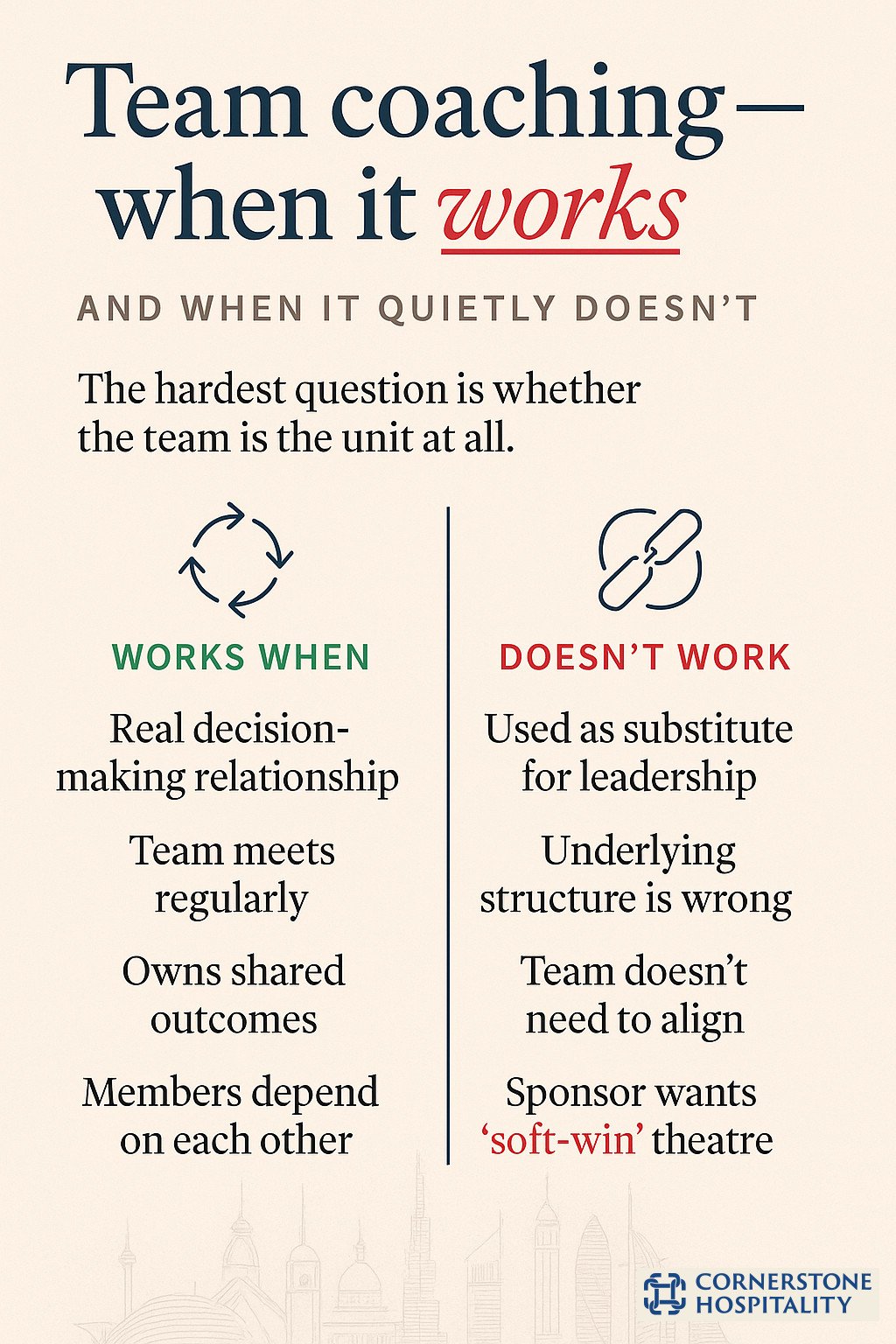
Conditions
team coaching for hospitality leadership teams, when it works and when it does not
When it works
- ✓The CEO is in the room and stays in the room.
- ✓The team owns a live, shared commercial goal.
- ✓Success is defined in advance and measured after.
- ✓The engagement runs six months or longer, not one workshop.
When it does not
- ✗The CEO dips in for the opening and delegates the rest.
- ✗Individual coaching is being rebranded as team work.
- ✗The goal is culture in the abstract, not a business outcome.
- ✗The team is expected to change in a single offsite.
Four tests that separate real teams from parallel individuals
Four tests separate the real team from the parallel-individuals group. They are not subtle, but they are easy to skip in the enthusiasm of commissioning the work.- ✓There is a real decision-making relationship across the team. Decisions of consequence are made by the team, not announced to it.
- ✓The team meets regularly with a structured agenda. There is a rhythm, a working artifact, and something that gets followed up.
- ✓Members own shared outcomes. Property GMs share regional numbers; corporate functions share commercial targets; success or failure is collective, not solo.
- ✓Members depend on each other to do their own work well. Rooms can’t deliver without F&B; operations can’t deliver without commercial; commercial can’t deliver without brand. The interdependence is real and visible.
What real-team coaching actually surfaces and shifts
Senior hospitality leadership teams that meet all four tests benefit enormously from team coaching. Communication patterns surface that no individual coaching engagement would touch: the unspoken rules about who interrupts whom, whose objection is allowed to stop a decision, what gets escalated, and what gets quietly dropped. As a result, strategic decisions get sharper and get made faster because the team learns where its own disagreement actually sits. The team’s capacity to handle disagreement constructively, which is the hallmark of high-performing team behavior, visibly grows too. An analysis of 541 leadership teams quantifies how much of the engagement gap is owned by team-level climate rather than by individual traits: up to 31% of the variation in team-level engagement traces to team climate alone [5]. Team coaching hospitality work is the discipline that targets exactly that variable.Why this matters
In hospitality, the senior leadership team is the unit the strategy actually runs through. A regional VP can write a brilliant five-year plan, but it lands or fails through the GMs, the F&B leadership, the commercial team, the brand team, and the asset partner all moving in the same direction at the same pace. When the team’s working pattern is broken, the plan never reaches the property in the form the strategist intended. Team coaching is the work that fixes the medium through which strategy travels.
The Conditions
Four moments when team coaching hospitality work earns its keep
The four tests filter that answers, is this a team? The next question is, is now the right moment? Across Cornerstone’s engagements, four moments in the life of a senior hospitality leadership team produce the highest return on team coaching investment. Each one is a moment where the team genuinely has to become a new team, rather than simply going on being the team it was.A brand reorganization, a new CEO, a structural reshape that brings five or six leaders into a room they haven’t shared before. The team has to find its working pattern fast; the business is already running. Team coaching compresses what would otherwise be eighteen months of awkward feeling-out into a structured three to six months.
Two legacy leadership groups become one. Each side has its own brand DNA, decision rituals, and shorthand. The integration plan addresses systems and reporting lines; team coaching addresses the human operating system that the integration plan cannot reach.
A new property, a new region, a new brand. The team is taking something from paper to opening. The patterns the team sets in pre-opening become the operating culture for years; team coaching is the moment to deliberately set those patterns before the pressure of opening locks them in.
EMEA and APAC are on the same team. Multiple first languages. The unspoken rules of meetings, disagreement, and decision-making diverge in ways that are invisible to the people inside them. Team coaching makes those rules visible and writes new ones the team owns together.
Why these four moments concentrate the risk and the return
In each of these moments, the team is genuinely the unit, and the work has somewhere to go, so the cost of not doing the work is large: it is the difference between a leadership team that delivers on its remit and one that runs at 60% effectiveness for eighteen months while its members quietly look elsewhere. The broader senior-hire literature shows roughly 89% of failed senior hires fail for attitudinal and team-fit reasons instead of technical capability [2], which is exactly where a moment that creates a new team concentrates that risk.Why this matters
Team coaching commissioned in one of these four moments has a brief that writes itself. Team coaching commissioned outside them tends to drift; the team isn’t sure what they’re working on because nothing has fundamentally changed. If a board is weighing the investment, the first diagnostic question is which of the four moments (if any) is the actual driver.
The Honest Conversation
When team coaching does not work, and what to do instead
Knowing when team coaching hospitality work does not land is as important as knowing when it does. Four situations show up regularly in conversations with hospitality boards, and in each one, team coaching is the wrong tool. Saying so up front is the most valuable thing a coach or search partner can do, because it protects the team’s time, the board’s budget, and, most importantly, the credibility of the next intervention, which has to be the right one.- ✓It is being used as a substitute for leadership. A leader who cannot bring themself to make the difficult decision, promote, exit, or restructure sometimes commissions team coaching, hoping the team will solve it for them. It will not.
- ✓The underlying structure is wrong. If two people in the team can’t do their jobs because their remits overlap, team coaching cannot fix that; the org chart needs to change first. Coaching the symptom rather than the structural cause is expensive and slow.
- ✓The team does not actually need to align. A regional VP’s direct reports who run independent properties may not need to act as a team at all; they may need to be excellent individual operators with a clear regional brief. Forcing team-ness where it isn’t needed creates ceremony, not performance.
- ✓The sponsor wants ‘soft-win’ theater rather than real change. If the success criterion is “the team felt good about the offsite,” the engagement will deliver that and nothing else. Real team coaching is uncomfortable in places, because change is.
What to do instead when team coaching is not the right tool
Team coaching applied to these situations consumes budget and produces a feel-good debrief, but it does not produce sustained behavior change. The honest conversation at the contracting stage, sometimes the conversation that prevents the contracting stage, is what separates engagements that work from those that produce a glossy report no one re-reads. Cornerstone has walked away from team-coaching briefs where the honest answer was that the team was not the unit, or the moment was not right. In those cases, the right answer is usually individual coaching for one or two members, a structural change at the org-chart level, or an executive assessment of the team leader, instead of team coaching.“The hardest question to ask before a team-coaching engagement is whether the team is actually the right unit at all. If the answer is no, the work is somewhere else, usually structural, or one-on-one. We say so. We have walked away from team-coaching engagements where the honest answer was that the team did not exist as a team yet, and our job was to say it first.”
Florian Kittler, Managing Partner, Cornerstone Hospitality
What to do
- Test the four conditions first: before commissioning. If two or more fail, pause.
- Name the moment. If none of the four moments applies, ask what the actual catalyst is and whether the right intervention is something else.
- Expect the coach to disqualify the work if the team isn’t the unit. That’s the sign of a coach worth working with.
The Arc
Four phases of a Cornerstone team coaching engagement
A Cornerstone team coaching hospitality engagement runs in four phases. Each phase has a defined output, a defined cadence, and a defined point at which the next phase can or cannot begin. That structure protects the work from drifting into open-ended group facilitation, which is what most poorly designed team-coaching engagements become.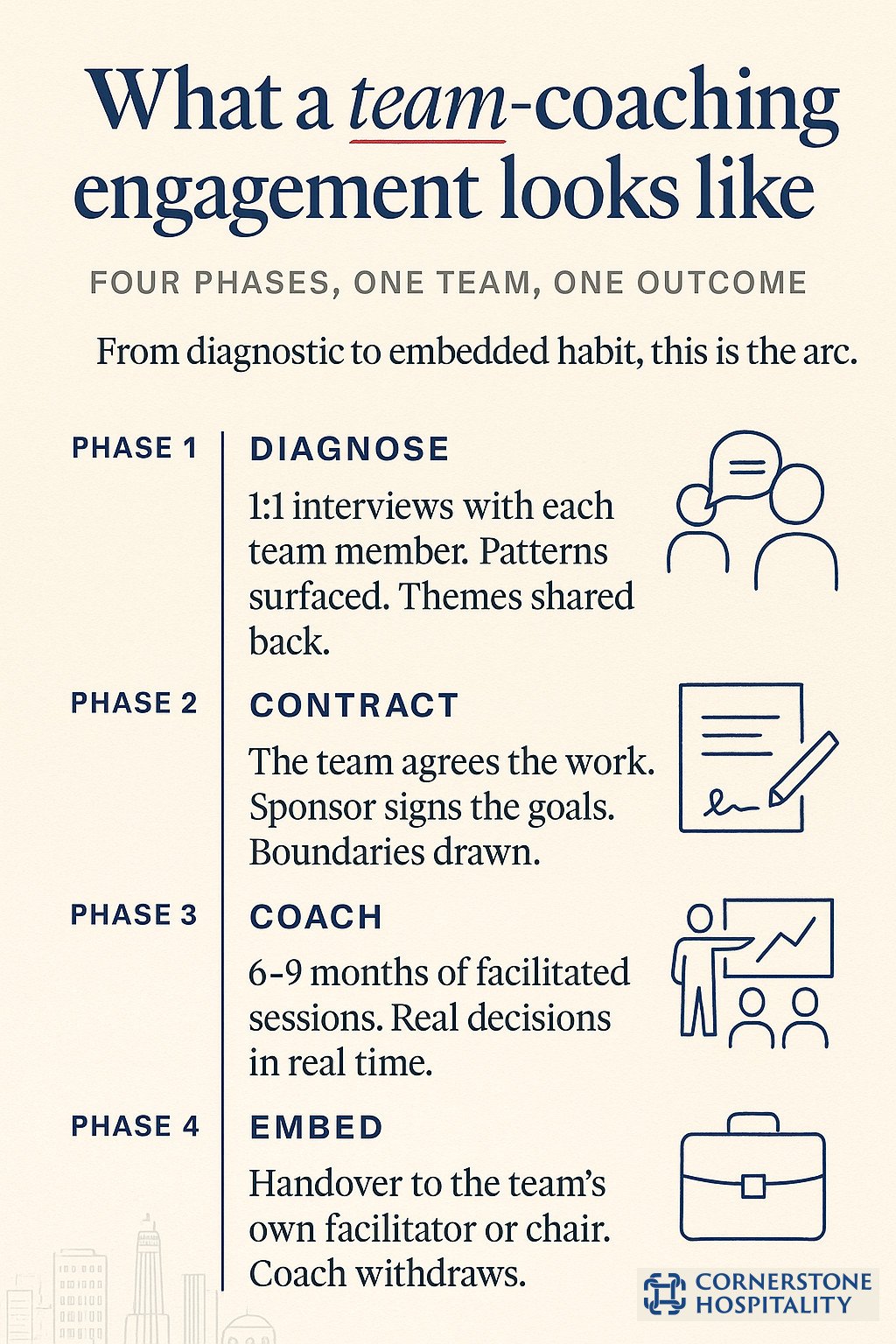
The engagement
Four phases of a Cornerstone team coaching engagement for a senior hospitality leadership team
| Phase | Duration | Focus |
|---|---|---|
| Phase 1 | Weeks 1 to 3 | Diagnose. Individual interviews, team pattern mapping, agreed problem statement. |
| Phase 2 | Weeks 4 to 10 | Contract. Shared goal set, working agreements written, coach observing live meetings. |
| Phase 3 | Weeks 11 to 22 | Practice. Real-time interventions in real meetings, harder conversations rehearsed and held. |
| Phase 4 | Weeks 23 to 26 | Measure. Outcomes being reviewed against the phase-1 problem; the next agenda is handed to the team. |
Each of the four phases, one card at a time
Sixty to ninety minutes with each team member individually. Themes are anonymized, aggregated, and shared back to the whole team in a single facilitated session. The themes are what the team will work on, not what the coach decides they should work on.
Two to three sessions to convert the themes into a named set of goals, a working rhythm, confidentiality boundaries, and success markers the sponsor signs off. Without an explicit contract, the work has no edges and no completion criteria.
Coaching happens around the team’s actual decisions in real time, not in a workshop bubble. The cadence is usually monthly, integrated with the team’s existing leadership-team rhythm. Real decisions, real disagreements, real outcomes.
The chair or a nominated team facilitator takes ownership of the new patterns. The coach withdraws by design; the goal is a team that no longer needs the coach in the room. A six-month check-in confirms the patterns held.
Deliverables and durations across the whole engagement
- ✓A diagnostic theme report: the anonymized themes from the 1:1 interviews, ready to share back.
- ✓A signed team contract: goals, working rhythm, confidentiality boundaries, sponsor-approved success markers.
- ✓Monthly facilitated sessions: integrated with the team’s leadership rhythm, working on real decisions in real time.
- ✓Sponsor briefings: at agreed checkpoints, at the team-themes level rather than individual contributions.
- ✓An embed-phase handover: documented patterns the team has adopted, and a named owner inside the team for each one.
- ✓A six-month post-engagement check-in: confirmation that the patterns held, and a short report to the sponsor.
| Phase | Typical duration | Defined output |
|---|---|---|
| 1. Diagnose | 4 to 6 weeks | An anonymized theme report; one facilitated theme-back session. |
| 2. Contract | 3 to 5 weeks | Signed team contract; sponsor-approved goals and success markers. |
| 3. Coach | 6 to 9 months | Monthly facilitated sessions; mid-engagement sponsor briefing. |
| 4. Embed | 6 to 8 weeks plus a 6-month check-in | Handover document; six-month sponsor confirmation report. |
If you’re weighing a team coaching engagement for a senior hospitality leadership team, the first conversation is the diagnosis: Is the team actually the unit, or is the work somewhere else? We have that conversation honestly, including when the answer is “not yet.”
Talk to us →What to do
Five tells of a team coaching engagement that will land
For a board commissioning team coaching hospitality work for the first time, the following five tells separate the engagements that produce durable change from the ones that produce warmth in the room. Each tell is observable at the briefing stage, before any contract is signed.- The coach asks, ‘Is the team actually the unit?’ before they ask anything else.
A coach who skips the four-conditions test and goes straight to scheduling sessions is selling a product, not diagnosing a problem. The pre-contract conversation should feel like an honest interrogation of fit, rather than a sales call.
- The 1:1 diagnostic phase is non-negotiable.
No coach should commit to a team-coaching engagement without first interviewing each member individually. The themes the team will work on come from those interviews, not from the brief.
- The contract names what success looks like for the sponsor, in business terms.
“Better collaboration” isn’t a success marker. “Decisions that previously took three meetings now take one” or “the regional leadership team owns the regional P&L collectively, instead of as individual property GMs” is.
The final two tells are real meetings and a deliberate end
- The coaching happens in the team’s real meetings, not in workshop bubbles.
Real change happens when the coach is in the room while the team is making real decisions. A coaching engagement that lives entirely in offsite workshops produces offsite-only behavior change, and nothing transfers back.
- The engagement has a deliberate end, with handover, not departure.
Ultimately, the coach’s job is to make themselves unnecessary. An engagement that quietly renews indefinitely is rarely producing change at the rate it was producing it in month three.
What to do next
Ask the prospective team coach to walk you through how they would handle all five tells before committing to the engagement. The answers tell you whether you are buying a structured intervention with named outcomes, or buying a series of sessions and hoping for the best. The cost difference is similar; the result difference is not.
Glossary
- Team coaching
- A structured intervention that coaches a leadership team as a single unit, targeting how the team makes decisions, handles disagreement, and delivers shared outcomes. Distinct from individual coaching, which works one-to-one with each member.
- Team climate
- The shared working atmosphere of a team, openness, clarity, accountability, recognition, and cohesion. Empirically linked to engagement and performance at the team level [5].
- Diagnostic phase
- The opening phase of a team-coaching engagement, in which the coach conducts confidential 1:1 interviews with each team member and aggregates the themes into a shared report.
- Contracting
- The phase in which the team converts diagnostic themes into named goals, agreed working rhythm, confidentiality boundaries, and success markers the sponsor signs off on.
- Sponsor
- The senior executive (chair, CEO, owner) who carries the relationship with the team and signs off on the engagement’s goals and success markers. Usually distinct from the team leader being coached.
- Embed phase
- The closing phase of a team-coaching engagement, in which the coach hands ownership of the new patterns to a nominated internal owner and deliberately withdraws.
Frequently asked questions
How long does a senior hospitality team coaching engagement usually run?
How many people in the team is too many for team coaching?
Can team coaching run alongside individual coaching for team members?
On confidentiality, offsites, and what success looks like
Is team coaching confidential?
Do you facilitate team off-sites and retreats as part of the engagement?
What does success look like for the sponsor?
When is team coaching not the right tool?
When the team isn’t genuinely a team, when the underlying structure is wrong, when the team doesn’t need to act as a unit, or when the sponsor is looking for a soft-win narrative rather than real change. In any of those situations, the better intervention is usually individual coaching, a structural review, or an honest leadership-team assessment.
Read next
Leadership Development & Coaching
The ROI of executive coaching for a hospitality leader
B2C and B2B coaching contexts
Sources
- PrimeGenesis: 40% of executives pushed out, fail, or quit within 18 months (citing Heidrick & Struggles internal study of 20,000 searches; CEO Kevin Kelly interview, Financial Times, 30 March 2009): primegenesis.com/2009/04/40-percent-of-execs-pushed-out-fail-or-quit-within-18-months
- Leadership IQ: Executive Failure Rates (study of 20,000+ new hires across 312 organizations): “46% of newly hired employees failed within 18 months while only 19% achieved unequivocal success. Attitudes drive 89% of hiring failures while technical skills account for only 11%.”: leadershipiq.com/blogs/leadershipiq/executive-failure-rates
- Plum: Schmidt & Hunter (1998) Meta-Analysis Explained: structured interview r =.51, cognitive ability r =.51, composite validity of structured interview + cognitive ability >.60: plum.io/blog/schmidt-hunter-meta-analysis
- Kapable: Statistics On Leadership In The Hospitality Industry: 82% of surveyed hotels report a staffing shortage; 73% annual U.S. hospitality turnover: kapable.club/blog/statistics/statistics-on-leadership-in-hospitality-industry
- Korn Ferry Institute: Stronger Leadership, Stronger Climate, Better Results (analysis of 2,700+ individuals across 541 leadership teams using KFCTD and S&C assessment tools): team climate accounted for up to 31% of the variation in team-level engagement; the right leadership characteristics and team environment can lift engagement scores by up to 42 percentile points; leaders scoring high on Presence, Agility and Striving created team climates approximately 30 percentile points stronger than lower-scoring leaders: kornferry.com/institute/stronger-leadership-stronger-climate-better-results
- International Coaching Federation: Coaching Statistics: The ROI of Coaching (citing the ICF / PricewaterhouseCoopers Global Coaching Client Study): 87% of survey respondents agreed that executive coaching has a high return on investment; average ROI of seven times the cost of employing a coach: coachingfederation.org/blog/coaching-statistics-the-roi-of-coaching-in-2024. Also referenced, Manchester Inc. Maximizing the Impact of Executive Coaching, McGovern et al., The Manchester Review, 2001, Vol. 6 No. 1: average ROI of 5.7× the initial investment across 100 mostly Fortune 1000 executives, with intangible benefits including improved teamwork (67%) and peer relationships (63%): donnaschilder.com/manchester-study
About the author