

Executive Assessment in Senior Hospitality Hiring: Making Better Leadership Decisions


Executive assessment is what turns a strong shortlist into a confident decision. At senior level, most of the candidates in front of a client are credible. Generally, they are polished, experienced and convincing in the room. A CV shows what a leader has done. An interview shows how well they present in a structured conversation. Neither, on its own, reliably shows how that person will lead under pressure or fit the team. Equally, neither shows where their strengths and risks will surface once they are in the seat.
That gap is exactly where senior appointments go wrong. Our executive assessment practice exists to close it. Specifically, it adds a rigorous, evidence-based layer to executive and board search. As a result, the panel is not deciding on interview impression alone. A Chartered Occupational Psychologist with 25 years of experience delivers the work. This expert has personally assessed more than 24,000 leaders globally. Moreover, the work has one job: to help clients make better, clearer, more confident senior hiring decisions.
In short, this article covers what executive assessment reveals that a CV and interview cannot. It also explains why interview performance is not the same as future performance. Then it shows how a Cornerstone assessment engagement runs from questionnaire to panel debrief. Finally, it looks at the instrument and psychology that sit behind the report.
The Evidence Behind The Decision
The case for executive assessment: senior-appointment failure rates, the added predictive value of structured assessment, and the depth of experience behind the Cornerstone report. Sources listed in full at the foot of the article.
Key insight
What executive assessment reveals
Executive assessment provides behavioral evidence that sits beneath the surface of a senior candidate. It helps a client understand more than whether a leader can do the job. It also shows how they are likely to do it. Equally, it shows what will help them succeed and where the organization may need to be careful.
A well-designed assessment gives the panel a clear read on the things that actually determine whether a senior appointment works. For example:
- Leadership style and the likely impact it has on others.
- Decision-making preferences, including how the person approaches ambiguity, pressure and complexity.
- Strengths that may help the leader accelerate quickly in the role.
- Behavioral risks that often only become visible once someone is under sustained pressure.
- Potential derailers, including how a leader responds to a high-priority decision when they are unsure where to turn for support.
- Motivation, values and cultural fit.
- Likely fit with the existing team, board and organizational environment.
- Development areas that may need support during onboarding.
The reason this matters is simple. At executive level the shortlist is rarely the problem. Most shortlisted candidates are strong. The real question is how they differ from one another and where each will add the most value. Equally, it is what the client needs to manage before making a final call. Assessment answers that question with evidence rather than impression.
What each source shows
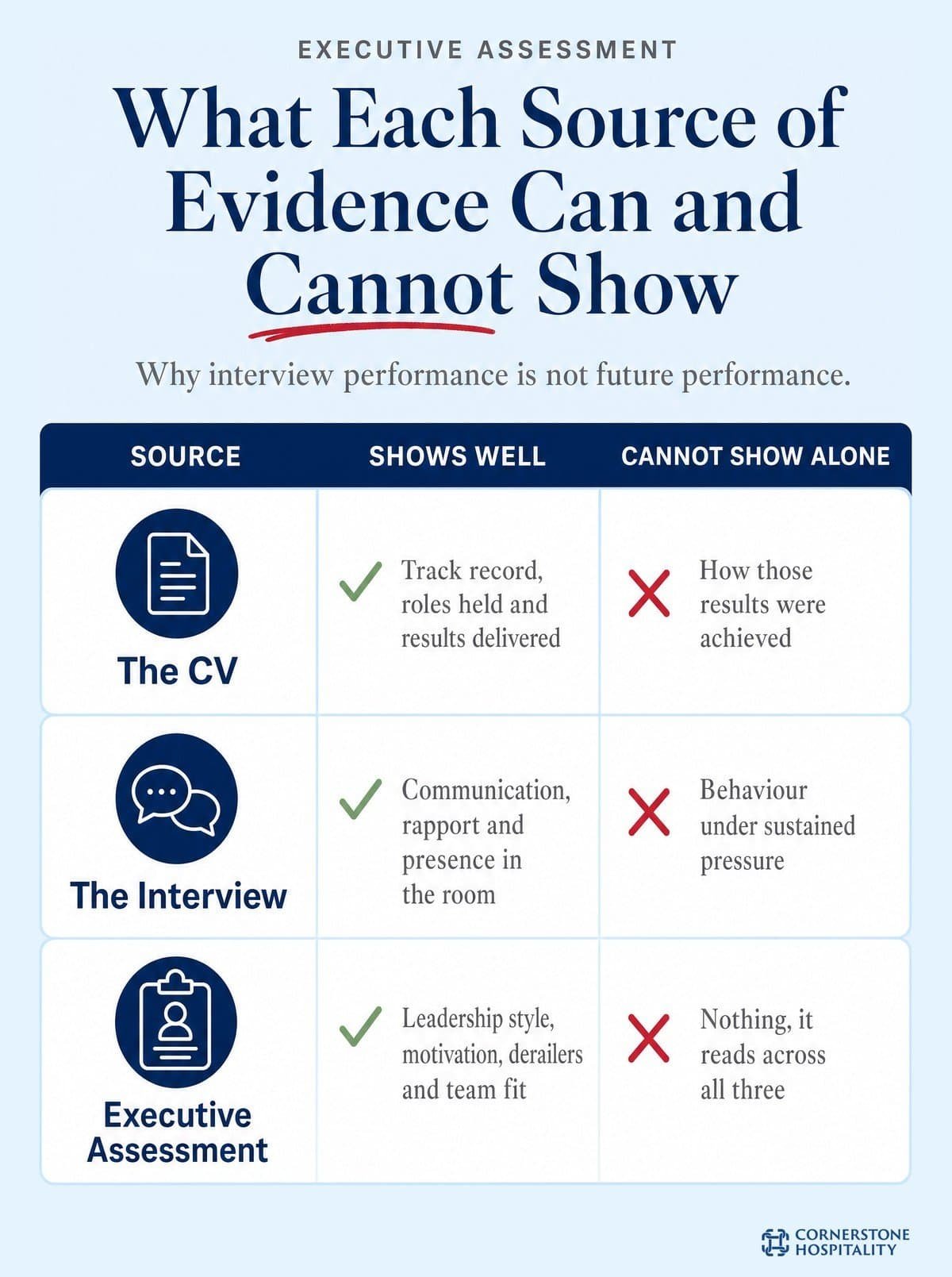
| Source of evidence | What it shows well | What it cannot show on its own |
|---|---|---|
| The CV | Track record: roles held, results delivered and career progression. | How a leader achieved those results, or how they will lead in a new context. |
| The interview | Communication, rapport, chemistry and how a candidate presents in the room. | Behavior under sustained pressure, derailment risk and fit once in the seat. |
| Executive assessment | Leadership style, decision-making, motivation, risks, derailers and team fit, all read against the role. | It works alongside the CV and the interview, adding evidence rather than replacing them. |
The best senior recruitment decisions do not come from asking whether a person can do the job. Instead, they come from three deeper questions. How is this person likely to do the job? What will help them succeed? And where might we need to be careful? That is the shift assessment makes possible.
The interview blind spot
Why interview performance is not future performance
Interviews remain important, and we would never suggest otherwise. They simply have limits that are worth naming.
More outgoing, socially confident leaders often interview well. They are comfortable thinking aloud, building rapport and presenting themselves fluently. That is a genuine strength. However, it is not, by itself, evidence that they are the strongest fit for the role. Equally, some highly capable leaders are more reflective, measured or understated. They may bring deep judgment, resilience and steadiness. Even so, they may not create the same immediate impression across a panel table.
In effect, executive assessment reduces that imbalance. It gives the panel evidence that sits behind presentation style. As a result, it helps to separate confidence from competence, polish from potential, and interview performance from likely future behavior. It also supports fairness: we assess every candidate against the same robust framework. Consequently, the panel gains a consistent basis for comparison, and charisma, familiarity or personal preference pull less weight.
This is not only our experience. It is what decades of selection psychology show. For example, a structured, evidence-based assessment combined with a cognitive measure reaches a composite predictive validity above .60. That is far higher than the impression formed in an unstructured interview [2]. At executive level, almost every shortlisted candidate is credible. Therefore, that added evidence is often the difference between a confident decision and a coin toss.
Assessment helps a panel separate confidence from competence, polish from potential, and interview performance from likely future behavior.
What to do with this
Use the interview for what it does best: reading rapport, communication and chemistry. Meanwhile, use assessment for what the interview cannot see. The two together give the panel a rounded, defensible picture instead of a single impression formed on the day.
How it works
How a Cornerstone executive assessment runs
The process is practical, robust and easy for a client to use. It does not slow the search down. Used well, it sharpens it.
The report focuses on the individual in relation to the role. In other words, it does not describe personality traits in isolation. It considers likely strengths, possible risks, leadership style, decision-making, motivation, derailment risk, team fit and organizational culture fit. Then it turns all of that into something the panel can actually decide with.
What to do
Brief the panel early. When the report and the candidate-specific questions land before final interviews, the panel walks in aligned on what to probe for each leader. As a result, the search keeps its pace and the final conversation gets sharper.
Weighing a senior appointment, and want more evidence behind the decision? We start with the role you are trying to fill, not with our process.
The evidence layer
The instrument and psychology behind the report
Good interpretation needs good data. For the data layer, a Cornerstone assessment can draw on a rigorous, scientifically grounded instrument: the LINC Personality Profiler. This instrument rests on the Big Five model that modern personality psychology treats as its standard. Indeed, a large body of research has reaffirmed the Big Five. Researchers widely regard it as more robust than older, type-based approaches.
The instrument captures personality across three building blocks:
Two features make this kind of instrument suitable for high-stakes selection. First, it uses a forced-choice response format, which keeps it low in susceptibility to manipulation. As a result, a candidate cannot easily present the answer they think a panel wants. Second, it carries strong construct validity with scale reliability around .80. This means the results are stable and dependable rather than a snapshot of mood on the day. Equally, the implementation is GDPR-compliant, which matters when you are handling the personal data of senior candidates.
The instrument gives structure and scientific grounding. The Chartered Psychologist gives interpretation, judgment and role context. Neither replaces the other. Together they turn a questionnaire into evidence a panel can trust.
A strong instrument on its own is data. An expert on their own is opinion. In contrast, the combination makes an executive assessment report a decision tool rather than a personality printout. That combination is rigorous psychometrics interpreted by a Chartered Psychologist against the real role.
Where the value lands
The panel debrief, where the value lands
A report has value on its own. However, the real impact comes when the panel discusses the findings with the Chartered Psychologist before final interviews.
The debrief brings each candidate report to life. It deepens the panel’s understanding of every leader’s strengths, risks, likely leadership impact and fit with the team and culture. It lets panel members ask questions, test interpretations and agree where they need to probe further. Most of all, it gives the panel a shared language for the candidates. Consequently, they move into final interviews with clarity rather than a stack of documents.
It also improves the decision after the interviews. Rather than relying on who performed best on the day, the panel can weigh interview performance against broader behavioral evidence. That makes the final call more rounded, more defensible and more robust.
And the value does not stop at the appointment. Every assessed leader receives a full developmental debrief. For the successful candidate, it supports a stronger start, informing onboarding conversations with their manager, board or team. For those not appointed, it offers meaningful, respectful feedback from a demanding process. After all, senior candidates invest real time and emotional energy in executive searches. Handling that well reflects on both the client and the search partner.
The So What
The real value of executive assessment is not the assessment itself. It is the quality of the decision it enables. It reveals what sits beneath the surface of a senior candidate. In addition, it gives the panel more confidence in what they are seeing. It also reduces the risk that interview style over-influences the panel. Furthermore, it shows where a leader may thrive and where they may struggle. It even shows how they are likely to fit the wider team and culture.
In a senior appointment, confidence does not come from simply liking a candidate. Instead, it comes from understanding them deeply enough to make a clear, balanced and well-informed decision. That is the value executive assessment brings.
Weighing a senior appointment, or want more evidence behind your next leadership decision? The conversation starts with the decision you are trying to make, not with our process.
Glossary
- Executive assessment
- A structured, psychology-led evaluation of a senior candidate that adds behavioral evidence to the CV and interview, so a client can decide with more confidence.
- Chartered Occupational Psychologist
- A psychologist formally qualified and regulated in the workplace application of psychology, including selection and assessment at senior level.
- The Big Five
- The standard model of modern personality psychology, describing personality across five broad, well-validated dimensions.
- Derailer
- A behavioral tendency that can undermine an otherwise capable leader, often only surfacing under sustained pressure.
- Predictive validity
- A measure of how well an assessment method actually predicts later job performance. Higher is better; structured assessment scores well above unstructured interviews.
- Panel debrief
- A working session in which the psychologist takes the hiring panel through the candidate reports before final interviews, giving them a shared language and sharper questions.
In their words
What clients and leaders say
The real test of a rigorous hiring process is the quality of the people it puts in the seat. Here is what two leaders who have worked with us have said.
“Over the years I have worked with Florian and he has continually provided a service second to none. The caliber of individuals he recommends is always spot on, as he ensures that he understands not only the requirements and expectations of a role but also the importance of the success and growth of the business being related to people.
Daniel AylmerChief Executive Officer, Greater China
“Florian played a pivotal role in my career transition within the hospitality industry, combining deep expertise in executive search with a highly strategic advisory approach. Unlike traditional recruiters, he takes the time to truly understand your long-term ambitions, challenges your assumptions, and positions you for sustainable leadership success. His network across the global hospitality sector is exceptional, and his commitment to delivering the right long-term fit goes far beyond a transactional placement.
Stefan SavicHospitality Professional · Asset Management, Development & Strategy
Frequently asked questions
What does executive assessment reveal that a CV and interview cannot?
It reveals how a leader will likely behave in the role. For example: leadership style, impact on others, decision-making under pressure, motivation and values, and team and culture fit. It also flags behavioral risks, derailers, and development areas for onboarding. In short, a CV shows the past, an interview shows presentation, and assessment shows likely leadership in the seat.
Does executive assessment replace the interview?
No. The interview stays important for rapport, communication and chemistry. Assessment adds evidence the interview cannot see. As a result, the panel can separate confidence from competence and weigh interview performance against behavioral evidence. The two work best together.
How long does the assessment take for a candidate?
The online questionnaire takes around 30 minutes in the candidate’s own time. Meanwhile, the Chartered Psychologist handles interpretation, tailored report, candidate-specific questions and panel debrief. These fit the search timeline rather than slowing it.
Who conducts the assessment?
A Chartered Occupational Psychologist with 25 years of experience leads the assessment, having personally assessed more than 24,000 leaders globally. The psychologist interprets the report against the specific role and debriefs the panel and every candidate.
Is the assessment fair to every candidate?
Yes. We assess every candidate against the same robust framework, giving a consistent basis for comparison. Consequently, charisma, familiarity or personal preference pull less weight. Moreover, its forced-choice format is hard to manipulate. Every candidate also receives a developmental debrief, appointed or not.
Do unsuccessful candidates get anything from the process?
Yes. Every assessed leader receives a full developmental debrief with the psychologist after final interviews. For those not appointed, this provides meaningful, respectful feedback. Equally, it reflects well on the client and search partner and protects the employer brand.
Florian leads Cornerstone International Group’s global Hospitality, Travel & Leisure Practice. He brings seventeen years of senior hospitality experience, including Marriott, Hyatt, IHG, Mandarin Oriental and Shangri-La Hotels & Resorts, and sixteen years in retained executive search. He is bilingual in English and German and works across Europe, the Middle East, the Americas and Asia-Pacific.
Read next
What the figures draw on: published selection-psychology research and reporting on senior-appointment outcomes, referenced in full below.
The practice behind the report: Cornerstone’s assessment work is led by a Chartered Occupational Psychologist with 25 years of experience who has personally assessed more than 24,000 leaders globally.
The instrument: where an assessment draws on a psychometric layer, it uses a validated Big Five instrument with a forced-choice format and scale reliability around .80.
Sources
- PrimeGenesis: 40% of executives pushed out, fail, or quit within 18 months (citing Heidrick & Struggles internal study of 20,000 searches; CEO Kevin Kelly interview, Financial Times, 30 March 2009): primegenesis.com/2009/04/40-percent-of-execs-pushed-out-fail-or-quit-within-18-months
- Plum: Schmidt & Hunter (1998) Meta-Analysis Explained (structured interview r =.51, cognitive ability r =.51, composite validity of structured interview plus cognitive ability above .60): plum.io/blog/schmidt-hunter-meta-analysis
- LINC GmbH: The LINC Personality Profiler, tool for professional personality development (Big Five foundation, three building blocks, forced-choice format, scale reliability approx. .80, GDPR-compliant): linc-north-america.com/linc-personality-profiler
- CIPD (Chartered Institute of Personnel and Development): Selection Methods factsheet (combining structured interviewing with psychometric testing and task-based assessment for fairer, more reliable selection): cipd.org/en/knowledge/factsheets/selection-factsheet
- British Psychological Society: Guidelines on Testing and Test Use (national standards for occupational test use, test reliability and validity, and qualified test users): bps.org.uk/guidelines-testing-and-test-use
- CIPD: Fair Selection: An Evidence Review, scientific summary (2023) (evidence on structured, standardized assessment reducing bias and improving selection outcomes): cipd.org: fair-selection evidence review