


Building Resilience in Hospitality Senior Leadership Teams
The resilience of senior leadership teams under pressure is not the sum of the stress each executive can personally absorb. It is a property of how well the group makes decisions together once the pressure is highest.

Every senior leadership team in hospitality meets a season that tests it. It might be an occupancy swing nobody forecast. It might be a wave of departures inside six weeks. Or it might be a crisis that lands with no warning at all. What decides how the team comes through it is not how much stress any one executive can personally absorb. It is whether the group keeps making sound, coordinated decisions once the pressure is on. Those are different capacities. Hospitality tends to build the first one by default, and it leaves the second one to chance.
The stakes are not abstract. In a survey of 500 US hospitality frontline managers, 47% reported experiencing burnout personally, and 68% said members of their own team had expressed it to them [1]. Almost two thirds, 64%, said workers had actually left specifically because of burnout [1]. Hospitality already runs a punishing turnover rate near 74% a year, well above the 12% to 15% typical of most other industries [2]. When senior leadership teams cannot hold together through a hard stretch, they are not managing a mood problem. They are managing a direct line to the numbers that decide the property’s season.
This article looks at what actually builds resilience in senior leadership teams. It works at the team level rather than the individual one, covering the conditions that let a group keep deciding well together, the habits that carry it through a bad season, and where team coaching differs from coaching any one executive on the team.
Figures throughout this article are drawn from the hospitality workforce and team-performance research cited in the sources list at the end.
Individual toughness is not the same thing as team resilience
Hospitality selects for individually tough people by the nature of the work. Long hours, unsociable seasons, and constant interruption come with senior operating roles, arriving before anybody gets to the question of leadership style. That toughness is real and it matters. However, it is not the same capacity as team resilience. Team resilience means the group keeps making good collective decisions once the pressure is highest.
How burnout weakens decisions in senior leadership teams
A room can be full of individually resilient executives and still make a poor collective call under strain. Most often, nobody names the strain out loud until it has already shaped the decision. Burnout research shows why this matters at the team level and not only the individual one. Employees experiencing burnout are far less likely to exceed expectations at work, 40% against 56% of those who are not burned out [3]. They are also close to three times more likely to be actively job hunting [3]. In a senior leadership team where two or three members are quietly burning out, decision quality is already degrading, even while everybody in the room still looks composed.
Resilience can be built, not just selected for
Resilience itself is not fixed. Research on hotel employees in Pakistan found that ethical, supportive leadership measurably raised individual resilience, which in turn reduced burnout [4]. That finding is about the individual employee, not the team as a unit, and the distinction is worth holding onto. It shows resilience can be built rather than simply selected for at hiring. It does not yet explain what builds it in a team that must decide together in real time, under pressure. That is a different question, and it has a more specific answer.
What a sustained test looks like
The test rarely arrives as a single dramatic event. More often it is a six week stretch with two open department head roles, a booking system outage during a sold out weekend, or a general manager handling a guest incident while the rest of the team is short staffed for the shift. None of those individually looks like a crisis on a calendar. Together, over weeks, they add up to sustained pressure, and that pressure separates a team with real resilience from one that has simply not faced a test yet.
Why this matters
A team stacked with individually tough people can still fail together, if nobody feels able to say the season is going badly before it shows up in the numbers. The fix is a team-level practice, not a tougher hiring bar. If your team is heading into a difficult season now, talk to us before it turns into a crisis.
What actually builds resilience in a senior leadership team
Three things repeat across the research on teams that keep functioning well under pressure, and none of them are about how tough any individual member is. First, the team can say, out loud, that something is going wrong. Second, everybody in the room knows who decides what once the pressure is on. Finally, the team has a way of learning from a hard stretch once it is over, rather than just feeling relieved that the stretch ended.
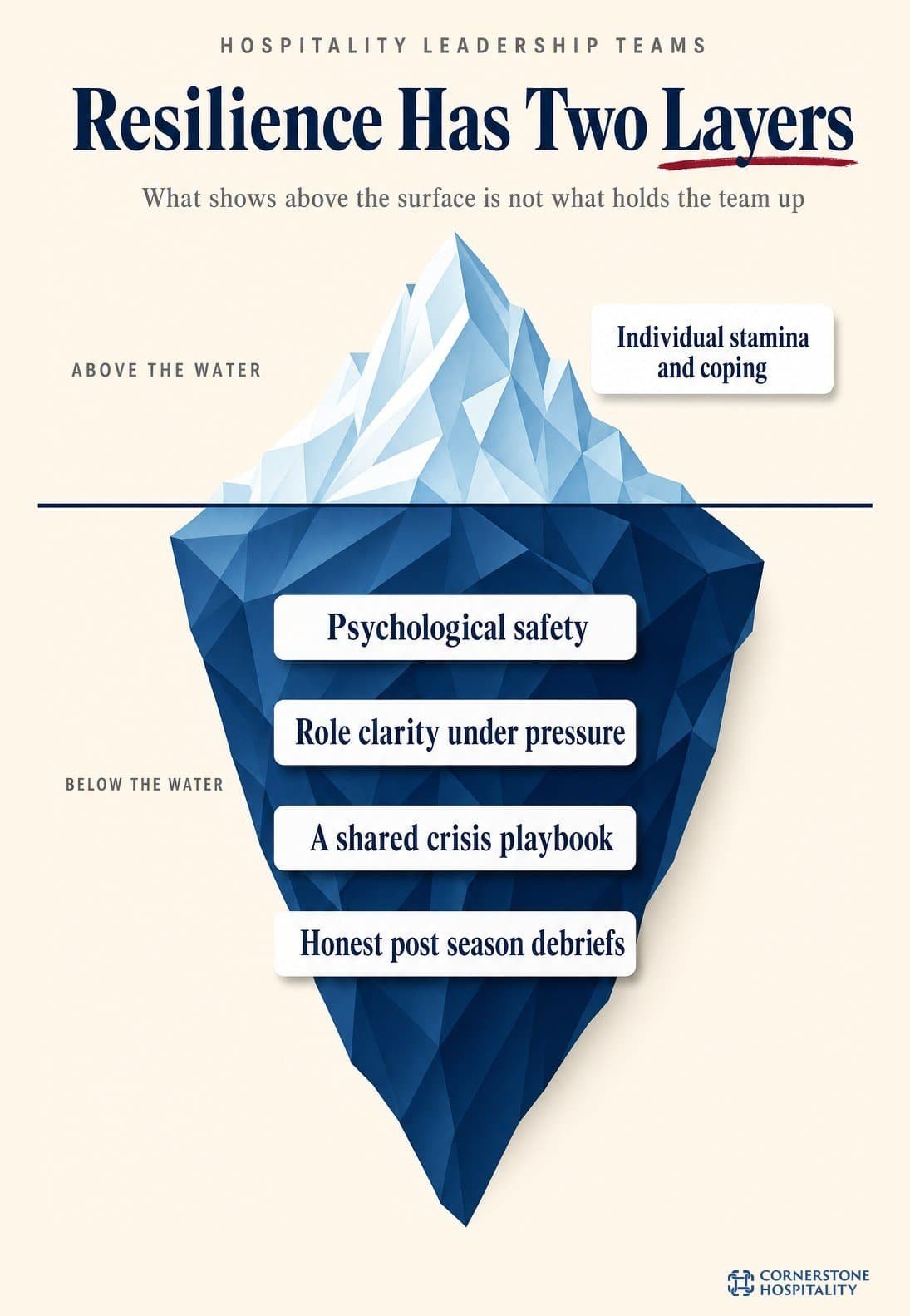
Psychological safety: the ability to say the season is going badly
Amy Edmondson researches team performance at Harvard Business School. She defined psychological safety as a shared belief that a team is safe for interpersonal risk taking, where a member can ask a question, admit a mistake, or challenge an idea without it costing them [5]. Her original research produced a counterintuitive finding: the best performing hospital nursing units she studied did not report fewer errors than the weaker units. They reported more [5]. The stronger teams were not making more mistakes. They were the only ones willing to say a mistake had happened, and that willingness is the precondition for fixing it before it compounds.
Team resilience is not the sum of what each executive can personally absorb. It is whether the group keeps making good, coordinated decisions once the pressure is highest.
The thesis this article works from
What Google’s study found about psychological safety
Google tested the same idea at scale inside its own workforce, running an internal study across 180 teams and more than 250 team attributes [5]. Psychological safety came out as the single strongest differentiator between its highest performing teams and the rest. Teams with high psychological safety exceeded their revenue targets 17% more often. Teams with low psychological safety fell short of target 19% more often [5].
Psychological safety inside senior leadership teams
The mechanism transfers directly to hospitality senior leadership teams managing a difficult season. Psychological safety is not the same thing as a comfortable meeting. A 2025 piece from Harvard Business Impact draws on Edmondson’s more recent work, and frames the useful version as safety and high standards operating together. Without safety, a team stays quiet and agreeable while a problem gets worse. Without standards, a team feels comfortable but produces sloppy decisions [6]. Picture a senior leadership team that says “the plan for this weekend is not working” in the Tuesday leadership meeting, three days before the problem becomes obvious on the floor. That team gets a three day head start on fixing it. A team that cannot say it loses those three days every single time, regardless of how personally tough its individual members are.
Role clarity under pressure
Gallup’s most recent workforce research finds that only 46% of US employees strongly agree they know what the job expects of them, down from 56% in 2020. The decline runs at twice that rate among remote and hybrid staff [7]. Employees who do have that clarity are 47% less likely to experience frequent burnout, and 23% less likely to say they struggle with work-life balance most weeks [7].
That figure describes the general workforce, and a senior leadership team is not immune to the same gap. In fact, senior leadership teams often have less of it than line staff, because people write day to day role definitions for the front desk. They rarely write them for the five or six people who run the property together.
Decision authority in senior leadership teams
The gap that matters here is narrower than a job description. It is decision authority under stress specifically. Who has the standing call on a compensation decision during a service failure? Who talks to a guest or a review platform during a public incident? The team also needs one voice that briefs the owner, and it needs to know who covers for whom when two of the five face the same crisis at once. A team that has never had that conversation finds out who owns what by trial and error, in public, during the crisis itself. A team that has had it in advance loses none of that time.
How unclear roles play out in a crisis
Consider a property absorbing an unplanned wave of cancellations after a regional weather event. Suppose the team has never agreed who owns guest communication versus revenue decisions versus staffing decisions. Three senior people can then end up independently promising three different things to three different audiences within the same afternoon. None of them did anything wrong individually. The team simply never decided who was driving.
What to do
Name the five or six decisions a senior leadership team most often has to make under pressure. Then agree in advance who owns each one. That single conversation removes most of the improvisation a crisis otherwise forces.
Individual resilience and team resilience compared
Senior leadership teams often confuse the two because they look similar from the outside. They come from different sources, they fail differently, and they need different responses.
| Dimension | Individual resilience | Team-level resilience |
|---|---|---|
| What it actually is | The capacity of one person to keep functioning well under sustained stress | Whether the group keeps making good, coordinated decisions once the pressure is on |
| Where it comes from | Rest, personal support, experience, one to one coaching | Psychological safety, defined decision authority, a rehearsed response, honest debriefs |
| How it shows up in a crisis | One executive staying calm and clear headed | The team naming the problem early, agreeing who owns what, and acting together |
| How it fails | A single person burns out, disengages, or leaves | The team looks composed individually while decisions stall, duplicate, or get made in silence |
| What strengthens it | Individual coaching, workload management, time off | Team coaching, a shared crisis playbook, structured post-season debriefs |
Individual resilience
One person’s capacity to keep functioning well under sustained stress, built through rest, support and one to one coaching.
Team-level resilience
The group’s capacity to keep deciding well together, built through psychological safety, role clarity, a rehearsed playbook and honest debriefs.
Not sure where your leadership team stands?
Tell us about the season you are heading into. We will talk through where the team’s resilience is solid and where it still depends on individual stamina.
Why this matters
Judging a senior leadership team by how tough its individual members seem misses the real question. The question is whether the group, together, keeps deciding well once the pressure is on.
Building the playbook before the season turns, not during it
A crisis playbook sounds like a document, but the document matters less than the conversation that produces it. Before a difficult stretch arrives, senior leadership teams in hospitality need a short, rehearsed answer to four questions. The stretch might be a severe staffing gap, a major weather or travel disruption, or a sudden departure at the top of the organization. Those four questions are these. What counts as serious enough to convene the group outside the normal meeting cadence? Who calls that meeting? What gets escalated to ownership, and on what timeline? And who is the one person briefing the rest of the property once the group decides?
Why a rehearsed plan frees senior leadership teams to focus
None of that is complicated, and that is the point. The value is not in the sophistication of the plan. It is in settling the answer before the first hard week, so the team spends that week executing a decision it already agreed on, rather than negotiating the decision for the first time while also running the property. A team that improvises its response structure during the crisis itself is, in effect, doing two jobs at once: it manages the actual event, and it invents the process for managing it. A team working from an agreed playbook does only the first job.
Where role clarity and psychological safety meet
The playbook is also where role clarity and psychological safety meet. A plan nobody feels safe questioning is not a plan. It is an assumption waiting to be wrong. Teams that review their playbook periodically treat a member’s “I don’t think this part still works” as useful information, rather than a challenge to authority. As a result, they walk into the next hard season with a plan tested against reality, not one written down once and filed.
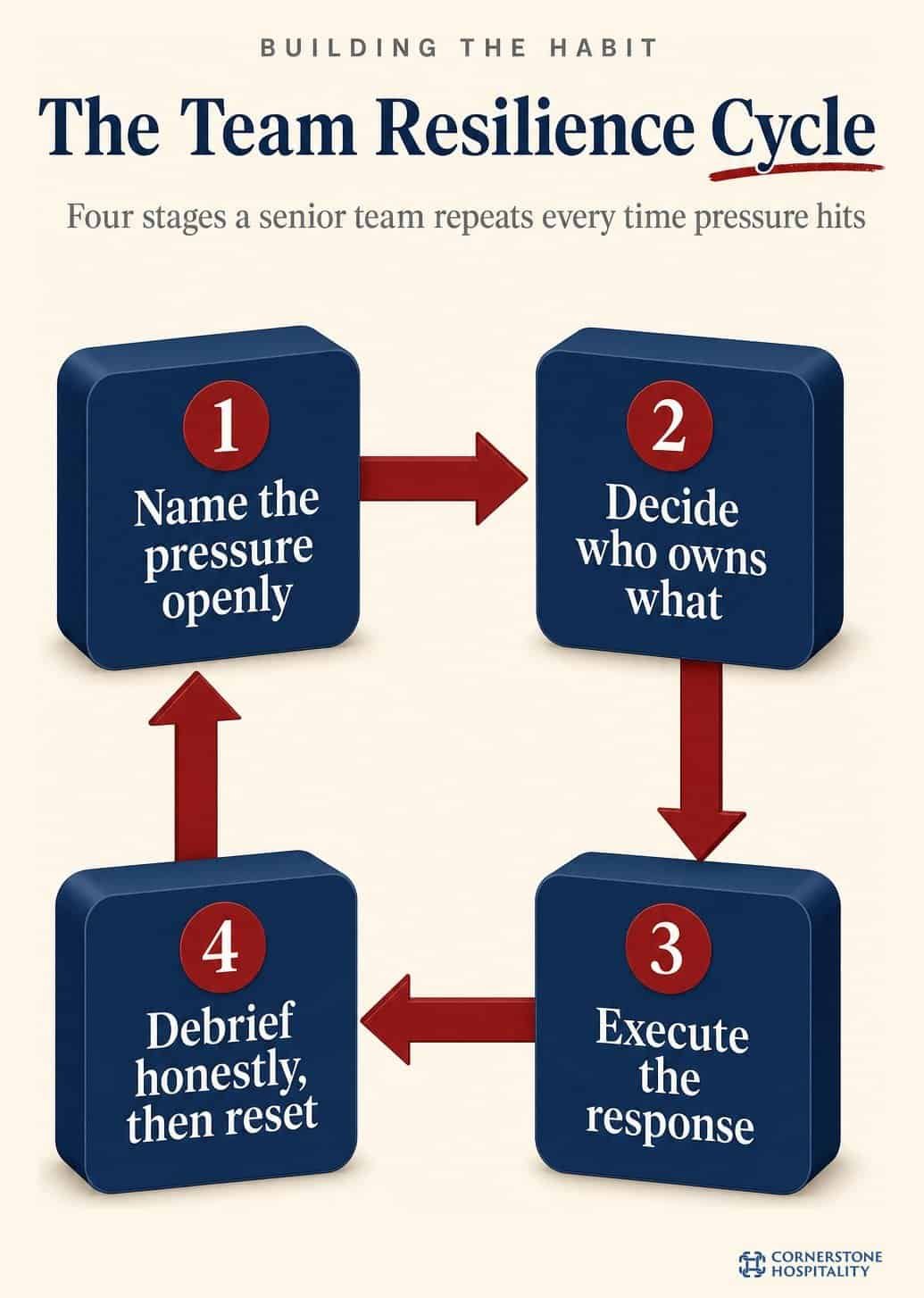
1. Name the pressure openly
Say out loud, in the room, that the season is going badly before it shows up in the numbers.
2. Decide who owns what
Agree in advance who makes the call on guest communication, compensation and staffing during a crisis.
3. Execute the response
Run the agreed playbook rather than inventing the process while also managing the event.
4. Debrief honestly, then reset
Hold a structured debrief on a fixed cadence, then carry what it taught into the next season.
How the playbook differs by property
The playbook looks different depending on the property. A branded hotel inside a larger group usually has more of this decided already. It has the brand’s own crisis protocols and a regional office that the team can loop in quickly. An independent or owner-operated property rarely has that structure sitting above it, which means the senior leadership team on site is the entire decision chain. In that setting, the four questions above are not a small addition to how the team works. They are the closest thing the property has to a safety net.
What to do
Walk through the four playbook questions at the next leadership meeting, even if nothing is wrong right now. A plan agreed in a calm week is the one the team can actually execute in a hard one.
How the team recovers: debriefs after a hard season
What senior leadership teams do after a difficult stretch matters roughly as much as what they do during one. The instinct, once a hard season, a labor shortage, or a crisis event finally ends, is relief, and relief on its own teaches the team nothing. What builds the next season’s resilience is an honest, structured look at what actually happened, not a celebration that the stretch is over.
What the research says about debriefs
This is not a hospitality-specific insight. It is one of the more consistently replicated findings in the research on team performance. A meta-analysis covered 46 separate samples and found that structured debriefs improve team effectiveness by roughly 25% on average, compared with teams that skip them, with similar effect sizes in simulated and real settings [8]. People sometimes call the underlying practice an after-action review. It originated in military training and has since spread into medicine, aviation, and other high-pressure fields, because the effect holds up outside a classroom.
What a useful debrief asks of senior leadership teams
A useful post-season debrief for senior leadership teams in hospitality asks a small number of specific questions, not a general “how did that go.” It asks four things. What did we see coming, and what caught us off guard? Where did the playbook hold up, and where did it not? Who ended up carrying more than their share of the load? And what is the one thing we change before the next time this happens? The value is in the specificity. A team that only manages “that was rough, glad it’s over” skips the part where the season teaches it anything, and will meet the next hard stretch no better prepared than it met the last one.
Keeping the debrief on a fixed cadence
Who leads the debrief matters less than whether it happens on a fixed cadence. A fixed cadence beats calling one only when somebody remembers, so attach it to an existing rhythm instead. That could be the first leadership meeting after a big weekend, the week after a labor shortage eases, or the close of a peak season. Doing so keeps the debrief alive precisely when the team is most tired, which is also when it is least inclined to talk about what went wrong.
Why this matters
A season that ends without a debrief is a season a senior leadership team learns nothing from. The next hard stretch then starts from the same position as the last one, rather than a stronger one.
How team coaching works alongside individual coaching
Executive coaching for one senior leader is a well understood tool, and it solves a different problem than the one this article covers. The tool improves how one person manages their own stress, decisions, and development. However, it does very little, directly, to change how the group decides. The five or six people running a property together still have to make good collective calls once the pressure is on. That gap matters most for senior leadership teams, and team coaching, done properly, exists to close it.
How team coaching supports senior leadership teams
Peter Hawkins offers the most established framework in the field, a systemic approach. He makes the case that coaching a team as a system produces outcomes that coaching its members one at a time cannot reach on its own [9]. His model works through five disciplines, including commissioning, clarifying, co-creating, connecting, and core learning [9].
The first of those, commissioning, is the part most individual coaching skips entirely. It starts from what the team’s stakeholders actually need from the team, rather than relying only on how the team members get along with each other. Those stakeholders include ownership, the workforce, and the wider property. For senior leadership teams in hospitality, that stakeholder list is unusually concrete. It includes an owner who wants honest reporting, a workforce that needs clear direction during a hard stretch, and guests who feel the difference immediately when the leadership team is not functioning well together.
Team coaching and individual coaching working together
Cornerstone works with senior leadership teams in hospitality on exactly this distinction. We run team coaching engagements built around the group rather than any one member of it, and we also provide individual leadership development and executive coaching. The two are not competitors. For example, a team with one struggling member sometimes needs individual coaching for that person, and team coaching for the group at the same time. Equally, senior leadership teams with no individual problems at all can still be poor collective decision makers under pressure. That is a team-level gap, and individual coaching, however good, never set out to close it. We have written more on when team coaching works for a hospitality leadership team.
Assessment as a starting point
Assessment often comes before the coaching itself. It is a structured read of how the team currently makes decisions under pressure, showing where authority actually sits versus where people assume it sits, and where the team’s shared blind spots are. Together, these give both the coach and the team a more reliable starting point than each member’s own account of how the group works. It is easier to build resilience against a problem the team can see than one it is guessing at.
Bringing the four practices together in senior leadership teams
The four practices covered here are psychological safety, role clarity under pressure, a rehearsed playbook, and an honest post-season debrief. None of them is complicated on its own, and what they have in common is that none of them happens by accident. None of them shows up simply because the individuals on the team are personally tough. For a board weighing how aligned its own leadership really is, the same discipline applies, as this piece on why aligned leadership teams still get blindsided sets out. Senior leadership teams build these four practices the way any team builds a capability: they name them, practice them, and review them, before the season that actually tests them arrives.
What to do
If your leadership team has never had a structured conversation about these four practices, that conversation is the starting point, whether you run it yourselves or bring in a team coach to run it with you.
Ready to talk through your leadership team’s resilience?
Tell us about the team and the season ahead. We will share what a team coaching engagement focused on resilience would look like.
What clients and candidates say
Florian played a pivotal role in my career transition within the hospitality industry, combining deep expertise in executive search with a highly strategic advisory approach. He takes the time to truly understand your long term ambitions and positions you for sustainable leadership success. His network across the global hospitality sector is exceptional.
Stefan Savic, Hospitality Professional, Asset Management, Development and Strategy
Over the years I have worked with Florian and he has continually provided a service second to none. The caliber of individuals he recommends is always spot on, as he ensures he understands not only the requirements of a role but the importance of the business behind it.
Daniel Aylmer, Chief Executive Officer, Greater China
Both are verified public LinkedIn recommendations.
About this analysis
This article draws on workforce and burnout research from SHRM, Gallup, and OysterLink, Amy Edmondson’s psychological safety research as reported by SI Labs and Harvard Business Impact, a peer reviewed study on ethical leadership and resilience in Frontiers in Psychology, a meta-analysis of structured debriefs published in Human Factors, and Peter Hawkins’ systemic team coaching framework, set alongside how Cornerstone Hospitality works with senior leadership teams directly. Figures and quotations are attributed to their original source below.
Frequently asked questions
Related reading
Ready to build this kind of resilience into your leadership team?
Tell us about the team and what the last hard season looked like. We will explain how a team coaching engagement would run.
Written by
Florian Kittler, Managing Partner, Cornerstone Hospitality
Cornerstone Hospitality is the Hospitality, Travel and Leisure practice of Cornerstone International Group. Its consultants bring full careers as hospitality operators into the executive search, leadership development, career transition, and executive assessment work the practice runs for senior hospitality leaders and teams.
Sources
- HR Dive, reporting an Axonify survey of 500 US hospitality frontline managers: Hospitality industry faces increased pressure over worker burnout, outdated training: finds “47% of frontline managers reported experiencing burnout” personally, that 68% said team members had expressed burnout to them, and that 64% confirmed workers had left specifically over burnout, alongside training gaps where 54% said their company did not offer enough training on mental health or wellbeing: hrdive.com/news/hospitality-industry-faces-increased-pressure
- OysterLink: Burnout in Hospitality: 2025 Data and How Employers Can Respond: reports that hospitality averages “74% annual turnover”, against roughly 12% to 15% in other industries, and that around a third of hospitality workers describe themselves as engaged at work: oysterlink.com/spotlight/hospitality-employee-burnout-statistics
- SHRM: Here’s How Bad Burnout Has Become at Work, from the Employee Mental Health in 2024 Research Series surveying 1,405 US employees: finds burned out employees are less likely to exceed expectations at work, “40%” against “56%” of those who are not burned out, and are close to three times more likely to be actively job searching: shrm.org/topics-tools/news/inclusion-diversity/burnout-shrm-research-2024
- Ali, Hamid, Naveed, Siddique, Ryu and Han: Preparing for the “black swan”: Reducing employee burnout in the hospitality sector through ethical leadership, Frontiers in Psychology, drawn from 346 hotel employees in Pakistan: finds ethical leadership positively predicts employee resilience, which in turn mediates a reduction in burnout: pmc.ncbi.nlm.nih.gov/articles/PMC9597687
- SI Labs: Psychological Safety: Definition, Research, and Practical Guide for Teams: summarizes Amy Edmondson’s original hospital research, where “the best teams reported the most errors” because psychologically safe teams disclosed mistakes rather than concealing them, and an internal Google study across 180 teams that found psychological safety the strongest differentiator among the factors it examined, with high-safety teams “exceeded revenue targets 17 percent more often” and low-safety teams falling short “19 percent” more often: si-labs.com/en/articles/psychological-safety
- Harvard Business Impact: Why Psychological Safety Is the Hidden Engine Behind Innovation and Transformation, on a 2025 keynote by Amy Edmondson: defines psychological safety as “the belief that a team is safe for interpersonal risk-taking, that you can ask a question, admit a mistake, or challenge an idea without fear of embarrassment or retribution”, and notes that “without safety, teams may appear agreeable but remain silent. Without standards, teams may feel comfortable but lack rigor”: harvardbusiness.org/insight/why-psychological-safety-is-the-hidden-engine-behind-innovation-and-transformation
- Gallup: Employee Wellbeing Hinges on Management, Not Work Mode, published 14 August 2024: finds only “46%” of US employees strongly agree they know what is expected of them at work, down from “56%” in 2020, and that employees with that clarity are “47%” less likely to experience frequent burnout and “23%” less likely to struggle with work-life balance most weeks: gallup.com/workplace/648500/employee-wellbeing-hinges-management-not-work-mode
- Safety Insights, reporting Tannenbaum and Cerasoli’s 2013 meta-analysis published in Human Factors: Debriefs/After-Action Reviews improve individual and team performance: covering 46 samples, finds “debriefs improved effectiveness over a control group by ~25%” on average, with similar effect sizes across simulated and real settings: safetyinsights.org/2024/06/01/debriefs-after-action-reviews-improve-individual-and-team-performance
- Paperbell: Master Team Coaching with Peter Hawkins’ Five Disciplines: describes how Hawkins “made the case, through research and practice, that coaching entire teams as systems could produce results no amount of individual coaching could replicate”, built around five disciplines including commissioning, which starts from what a team’s stakeholders need from it rather than internal dynamics alone: paperbell.com/blog/peter-hawkins
This sits inside our leadership development work, which covers the fuller picture beyond this one piece.