


How to Identify High-Potential Hospitality Leaders
Identifying high-potential hospitality leaders is decided in the selection long before the development starts. Here is what genuinely predicts and what only looks as though it does.


Identifying high-potential hospitality leaders is a task almost every group believes it already does well. The evidence says otherwise, and the gap is not small. Across companies, 66% invest in programs to identify and advance high-potential employees, and only 24% of senior executives at those same firms consider the programs a success [1].
That is a striking pair of numbers. It means two-thirds of organizations are paying for the activity, and three-quarters of the executives watching it happen do not believe it is working. The money is going out. The result is not arriving.
What follows is where the identification actually breaks, what genuinely predicts, and how to run the exercise in a hospitality group where the operating rhythm makes every part of it harder.
Wondering how your own list would hold up against this. Talk to us about a confidential outside read.
The stakes: what the research says
About this analysis
The figures in this article are drawn from sixteen named studies and surveys, including Harvard Business Review, DDI, Gallup, Deloitte, Korn Ferry and the Center for Creative Leadership, cited inline by number and listed in full, with links, in the Sources section at the end. Sample sizes and methods vary by study; the original reporting is linked so readers can check the context for themselves.
What is decided before any high-potential hospitality leaders are chosen
Selection sets most of the outcome, not the development that follows it. Three things shape that selection, and each of them is worth checking separately.
The first is that performance draws the list. This is the big one, and it is discussed at length in our piece on building a leadership pipeline. Performance is measurable, defensible, and recent. Potential is none of those things, so the room reaches for the number it has.
The second is that visibility draws the list. In hospitality this is acute because a property does not distribute visibility evenly. The rooms division director is in front of the general manager daily. Weekly, the revenue manager is in front of them. The executive housekeeper, running the largest department in the building with the highest turnover and the most direct effect on the guest score, may be in front of them monthly.
The third is that availability draws the list. Nomination disproportionately favors the person who puts their hand up, which selects for confidence rather than capability.
Why confidence keeps being mistaken for capability
Confidence and capability correlate, but not like as strongly as people assume, and in this industry confidence is heavily patterned by background. It is worth remembering that companies miss the mark on managerial talent in 82% of their hiring decisions even when choosing deliberately [5].
The compounding effect
Each of the three biases pushes in roughly the same direction, toward front-of-house, toward the articulate, and toward people who already resemble the person choosing. That is why a high-potential population can end up looking less varied than the workforce it was drawn from and why widening the selection is usually the cheapest available improvement.
People name a fourth failure less often. Somebody draws the list, publishes it, and then nothing happens. High-potential intention to depart rose from 13% in 2020 to 21% in 2024, and high-potential talent is 3.7X more likely to leave within a year when their manager does not provide regular growth opportunities [2]. Naming somebody a high potential and then leaving them alone is worse than never naming them, because it converts a vague ambition into a specific, dated disappointment.
What to do
Widen the nomination pool before scoring it. Ask every department head for names, not just the ones who volunteer, and separate the performance conversation from the potential conversation so the second one is not simply a restatement of the first.

Three signals that mark out high-potential hospitality leaders
The most useful thing to hold onto is that potential is not one property. It is the intersection of three, and each is independently necessary.
The three signals
Only one of the three can be judged at a distance
The three-way test is not new, and it is not complicated. What makes it hard is that people can only assess the first one at a distance. Aspiration and engagement have to be asked about directly; by somebody, the person will answer honestly. This usually means somebody outside their reporting line.
“The question we ask that changes the most conversations is not “where do you want to be in five years”. It is “what would have to be true for you to still be here in three”. The first question gets an ambition. The second one gets the truth.”
Florian Kittler, Managing Partner, Cornerstone Hospitality
Why this matters
Ability shows up in the numbers a manager already has. Aspiration and engagement do not, and both require a direct, confidential conversation, ideally with someone outside the person’s own reporting line. Skipping that conversation is the single most common reason a promotion that looked safe on paper fails within a year.
How many high-potential hospitality leaders a group really has
It helps to be precise about how much narrowing actually happens, because groups routinely overestimate the size of the eligible population and then wonder why the program feels diluted.
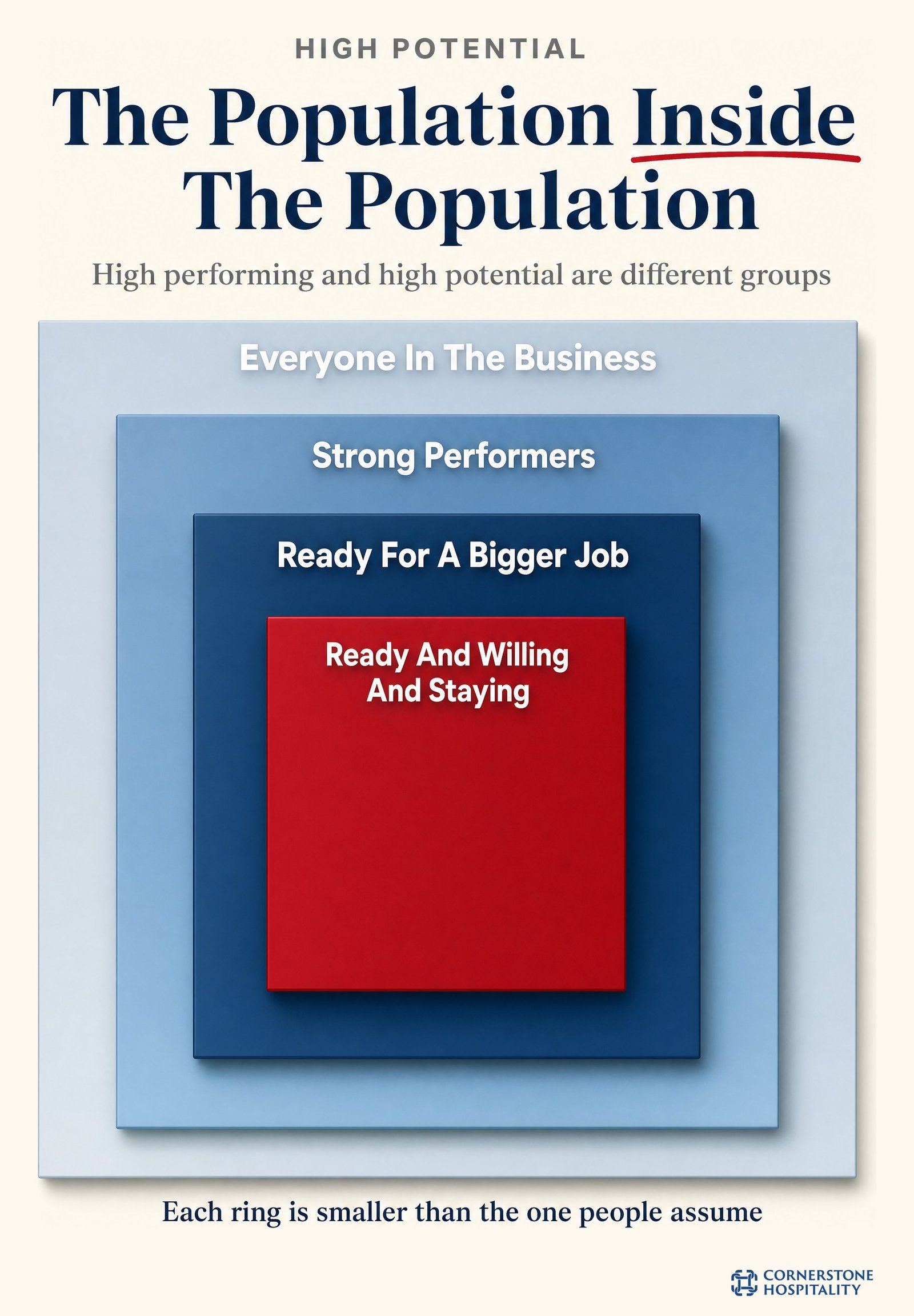
Start with everyone. Narrow to strong performers, which in most properties is a genuine minority rather than a majority. The next cut keeps only those who could do a materially bigger job, which removes a large share of the strong performers, because excellence in a role is frequently role-specific. A third cut narrows it again, to those who want it and will still be here.
What survives all three cuts is small. In a five-hundred-person property it is likely to be a handful of people, not a cohort.
What a list of forty actually costs
Groups that end up with a high-potential list of forty have almost certainly applied one filter rather than three. The cost of that is real: the development budget spreads thin across a mostly strong population of performers who were always going to be fine.
| Cut | What it removes | What it usually reveals |
|---|---|---|
| Strong performance | The majority | Uncontroversial and easy. This is the cut every group already makes. |
| Transferable ability | Much of what remains | That several of the most admired operators are admired precisely for something that does not travel upward. |
| Aspiration | More than expected | That two or three of the obvious names do not actually want the seat everyone has assumed they are aiming at. |
| Engagement | A painful few | That somebody on the list has already had a conversation elsewhere. Better found now than at the point of promotion. |
A small list is the correct outcome
If the identification produces a short list, the process worked. Length is not a measure of talent depth; it is usually a measure of how many filters the process skipped. Organizations with genuinely strong benches are 2.9X more likely to fill leadership roles internally [3], and depth of that kind comes from precision rather than volume.
Six behaviors that predict high-potential hospitality leaders
Once the group establishes the three signals, the practical question is what to look for. Traits are difficult to observe and easy to project onto people. Behaviors are visible, and they are visible in specific circumstances rather than continuously.

The first is seeking hard feedback rather than receiving it politely. Almost everybody accepts feedback. Very few people go and find it. The difference between those two behaviors is close to the whole of learning velocity. Coachability is the single largest attributable cause of new-hire failure, accounting for 26% of failures in a study of more than 20,000 new hires across 312 organizations [6].
The second is changing position when shown evidence. This sounds like a low bar and is not. Senior hospitality leaders defend a great deal of decision-making long after the numbers have moved, because reversing a decision reads as weakness. A person who reverses cleanly and says why is showing you something rare.
The third is building people who then leave. This is the most counterintuitive signal on the list and probably the most predictive. A head of department whose people keep earning promotions elsewhere is producing capability, at a personal operational cost, repeatedly. That is precisely the behavior the group needs at the layer above.
The fourth is composure when the plan breaks, which in hospitality happens weekly rather than occasionally.
Thinking under pressure and curiosity about the whole business
The signal is not calmness for its own sake. It is whether the person continues to think while under pressure or reverts to activity.
The fifth is curiosity about the whole business rather than their own function. A director of food and beverage who asks intelligent questions about the rooms’ forecast is showing a scope of attention that the bigger seat requires and the current one does not reward. It also matters commercially: travel and tourism are forecast to support 376 million jobs in 2026 and add almost 89 million more over the decade [15], and the leaders who understand the whole business are the ones who can be moved into that growth.
The sixth is ownership without prompting. Specifically, does the person raise their own bad news before somebody else discovers it? Nearly nine out of ten hiring failures are attributable to attitudinal factors rather than technical skill [6], and this behavior sits close to the center of that finding.
Where to look for them
None of these six show up in a performance review, because a performance review measures output under normal conditions. They show up in a crisis, during an audit, at a difficult owner meeting, and in the fortnight after somebody senior resigns. Those are the moments worth watching deliberately.
Not sure which of your people show these six.
We run a structured read of a hospitality bench in about six weeks and usually change two or three names.
What is different about high-potential hospitality leaders
Researchers wrote most of the literature on high-potential identification for corporate populations with stable teams, annual cycles, and low churn. Hospitality has none of those, and four differences matter.
Why identification is really an assignment decision
That last point deserves emphasis, because it changes what identification is for. If most development happens through assignment rather than through training, then the output of the identification process is a list of people who will get a specific stretch in the next twelve months, rather than a cohort roster. If nobody can name the assignments, the list has no mechanism attached and will produce nothing.
It also affects the economics. US training expenditure reached $102.8 billion in 2025 at an average of $874 per learner, while average training received per employee actually fell to 40 hours from 47 the year before [14]. Spend rose, hours fell. That combination only makes sense if the useful part of development is increasingly happening somewhere besides the classroom. That is exactly what the 70-20-10 evidence would predict.
Why this matters
Because the floor cannot be left short-staffed for a classroom session, the 70 in the 70-20-10 pattern is the only part of development a hospitality group can realistically scale. That makes the stretch assignment, not the training calendar, the main tool available.
How to identify high-potential hospitality leaders in practice
A workable process in a multi-property hospitality group looks like this. It takes about six weeks, and the group repeats it annually.
The question worth asking in a calibration session
“The most useful question in a calibration session is not whether somebody is high potential. It is: what is the specific job we would give this person next year, and who would be accountable if it went badly. If nobody in the room can answer both halves, the name is aspiration rather than assessment.”
Florian Kittler, Managing Partner, Cornerstone Hospitality
One warning about timing. Groups tend to run this exercise once, produce a list, and then treat it as settled for a year or more. Readiness moves. Somebody who was two years away in January can be ready by the following autumn after one difficult season. Somebody who looked certain can disengage in a quarter. It is also worth allowing for how long a new seat takes to settle: unaided. A leader typically needs up to six months to reach the point where they contribute as much as they consume [16]. A quarterly light-touch review against an annual deep read is the pattern that works. External hiring is the fallback when the group skips the review. It is expensive: external hires are paid about 18% to 20% more than comparable internal promotions and take roughly two years to reach the same performance [7].
What to do
Run the six steps in order and do not skip step six. A list without a named assignment and a named sponsor is a document, not a process, and it will not survive first contact with a busy operating calendar.
What to do the day after the list exists
The group has to make two decisions immediately. Most groups get both of them wrong by default rather than by choice.
The first is whether to tell people. The arguments against it are real: naming people creates expectation, and expectation unmet becomes resentment. Weighed against them, the arguments for are stronger. An unnamed high potential is receiving no additional development and has no reason to believe the group is investing in them, and is precisely the population whose intention to depart has risen from 13% to 21% in four years [2].
The workable middle is to tell people what they are getting rather than what label they have received. “We are giving you the pre-opening project because we want you to be ready for a bigger property” is a stronger message than “You are on the high-potential list,” and it commits the group to something specific.
The second decision is what to do about the people the group considered and did not include. Almost every group does nothing, on the reasoning that nobody ever told those people the group was considering them. That is technically true and practically naive.
Everyone knows who went on the program
In a property, everyone knows who went on the development program within about a fortnight.
The forgotten conversation
The single highest-return conversation in this whole process is the one with a strong performer who did not make the list. Done properly, it says what would have to change, over what period, and who will help. Done badly, or not at all, it produces the quiet resignation of somebody the property could not afford to lose. Half of voluntarily exiting employees say their manager or organization could have prevented their departure [13].
There is one final measure worth tracking. It is the only one that tells you whether any of this worked. Not the size of the cohort, not attendance, and not satisfaction. Track how many of the people identified three years ago are now in a bigger seat inside the group. Only 20% of HR leaders say they currently have leaders ready to fill their most critical roles [3], so a group that can move that number has done something genuinely unusual. That number is slow, unflattering, and impossible to game. That is exactly why it is the one to put in front of an owner.
Glossary
- High potential
- A person who has the ability to do a materially bigger job. The aspiration to want it on the terms available and the engagement to still be present when it opens. All three, not any one.
- Transferable ability
- The part of somebody’s current excellence that survives a change of scope. Frequently smaller than it appears, because much operational excellence is a function of proximity to the work.
- Calibration
- The session in which the group compares property-level lists against each other so that a group-level standard exists rather than several local ones.
- Stretch assignment
- A defined job slightly larger than demonstrated capability, with a named sponsor and an agreed-upon acceptable failure. The primary vehicle of development and roughly the 70 in the 70-20-10 pattern [8].
- Nomination bias
- The tendency for nominated populations to over-represent front-of-house functions, articulate individuals, and people who resemble the nominator.
- Readiness window
- The period during which somebody is genuinely ready for the next step. It opens and closes, which is why an annual-only review misses people.
What clients and candidates say
Florian played a pivotal role in my career transition within the hospitality industry, combining deep expertise in executive search with a highly strategic advisory approach. His network across the global hospitality sector is exceptional, and his commitment to delivering the right long-term fit goes far beyond a transactional placement.
Stefan SavicHospitality Professional, Asset Management, Development & Strategy
Over the years I have worked with Florian and he has continually provided a service second to none. The caliber of individuals he recommends is always spot on, as he ensures that he understands not only the requirements of a role but also the importance of the business the people are joining.
Daniel AylmerChief Executive Officer, Greater China
Both are verified public LinkedIn recommendations.
Want a second read on your own bench?
We are glad to walk through how the three-signal test would apply to your current list, no cost and no obligation.
Frequently asked questions
What is the difference between a high performer and a high potential?
A high performer delivers in the job they hold. A high potential could deliver in a materially larger one, wants to, and will still be present when it opens. The two populations overlap but are far from the same, and treating the first as a proxy for the second is the most common single error in this exercise [1].
How many high potentials should a property have?
Fewer than most groups expect. In a five-hundred-person property, a genuine list after three honest filters is usually a handful rather than a cohort. A long list is normally evidence that the group applied only the performance filter.
Should we tell people they are on the list?
Tell them what they are getting rather than what label they have received. Naming without action is actively harmful, and high-potential talent is 3.7X more likely to leave within a year when the manager provides no regular growth opportunities [2].
Do assessments help, or are they just a formality?
They help meaningfully. Promotions are 1.6X more likely to succeed when assessments inform them [3], and structured methods show the highest measured operational validity among common selection instruments at around .42 [4]. That is an edge, not a certainty, and anyone presenting it as a certainty is overselling.
How do we avoid only picking front-of-house people?
Ask every head of department for one person they would be sorry to lose and one they think is underestimated. The second question does most of the work. Groups chronically under-nominate housekeeping in particular, despite its accounting for 38% of the industry’s staffing gaps [12].
How often should the list be reviewed?
A deep read annually and a light review quarterly. Readiness moves within a year in both directions. A group that reviews only annually will regularly discover somebody became ready nine months ago and nobody noticed.
What single measure tells us whether this is working?
How many of the people identified three years ago now hold a bigger seat inside the group? It is slow, and it cannot be gamed. This is why it is worth more than cohort size, attendance, or program satisfaction.
Not sure the right names are on your list?
An outside read on a hospitality bench takes about six weeks and tends to change two or three names. Start with a confidential conversation.
Related reading
Sources
- Harvard Business Review: Turning Potential into Success: The Missing Link in Leadership Development: by Claudio Fernández-Aráoz, Andrew Roscoe and Kentaro Aramaki, reports that “66% of companies invest in programs that aim to identify high-potential employees and help them advance” while “only 24% of senior executives at those firms consider the programs to be a success”. It adds that “a mere 13% have confidence in the rising leaders at their firms, down from an already-low 17% just three years ago”, and that at the world’s largest corporations “a full 30% of new CEOs are hired from the outside”: hbr.org/2017/11/turning-potential-into-success-the-missing-link-in-leadership-development
- DDI: Global Leadership Forecast 2025 Study Signals Looming Leadership Exodus: surveys 10,796 leaders and 2,185 HR professionals across more than 50 countries and 24 industry sectors, reporting 71% of leaders with increased stress, 40% of stressed leaders considering leaving leadership altogether, and trust in immediate managers at “just 29%, a 37% decline since 2022”. It also records high-potential intention to depart rising “from 13% in 2020 to 21% in 2024”, with high-potential talent 3.7X more likely to leave within a year where the manager does not provide regular growth opportunities: ddi.com/about/media/global-leadership-forecast-2025
- DDI: Succession Planning Best Practices: How to Close the Leadership Readiness Gap: reports that “only 20% of HR leaders say they have leaders ready to fill their most critical roles” and that “80% of organizations lack confidence in their leadership bench”, while “75% of organizations prioritize internal promotion over external hiring” and internal candidates “can fill only 49% of critical positions immediately”. It also finds promotions are 1.6X more likely to succeed when assessments inform selection, and organizations with strong benches are 2.9X more likely to fill leadership roles internally and 2.8X more likely to outperform financially: ddi.com/blog/succession-planning-best-practices
- Society for Industrial and Organizational Psychology: Is Cognitive Ability the Best Predictor of Job Performance? New Research Says It’s Time to Think Again: reports the revised operational validity estimates from Sackett and colleagues, in which “structured interviews emerged as the strongest predictors of job performance” with a mean operational validity of .42, job knowledge and work sample tests follow at .40, .38 and .33, and “cognitive ability rounded out this list with a validity estimate of .31”. The article explains that earlier meta-analytic corrections had systematically inflated these figures: siop.org/tip-article/is-cognitive-ability-the-best-predictor-of-job-performance
- Gallup: Managers Account for 70% of Variance in Employee Engagement: states that “managers account for at least 70% of the variance in employee engagement scores across business units”, drawn from research measuring the engagement of 27 million employees and more than 2.5 million work units over two decades. It also finds about one in 10 people possess high talent to manage, that companies “miss the mark on high managerial talent in 82% of their hiring decisions”, and that talented managers contribute about 48% higher profit than average managers: news.gallup.com/businessjournal/182792/managers-account-variance-employee-engagement
- Leadership IQ: Executive Failure Rates: reports a longitudinal study of more than 20,000 new hires across 312 organizations, evaluated by 5,247 hiring managers at 6, 12, 18 and 24 months, finding that “46% of new hires failed within 18 months; only 19% achieved unequivocal success” and that 89% of failures were attributable to attitudinal factors against 11% for technical skill. The leading drivers were coachability at 26%, emotional intelligence at 23%, motivation at 17% and temperament at 15%: leadershipiq.com/blogs/leadershipiq/executive-failure-rates
- Knowledge at Wharton: Why External Hires Get Paid More, and Perform Worse, than Internal Staff: reports Matthew Bidwell’s study “Paying More to Get Less: The Effects of External Hiring versus Internal Mobility”, published in Administrative Science Quarterly and drawn from personnel data in a US investment banking division from 2003 to 2009. External hires are paid “about 18% to 20% more” than comparable internal promotions and need “about two years to get up to speed”, and hiring managers confirm they “typically pay 10% or 20% more to pull people out of positions” where they already have security: knowledge.wharton.upenn.edu/article/why-external-hires-get-paid-more-and-perform-worse-than-internal-staff
- Center for Creative Leadership: The 70-20-10 Rule for Leadership Development: sets out the framework that “emerged from over 30 years of our Lessons of Experience research”, in which development divides into “70% challenging experiences and assignments, 20% developmental relationships, 10% coursework and training”. CCL notes the framework is drawn from research spanning China, India, Singapore and the United States and is used across a client base including two thirds of the Fortune 1000: ccl.org/articles/leading-effectively-articles/70-20-10-rule
- Korn Ferry Institute: Stronger Leadership, Stronger Climate, Better Results: analyzes “data from over 2,700 individuals across 541 teams” and finds that “team climate accounted for up to 31% of the variation in team-level engagement”. It reports that the right leadership characteristics and team environment “can lift engagement scores by up to 42 percentile points”, and that leaders scoring high on Presence, Agility and Striving produced team climates “approximately 30 percentile points stronger” than lower-scoring leaders: kornferry.com/institute/stronger-leadership-stronger-climate-better-results
- OysterLink analysis of US Bureau of Labor Statistics JOLTS data: Hospitality Workers Quit at a Higher Rate Than Any Other Industry in the U.S.: establishes that “the quit rate for accommodation and food services reached 4.3% in March 2026, the highest among all industries” and “nearly double the private-sector average of 2.2%”. Retail trade, the next highest sector, recorded 3.1%, against healthcare at 1.9%, manufacturing at 1.4% and finance at 1.2%. Layoffs in the sector held at 1.3%, matching the national average, so roughly three-quarters of separations are people choosing to leave: prnewswire.com/news-releases/hospitality-workers-quit-at-a-higher-rate-than-any-other-industry-in-the-us
- Deloitte: Frontline Workforce Trends in Airlines, Hospitality, and Restaurants: reports that “80% of restaurant workers and 76% of hospitality workers leave their job within a year”, and that “66% of executives and managers say most recent hires were not fully prepared, and that lack of experience was the most common failing”. It also finds 82% of workers naming feeling happy and engaged at work as the key driver of productivity, and 75% hoping for greater stability in the face of change: deloitte.com/us/en/Industries/consumer/articles/frontline-workforce-human-capital-trends
- American Hotel & Lodging Association: 65% of surveyed hotels report staffing shortages: surveys 282 hoteliers between 6 December 2024 and 3 January 2025 with Hireology, finding 65% still reporting shortages, 9% describing themselves as “severely understaffed” against 13% in May 2024, hotel employment “nearly 10% below pre-pandemic staffing levels”, and 71% carrying open positions at an average of six to seven per property. Housekeeping accounts for 38% of the gaps and front desk 26%, and 72% of respondents say career opportunities in hospitality are better than ever: ahla.com/news/65-surveyed-hotels-report-staffing-shortages
- Gallup: This Fixable Problem Costs U.S. Businesses $1 Trillion: establishes that “the cost of replacing an individual employee can range from one-half to two times the employee’s annual salary” and describes that as “a conservative estimate”. It also reports that 52% of voluntarily exiting employees say their manager or organization could have prevented their departure, and 51% say that in the three months before leaving, neither their manager nor any other leader spoke with them about job satisfaction or their future: gallup.com/workplace/247391/fixable-problem-costs-businesses-trillion
- Training magazine: 2025 Training Industry Report: records that “U.S. training expenditures jumped 4.9 percent to $102.8 billion in 2025” and that “organizations spent $874 per learner this year compared with $774 per learner in 2024”, while average training received fell to “40 hours of training per year vs. 47 hours last year”. Management and supervisory training took 13 percent of the average budget. The survey covers a weighted universe of 152,572 US companies with 100 or more employees: trainingmag.com/2025-training-industry-report
- World Travel & Tourism Council: Global Travel & Tourism Growth to Outpace Wider Economy by 1.5 Times Over the Next Decade: published 12 May 2026 with research partner Oxford Economics, forecasts that the sector will “support 376 million jobs worldwide in 2026, representing one in nine jobs globally” and contribute “$12TN to the world economy, accounting for 9.9% of global GDP”. Over the next decade it projects “almost 89 million new jobs globally, accounting for approximately one-third of all new jobs expected” across the wider economy: wttc.org/news/global-travel-tourism-growth-to-outpace-wider-economy-by-1-5-times-over-the-next-decade
- The Future Organization, interview with Michael Watkins: The First 90 Days: Strategies for Leaders in Transition: records Watkins stating that “unaided the process for leaders to reach the breakeven point can take up to six months”, the breakeven point being where a leader contributes as much value as they have consumed. He also observes that “most people spend 10 to 15 years in leadership positions before getting any formal leadership training from their organization”, with the average leader in their late thirties or early forties before any training at all: thefutureorganization.com/the-first-90-days-strategies-for-leaders-in-transition
About the author
Florian leads Cornerstone International Group’s global Hospitality, Travel & Leisure Practice. He brings seventeen years of senior hospitality experience, including Marriott, Hyatt, IHG, Mandarin Oriental, and Shangri-La Hotels & Resorts, and sixteen years in retained executive search. He is bilingual in English and German and works across Europe, the Middle East, the Americas, and Asia-Pacific.