

Executive Leadership Development for Hospitality
Executive leadership development for the leaders who already run something, built and delivered by people who ran one first.
Executive leadership development is the work that happens after the promotion, when a leader already has the seat and now has to grow into what the seat actually asks of them.
Cornerstone Hospitality delivers that work for hotel groups, resorts, restaurant companies and travel operators. Our consultants came into this after full operating careers, which matters because development at this level is not taught, it is worked through with someone who has stood where the leader is standing.
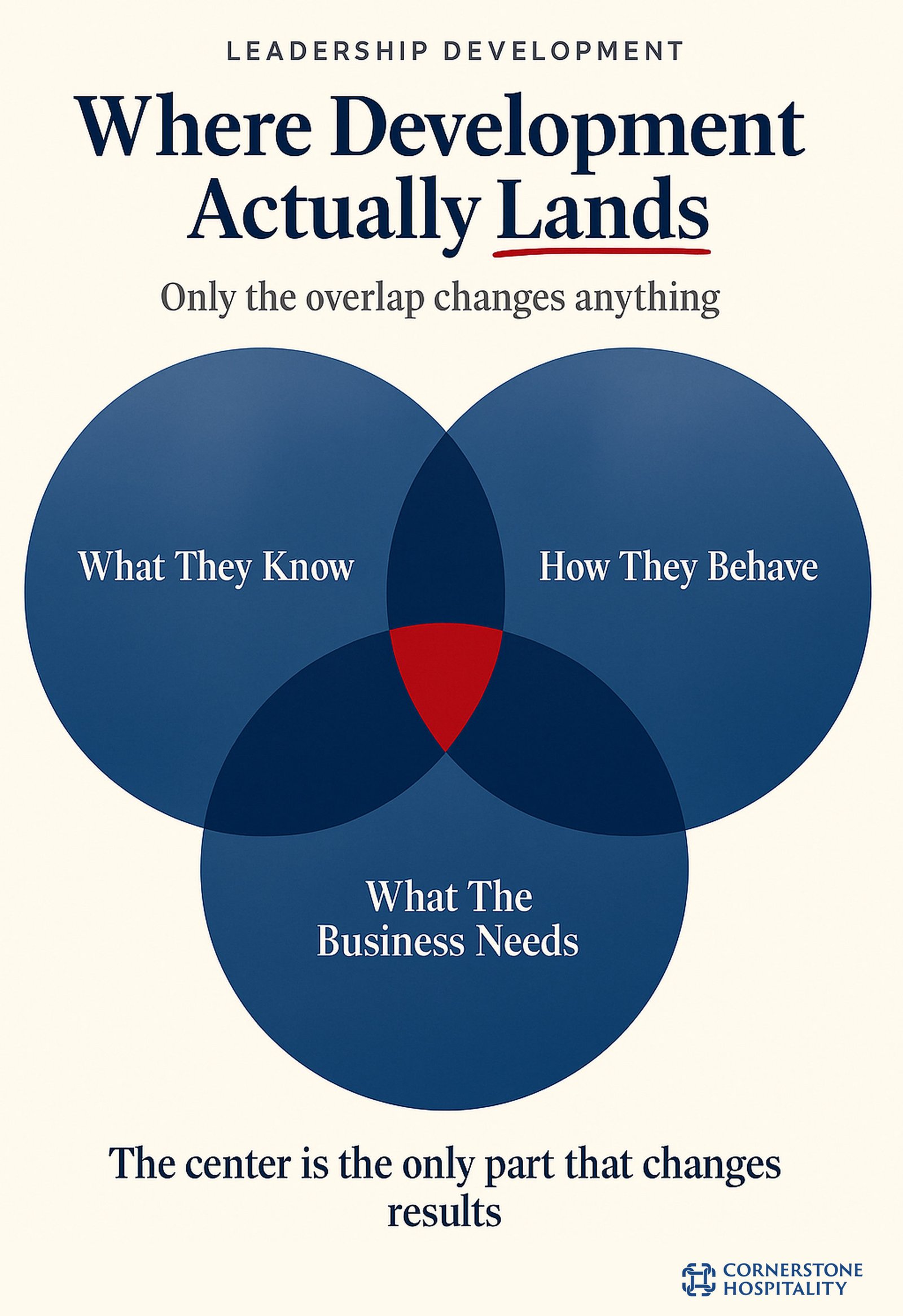
Where executive leadership development actually lands
Three things have to line up before any of this changes an outcome, and most programs only get two of them.
What a leader knows is the easiest to add and the least likely to be the constraint. In fact, very few senior people in this industry are held back by missing knowledge. They are held back by a habit that used to be a strength.
How a leader behaves is harder to shift, slower to show and rarely visible to the person doing it. It is also where almost all of the value sits, because behavior is what a team actually responds to, long after they have stopped listening to what was said in the briefing.
What the business needs is the part most programs skip entirely. Development untethered from the commercial reality of the property is interesting in the room and forgettable outside it, because nothing in the leader’s week depends on it. In practice the overlap of all three is the only part that changes results, so that is where the work goes.
Why it takes an operator to run it
A senior hospitality leader will be polite to anyone, of course. They will be honest with someone who has held the job, because that person can tell when the answer is a rehearsed one.
In short, that is the whole difference. A consultant who has run a property knows which pressures are real and which are excuses, and can say so without it landing as a lecture.

Need executive leadership development for a leader growing into the seat?
Tell us where they are strong and where the business is feeling the gap.
What separates executive leadership development from training
Both are useful, but only one changes how a leader behaves on a Tuesday.
| Leadership training | Executive development | |
|---|---|---|
| What it adds | Knowledge and frameworks | A change in how the leader operates |
| Who sets the agenda | The curriculum | The leader, the sponsor and the next seat |
| How long it runs | Days | Six to twelve months |
| How it is measured | Attendance and feedback | Named behavioral targets, reviewed three times |
| Who sees progress | Nobody after the room empties | The sponsor, in writing |
A course ends, and that is the end of it. A program is still running when the difficult conversation finally happens.
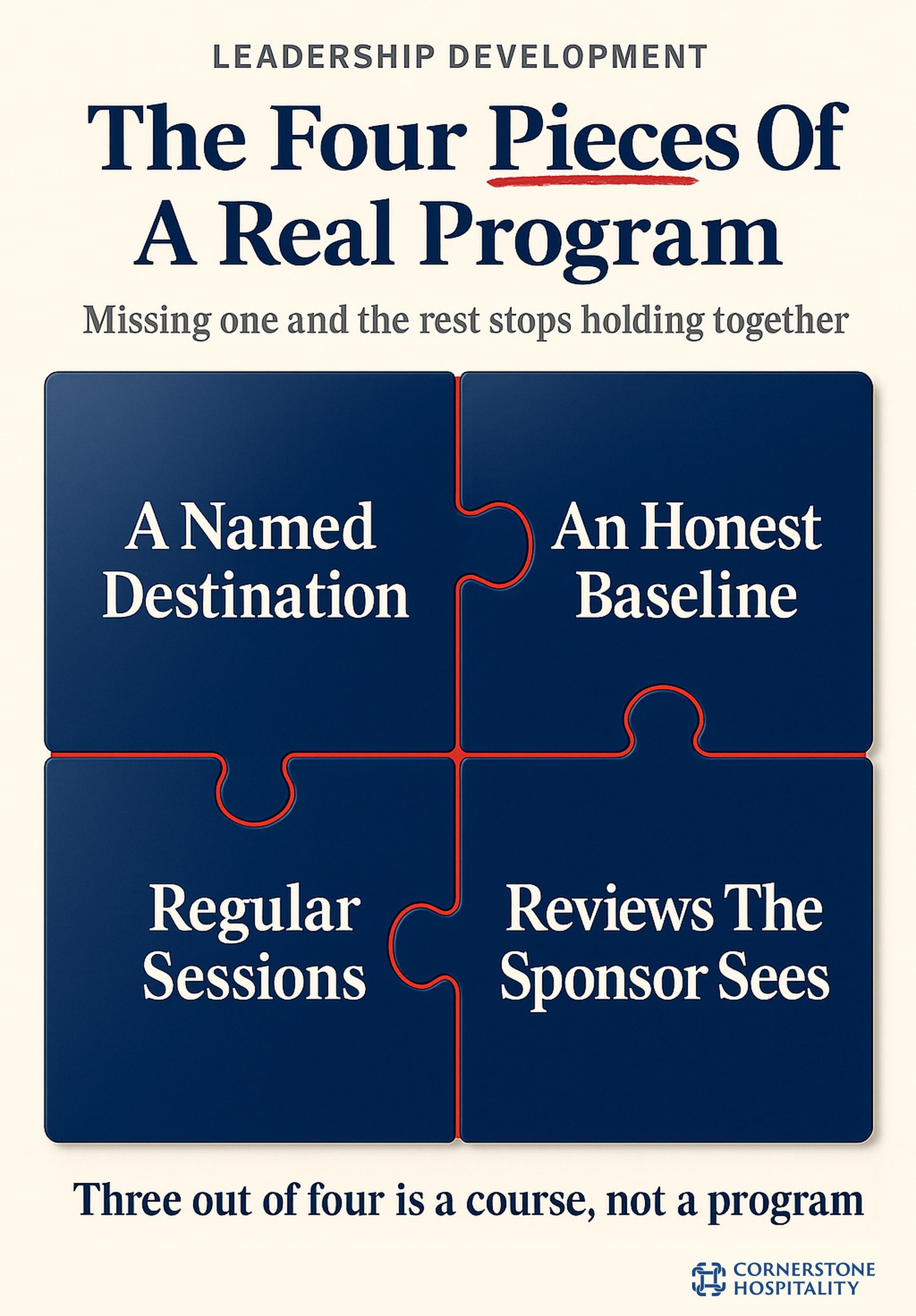
The four pieces of real executive leadership development
Every engagement we run has the same four components, and a program missing any one of them tends to fail in a predictable way.
A named destination comes first, because development toward general improvement drifts. There is nothing to test that kind of progress against. Naming the seat or the standard being aimed at is what makes the rest of the work decidable.
An honest baseline is second, although it is the part leaders resist most. Because a structured read from the people above, beside and below them will say something they have not heard, that discomfort is the point of it.
Regular sessions are third, at a cadence close enough that real situations arrive inside the engagement rather than being recalled afterwards. And reviews the sponsor sees are fourth, because development nobody can observe is indistinguishable from development that did not happen.
How an engagement runs
Scope and destination
A conversation with the leader and the sponsor to agree what this is preparing for and what changed looks like.
Baseline
A structured read from the people around them, returned as a written plan with named behavioral targets.
Sessions and reviews
Two to four sessions a month with access between, and three milestone reviews the sponsor sees.

Frequently asked questions about executive leadership development
What is executive leadership development?
Structured work with a leader already in a senior seat, aimed at a named next step or standard rather than at general improvement. It combines an honest baseline, regular one to one sessions and written reviews over six to twelve months.
How is it different from leadership training?
Training adds knowledge to a group over days, whereas development changes how one leader operates over months, against targets agreed with their sponsor. Most senior leaders in this industry are not short of knowledge.
Who is a good candidate for it?
Leaders who are strong operationally and are moving toward a seat where operational command stops being the main skill. General managers, executive committee members, regional directors and corporate executives.
Does the leader have to want it?
Yes, and that is the one condition we will not work around. Development imposed on someone who does not accept the premise produces compliance for six months and no change at all.
What does the sponsor actually see?
The written plan, the named behavioral targets and three milestone reviews against them. The content of individual sessions stays between the leader and the consultant, which is what makes the sessions useful.
Can you develop a whole leadership layer rather than one person?
Yes. The same engagement runs for an executive committee or a regional layer, with individual work underneath a shared standard so the group ends up operating the same way rather than five different ways.
Ready to develop the leaders you already have?
Whether it is one person moving toward a bigger seat or a whole layer that needs to operate to one standard, start with a confidential conversation. No commitment, no charge.
Start a confidential conversationSources and references
- Center for Creative Leadership, The 70-20-10 Rule for Leadership Development: sets out the framework that “emerged from over 30 years of our Lessons of Experience research”, in which development divides into “70% challenging experiences and assignments, 20% developmental relationships, 10% coursework and training”. CCL notes the framework is drawn from research spanning China, India, Singapore and the United States and is used across a client base including two thirds of the Fortune 1000.
- International Coaching Federation, Coaching Statistics: The ROI of Coaching in 2024: reports that “87% of survey respondents agreed that executive coaching has a high return on investment” and cites a PricewaterhouseCoopers and Association Resource Center global survey finding “an average ROI of seven times the cost of employing a coach”. It further records 72% of respondents linking coaching to increased employee engagement, with approval of coaching running at 78% among senior executives and 73% among employees.