

The hiring & development cycle of senior hospitality executives


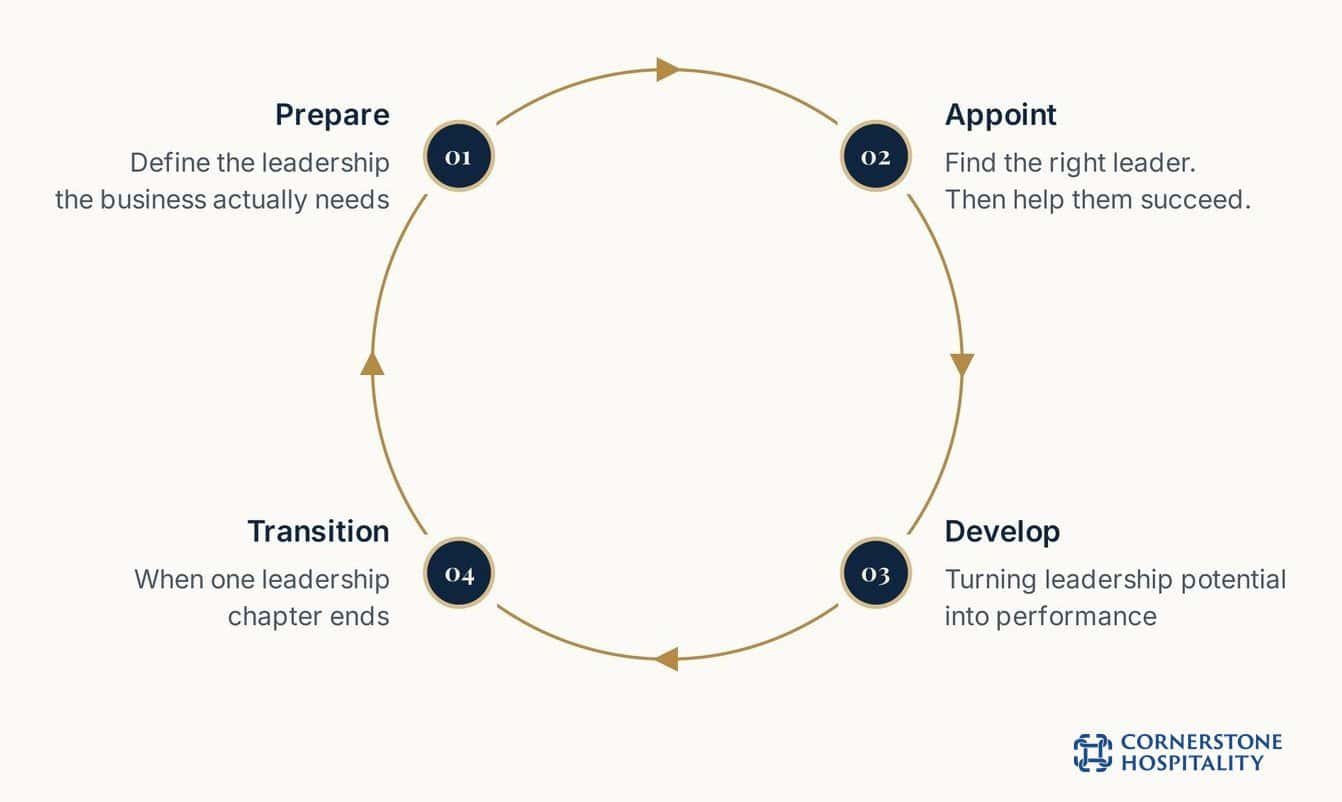
The hiring and development cycle of a senior hospitality executive has four connected stages. A leader’s journey through a career has many of them, and we at Cornerstone Hospitality are there every step of the way.
Our new guide, The Hiring & Development Cycle for Executives, walks through all four. Download it below, then read on for the short version.
Key insight
The Four Stages of the Hiring and Development Cycle
Prepare
When a position becomes vacant, we analyze with you what the person should have or be able to do as well as what this role actually covers, what a cultural fit would look like, and what results are being expected.
We challenge assumptions and bring market intelligence to the discussion. Does the previous brief still reflect the business? Has the role changed? Or does the organization need a different kind of leader altogether?
What does the business require its next leader to accomplish?
As a result, when we are involved earlier, we can also help organizations think ahead: mapping succession for mission critical roles, identifying potential successors, and understanding where development or external talent may be needed.
Appoint
Once the need is clear, we identify, attract, assess, and recruit the leaders who can deliver against it.
However, the appointment is not the finish line.
The first 90 days can determine whether a leadership transition gains momentum or loses it. Through executive coaching, we help new leaders navigate expectations, relationships, and the realities of their new environment, creating the conditions for a successful start.
Develop
The larger the role, the more often a leader needs to change how they lead.
Executive coaching and leadership development are not about fixing what is broken. They are about helping capable leaders become more effective in the role they now have, sharpening their focus, challenging limiting assumptions, and translating their strengths into greater impact.
Importantly, the same principle applies to executive teams.
We help teams align around shared priorities, navigate different leadership styles and cultural perspectives, reduce unnecessary friction, and make better decisions together.
Transition
Every leadership chapter eventually changes.
For example, that can mean moving into a larger executive role. Alternatively, it can mean a board position, advisory work, or a completely different direction.
Either way, we help senior executives step back, understand what they want their next chapter to look like, and make that transition deliberately rather than simply react to what comes next.
In short, we want to help you make better leadership decisions by connecting these moments in the hiring and development cycle, rather than treating them as separate events.
| Stage | Focus | Cornerstone’s Role |
|---|---|---|
| 01 Prepare | Define the leadership the business actually needs | Scoping, succession mapping, market intelligence |
| 02 Appoint | Find the right leader, then help them succeed | Search, assessment, first 90 day coaching |
| 03 Develop | Turn leadership potential into performance | Executive coaching, team alignment |
| 04 Transition | When one leadership chapter ends | Career and transition coaching |
A leader who is appointed well but left to develop on their own is still a leader at risk. Equally, a leader who is developed well but was never the right fit for the role was always going to struggle. Each stage protects the value created in the one before it.
Why this matters
Why We Treat These Stages as One Connected Cycle
Most organizations handle hiring, onboarding, development and succession as separate projects, often run by different people at different times. Consequently, the thread between them gets lost. A leader is appointed well, then left to find their own way. A leader is developed well, then moves on without a plan for what comes next. In each case, the value created at one stage quietly leaks away at the next.
The data on senior leadership transitions explains why that gap matters so much.
What the research shows
Industry data on leadership transition failure rates, the added value of structured assessment, and outcomes for leaders who receive structured support. Sources listed in full at the foot of the article.
Against that backdrop, the hospitality labor market gives organizations even less room for a misstep. Average annual turnover across U.S. hospitality runs around 73%, and 82% of surveyed hotels report a staffing shortage [4]. When a senior leadership role opens, there is rarely a deep bench waiting, and little time to recover from a decision that goes wrong.
A great appointment that is left to develop on its own rarely stays great for long. We see the strongest results when hiring and development are treated as one continuous relationship, not a handoff between teams.
The brief drifts from what the business actually needs. The new leader is appointed and then largely left to work things out alone. Development happens only when a problem shows up. A departure arrives with no plan, and the next search starts from zero.
The brief reflects the real business, informed by succession thinking. The first 90 days have structured support behind them. Development is continuous, not reactive. A later transition, if and when it comes, is handled deliberately rather than as a crisis.
About the evidence in this article
What the figures draw on: published research on senior leadership transitions and selection outcomes, plus hospitality workforce data, referenced in full below.
The practice behind the numbers: Cornerstone’s view of the cycle reflects our work across search, assessment, coaching and transition engagements with senior hospitality leaders and the organizations that employ them.
Want to talk through where a role or a leader sits in this cycle right now?
Before the next search starts, ask who owns the whole cycle, not just the open seat. A single team that carries a leader from preparation through transition keeps the brief honest, the first 90 days supported, and development continuous rather than reactive.
What to do
How Cornerstone Supports Every Stage
In practice, this means one team stays involved across the whole cycle rather than handing a leader off at each stage. Here is where each part of that support sits.
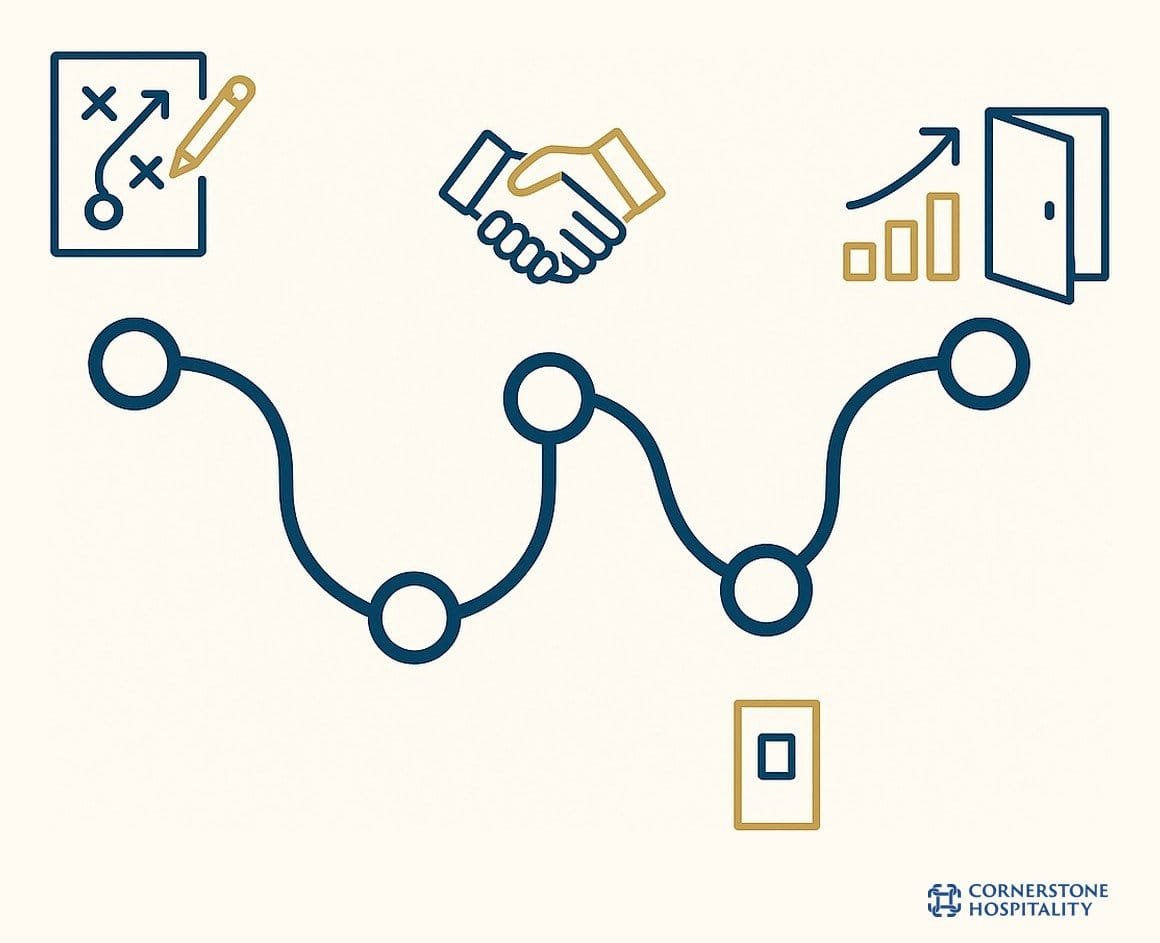
When one team carries a leader across every stage, nothing gets lost in the handoff. The people who help you define the role are the same people who help the appointed leader succeed in it, and the same people who support what comes next.
In their words
What clients and leaders say
The real test of a connected hiring and development cycle is the quality of the people it puts in the seat, and how they go on to perform. Here is what two leaders who have worked with us have said.
“Over the years I have worked with Florian and he has continually provided a service second to none. The caliber of individuals he recommends is always spot on, as he ensures that he understands not only the requirements and expectations of a role but also the importance of the success and growth of the business being related to people.
Daniel AylmerChief Executive Officer, Greater China
“Florian played a pivotal role in my career transition within the hospitality industry, combining deep expertise in executive search with a highly strategic advisory approach. He takes the time to truly understand your long term ambitions, challenges your assumptions, and positions you for sustainable leadership success. His network across the global hospitality sector is exceptional, and his commitment to delivering the right long term fit goes far beyond a transactional placement.
Stefan SavicHospitality Professional · Asset Management, Development & Strategy
Want to talk about where your organization sits in this cycle, before the next search even starts?
Frequently Asked Questions
What is the hiring and development cycle for a senior hospitality executive?
It is the four connected stages a leader moves through over a career: Prepare, where the role and the brief are defined, Appoint, where the right leader is identified and helped to start well, Develop, where coaching and leadership development turn potential into performance, and Transition, where a leadership chapter changes deliberately rather than by accident.
Why treat these four stages as one connected cycle instead of separate events?
Because the value created at one stage can leak away at the next if nobody owns the thread between them. A leader appointed well but left to develop alone, or developed well but never given a deliberate path to what comes next, is still a leader at risk. Research on senior transitions puts the failure or disappointment rate as high as 27% to 46% two years in, which is exactly the gap a connected approach closes.
How does Cornerstone support someone in the first 90 days after an appointment?
Through executive coaching focused on the realities of the new seat: expectations, relationships and the organization’s actual culture, not just the job description. The first 90 days often determine whether a leadership transition gains momentum or loses it, so this support starts immediately after the appointment rather than only if a problem appears later.
What happens during the Prepare stage, before a search even begins?
We work with the organization to define what the role actually requires now, not what the last job description said. That includes challenging assumptions, bringing market intelligence to the discussion, and, where it is useful, mapping succession for mission critical roles so the organization is thinking ahead rather than reacting to a vacancy.
More questions
Does Cornerstone only get involved once a position becomes vacant?
No. Organizations that bring us in earlier get more from the relationship, including succession mapping for mission critical roles, identifying potential successors, and understanding where development or external talent will be needed before a role actually opens.
How does executive coaching fit into the Develop stage?
Executive coaching and leadership development are not about fixing what is broken. They help capable leaders become more effective in the role they already hold, sharpening focus, challenging limiting assumptions, and translating existing strengths into greater impact, for individuals and for the executive teams around them.
What does Transition mean if a leader is not leaving the company?
Transition covers any point where a leadership chapter changes, which is not always a departure. It can mean moving into a larger executive role, taking on a board position, or stepping into advisory work. In every case, we help the leader step back, understand what they want the next chapter to look like, and make that change deliberately.
Written by
Florian leads Cornerstone International Group’s global Hospitality, Travel & Leisure Practice. He brings seventeen years of senior hospitality experience, including Marriott, Hyatt, IHG, Mandarin Oriental and Shangri-La Hotels & Resorts, and sixteen years in retained executive search. He is bilingual in English and German and works across Europe, the Middle East, the Americas and Asia-Pacific.
Read next
Sources
- PrimeGenesis: 40% of executives pushed out, fail, or quit within 18 months (citing Heidrick & Struggles internal study of 20,000 searches; CEO Kevin Kelly interview, Financial Times, 30 March 2009): primegenesis.com/2009/04/40-percent-of-execs-pushed-out-fail-or-quit-within-18-months
- McKinsey & Company: Scott Keller and Mary Meaney, Successfully transitioning to new leadership roles (May 2018): between 27% and 46% of executive transitions are regarded as failures or disappointments two years in: mckinsey.com/capabilities/people-and-organizational-performance/our-insights/successfully-transitioning-to-new-leadership-roles
- Plum: Schmidt & Hunter (1998) Meta-Analysis Explained (structured interview r =.51, cognitive ability r =.51, composite validity of structured interview plus cognitive ability above .60): plum.io/blog/schmidt-hunter-meta-analysis
- Kapable: Statistics On Leadership In The Hospitality Industry: 82% of surveyed hotels report a staffing shortage, and average annual U.S. hospitality turnover runs around 73%: kapable.club/blog/statistics/statistics-on-leadership-in-hospitality-industry
- LHH: Top 5 Outplacement Trends to Watch in 2025, supported by Korn Ferry career transition outcomes data: 92% of leaders who received career transition support found a next role better than or equal to the one they left (kornferry.com/capabilities/business-transformation/career-outplacement-services): lhh.com/en-us/insights/top-outplacement-trends-data
Want to talk about where your organization sits in this cycle?
Talk to Us