


Career Transition for Senior Hospitality Executives: How Cornerstone Supports You Through the Move

Hospitality career transition coaching exists because a senior career move is rarely a planned moment. That is exactly why the support around the leader matters so much. Consider a General Manager invited into a corporate seat, or a corporate officer heading for the C-suite. Consider a senior leader exited in a restructure, or an executive quietly thinking about what comes next. Each of these is a real inflection point with real stakes.
McKinsey’s research into senior leadership transitions finds that between 27% and 46% count as failures or disappointments two years in [5]. Interestingly, the leaders who land cleanly aren’t the ones with the smoothest exit. Rather, they are the ones who had the right support around them at the right moment.
Cornerstone Hospitality’s career transition practice exists to be that support, a single team, end-to-end, for the senior leader navigating the move. In practice, our hospitality career transition coaching is deliberately holistic: emotional reset, market reality, positioning, narrative, network, interview, compensation, and the first ninety days in the new seat. In a career transition, however, the parts don’t separate cleanly. Treat them as one engagement, and the outcome improves.
In short, this is who the work is for and the shapes a senior hospitality career transition typically takes. It also covers the components every engagement contains. Finally, it shows what a leader can expect, from the first conversation to performing in the next role.
Hospitality Career Transition Coaching: What The Research Says
Industry data on senior-transition failure rates, hospitality leadership scarcity, and outcomes for leaders who receive structured transition support. Sources listed in full at the foot of the article.
Where’s your career going? Let’s find out together.
Have a short, private conversation with our AI assistant. It asks 7 questions, takes 6 to 8 minutes, and you leave with a personalized read on your next move, sent straight to your inbox.
The Audience
Who hospitality career transition coaching is for
At first glance, the label “career transition” covers more ground than the phrase suggests. Specifically, in senior hospitality, a transition is any point where the next seat differs meaningfully from the last one. The leader may be moving up, stepping sideways, sitting between roles, or quietly weighing whether the current role still fits. Notably, each shape carries its own weight, and the support that produces a clean outcome differs in each case. With 82% of hotels currently unable to fill their open leadership positions [4], the market is moving fast around senior leaders. The cost of a misjudged transition compounds when the next opportunity disappears before the leader identifies the right one. In each case, hospitality career transition coaching is the mechanism that closes the distance.
Audience 1
The GM invited into a corporate role; the corporate officer stepping toward the C-suite. The challenge is identity, not capability; the new seat asks for a different leader.
Audience 2
A restructure, a strategic pivot, an owner change. The leader is between seats, and the first weeks are emotional, not strategic. The mindset reset has to come first.
Audience 3
Still in seat, performing well, beginning to wonder whether this is the role for another five years. Working on the question privately, before there is any external pressure, produces the best outcome.
Audience 4
A hotel group, owner, or operator commissioning outplacement for a leaving executive. The work supports the leader, while the engagement protects the relationship and the reputation of both sides.
Why this matters
The four audiences look different on the surface, but they share the same underlying need. Each needs a clear-eyed read of where the leader is and an honest conversation about the goal. Then a structured engagement closes the distance. Treat any of the four as a quick-fix, however, and the outcome suffers. Treat all four with the same seriousness and the leader arrives in the next seat ready to perform.
The Shapes
The three transition shapes we see most often
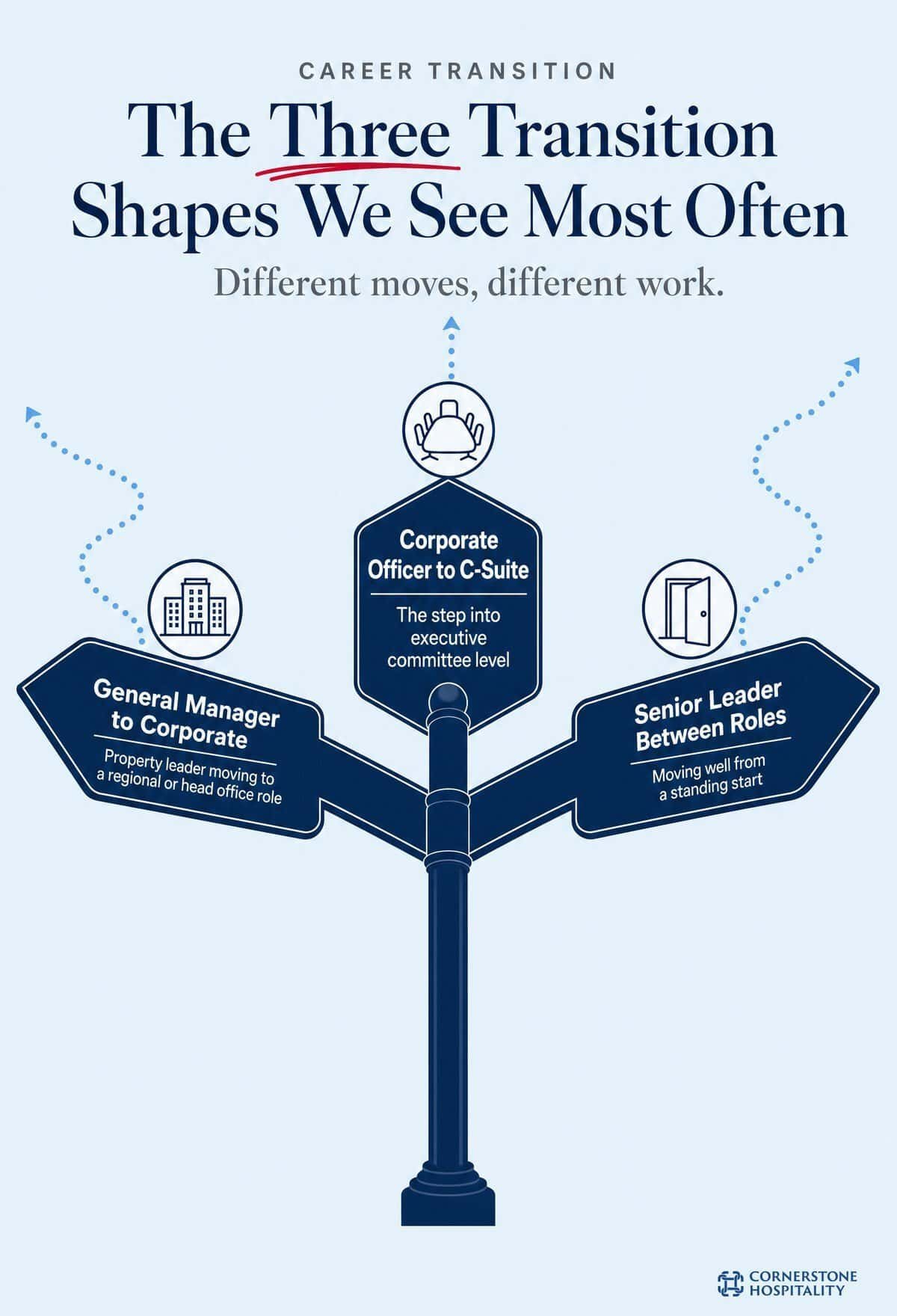
Although every senior hospitality career transition has its own context, three recurring shapes account for most of the work we do. Each carries a different identity shift, a different practical workload, and a different emotional terrain, and each rewards a different first move. Consequently, naming the shape early is the single biggest factor in whether a hospitality career transition coaching engagement lands.
The three shapes at a glance
Often a senior hospitality career-transition takes one of three shapes.
From running one property to overseeing many. The identity shift is the real work.
From executing strategy to setting direction. No one sits in front of the leader any more.
Emotionally complex. Mindset reset first, strategic work second.
1. The General Manager moving to a corporate or regional role
First, this is the shift from being, as we sometimes put it, king of your castle to one of many regional or corporate leaders. Typically, the GM has run a property, hosted owners and ambassadors, built and selected a team, and seen the business in motion every day. In contrast, the corporate or regional seat replaces that with a weekly call, a report, and a portfolio of properties run by leaders who report to them. Yet the skills that made the leader an exceptional GM, presence, instinct, hands-on leadership, don’t translate one-to-one into the new role.
Above all, the identity shift is the real work. For instance, as a GM, the leader had glamour, ceremony, and direct authority. By contrast, in the corporate seat, they have spreadsheets, video calls, less direct control, and the discipline of validating from a distance.
Harvard Business Review’s research on the move into enterprise leadership names “seven seismic shifts” required to succeed in the seat [6]. The operational-to-strategic move is one of them. In response, our hospitality career transition coaching surfaces the shift honestly before the leader commits, then equips them to make it. That means supporting from a different angle and finding information the official channels don’t surface. It also means helping the property leader they now oversee rather than duplicating them.
Why this matters
The GM-to-corporate move is one of the highest-failure transitions in the senior hospitality career. The reason is simple: the leader and the organization often underestimate the identity work involved. Naming it as identity work, not skill-building, is the first move that changes the outcome.
2. The corporate officer is moving to the C-suite
By comparison, this is a different kind of shift altogether. Already adapted to the corporate world, the corporate VP has executed strategy successfully for years, and has the trust of the people they report to. In fact, the leap into the C-suite is mostly internal: it is the move from being a follower who executes well to a leader who sets the direction. Once in the C-suite, there is no one in front of you. Now the owners are looking to you for the answer, not the other way around. Instead, the brief is no longer “deliver this”; it is “decide what the next chapter is.”
Of course, not every exceptional VP is cut out for this move, and that’s a feature of the work, not a failure of the leader. For example, some leaders are excellent at delivering a strategy and want to stay close to that work. Others have always been waiting to set the direction themselves. To that end, our hospitality career transition coaching makes the distinction explicit early. Then it equips the committed leader with the executive presence, strategic articulation, and board-level communication the new seat demands.
McKinsey’s research finds that 68% of senior transitions founder on issues related to politics, culture, and people [5], not on the technical depth the leader brings. The broader selection-science literature reinforces it: across more than 20,000 hires, 89% of failures trace to attitudes, fit, and judgment rather than technical capability [2]. Indeed, the C-suite move is where that pattern shows up most clearly.
3. The senior leader between roles
Meanwhile, this is the most emotionally complex transition we support. In most cases, the leader didn’t choose the exit: a restructure, a strategic pivot, an owner change. As a result, the first days carry real weight: shock, anger, hurt, and a confidence that hasn’t recovered yet. Therefore, acting from that state, rewriting the CV, sending applications, or networking aggressively almost always leads to worse outcomes than waiting and resetting first.
For that reason, our first work with a leader in this position is emotional, not strategic. First, we let them air the situation. Then we point out choices they may not yet see. These include living somewhere else, taking a different kind of role, or stepping away from the corporate path entirely. Finally, we frame the new freedom as a real choice rather than as an enforced loss.
Only after that mindset has reset does our hospitality career transition coaching move into the strategic work. That work covers positioning, narrative, market mapping, interview preparation, compensation negotiation, and a re-entry plan calibrated to the leader’s runway. The outcomes are quietly encouraging; in supported senior transitions, 92% of leaders land in a next role equal to or better than the one they left [7].
“It doesn’t help, in the moment the person lost the job, to right away train them in interview. It’s more about let them digest a little bit, get the mindset cleared up, and get the timing right. Initially, they might feel that everything is wrong, hurt, angry, the rest. So you need to listen to them, let them air certain thoughts, and just point out that you can see things also from a different angle. When that one slowly diminishes, then you can start getting to work.”
Florian Kittler, Managing Partner, Cornerstone Hospitality
What to do
- First, name the shape of the transition early. The first move that works for an exit is different from the first move that works for a promotion.
- If the leader is mid-exit, resist the urge to send the CV in the first week. The mindset reset comes first; the strategic work works better afterward.
- If the leader is moving up, treat the move as identity work, not skill-building. The capability is usually already there; the identity has to catch up.
The Engagement
Considering a senior career transition, for yourself, or for a leader on your team? The conversation starts with what you are actually trying to decide, not with our process.
How Cornerstone hospitality career transition coaching runs
Although the work is structured, it is not formulaic. The order changes depending on which transition we are supporting and how the leader is arriving. In practice, the six components below appear in every hospitality career transition coaching engagement; the sequencing depends on the person. Because the same coaching team delivers every component, context never gets lost in a handoff. The leader who told the wheel-of-life story in week one doesn’t retell it in week six when interview coaching starts.
How the work runs
Six components. One coaching team. Every Cornerstone career-transition engagement.
Component 1
A wheel-of-life conversation. Financial reality, family, where home is, runway, who is depending on the next move. The strategic work only makes sense once that ground is clear.
Component 2
Furthermore, the team walks the leader through a structured psychometric. The result is a shared baseline of how they show up, so the rest of the work starts from something honest. Structured assessment composite predictive validity exceeds .60, well above unstructured interview alone [3].
Component 3
Notably, Florian is a certified resume writer; the team helps the leader rebuild each asset from the positioning that emerged in the first two components. After all, the way a leader describes themselves shapes how the market evaluates them.
Component 4
Additionally, target-market mapping, the recruiter’s lens on engaging headhunters productively, and the accountability that keeps the campaign moving when motivation dips. Because job search is a lonely business, we sit on the leader’s side of the table.
Component 5
Then, people who have run the search side of these discussions coach interview performance and compensation conversations. As a result, the leader knows what is realistic, what to push on, and what to let go.
Component 6
The engagement doesn’t end when the offer lands; it ends when the leader is operating effectively. We stay engaged through the first 90 days, helping the leader navigate first decisions and first stakeholder meetings.
| Engagement phase | Typical duration | What success looks like at the end of this phase |
|---|---|---|
| Reset & calibrate | 2 to 6 weeks | The leader has a clear-eyed read of where they are, what they want, and what the runway will support. |
| Position & build | 3 to 6 weeks | CV, LinkedIn, and narrative all reflect the positioning the leader actually wants to be hired for. |
| Search & campaign | 2 to 6 months | Active conversations with target companies and search firms; interview shortlists forming. |
| Interview & offer | 4 to 10 weeks | Coached interview performance and an offer the leader has negotiated on solid footing. |
| First 90 days | 3 months in seat | The leader is operating effectively, with the first key stakeholder relationships established. |
Why this matters
Most senior hospitality leaders we work with have never been through a structured transition before; the previous career steps came organically, through reputation and relationship. Putting structure around the move, without flattening the person inside it, is the work. Phases are markers, not deadlines; the leader sets the pace, and the team keeps the structure intact.
The Output
What the work delivers for the leader and the organization
Ultimately, a hospitality career transition coaching engagement stands or falls on two outcomes that have to land together. First, the leader has to arrive in the next seat ready to perform. Second, the relationships behind the engagement have to come through the transition intact. That includes the previous employer, the broader industry, and the leader’s own sense of themselves. In short, both are deliverables. If either is missing, the work becomes a half result.
For the leader
- ✓An open conversation about the move you are really considering, including the trade-offs it carries.
- ✓The mindset and positioning work that makes the next opportunity available to you.
- ✓The practical reset of CV, LinkedIn, and professional network.
- ✓A search strategy built on real market knowledge, not generic advice.
- ✓Interview & compensation coaching from someone who has run the search side of these conversations.
- ✓Support through the first 90 days in your next seat, so the transition is complete when you are performing.
For the organization commissioning outplacement
- ✓Dignified support for the leaving leader, paid for by the organization, delivered confidentially by a dedicated coach.
- ✓Structured engagement summaries at agreed checkpoints, visibility for the company without intruding on the coaching itself.
- ✓Reputation protected on both sides; because the hospitality industry is small, handling a senior exit well leaves both parties with their standing intact.
- ✓A clean handover: the engagement preserves the relationship between the leaving leader and the organization, often improving it on the way out.
About this approach
Scope: Individual senior career transition engagements; organization-commissioned executive outplacement; quiet pre-exit coaching for leaders weighing their next chapter.
Inputs: Wheel-of-life conversation, structured psychometric, positioning work, CV/LinkedIn rebuild, target-market mapping, interview & compensation coaching, first-90-day support.
Duration: Typically three to six months from the first conversation to the leader in the next seat. Variance reflects market conditions, target-role clarity, and how much mindset-reset work the leader needs.
Network: Drawn from Cornerstone International Group’s global Hospitality, Travel & Leisure Practice, 60+ offices across 40+ countries.
What to do
Five tells of a strong transition engagement
Five tells separate an engagement that lands from one that merely produces a handsome document. They apply to any senior leader weighing this work, and to any organization weighing outplacement. Notably, each tell is observable from the first conversation, before the engagement begins. Since nearly half of all senior transitions misfire two years in [5], support quality matters enormously. It is one of the highest-leverage choices in the whole transition.
- The first conversation is about the person, not the process.
A strong engagement opens with where the leader is, emotionally, practically, and geographically. By contrast, a weaker engagement opens with the workshop schedule.
- The team that coaches week one is the team that coaches week thirty.
Career transitions don’t lend themselves to handoffs. Moreover, the context built in the reset phase is what makes the interview coaching land. Instead, a single team carries the engagement end-to-end.
- The coach has run the search side, not just the coaching side.
Interview and compensation coaching is sharper when it comes from someone who has sat in the headhunter’s chair. In fact, Florian has spent sixteen years in retained executive search; that experience informs every offer conversation.
- The engagement is open about the trade-offs in front of the leader.
A reputable engagement names every move the leader could make, including leaving the industry, relocating, or stepping away from the corporate path altogether. Conversely, a weaker one quietly steers the leader back into the most recognizable next role.
- The work continues into the first 90 days in the new seat.
Ultimately, the transition doesn’t end when the offer lands. Rather, it ends when the leader is performing. Indeed, the strongest engagements stay engaged through the on-ramp, so the early decisions in the new role are coached, not improvised.
What to do next
If you are weighing hospitality career transition coaching or evaluating outplacement providers for a leaving executive, ask about all five tells in the first conversation. The answers will then tell you whether you are buying a process or buying an outcome.
Glossary
- Career transition
- Any inflection point where the next senior role is meaningfully different from the last one, promotion, lateral move, exit-and-re-entry, or considered career pivot. Distinct from a routine job change in scale and stakes.
- Executive outplacement
- Career transition support commissioned and paid for by the organization, delivered confidentially to the leaving executive. Designed to support the leader and protect the relationships and reputations of both sides.
- Wheel-of-life conversation
- A structured opening conversation that brings out the leader’s full context, financial reality, family, location, runway, dependents, before any strategic positioning work begins.
- Positioning
- The deliberate articulation of the leader’s next-role identity, what they are now hireable for, in what kind of seat, for what kind of organization. Underpins CV, LinkedIn, narrative, and search strategy.
- Re-entry plan
- The structured plan that returns a leader between roles to the senior market. We calibrate it to the leader’s runway, target market, and the realistic time needed to land the right next seat.
- First 90 days
- The on-ramp period in the new seat. Where reputations are formed, stakeholder relationships are established, and the leader’s read of the new context is built. Coached as part of the engagement, not left to chance.
Not sure where to go from here?
Talk it through with our AI assistant
Answer 7 questions in 6 to 8 minutes and get a personalized read on your next move, then the option to book a thirty minute session with Florian Kittler.
No login, no cost, no pressure. 6 to 8 minutes.
What our clients and candidates say
The measure of good transition support is what leaders say once they are through it. Here is what two of them have said.
“Florian played a pivotal role in my career transition within the hospitality industry, combining deep expertise in executive search with a highly strategic advisory approach. Unlike traditional recruiters, he takes the time to truly understand your long-term ambitions, challenges your assumptions, and positions you for sustainable leadership success. His network across the global hospitality sector is exceptional, and his commitment to delivering the right long-term fit goes far beyond a transactional placement.
Stefan SavicHospitality Professional · Asset Management, Development & Strategy
“Over the years I have worked with Florian and he has continually provided a service second to none. The caliber of individuals he recommends is always spot on, as he ensures that he understands not only the requirements and expectations of a role but also the importance of the success and growth of the business being related to people.
Daniel AylmerChief Executive Officer, Greater China
Both quotes are verified public LinkedIn recommendations from clients and colleagues who have worked with Florian Kittler.
Frequently asked questions
Who is career transition for senior hospitality executives for?
Senior hospitality leaders are navigating an inflection point: General Managers moving to corporate or regional roles, corporate officers are preparing for the C-suite, senior leaders are between roles after a restructure, and executives are quietly considering whether their current seat is the right one for the next chapter. Overall, hospitality career transition coaching ranges from an individual engagement commissioned by the leader through to full executive outplacement commissioned by an organization.
How long does a typical engagement take?
Typically, senior hospitality transitions take three to six months from the first conversation to the leader in the next seat. The timing depends on where the leader is starting from, the clarity of the target role, the market they are searching, and how much mindset-reset work is needed. Notably, we don’t promise a timeline at the start; we set realistic expectations once we understand the situation.
What is included in the engagement?
Included: a whole-person conversation, psychometric assessment and self-perception calibration, positioning work, CV and LinkedIn rebuild, search strategy and active campaign support, interview and compensation coaching, and ongoing support through the first 90 days in the new seat. Every component is delivered by the same coaching team, so context never gets lost in a handoff.
Do you work with leaders who haven’t yet exited their current role?
Yes. In fact, many engagements start while the leader is still in their seat, quietly considering the next move. Working through positioning and target-role clarity before there is external pressure usually produces a better outcome than starting under the time pressure of a forced exit.
Outplacement and ongoing support
What does executive outplacement look like when a company commissions Cornerstone for a senior leader’s departure?
In practice, we work directly with the leaving executive through every stage above, paid for by the organization. For governance, the organization receives a structured engagement summary at agreed checkpoints. Meanwhile, the leader receives a dedicated coach for the duration. As a result, the relationship between the leader and the organization usually improves; handling a senior exit well leaves both sides with their reputations intact.
Can the work continue once the leader starts the new role?
Yes. Notably, the standard engagement includes the first 90 days in the new seat as a core component, not an add-on. Occasionally, leaders extend the coaching beyond that, particularly when the new role is a meaningful step up; we structure that as a separate executive coaching engagement rather than open-ended transition work.
How do I start a conversation?
Use the form on our contact page or email Florian Kittler directly at florian-kittler@cornerstone-group.com. The first conversation is confidential, free of charge, and focused on understanding your situation. Engagement only begins once we mutually agree on the fit.
Read next
Sources
- PrimeGenesis: 40% of executives pushed out, fail, or quit within 18 months (citing Heidrick & Struggles internal study of 20,000 searches; CEO Kevin Kelly interview, Financial Times, 30 March 2009): primegenesis.com/2009/04/40-percent-of-execs-pushed-out-fail-or-quit-within-18-months
- Leadership IQ: Executive Failure Rates (study of 20,000+ new hires across 312 organizations): “46% of newly hired employees failed within 18 months while only 19% achieved unequivocal success. Attitudes drive 89% of hiring failures while technical skills account for only 11%.”: leadershipiq.com/blogs/leadershipiq/executive-failure-rates
- Plum: Schmidt & Hunter (1998) Meta-Analysis Explained: structured interview r =.51, cognitive ability r =.51, composite validity of structured interview + cognitive ability >.60: plum.io/blog/schmidt-hunter-meta-analysis
- Kapable: Statistics On Leadership In The Hospitality Industry: 82% of surveyed hotels report a staffing shortage; 73% annual U.S. hospitality turnover: kapable.club/blog/statistics/statistics-on-leadership-in-hospitality-industry
- McKinsey & Company: Scott Keller and Mary Meaney, Successfully transitioning to new leadership roles (May 2018): “between 27% and 46% of executive transitions are regarded as failures or disappointments” two years in; 68% of transitions founder on issues related to politics, culture and people: mckinsey.com/capabilities/people-and-organizational-performance/our-insights/successfully-transitioning-to-new-leadership-roles
- Harvard Business Review: Michael D. Watkins, How Managers Become Leaders (June 2012): the “seven seismic shifts” required when a leader moves from functional or operational leadership to enterprise leadership for the first time: hbr.org/2012/06/how-managers-become-leaders
- LHH: Top 5 Outplacement Trends to Watch in 2025, supported by Korn Ferry career transition outcomes data: 92% of laid-off employees who received career-transition support found a next role better than or equal to the one they left (kornferry.com/capabilities/business-transformation/career-outplacement-services): lhh.com/en-us/insights/top-outplacement-trends-data
Written by
Florian leads Cornerstone International Group’s global Hospitality, Travel & Leisure Practice. He brings seventeen years of senior hospitality experience, including Marriott, Hyatt, IHG, Mandarin Oriental and Shangri-La Hotels & Resorts, and sixteen years in retained executive search. He is bilingual in English and German and works across Europe, the Middle East, the Americas and Asia-Pacific.