


Compensation for the Next Hospitality Role: Three Layers, One Walk-Away Number


Hospitality executive compensation is rarely lost in the negotiation, and overall the pattern is remarkably consistent across regions. Instead, it is lost in the preparation, or the lack of it. Because the offer letter arrives after the framing conversations have already happened, the work that decides whether the package will feel right in eighteen months is already done, or already missed by the time a senior hospitality leader is sitting in front of it. Indeed, the leaders who finish a transition with a package they are proud of are almost always the ones who did the homework before the first conversation. In contrast, the ones who finish a transition wondering what happened are almost always those who let the offer drive the thinking.
Similarly, the pattern repeats across every region and every brand. In particular, hospitality executive compensation has more moving parts than most other industries: cash, variable, long-term, family logistics, tax structure, currency, equity in operators, and ownership stakes in independents. Additionally, each layer behaves differently. Meanwhile, each one rewards a different kind of preparation. Hence, treating the conversation as a single number is how packages get negotiated that seem attractive at first but fall short after eighteen months.
In short, this is the framework Cornerstone Hospitality walks every senior leader through before a compensation call, the same one we use inside our career-transition work with senior hospitality executives: three layers, valued independently, with one walk-away number that anchors the whole conversation. If a compensation conversation is already on the horizon, talk to us before the first call rather than after the offer.
The stakes, what the research says
Industry data on hospitality executive compensation, senior-hire failure rates, and the current hospitality supply gap. Sources are listed in full beneath the article.
The framework overview
Three layers of hospitality executive compensation, valued independently
Three layers
The three layers of compensation for the next hospitality role
| Layer | Component | What senior leaders anchor on |
|---|---|---|
| 1 | Base salary and annual bonus | The visible number the market talks about, and the yearly performance top-up |
| 2 | Long-term incentive | Equity, deferred cash, or LTIP grants that vest over three to five years |
| 3 | Total family package | Relocation, schooling, housing, tax equalization, healthcare, travel home |
Senior hospitality executive compensation is best read as three independent layers, each with its own market, its own logic, and its own risks. Generally, the leaders who finish the conversation in a strong position are the ones who value each layer separately before stacking them, not those who let the recruiter present a single headline number and react to it. Moreover, the shape of the market makes the discipline more important than ever: average hospitality CEO packages have moved from $9.8 million to $11.9 million in a single year, and the bulk of that movement sits in the long-term layer, where most senior leaders often feel the most uncertain [5].
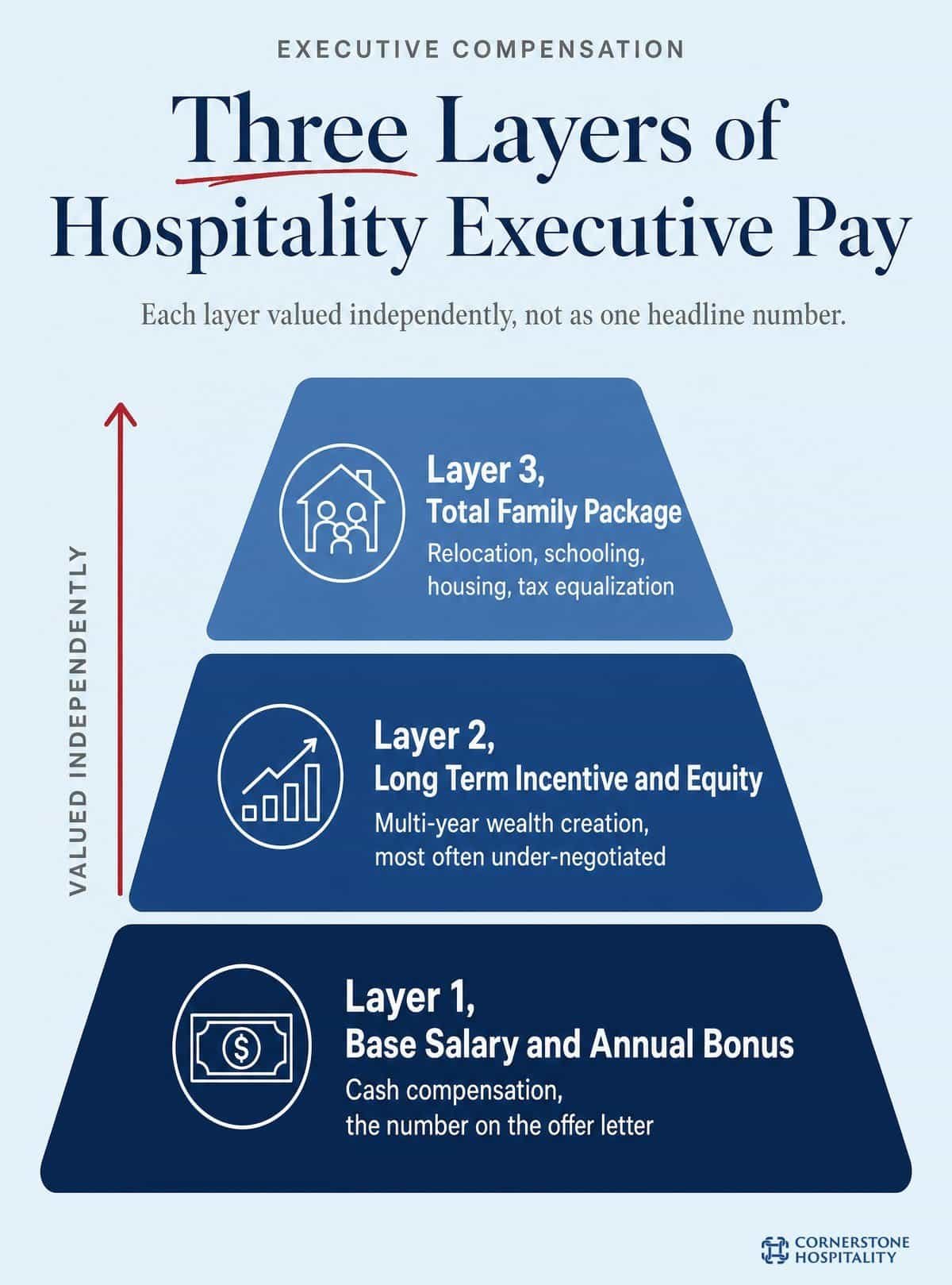
Layer 1, Base salary and annual bonus
Cash compensation. The number on the offer letter that everyone in the room knows how to discuss. In particular, validated against the market for the brand, the region, and the asset class. Of course, this is the layer most senior leaders feel confident negotiating, but the data they rely on is often six to twelve months stale. Meanwhile, the market moves faster than memory, and hospitality cash benchmarks have shifted clearly across regions in the past two years.
Furthermore, the annual bonus inside this layer deserves its own attention. In particular, the percentage of base it represents at target, the metrics it is tied to (RevPAR, GOP, owner-relationship score, guest experience index), the threshold at which it pays, and the cap at which it stops, these four numbers shape what the bonus actually delivers in practice. For example, a 50% bonus tied to four metrics with a 200% cap is a different package from a 50% bonus tied to one metric with a 100% cap. Same headline, different reality.
Why this matters
A 50% target bonus that pays at a threshold of 90% of the plan is a meaningfully better package than a 60% target that pays only above 100% of the plan. The headline reads worse; the cash in the account reads better. Reading the bonus mechanics is part of reading the offer.
Layer 2, Long-term incentive and equity
Multi-year wealth creation. In fact, this is the layer most senior leaders forget to negotiate properly, then regret. Indeed, long-term incentive structures vary widely by ownership type: a branded operator, an independent owner, a private-equity-backed group, and an asset-management platform each carry a different toolkit. Restricted stock, performance shares, phantom equity, profit interests, owner carry: the labels look similar across letters; the value behind them is anything but.
In particular, this is where the senior hospitality market has moved the hardest. Significantly, a CEO pay in hospitality study tracks the average package rising by roughly $2 million year over year and notes that the increase was driven almost entirely by long-term incentives, while base salaries rose by just over $100,000 and short-term incentives held flat [5]. As a result, the market is telling senior hospitality leaders something specific: the layer to read carefully and to negotiate carefully is the long-term one.
Equally important, knowing what is actually on the table requires industry-specific intelligence: vesting schedules, accelerator clauses on change of control, treatment on good leaver/bad leaver, dilution mechanics, and the underlying valuation methodology. Accordingly, a leader who can ask three precise questions about the long-term layer is read by the other side as someone who has done senior-level moves before. Conversely, one who skips those questions is read as someone who can be priced more cheaply on the layer that matters most over a five-year horizon.
Layer 3, Total family package
Relocation, schools, housing allowance, spousal support, tax equalization, repatriation clause, healthcare, club memberships, car, flights home. After all, this is the layer that the leader’s spouse will be the one to remember when the move is in motion. In fact, get this layer wrong, and a great cash deal can still become a regret within twelve months. As a result, the leader is succeeding at work and bleeding at home, and the package is part of the reason.
In reality, the family layer in senior hospitality is rarely about discrete dollar amounts; it is about setting up the entire move. For example, international schools in Singapore, a four-bedroom apartment in central Madrid, a tax structure that survives a move from a low-tax to a high-tax jurisdiction, and a repatriation clause that protects the leader if the role doesn’t work out. Undeniably, each of these is a real number, and the gap between a casually written offer and a thought-through one can easily reach six figures a year.
Why this matters
A relocation handled well buys the leader the first six months of the new role. A relocation handled badly costs the leader the first six months of the new role, precisely the window in which most senior hires either land or don’t. Given that 89% of failed senior hires fail for attitudinal and fit reasons rather than capability [2], the family layer carries more weight than the offer letter suggests.
The comparison
Why a layered read beats a single-number offer
In short, avoid presenting hospitality executive compensation as a single headline number. Certainly, total target compensation, fully loaded, is the cleanest way to introduce an offer in a single email, but it is also the way most leaders lose money. As a result, the headline number flattens the three layers into one and obscures where the package is actually generous and where it is actually thin. However, set side by side, the gap between a layered read and a single-number read is sharper than most senior leaders expect.
Six lines that separate a layered read from a headline read
The table below is the artifact senior leaders carry into the room. Specifically, each row is one of the six lines a layered read covers that a single-number read leaves implicit, and each one has cost real money in real offers.
| Layer | Single-number read | Layered read |
|---|---|---|
| Base + bonus | “Cash on target is X.” | Base, bonus target, bonus metrics, threshold, and cap, each negotiated separately. |
| Long-term incentive | “LTI is worth Y at target.” | Instrument, vesting, performance conditions, change-of-control treatment, leaver mechanics, each priced. |
| Family package | “Relocation is covered.” | Housing, schools, spouse support, tax equalization, and repatriation, each provisioned with a number. |
| Tax and currency | Rarely raised. | Modeled across both jurisdictions, including currency volatility on the long-term layer. |
| Exit terms | Implied. | Notice, severance, non-compete, garden leave, accelerated vesting, agreed before the offer is signed, not after. |
| Year-three view | Out of scope. | A modeled view of what the package is worth in year three, in the currency the leader actually spends. |
Why this matters
The single-number read protects the speed of the deal. In contrast, the layered read protects the leader. Both have their place, but the layered read is what should sit on the leader’s side of the table before the first conversation, not after the offer arrives.
The anchor
The walk-away number, the figure that anchors the call
One number
The walk-away number for compensation in the next hospitality role
A single figure, written down before the call, below which the offer is declined without argument.
Every senior leader Cornerstone Hospitality coaches into a new role has done one specific piece of homework before the first compensation call: they have written down their walk-away number. Not a target. Not an opening position. In short, a walk-away figure that, if the offer falls below it, means the conversation ends rather than continues. Without it, hospitality executive compensation conversations drift downward by small, reasonable-seeming increments until the leader is signing a package that doesn’t honor the seat. On the other hand, with it the conversation has a floor that the leader, not the recruiter, has set.
The four inputs behind the number
- ✓The market floor: what the role pays at the brand and region today. Benchmarked against current data, not what the leader remembers from their last move.
- ✓The life floor: the cash the leader needs to fund housing, schools, family logistics, and savings rate in the new city, in the leader’s actual currency.
- ✓The opportunity cost: what the leader is giving up by accepting the equity arc of the current role, including any unvested long-term incentive that would be forfeited.
- ✓The walk-away number: the highest of the three. Below it, the leader declines before the negotiation drifts.
A discipline, not a negotiating position
Above all, the walk-away number is not a negotiating position; it is a discipline. Specifically, the leader does not lead with it, does not show it, and does not anchor the recruiter to it. They simply know it, and the knowing changes the conversation. As a result, a leader who knows their walk-away figure sits differently in the room. The recruiter feels it. The board feels it. Eventually, the package that comes back reflects it.
“We always tell senior leaders that the compensation conversation is three conversations in disguise. Handling them as one is how packages get negotiated in a way that looks good on the offer letter and feels bad eighteen months later. The walk-away number is the discipline that keeps all three honest at once.”
Florian Kittler, Managing Partner, Cornerstone Hospitality
What to do
Write the walk-away number down this week, before any recruiter calls. Share it with the spouse, keep it off the table in the conversation, and let it quietly set the floor. It is also where a career coach earns their place in an executive transition, keeping the discipline honest once a live offer starts pulling at it.
What senior leaders say
“Florian played a pivotal role in my career transition within the hospitality industry, combining deep expertise in executive search with a highly strategic advisory approach. Unlike traditional recruiters, he takes the time to truly understand your long-term ambitions, challenges your assumptions, and positions you for sustainable leadership success.
Stefan SavicHospitality Professional · Asset Management, Development & Strategy
“Florian’s experience and in-depth knowledge of the hospitality industry give him the insight most others simply don’t see or understand. He is a strategic thinker and committed to achieving only the best possible. I always look forward to receiving his advice and recommend him as a trusted partner in any business relationship.
Jens BuschOperations Leader · Hospitality, Leisure & Travel · Board Advisor
Both quotes are verbatim, publicly verifiable LinkedIn recommendations, see Florian’s LinkedIn profile.
The preparation
The four-week preparation a senior leader actually needs
Of course, hospitality executive compensation conversations almost never arrive at a convenient time. Generally, the leader has weeks, sometimes days, between the first serious signal and the offer. As a result, the four-week preparation below is what Cornerstone Hospitality runs alongside a senior leader from the moment a real conversation begins. Each week has one output. Undoubtedly, none of them are negotiable.
One output per week, four weeks in a row
Overall, the four-week cadence below is the rhythm that has held up across senior hospitality moves in every region we serve. Each week produces one artifact the leader can point to, and each artifact builds directly into the one that follows.
Current cash benchmarks for the brand, region, and seat. Long-term incentive structures common to this ownership type. Family-package norms for the destination city.
Housing, schools, healthcare, savings rate, tax. Modeled in the destination currency, with a margin for currency drift over the contract term.
Current long-term grants, vesting calendars, performance conditions, retention bonuses. What is forfeited by leaving, and what would be required to make the new role honor the move.
Three numbers, one figure. The higher of the three becomes the walk-away. Written down, shared with the spouse, never shared with the recruiter.
Why the preparation window matters
Four weeks. One output per week. In fact, by the time the formal offer arrives, the leader is ready to read it the way a board reads a deal, layer by layer, with a number behind every layer. Conversely, without that preparation, the leader is reading the offer the way a candidate reads an offer, one headline figure, with the rest assumed.
Why this matters
The difference between four weeks of preparation and none is rarely visible at signing. It shows up at month eighteen, where 40% of senior executives fail, quit, or are pushed out [1], and where the packages that held were the ones read layer by layer before the first call. Leaders who treat the window as development rather than admin tend to carry the habit into the seat itself, the same pattern we see in leadership development work with senior hospitality executives.
Coaching the compensation conversation is part of every Cornerstone Hospitality career-transition engagement. If you would rather not navigate it alone, the conversation starts with what you are weighing, not with our process.
What to do
Five tells of a compensation conversation that went well
In fact, a senior leader can usually tell, the morning after the offer is signed, whether the conversation went well. Surprisingly, the package that honors the seat looks the same in every region. Specifically, these are the five tells: observable, specific, and worth measuring against the package the leader is about to accept.
- The three layers were valued separately.
Notably, the leader can describe the base, the bonus mechanics, the long-term layer, and the family package, each on their own terms, not as a single “total target” figure.
- The long-term layer was negotiated as carefully as the base.
Vesting, performance conditions, change-of-control treatment, and leaver mechanics were named, asked about, and adjusted, not accepted in the standard form letter.
- The family package was provisioned with real numbers.
Housing, schools, spousal support, and tax equalization each carry a specific dollar (or local-currency) figure, not a vague “market-standard relocation” clause.
- The walk-away number held.
The final offer sits at or above the walk-away figure the leader wrote down in week four. If it doesn’t, the leader declines, without apology, without dramatic exit, and without burning the relationship.
- The exit terms were agreed upon in writing before signing.
Notice, severance, non-compete, and accelerated vesting on certain scenarios are documented inside the offer letter or the side agreement, not left to be negotiated later under duress.
What to do the morning after the offer
What to do next
If a senior leader is heading into a hospitality executive compensation conversation in the next ninety days, the four-week preparation outlined above can begin today. The walk-away number is the first artifact to produce, before the recruiter calls, not after the offer arrives.
What to do for the spouse
- Share the life-floor number with the spouse early. The number changes meaningfully once the destination city is on the table together.
- Model the family logistics in the destination currency, not the home currency. The mental gap closes faster.
- Agree on the walk-away number jointly. A walk-away figure the spouse hasn’t seen is a walk-away figure that won’t hold under pressure.
Glossary
- Hospitality executive compensation
- The full package paid to a senior hospitality leader, including base salary, annual bonus, long-term incentive, and family-package elements. Read as three independent layers rather than one headline figure.
- Long-term incentive (LTI)
- The multi-year wealth-creation layer of the package, restricted stock, performance shares, phantom equity, profit interests, or owner carry, depending on the ownership type. Vests over a defined period against defined conditions.
- Walk-away number
- The figure below which the leader declines the offer. The higher of the market floor, the life floor, and the opportunity cost. A discipline, not a negotiating position.
- Tax equalization
- A clause that ensures the leader pays no more tax on the new package than they would have paid in their home jurisdiction. Common in cross-border senior hospitality moves; often missed when not asked for.
- Repatriation clause
- A pre-agreed package for the leader and family to return home if the role ends inside a defined window. Protects the move’s downside without changing its upside.
- Good leaver / bad leaver
- Defined categories that determine how unvested long-term grants are treated when the leader exits. The definitions matter more than most senior leaders realize at signing.
One conversation before the next offer usually changes the offer. If a senior move is taking shape, we can walk the three layers with you before the first call.
Frequently asked questions
How is hospitality executive compensation different from other industries?
Basically, the total package is more complex. Cash is often only half the story; equity in operators, ownership stakes in independent groups, residency, and tax structures across countries, these add up to a package that requires hospitality-specific reading rather than a generic executive-comp template.
Do you negotiate on the leader’s behalf?
Rarely. The leader negotiates; we prepare them. Direct negotiation by a third party often weakens the relationship the leader is about to begin with the board, which costs more in the long run than it gains at signing.
What about non-cash elements like apartments, cars, and school fees?
All in scope. We help the leader put a credible market value on each non-cash element so the comparison across offers stays honest and so the family layer is provisioned with a real number rather than a vague clause.
Is this work confidential to the leader’s current employer?
Yes. Moreover, the compensation work runs in parallel with the offer conversation and is held completely separate from any other engagement we may have with the current employer. The compensation conversation belongs to the leader alone.
Common follow-up questions
Do you do compensation benchmarking for organizations as well?
Yes. Specifically, we run organization-side compensation benchmarks for hospitality clients sizing roles, validating long-term incentive structures, or designing new packages for executive committees and corporate senior teams.
How early should I start the preparation?
In general, the four-week preparation works best when it runs in parallel with the first serious conversations, before a formal offer arrives. The leaders who start it the day the offer letter lands are usually a week behind where they need to be.
What if the walk-away number is above what the market will pay?
Then the leader walks, calmly, without burning the relationship, and with a clearer view of what the next conversation needs to deliver. A walk-away figure is only useful if the leader is willing to honor it; otherwise, it is a wish, not a discipline.
Read next
About this analysis
Data: AETHOS Consulting Group’s CEO Pay in Hospitality 2025 review, Leadership IQ’s study of 20,000+ hires across 312 organizations, the Heidrick & Struggles search data cited by PrimeGenesis, and Kapable’s hospitality leadership statistics.
Framework: the three-layer read and the walk-away discipline are the preparation Cornerstone Hospitality runs inside career-transition engagements with senior hospitality leaders. Full citations are listed below.
See our Career Transition work for how this connects to the wider engagement.
This question comes up often in our executive and board search work, where compensation structure is usually part of the brief from the start.
Sources
- PrimeGenesis: 40% of executives pushed out, fail, or quit within 18 months (citing Heidrick & Struggles internal study of 20,000 searches; CEO Kevin Kelly interview, Financial Times, 30 March 2009): primegenesis.com/2009/04/40-percent-of-execs-pushed-out-fail-or-quit-within-18-months
- Leadership IQ: Executive Failure Rates (study of 20,000+ new hires across 312 organizations): “46% of newly hired employees failed within 18 months while only 19% achieved unequivocal success. Attitudes drive 89% of hiring failures while technical skills account for only 11%.”: leadershipiq.com/blogs/leadershipiq/executive-failure-rates
- Plum: Schmidt & Hunter (1998) Meta-Analysis Explained: structured interview r = .51, cognitive ability r = .51, composite validity of structured interview + cognitive ability > .60: plum.io/blog/schmidt-hunter-meta-analysis
- Kapable: Statistics On Leadership in the Hospitality Industry: 82% of surveyed hotels report a staffing shortage; 73% annual U.S. hospitality turnover: kapable.club/blog/statistics/statistics-on-leadership-in-hospitality-industry
- AETHOS Consulting Group via Hospitality Net, CEO Pay in Hospitality 2025 (Emily Whitmore and Keith Kefgen): average hospitality CEO package rose from $9.8M to $11.9M year over year, with the bulk of the increase driven by long-term incentives; base salaries rose by just over $100K and short-term incentives held flat; CEO-to-average-pay ratio widened from 146:1 in 2022 to 205:1 in 2024: hospitalitynet.org/opinion/4129750.html
Florian leads Cornerstone International Group’s global Hospitality, Travel & Leisure Practice. He brings seventeen years of senior hospitality experience, including Marriott, Hyatt, IHG, Mandarin Oriental and Shangri-La Hotels & Resorts, and sixteen years in retained executive search. He is bilingual in English and German and works across Europe, the Middle East, the Americas and Asia-Pacific.
Preparing for a compensation conversation?
The first conversation is confidential, free of charge, and starts with what you are weighing, not with our process.