


What an Executive Assessment Report Actually Contains
An executive assessment report answers one narrow question: will this person succeed in this seat, right now? Here is what each section needs to do.
An executive assessment report is only useful if it changes a decision, not just documents one. The best executive assessment report reads like a case built on evidence, not an adjective-laden impression. When an executive assessment report is vague, it protects nobody; when it is specific, it gives the hiring group something to act on. That is the real test of any executive assessment report: would you make the same call without it?


It is not a personality profile, a scorecard, or a recommendation dressed up in graphs. In fact, a good one is more like a diligence report on a person. Someone who was not in the room and never met the candidate should be able to read it. If they can’t, it will not survive the meeting where the decision is actually made.
This piece sets out the six sections a proper report contains. It covers where its evidence comes from and how much each source is actually worth. The same discussion covers how a board or an owner should read one. Its intended readers are the people commissioning an assessment, not the people conducting it.
About this analysis
The figures below come from seventeen published sources. These include peer-reviewed research, industry bodies such as the World Travel and Tourism Council and the American Hotel and Lodging Association, and research firms including Gallup, DDI, and Korn Ferry. Each one is cited and linked in the Sources section at the end of this piece, so a reader can check the original.
What the assessment is up against
Key insight
What an executive assessment report is for
The report exists because a senior appointment is a decision made on incomplete information. The alternative to structured evidence is not the absence of a judgment. It is an unstructured judgment instead, made from a small number of conversations, by people who each met the candidate in a different mood.
The commercial case is measurable. In practice, promotions are 1.6X more likely to succeed when assessments inform the selection [3]. Against that, 46% of new hires fail within 18 months and only 19% achieve unequivocal success [2]. External hires are paid about 18% to 20% more than comparable internal promotions. They also take about two years to get up to speed [4]. Replacing an employee costs between one half and two times annual salary, on what Gallup calls a conservative estimate [7].
The wider readiness picture is what makes it worth the money. 66% of companies invest in programs to identify and advance high-potential employees. Yet only 24% of senior executives at those firms consider the programs a success. Just 13% are confident in the rising leaders at their firms, down from an already low 17% three years earlier [5].
Businesses are short of evidence, not opinions
At the world’s largest corporations, 30% of new CEOs are hired from outside [5]. Businesses are not short of opinions about their leaders. Instead, they are short of evidence.
Demand makes the stakes higher rather than lower. The World Travel and Tourism Council forecasts the sector supporting 376 million jobs worldwide in 2026, one in nine jobs globally. It also forecasts almost 89 million new jobs over the next decade [17]. So every group in the industry will be making more senior appointments over that period, not fewer.
The question the report has to answer
The real question is different: “Is this person likely to succeed in this role, with this owner, in this property, at this moment?” That question is answerable. “Is this a good leader?” has no seat attached to it. So it is not answerable on its own. A report that could be handed to a different search unchanged has done the wrong job. It has answered the wide question, not the narrow one.
It also serves a second purpose that is rarely stated. A written report forces the people involved to commit to a view before the outcome is known. That is uncomfortable, and it is the entire point. As a result, people cannot simply reconstruct the decision after the fact. Instead, they can review it honestly a year later.
Why this matters
A report that never gets written still produces a decision, just an unexamined one. Putting it in writing is what makes the reasoning checkable later, by the same people who made the call.
What to do
What each section of an executive assessment report has to do
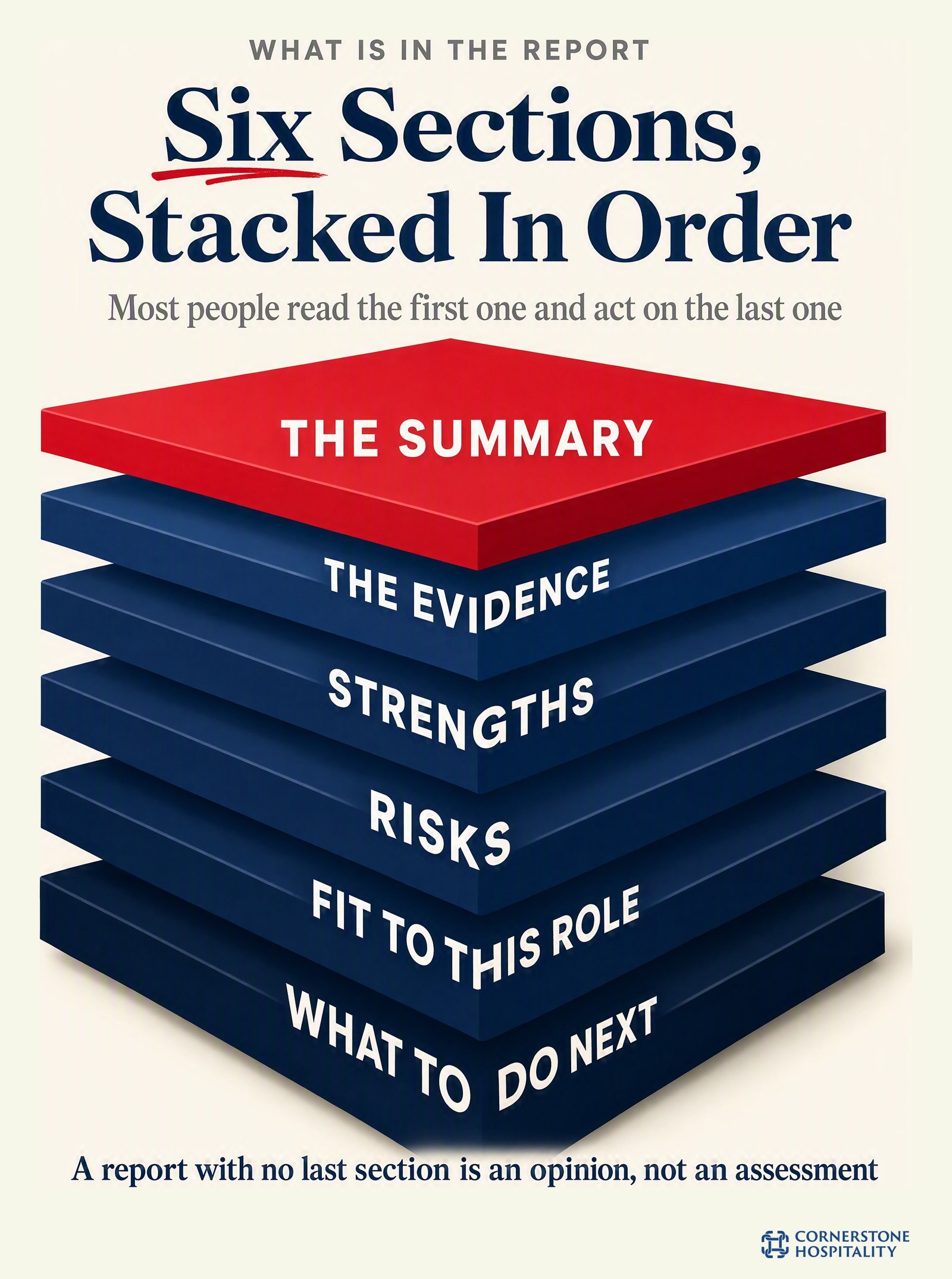
The order below is the order they appear. Most readers read the first section and act on the last one, which is worth knowing when writing them.
1. The summary
One page, and it should be genuinely one page. A clear recommendation, the two or three things that most support it, and the one or two that most argue against it. The conditions under which the appointment works. If the summary hedges, readers will read the rest of the report looking for the hedge rather than the evidence.
A good summary is falsifiable. “Strong commercial judgment, will need support on the owner relationship for the first two quarters” is a claim somebody can check in nine months. “A capable and well-rounded executive” is not.
2. The evidence
What was actually done, by whom, over how long? Which instruments, how many interviews and of what kind, how many references, and whether they were supplied by the candidate or sourced independently. This section exists so that the reader can weigh everything that follows. In fact, its absence is the single clearest sign of a weak report. Structured interviews carry an operational validity of .42, while unstructured conversations carry very little [1]. So knowing which of the two produced a given conclusion changes how much weight it deserves.
3. Strengths
Specific, evidenced, and relevant to this role. Every strength should be traceable to something observed rather than asserted. The report should leave out irrelevant strengths. A general manager candidate who is a gifted public speaker has a strength. However, unless the role requires it, saying so only pads the document.
4. Risks
The section that determines whether a report is worth commissioning. Specifically, it should name what could go wrong, how likely it is, what it would look like early, and what would mitigate it. A report with no risk section, or with risks phrased as development opportunities, has been written to be comfortable rather than useful.
The test of a risk section
Every named risk should carry an observable early indicator. “May struggle to delegate” is not actionable. “May struggle to delegate, visible by month three when the team brings decisions instead of making them” is different. That version can be watched for and addressed.
5. Fit to this role
The section that makes the report specific rather than portable. In practice, it maps the person against the actual demands of the seat: this owner, this property, this team, and this commercial situation. It is also where an honest report says that a strong candidate is a poor fit here. Overall, this is a more useful conclusion than a lukewarm recommendation. An external hire costs an 18% to 20% premium and takes about two years to reach full speed [4]. By comparison, declining a strong candidate for the right reason is a much cheaper outcome. Appointing them for the wrong one costs more.
6. What to do next
If the recommendation is to appoint, this section is the first ninety days: what the person needs, from whom, and by when. If the recommendation is not to appoint, it is what would need to change and over what period. Regardless, it is the section the reader will act on. A report that ends at section five has produced an opinion rather than an assessment.
“The sections most reports get wrong are four and six. Risks get softened into development areas because nobody wants to be the reason a good candidate was declined. The development plan gets left off because by then the decision feels made. Those are the two sections that pay for the report.”
Florian Kittler, Managing Partner, Cornerstone Hospitality
What to do
Before commissioning a report, check that its structure covers all six sections. A document missing the fit or the next-steps section is a profile, not an assessment. It will not carry the appointment through its first year.
Key insight
What each input is worth, measured
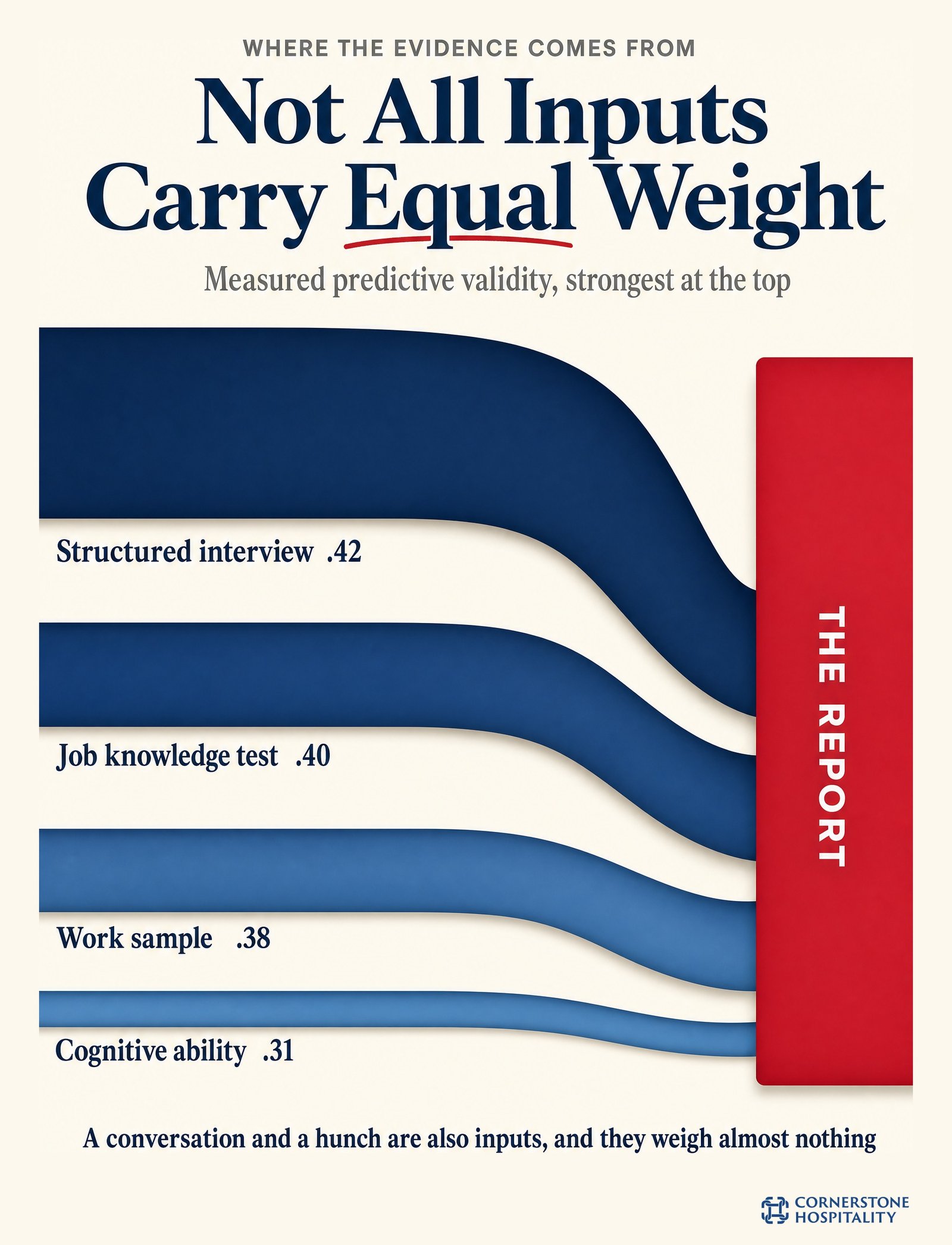
In fact, not all inputs are worth the same, and the differences are measured rather than a matter of opinion.
In the revised operational validity estimates from Sackett and colleagues, structured interviews emerged as the strongest predictors of job performance. Their mean operational validity was .42. Job knowledge and work sample tests follow at .40, .38, and .33. Cognitive ability rounds out the list at .31 [1]. The same work explains that earlier meta-analytic corrections had systematically inflated these figures. So the numbers are lower than the ones many practitioners still quote.
| Input | What it is | What it contributes |
|---|---|---|
| Structured interview | The same questions, in the same order, scored against agreed criteria | The strongest single predictor at .42 [1], and the backbone of a serious report |
| Work sample or simulation | A real task from the role, performed and observed | Direct evidence of how the person operates, at .38 to .33 [1] |
| References, sourced independently | Conversations with people who worked above, beside, and below the candidate | The behavioral picture, particularly the view from below |
| Psychometrics | Standardized instruments on preference and reasoning | Useful as a hypothesis generator, weakest on its own |
| An unstructured conversation | A meeting, impressions afterward | Almost nothing, which is why it should not be the main input |
Where most reports are thinnest
The references line deserves emphasis because it is where most reports are thinnest. A candidate-supplied reference list produces a predictable answer. The value is in the view from beside and below. This is where the behaviors that end senior appointments are visible and where a hierarchy-facing candidate looks different.
There is a wider practice problem here too. Only a third of learning and development professionals say they are proactive in identifying performance issues before recommending a solution. And only a quarter design using evidence-informed principles [16]. Assessment sits in the same discipline. The same gap shows up as reports built around whichever instrument the provider happens to own.
Why this matters
Ask an assessor which instrument carries the most weight in their report and why. If the honest answer is whichever one their firm happens to sell, the report is measuring convenience rather than the candidate.
Key insight
Why does behavior take up most of the page
The proportion of the report given to behavior surprises people who expected a capability audit. Naturally, that reflects where appointments actually fail.
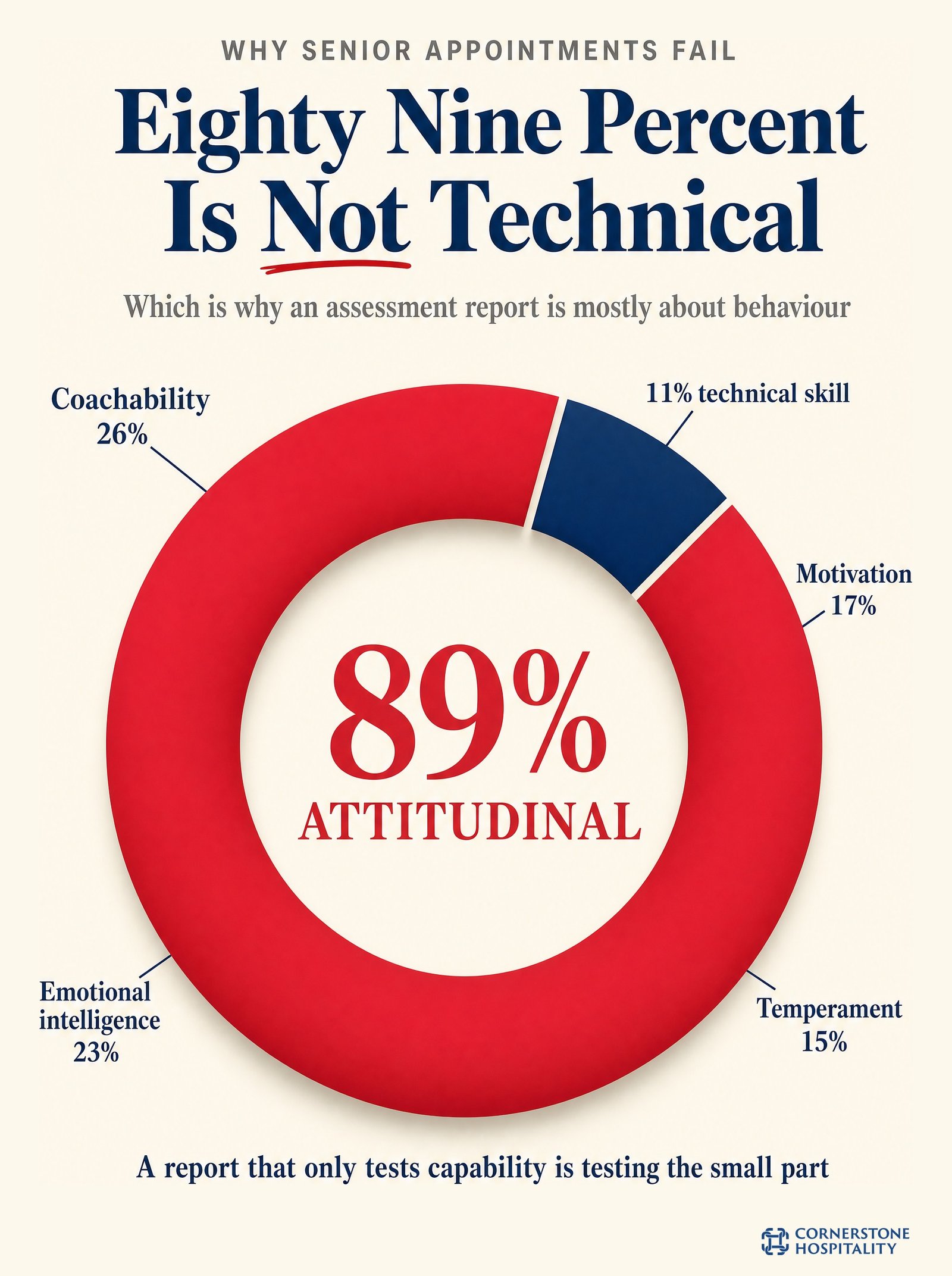
One longitudinal study followed more than 20,000 new hires across 312 organizations. 5,247 hiring managers evaluated the hires at 6, 12, 18, and 24 months. In that study, 46% failed within 18 months and only 19% achieved unequivocal success. 89% of the failures were attributable to attitudinal factors and 11% to technical skill, with coachability accounting for 26%, emotional intelligence 23%, motivation 17%, and temperament 15% [2].
That distribution is the whole argument. A report that spends its length on technical capability is examining the 11%. The 11% is generally the part a CV and a reference already establish. The harder and more valuable work is on the other 89%. So this is why the interviews are structured and why the references reach below the candidate. It is also why the risk section matters more than the strengths section.
It also explains why assessment is worth doing on internal candidates who are already known.
What a property already knows and what it does not
A property knows how its deputy performs in the seat they hold. However, it does not necessarily know how they behave when they are the final word. It also does not know how they act when an owner disagrees with them. Nor does it know how they behave when they have to remove somebody they came up with. Only 20% of HR leaders say they have leaders ready to fill their most critical roles. Internal candidates can fill only 49% of critical positions immediately [3]. That is a readiness question rather than a capability one.
The behavioral picture is also shifting under everybody’s feet. This is an argument for measuring it rather than assuming it. Trust in immediate managers has fallen to 29%, a 37% decline since 2022. High-potential intention to depart rose from 13% in 2020 to 21% in 2024. High-potential talent is 3.7X more likely to leave within a year when their manager does not provide regular growth opportunities [12]. In practice, a report establishes how a candidate behaves toward the people below them. In doing so, it assesses the variable that most determines whether the team stays.
What to do
When a report covers an internal candidate, ask specifically how the team below them describes working for them. That answer, more than any capability score, predicts whether the appointment holds.
What to do
Weighing up whether to commission one for an upcoming appointment?
We can walk through what a report would need to cover for the specific seat you are filling.
Talk to usHow to read an executive assessment report properly
Five things to do with the document when it arrives, in order.
One thing not to do, which is common: treat the report as a verdict to be ratified or overturned. Instead, it is one input to a decision that belongs to the business. An assessor who presents it as a verdict has overreached. Instead, the right posture is that the report tells you what is likely and what to watch. The appointment decision, with all its commercial context, remains yours.
Why this matters
The report informs the decision; it does not make it. A board or owner that treats a strong report as the decision itself has handed away a call that is theirs to own.
Key insight
What a hospitality executive assessment report should also contain
Four things that a generic executive assessment will not cover, and that matter much more in this industry.
How the person behaves when the property is under real pressure
Every senior hospitality role includes nights where everything is wrong at once. A report that has not looked at how this person operates in that state is missing something important. It has left out the single most predictive situation in the job. It is also the situation that a structured interview can get at directly by asking for a specific instance rather than a general disposition.
The owner relationship, specifically
In much of hospitality, the owner sits closer to the operation than a board would elsewhere. The working relationship is a genuine variable rather than an assumed one. Specifically, a report should say how this candidate is likely to handle an owner who intervenes. It should also say what pattern they will fall into when the news is bad.
Whether they build a bench or a dependency
A strong operator who builds a team dependent on them looks excellent for two years and leaves a hole. Managers account for at least 70% of the variance in employee engagement across business units [8]. Korn Ferry finds team climate accounts for up to 31% of the variation in team-level engagement [9]. So whether this leader develops people is a commercial question, not a cultural nicety.
Overall, it matters more in an industry losing people at this rate. Accommodation and food services recorded a monthly quit rate of 4.3% in March 2026, the highest of any industry. That is nearly double the private-sector average [11]. Deloitte finds 76% of hospitality workers leave their jobs within a year. And 66% of executives say their most recent hires were not fully prepared [10].
Still, the operating context makes the question sharper. In fact, more than half of hotels report being somewhat or severely understaffed. Labor costs are a top concern for 65%, and workforce shortages are named by 42% [13]. So a leader who cannot build and hold a team is a much more expensive appointment in that environment than in a loose labor market.
Portability of standards across properties
A leader whose success is built on the particular building they know is not the same as one whose standard travels. For a group appointment, this is often the deciding question. It is answerable. Ask for an instance where the person applied a standard somewhere unfamiliar. Then listen for whether the answer is about the standard or about the building. An internal candidate can fill only 49% of critical positions immediately [3]. So a leader whose standard travels is a much more valuable appointment to a group than one whose does not.
What to do
For a multi-property or group appointment, ask the assessor to name a specific instance of the candidate applying their standard somewhere new. A general answer about capability is not the same evidence as a specific instance.
Why this matters
What an executive assessment report cannot tell you
Ultimately, being clear about the limits is what makes the rest of it usable.
It cannot tell you what will happen. The strongest single predictor available is .42 [1], which is a meaningful relationship and nowhere near certainty. In fact, a report that reads as though the outcome is settled has overstated its own evidence. The honest register is likelihood with named conditions rather than prediction.
It cannot compensate for a badly defined role. If the business has not agreed on what the seat is for, no assessment of a person against it will be worth much. In that case, the most valuable thing an assessor can do is say so rather than proceed.
It cannot replace the first ninety days. Even a strong appointment sits at up to six months to break even [6] and about two years to full speed [4]. Instead, the report should shape what the business does in that window. It should not just be filed away once the offer is signed. This is what the sixth section is for. What that section should propose is also fairly well established. Roughly 70% of development comes from challenging experiences and assignments, 20% from developmental relationships, and only 10% from coursework [14]. So a sixth section whose entire content is a training recommendation aims at the smallest available lever.
Behavioral risk needs a relationship, not a course
Where the report identifies a behavioral risk rather than a knowledge gap, the fix is different. It is a relationship, not a course. 87% of respondents agree executive coaching has a high return on investment. A PricewaterhouseCoopers study found an average return of seven times the cost of employing a coach [15]. Still, those are reported perceptions of value rather than a controlled measurement. Even so, they are consistent enough to be worth acting on where the diagnosis points that way.
And it cannot be neutral about the business. An assessor who has met the candidate but not the owner, the team, and the property is assessing a person in the abstract. That is a much cheaper exercise, and a much less useful one.
The most useful sentence in any report
Some version of this appointment works if the business does these two things. Is at risk if it does not. That sentence puts an obligation on both sides, which is an accurate description of how senior appointments actually succeed.
Glossary
- Operational validity
- A measure of how strongly a selection method predicts job performance. Structured interviews sit at .42, the highest of the commonly used methods [1].
- Structured interview
- The same questions, in the same order, were scored against agreed criteria. Distinguished from a conversation by the scoring, not by the formality.
- Work sample
- A real task from the role, performed and observed. Direct evidence rather than reported evidence.
- Fit section
- The part of a report that maps a person against this specific seat, owner, and business. If it would read the same for a different role, it is not one.
- Early indicator
- The observable sign that a named risk is materializing, with a rough timeframe. What makes a risk section usable rather than decorative.
- The view from below
- References from people who reported to the candidate. Where the behaviors that end senior appointments are most visible.
Have a specific report in front of you and unsure what it is missing?
We are glad to talk through it, whether or not Cornerstone was the one who wrote it.
Talk to usFrequently asked questions
What is in an executive assessment report?
Six sections: a one-page summary, the evidence base, strengths, risks, fit to this specific role, and what to do next. The last two are what make it an assessment rather than a description.
How long should an executive assessment report be?
Long enough that the evidence and the risks are properly set out. The summary should genuinely fit on one page. Length is not the measure. What matters is whether a reader who never met the candidate can act on it.
Is an assessment worth it for an internal candidate?
Often more so. A business knows how its deputy performs in the seat they hold. But it does not know how they behave as the final word. Promotions are 1.6X more likely to succeed when assessments inform them [3].
What is the most predictive part of an assessment?
The structured interview has an operational validity of .42. That is ahead of job knowledge and work sample tests at .40, .38, and .33, and ahead of cognitive ability at .31 [1]. Unstructured conversations contribute very little.
Why is so much of the report about behavior rather than skill?
Because that is where appointments fail. 89% of new-hire failures come from attitudinal factors, and only 11% from technical skill, with coachability alone accounting for 26% [2].
Can a report guarantee the appointment will work?
No, and one that implies it should be read skeptically. The strongest predictor available is .42 [1], which is a real relationship and not certainty. The honest register is likelihood with named conditions.
What should we do with the report after the appointment?
Use section six to shape the first ninety days, then read the whole thing again at twelve months. It is the only written record of what was expected. It is the cheapest way to find out whether your own selection judgment is sound.
Appointing into a critical seat?
A structured assessment against the actual demands of the role takes about four weeks. Start with a confidential conversation.
Start a confidential conversationSources
- Society for Industrial and Organizational Psychology: Is Cognitive Ability the Best Predictor of Job Performance? New Research Says It’s Time to Think Again: reports the revised operational validity estimates from Sackett and colleagues. “Structured interviews emerged as the strongest predictors of job performance” with a mean operational validity of .42. Job knowledge and work sample tests follow at .40, .38 and .33. “Cognitive ability rounded out this list with a validity estimate of .31”. The article explains that earlier meta-analytic corrections had systematically inflated these figures. Source: siop.org/tip-article/is-cognitive-ability-the-best-predictor-of-job-performance
- Leadership IQ: Executive Failure Rates: reports a longitudinal study of more than 20,000 new hires across 312 organizations. Hiring managers, 5,247 of them, evaluated the hires at 6, 12, 18 and 24 months. The study found that “46% of new hires failed within 18 months; only 19% achieved unequivocal success”. It also found that 89% of failures were attributable to attitudinal factors against 11% for technical skill. The leading drivers were coachability at 26%, emotional intelligence at 23%, motivation at 17% and temperament at 15%. Source: leadershipiq.com/blogs/leadershipiq/executive-failure-rates
- DDI: Succession Planning Best Practices: How to Close the Leadership Readiness Gap: reports that “only 20% of HR leaders say they have leaders ready to fill their most critical roles”. It also finds “80% of organizations lack confidence in their leadership bench”. While “75% of organizations prioritize internal promotion over external hiring”, internal candidates “can fill only 49% of critical positions immediately”. Promotions are 1.6X more likely to succeed when assessments inform selection. Organizations with strong benches are 2.9X more likely to fill leadership roles internally, and 2.8X more likely to outperform financially. Source: ddi.com/blog/succession-planning-best-practices
- Knowledge at Wharton: Why External Hires Get Paid More, and Perform Worse, than Internal Staff: reports Matthew Bidwell’s study “Paying More to Get Less: The Effects of External Hiring versus Internal Mobility”. It was published in Administrative Science Quarterly, drawn from personnel data in a US investment banking division from 2003 to 2009. External hires are paid “about 18% to 20% more” than comparable internal promotions, and need “about two years to get up to speed”. Hiring managers confirm they “typically pay 10% or 20% more to pull people out of positions” where they already have security. Source: knowledge.wharton.upenn.edu/article/why-external-hires-get-paid-more-and-perform-worse-than-internal-staff
- Harvard Business Review: Turning Potential into Success: The Missing Link in Leadership Development: by Claudio Fernández-Aráoz, Andrew Roscoe and Kentaro Aramaki. It reports that “66% of companies invest in programs that aim to identify high-potential employees and help them advance”. Yet “only 24% of senior executives at those firms consider the programs to be a success”. It adds that “a mere 13% have confidence in the rising leaders at their firms, down from an already-low 17% just three years ago”. At the world’s largest corporations, “a full 30% of new CEOs are hired from the outside”. Source: hbr.org/2017/11/turning-potential-into-success-the-missing-link-in-leadership-development
- The Future Organization, interview with Michael Watkins: The First 90 Days: Strategies for Leaders in Transition: records Watkins stating that “unaided the process for leaders to reach the breakeven point can take up to six months”. The breakeven point is where a leader contributes as much value as they have consumed. He also observes that “most people spend 10 to 15 years in leadership positions before getting any formal leadership training from their organization”. The average leader is in their late thirties or early forties before any training at all. Source: thefutureorganization.com/the-first-90-days-strategies-for-leaders-in-transition
- Gallup: This Fixable Problem Costs U.S. Businesses $1 Trillion: establishes that “the cost of replacing an individual employee can range from one-half to two times the employee’s annual salary”. It describes that as “a conservative estimate”. It also reports that 52% of voluntarily exiting employees say their manager or organization could have prevented their departure. And 51% say that in the three months before leaving, neither their manager nor any other leader spoke with them about job satisfaction or their future. Source: gallup.com/workplace/247391/fixable-problem-costs-businesses-trillion
- Gallup: Managers Account for 70% of Variance in Employee Engagement: states that “managers account for at least 70% of the variance in employee engagement scores across business units”. The research measured the engagement of 27 million employees and more than 2.5 million work units over two decades. It also finds about one in 10 people possess high talent to manage. Companies “miss the mark on high managerial talent in 82% of their hiring decisions”, and talented managers contribute about 48% higher profit than average managers. Source: news.gallup.com/businessjournal/182792/managers-account-variance-employee-engagement
- Korn Ferry Institute: Stronger Leadership, Stronger Climate, Better Results: analyzes “data from over 2,700 individuals across 541 teams”. It finds that “team climate accounted for up to 31% of the variation in team-level engagement”. The right leadership characteristics and team environment “can lift engagement scores by up to 42 percentile points”. Leaders scoring high on Presence, Agility and Striving produced team climates “approximately 30 percentile points stronger” than lower-scoring leaders. Source: kornferry.com/institute/stronger-leadership-stronger-climate-better-results
- Deloitte: Frontline Workforce Trends in Airlines, Hospitality, and Restaurants: reports that “80% of restaurant workers and 76% of hospitality workers leave their job within a year”. Separately, “66% of executives and managers say most recent hires were not fully prepared, and that lack of experience was the most common failing”. It also finds 82% of workers naming feeling happy and engaged at work as the key driver of productivity. And 75% are hoping for greater stability in the face of change. Source: deloitte.com/us/en/Industries/consumer/articles/frontline-workforce-human-capital-trends
- OysterLink analysis of US Bureau of Labor Statistics JOLTS data: Hospitality Workers Quit at a Higher Rate Than Any Other Industry in the U.S.: establishes that “the quit rate for accommodation and food services reached 4.3% in March 2026, the highest among all industries”. That is “nearly double the private-sector average of 2.2%”. Retail trade, the next highest sector, recorded 3.1%, against healthcare at 1.9%, manufacturing at 1.4% and finance at 1.2%. Layoffs in the sector held at 1.3%, matching the national average. So roughly three-quarters of separations are people choosing to leave. Source: prnewswire.com/news-releases/hospitality-workers-quit-at-a-higher-rate-than-any-other-industry-in-the-us
- DDI: Global Leadership Forecast 2025 Study Signals Looming Leadership Exodus: surveys 10,796 leaders and 2,185 HR professionals across more than 50 countries and 24 industry sectors. It reports 71% of leaders with increased stress, and 40% of stressed leaders considering leaving leadership altogether. Trust in immediate managers stood at “just 29%, a 37% decline since 2022”. It also records high-potential intention to depart rising “from 13% in 2020 to 21% in 2024”. High-potential talent is 3.7X more likely to leave within a year where the manager does not provide regular growth opportunities. Source: ddi.com/about/media/global-leadership-forecast-2025
- American Hotel & Lodging Association: Rising Cost, Staffing Challenges Persist for Hotels as Travel Demand Expected to Hold Steady: surveys 246 hoteliers in late February 2026. It finds that “more than half of respondents report their properties are somewhat or severely understaffed”. Labor costs were a top concern for 65%, and workforce shortages were named by 42%. Retention incentives in use include higher wages at 70%, flexible scheduling at 54%, hotel discounts at 54% and enhanced benefits at 31%. Source: ahla.com/news/rising-cost-staffing-challenges-persist-hotels
- Center for Creative Leadership: The 70-20-10 Rule for Leadership Development: sets out the framework that “emerged from over 30 years of our Lessons of Experience research”. Development divides into “70% challenging experiences and assignments, 20% developmental relationships, 10% coursework and training”. CCL notes the framework is drawn from research spanning China, India, Singapore and the United States. It is used across a client base including two thirds of the Fortune 1000. Source: ccl.org/articles/leading-effectively-articles/70-20-10-rule
- International Coaching Federation: Coaching Statistics: The ROI of Coaching in 2024: reports that “87% of survey respondents agreed that executive coaching has a high return on investment”. It cites a PricewaterhouseCoopers and Association Resource Center global survey finding “an average ROI of seven times the cost of employing a coach”. It further records 72% of respondents linking coaching to increased employee engagement. Approval of coaching runs at 78% among senior executives and 73% among employees. Source: coachingfederation.org/blog/coaching-statistics-the-roi-of-coaching-in-2024
- CIPD: Learning and skills at work: surveys over 1,200 respondents. It finds that “only a third of L&D professionals say they are proactive in identifying performance issues before recommending a solution”. Only a quarter design learning using evidence-informed principles. It also records around a third of organizations reporting reductions in budgets, learning and development headcount and use of external consultants. Only 18% expect investment to return to pre-pandemic levels, and 72% report they can effectively tackle skills gaps. Source: cipd.org/uk/knowledge/reports/learning-skills-work
- World Travel & Tourism Council: Global Travel & Tourism Growth to Outpace Wider Economy by 1.5 Times Over the Next Decade: published 12 May 2026 with research partner Oxford Economics. It forecasts that the sector will “support 376 million jobs worldwide in 2026, representing one in nine jobs globally”. It will also contribute “$12TN to the world economy, accounting for 9.9% of global GDP”. Over the next decade it projects “almost 89 million new jobs globally, accounting for approximately one-third of all new jobs expected” across the wider economy. Source: wttc.org/news/global-travel-tourism-growth-to-outpace-wider-economy-by-1-5-times-over-the-next-decade
About the author
Florian leads Cornerstone International Group’s global Hospitality, Travel & Leisure Practice. He brings seventeen years of senior hospitality experience, including Marriott, Hyatt, IHG, Mandarin Oriental and Shangri-La Hotels & Resorts. He also has sixteen years in retained executive search. Bilingual in English and German, he works across Europe, the Middle East, the Americas, and Asia-Pacific.
Connect with Florian on LinkedIn →