


The First 14 Days After a Senior Hospitality Exit


The first fourteen days after a senior hospitality executive exit are the quietest, busiest, and most consequential two weeks of the transition. They are quiet because no one is reading your inbox the way they were a fortnight ago. They are busy because everything you do in this window quietly compounds across the next six to nine months. What you say, who you call, how you carry yourself online, all of it counts. And they are consequential because the data is uncompromising on what is at stake: roughly 40% of senior executives fail, quit, or are pushed out within the first eighteen months of a role [1]. As a result, almost every senior hospitality leader will face this moment at least once in a career.
In practice, spend these two weeks well and the next role finds you, on your terms, in a brand you would actually pick. By contrast, spend them badly and you are still explaining yourself in March. You are on someone else’s timeline, in a role that doesn’t quite fit.
This is the re-entry plan Cornerstone Hospitality runs with senior leaders the moment they engage us. Sometimes that is during the exit conversation, sometimes the day after the announcement, occasionally the morning after a board call no one saw coming. The principles hold across all three, regardless of how the exit began.
The stakes, what the research says
Industry data on senior-executive failure rates, the hidden senior job market, and the supply gap currently sitting in front of hospitality leaders. Sources listed in full at the foot of the article.
- Career transition support for senior hospitality executives
- Personal brand for hospitality executives
- Executive outplacement in hospitality
The Plan
Five stages, fourteen days, the re-entry plan after a senior hospitality executive exit
In practice, a senior hospitality executive exit is rarely a single event. It is a fortnight of decisions made quickly, in sequence, under emotional load. The five-stage plan below imposes order on that fortnight: each stage has a defined output, runs for a fixed window, and is built so the next stage can begin cleanly. The plan holds whether the exit was planned or sudden, voluntary or board-led, friendly or not.
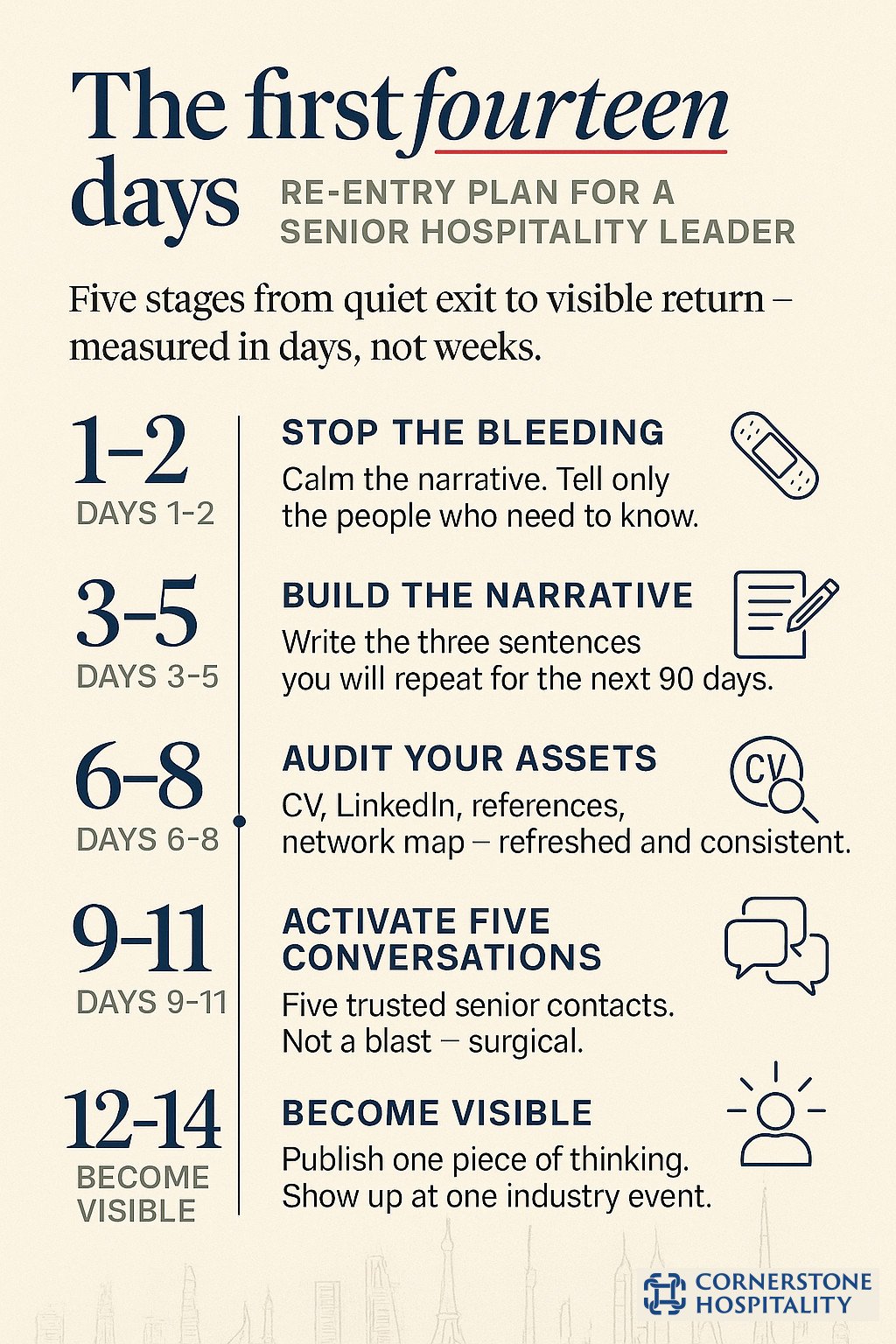
The 14-day plan
Five stages, fourteen days, one clean re-entry after a senior hospitality executive exit
| Days | Stage | Delivery output |
|---|---|---|
| 1 to 2 | Stop the bleeding | One coherent 3-sentence message, told only to those who must know |
| 3 to 5 | Build the narrative | Three memorized sentences, each under 20 words, used consistently |
| 6 to 8 | Audit your assets | CV refreshed, LinkedIn aligned, references warmed, network map drawn |
| 9 to 11 | Activate five conversations | Five surgical calls, each with a clear specific ask |
| 12 to 14 | Become visible | One published piece, one event, visibly in motion but not searching |
Days 1 to 2, stop the bleeding
First, calm the narrative. Tell only the people who need to know, and tell them the same three sentences. Indeed, the first 48 hours are when the most reputational damage is done. It usually comes from leaders who try to control too much, talk to too many people, or post on LinkedIn before they have a position. Rather, the fix is constraint, not output. That means a small number of well-briefed people, a single coherent message, and the discipline to leave the rest of the keyboard alone.
Days 3 to 5, build the narrative
Next, write the three sentences you will repeat for the next ninety days. First, what you did. Second, why the role ended. Finally, what you are looking for next. In practice, each sentence stays under twenty words. Memorize them, then use them consistently with everyone who asks. That includes old colleagues, recruiters, board friends, the head of HR at the brand you used to work for. The senior hospitality world is small; a story that arrives in three different versions arrives as no story at all.
Days 6 to 8, audit your assets
First, the CV refreshed. Second, LinkedIn aligned. Third, references pre-warmed. Finally, the network map drawn. Together, these are the four asset surfaces a senior hospitality leader needs in working order before any conversation that matters. In practice, the CV needs to read like the leader you are now, instead of the leader you were three roles ago. Similarly, the LinkedIn needs to say the same thing in a different register. Meanwhile, the references need to know what is coming and have agreed to take the call. The network map needs to be drawn deliberately, not from memory.
Tellingly, this is the week most leaders skip. Meanwhile, it is also the week that pays back the most in months three and four. In practice, the conversations that will matter most in November are activated by the asset work done in the second week of September. In short, skip the work, defer the payback.
Why this matters
Only around one in five senior roles is filled through a public posting [5]. The remaining four-in-five move through the network, warm introductions, board conversations, retained-search calls. The asset work in days 6 to 8 is what makes those four-in-five conversations possible. After all, every one of them runs through one of the surfaces being audited that week.
Days 9 to 11, activate five conversations
Five trusted senior contacts. Not a broadcast. Surgical. Specific asks. The conversations that change a trajectory after a senior hospitality executive exit are almost never with people you do not already know. Instead, they are with the people who already know you, activated correctly, at the right moment, with a clear ask in hand.
Days 9 to 11
The five conversations that change a trajectory after a senior hospitality executive exit
- ✓ A former operator peer. Someone who has run a comparable business and who will speak plainly about the market you are re-entering.
- ✓ A trusted board contact. A director or chair who can put your name in front of the search committees where you fit.
- ✓ A retained hospitality search partner. The firm that runs the confidential brief for the roles that are not posted.
- ✓ A former direct report now senior. A leader you developed who is now placed to be your first internal advocate.
- ✓ A voice outside hospitality. A senior figure from an adjacent sector who will stress-test your narrative from the outside in.
Days 12 to 14, become visible
Publish one piece of thinking. Show up at one industry event. Resume the relationships your role had crowded out. By day fourteen, you should be visibly in motion, not searching, but available. Visibility done well looks like the leader has paused, reflected, and re-entered with intent. Visibility done badly looks like the leader is panicking out loud. The difference is almost entirely about the work done in the previous twelve days.
What to do
- Treat the fourteen days as a project with a delivery date, not as recovery time, recovery comes after.
- Write the three narrative sentences before any conversation that matters, never improvise on the call.
- Run the asset audit even if it feels premature. The week most leaders skip is the week that pays the most.
The First 48 Hours
What to do and what not to do in the first 48 hours after a senior hospitality executive exit
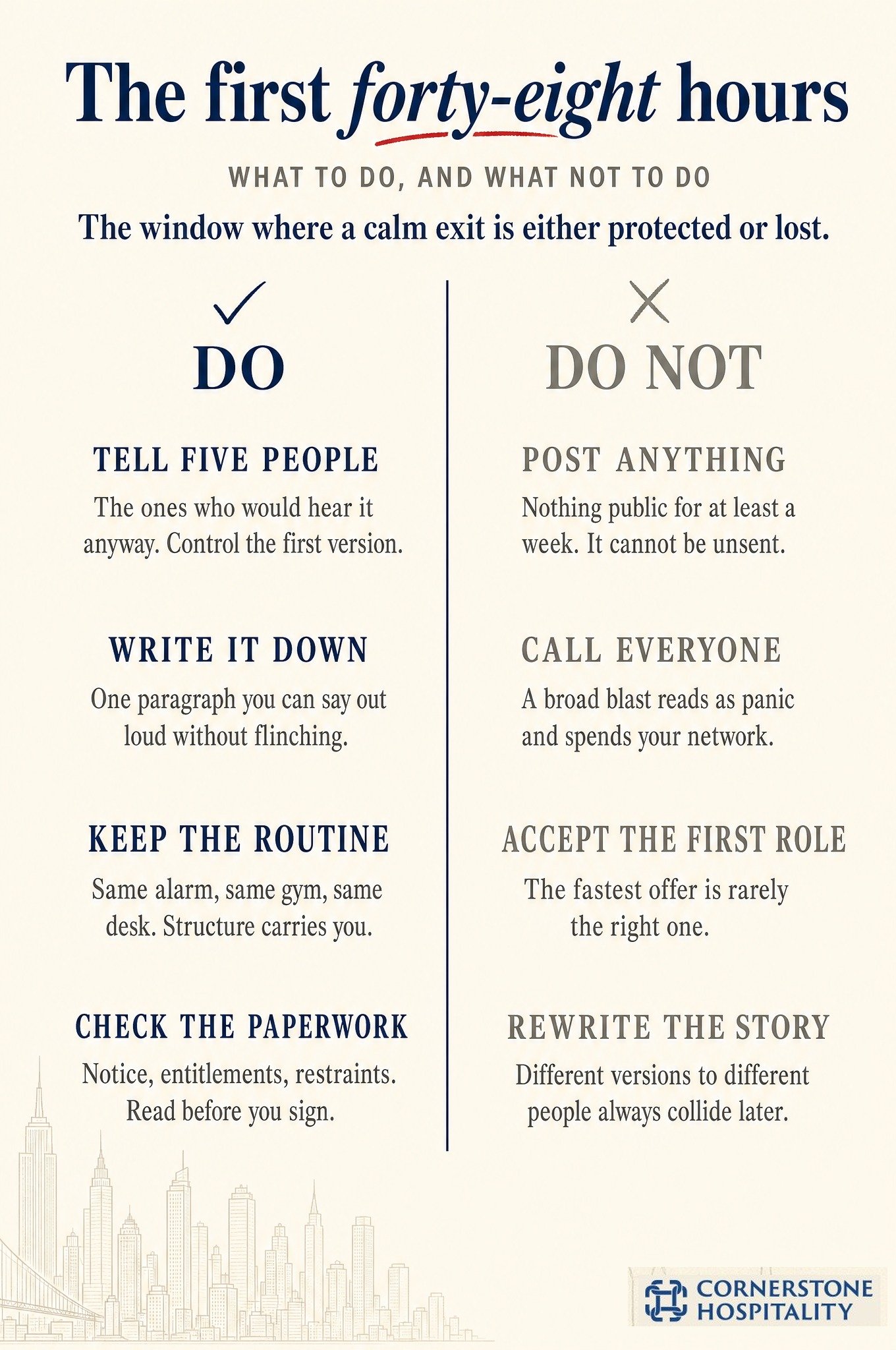
The first two days set the ceiling on every conversation that follows. The reflex during this window is to act, post, call, announce, defend. The discipline is to constrain. A leader who acts in hour three is rarely a leader who acts well. A leader who waits forty-eight hours, with a small circle and a coherent story, walks into week two with options. The contrast below is the simplest way to hold the line.
| In the first 48 hours | Do | Don’t |
|---|---|---|
| The story | Hold a single, plain, three-sentence version. Use the same wording with everyone. | Improvise on each call. Edit the story by the listener. |
| Leave the headline alone until the narrative work is done in week one. | Change the title to “Open to Work” in the first 24 hours. | |
| Inner circle | Call three to five people who matter, partner, mentor, former boss, board friend, trusted recruiter. | Send a wide email blast. Broadcast into the silence. |
| The former employer | Close the loop cleanly, handover, references, the agreed exit narrative. | Re-litigate. Publicly characterize. Brief journalists. |
| Recruiters | Tell one trusted retained-search contact you are open, in confidence. | Spray a list of fifteen recruiters with the same email. |
| Your own state | Sleep, walk, eat well. Postpone every non-essential decision for 48 hours. | Make a large life decision, move country, change sector, in the first week. |
Why this matters
Outplacement research shows the strongest results come when the leader follows a structured plan with senior coaching support. In fact, the majority of supported leaders land roles equal to or better than the one they left [5]. The leaders who do not follow a structured plan in the first 48 hours often pay for it later. Many spend the next six months unwinding the decisions made in hour three.
The Narrative
Building the three sentences you will repeat for 90 days after a senior hospitality executive exit
The narrative is the most-portable, most-quoted, and most-consequential artefact of the first fortnight after a senior hospitality executive exit. It is what people will repeat about you in rooms you are not in. It is what the recruiter will paraphrase to the chair. It is what the board friend will say when they put your name in front of a search committee three weeks from now. Get the narrative right in week one and the next six months tell a clean story. Get it wrong and every conversation has to do the explaining the narrative should have already done.
One sentence on the work, the brand, the scale, the result. Specific. Quantified where it can be. Under twenty words.
One sentence, calm, factual, future-facing. Acknowledges reality without re-litigating it. Leaves the listener with no awkward follow-up.
One sentence on the kind of seat, brand, owner type and region that fits. Narrow enough to be useful to a recruiter, wide enough to surface options.
One paragraph about the senior hospitality executive exit, delivered the same way every time
The three sentences travel together, because they are not three sentences a leader picks from. In truth, they are one paragraph, delivered the same way every time, until the next role is signed. In practice, the exact wording matters less than the consistency. A leader who arrives in three different versions of their own story is a leader the network cannot help. By contrast, a leader who arrives with one clean version is a leader the network forwards into rooms.
“The senior leaders who land well after an exit are the ones who treat the first two weeks like a project with a delivery date. The leaders who drift through those two weeks are still drifting three months later. The difference, almost every time, is whether they wrote the three sentences before week one was out.”
Florian Kittler, Managing Partner, Cornerstone Hospitality
The Conversations
The five conversations that change a senior hospitality executive exit
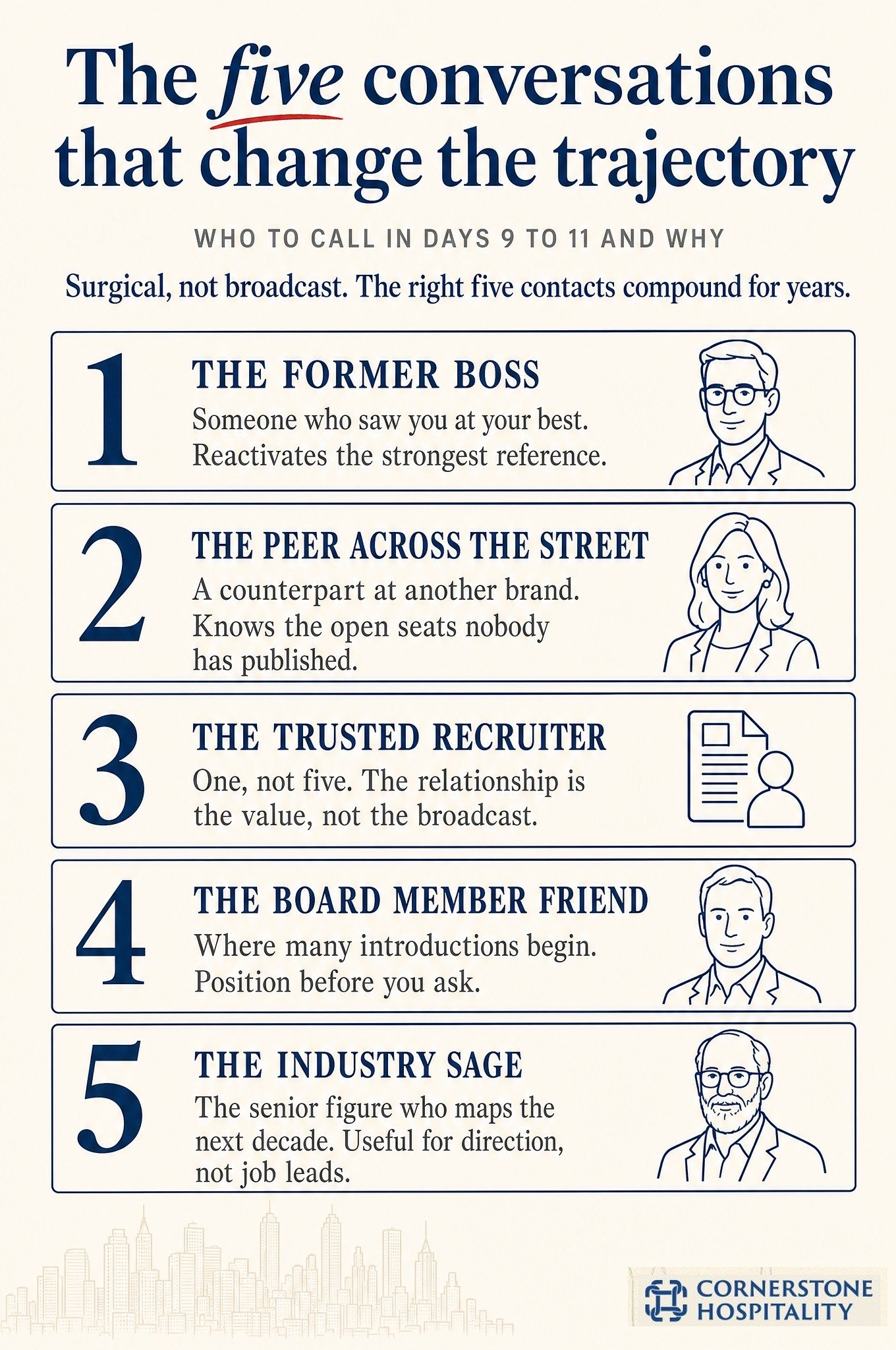
Around 80% of senior hospitality roles are filled before they reach a public posting [5]. The hidden market moves through people who already know each other, chairs, owners, brand presidents, retained-search partners, peers across the street. That is the market a senior hospitality executive exit needs to re-enter. The good news is that it is a relatively small market, and the leader almost always already knows the way in. The discipline is to pick five people, brief each one specifically, and resist the temptation to talk to a hundred.
- ✓The former boss: someone who saw you at your best, can speak to it on a call, and will pick up the phone when a recruiter asks.
- ✓The peer across the street: a comparable senior leader at another brand. Knows the open seats nobody has published, hears the owner gossip first.
- ✓The trusted retained-search partner: one, not five. Briefed in confidence, given the narrative, asked to keep an ear to the ground.
- ✓The board-member friend: where many senior introductions actually begin. Boards talk to each other long before a search is commissioned.
- ✓The industry sage: useful for direction and counsel, not job leads. A two-decade peer who can tell you which direction the wind is actually blowing.
One named ask per call, not a fishing expedition
In practice, each conversation is short, specific, and asks for one thing: not a job, and not introductions in general, but one named ask, an introduction to a specific person, a view on a specific brand, a sanity check on a specific direction. In the end, the senior leaders who get the most out of these five conversations are the ones who arrive prepared. They have already done the work to know what they want from each call.
Why this matters
A diffuse approach, the wide email, the “open to opportunities” post, the recruiter spray, loads the leader’s calendar with low-quality conversations. Worse, it signals weakness into the senior hospitality network. Five focused conversations, each with a clear ask, signals the opposite. It shows a leader who knows the work, knows the market, and is moving with intent.
If you are about to exit, in your first weeks out, or supporting a senior hospitality leader through this window, talk to us. The conversation can start today. Confidential, no obligation.
Talk to us →What good looks like
Five signs the first 14 days after a senior hospitality executive exit went well
At the end of the fourteen days, the leader should be able to read the list below and tick five out of five. Anything less is a signal, not of failure, but of a stage that needs a second pass before week three begins. These are the tells Cornerstone Hospitality uses to mark the close of stage one and the start of supported re-entry proper.
-
The story is one paragraph long, and you have told it the same way at least ten times.
A leader who can deliver the three sentences without thinking is a leader whose network can carry the story forward without distortion. Repetition is the proof, not the rehearsal.
-
Five named people know exactly what you are looking for, and have agreed to keep an ear open.
Not “the whole network.” Five specific senior contacts, each briefed in person or by call, each with one clear ask in hand.
-
CV, LinkedIn, references and network map are in working order and consistent with each other.
In practice, a recruiter who looks at the four asset surfaces should see the same leader. Inconsistency between any two of them is a flag and gets caught on the first introduction.
Visibility and state, the closing two tells
-
One published piece of thinking is live, and one industry event is on the calendar.
Visibility, done with intent, signals re-entry by choice rather than re-entry under pressure. One piece, one event, the discipline is restraint, not volume.
-
You are sleeping. The big life decisions are postponed. The next stage of work is mapped.
A leader who is rested, deferred on the irreversible decisions, and clear on stage two has done the fortnight properly. Anything else, do the asset-audit and narrative passes once more before moving on.
What to do next
If you can tick four or five of these, stage two of re-entry begins. If you can tick fewer, the most useful thing is another pass on the missing items before pushing into the next phase. A second-week consolidation is almost always cheaper than a third-month correction.
Glossary
- Senior hospitality executive exit
- The departure of a leader at GM, VP, regional, brand-president or C-suite level from a hospitality role, whether planned, board-led, mutual or sudden. The fourteen-day plan applies across all four.
- Re-entry plan
- The structured fourteen-day sequence that takes a senior leader from the day of exit to the start of supported career transition proper. Five stages, defined outputs, no improvisation.
- The three sentences
- The single most-portable narrative artefact a leader builds in week one. It covers what you did, why the role ended, what you are looking for next. Repeated identically across every conversation.
- Asset audit
- The week-one review of the four surfaces a senior leader is read on, CV, LinkedIn, references and network map. Run before any meaningful conversation begins.
- The five conversations
- The five specific senior contacts a leader briefs in week two: former boss, peer across the street, retained-search partner, board-member friend, industry sage. Each given one named ask.
- Supported re-entry
- The three- to six-month engagement that follows the first fourteen days. It runs a tighter rhythm in the first eight weeks, then a lighter touch through to the next role, coaching the interview and compensation conversations as they arrive.
Frequently asked questions
Do you only work with leaders who have already exited?
No. The strongest work often happens before the exit is final. At that point the conversation is still private, the narrative can still be shaped, and the references can be activated quietly. Cornerstone Hospitality is just as often engaged the week before an announcement as the week after.
What if the exit is not voluntary?
Most senior hospitality executive exits have some element that was not in the leader’s plan. We work with leaders across the whole spectrum, from a clean planned exit to a sudden one. The fourteen-day plan adjusts, because the narrative work in days 3 to 5 carries more weight in a non-voluntary exit. The principles, however, do not change.
Do you work with leaders globally or only in specific regions?
Globally. Cornerstone International Group has 60+ offices across 40+ countries. Our hospitality, travel and leisure practice draws on every one of them when the geography matters, particularly when the next role is across a region the leader has not previously worked in.
How is this different from generic executive coaching?
Hospitality specificity. Every conversation, every reference, every recommendation is shaped by what we know about how senior hospitality leaders are actually evaluated by hospitality boards, owners and brand head offices. That knowledge replaces a generalist competency framework lifted from corporate HR.
On engagement, timing and LinkedIn
What does the engagement look like beyond the first 14 days?
Typically three to six months of supported re-entry. It runs a tighter rhythm in the first eight weeks and a lighter touch through to the new role. We coach the interview process and the compensation conversation as they arrive. We also stay alongside the first ninety days of the next seat when it would help.
When should I update LinkedIn after a senior hospitality executive exit?
Not in the first 48 hours. The headline and the announcement are downstream of the narrative work in days 3 to 5. Without that, any LinkedIn move telegraphs the wrong tone. We typically advise leaders to leave LinkedIn untouched until at least day seven. Then publish the first piece of thinking in days 12 to 14 rather than before.
How quickly do senior hospitality leaders typically land the next role?
Senior hospitality searches typically run several months from quiet conversation to signed offer. That is longer than a mid-management hire, shorter than the leader sometimes fears. The fourteen-day plan is built to put the leader in the hidden market early. So when a relevant search opens up in month two or three, the name is already in the right room.
Read next
Sources
- PrimeGenesis: 40% of executives pushed out, fail, or quit within 18 months (citing Heidrick & Struggles internal study of 20,000 searches; CEO Kevin Kelly interview, Financial Times, 30 March 2009): primegenesis.com/2009/04/40-percent-of-execs-pushed-out-fail-or-quit-within-18-months
- Leadership IQ: Executive Failure Rates (study of 20,000+ new hires across 312 organizations): “46% of newly hired employees failed within 18 months while only 19% achieved unequivocal success. Attitudes drive 89% of hiring failures while technical skills account for only 11%.”: leadershipiq.com/blogs/leadershipiq/executive-failure-rates
- Plum: Schmidt & Hunter (1998) Meta-Analysis Explained: structured interview r =.51, cognitive ability r =.51, composite validity of structured interview + cognitive ability >.60: plum.io/blog/schmidt-hunter-meta-analysis
- Kapable: Statistics On Leadership In The Hospitality Industry: 82% of surveyed hotels report a staffing shortage; 73% annual U.S. hospitality turnover: kapable.club/blog/statistics/statistics-on-leadership-in-hospitality-industry
- LHH: Top 5 Outplacement Trends to Watch in 2025: “Despite advancements in job platforms, only 20% of roles are filled through postings”; supported by Korn Ferry career transition data: 92% of laid-off employees found a job better than or equal to the one they left (kornferry.com/capabilities/business-transformation/career-outplacement-services): lhh.com/en-us/insights/top-outplacement-trends-data
Florian leads Cornerstone International Group’s global Hospitality, Travel & Leisure Practice. He brings seventeen years of senior hospitality experience, including Marriott, Hyatt, IHG, Mandarin Oriental and Shangri-La Hotels & Resorts, and sixteen years in retained executive search. He is bilingual in English and German and works across Europe, the Middle East, the Americas and Asia-Pacific.
Connect with Florian on LinkedIn →