


How to Negotiate a Career Transition Package as a Senior Hospitality Leader
A career transition package has more separate parts than the size of the severance number ever suggests. Most of its real value comes from how a leader negotiates those parts together, not from any single line.


Why a career transition package has to fit a long search
For a hospitality leader specifically, how long a comparable senior search usually takes sharpens the stakes. C-suite and vice-president-level executive job searches typically run six months to a year [2]. A senior hospitality role adds its own layer on top of that.There are fewer comparable openings, and hiring cycles run longer. Employers frequently run searches confidentially rather than posting them [7]. A career transition package negotiated with that runway in mind looks very different from one built around a single number. That number may sound generous on the day someone offers it.What this article about a career transition package covers
This is a practical guide to the parts of a senior hospitality career transition package worth understanding before any conversation starts. First come severance, notice, bonus and equity, and benefits. Next come outplacement and coaching support, the language about the departure, and the reference. That reference follows the leader into the next search.Employment law affecting these terms varies by country and by US state. Nothing here replaces a lawyer reviewing the specific agreement. What follows shows how these terms typically work and where the room to negotiate usually sits.Key Insight
Why a transition package is negotiated as one document, not one number
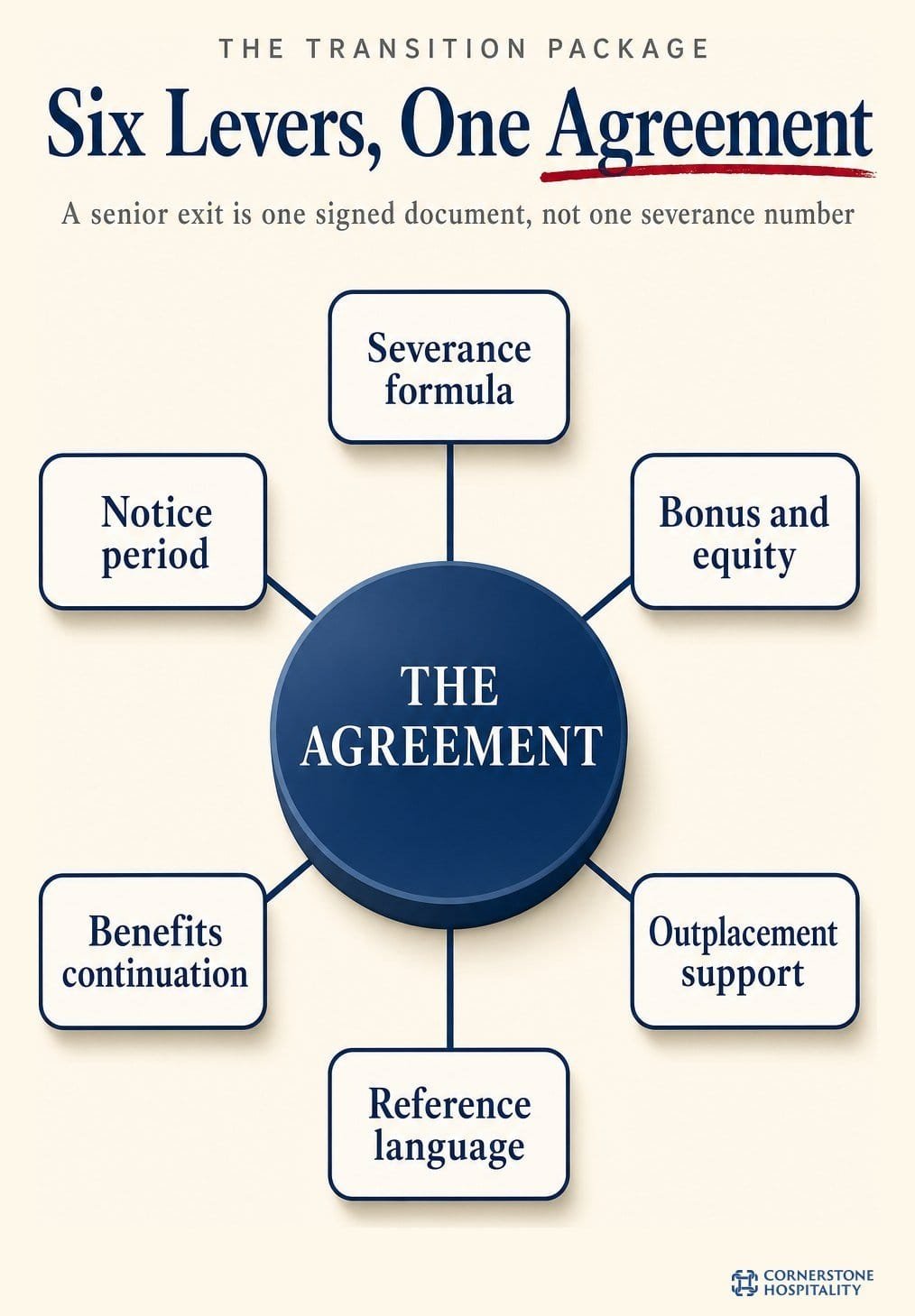
Most conversations about a career transition package start with a single question: What is the severance number? That question is worth asking. It is also the wrong place to spend most of the negotiation. A career transition package usually lives in one senior departure agreement that covers five or six separate terms. Both sides sign it once, in exchange for a release of claims [1].Once both sides sign, the terms inside become final. Treating severance as the only negotiable line usually leaves value on the table. So does accepting the group’s standard language on notice, bonus treatment, benefits, outplacement, and reference wording. Together, they usually leave more value on the table than a slightly larger severance number would recover.Why the order of the conversation shapes a career transition package
The order of the conversation matters as much as its content. Both sides usually agree on most of a senior career transition package in principle during the first real conversation about the departure. That happens before anyone drafts a word.Whatever the sides settle verbally before the paperwork exists is usually close to what ends up in the signed agreement. Once a draft circulates to the board or ownership group, changing it becomes a formal amendment rather than a discussion.One executive negotiation platform frames this as raising it early and from a shared-interest position. The tone is closer to “How can we both protect ourselves here?” than to an adversarial demand [2]. That framing works on the way out of a role. It works even better while negotiating the way in.A career transition package negotiated term by term after the draft arrives starts from a weaker position. One discussed as a whole, in conversation, before anyone writes it down, starts from a stronger one. The document formalizes what both sides already agreed to. It rarely reopens what nobody raised.
Key Insight
The parts of a package, and how much room each one has
Before going through each term in detail, it helps to see them side by side. The table below sets out what a senior hospitality career transition package typically looks like on the group’s first offer. It also shows where the room to negotiate usually sits.The package terms side by side
| Package component | What “standard” often looks like | What is usually negotiable |
|---|---|---|
| Severance formula | A multiple tied to tenure or role level. General benchmarks put staff severance at roughly one to two weeks of pay per year of service, with senior and executive roles commonly modeled at a flat multiple of that base rate [3]. | Which formula actually applies and the structure of payment: lump sum versus salary continuation. |
| Notice period | Full working notice or garden leave that keeps the executive on payroll but away from the business and its clients. | Converting notice to a payment in lieu, or shortening it to a defined handover period. |
| Bonus | Forfeited on departure unless the plan document says otherwise. | A bonus already earned but not yet paid and a pro-rata bonus for the part of the year already worked [4]. |
| Equity or deferred pay | Unvested awards typically lapse on the termination date. | Accelerated or partial vesting, or an extended window to exercise what has already vested [4]. |
| Benefits continuation | Coverage ends at termination or shortly after. | An extended period of continued coverage. Roughly half of employers already extend medical coverage for some departing staff [1]. |
| Outplacement or career transition support | A fixed, generic package offered as a standard line item. | The scope and length, including executive-specific components such as confidential search support and board-opportunity guidance [7]. |
| Reference language | A neutral reference limited to dates of employment and job title [6]. | Agreeing on the exact wording in advance and who is authorized to speak informally. |
| Announcement | Drafted by the group once terms are close to final, then circulated. | Reviewing and agreeing on the internal and external wording before it goes to the board or ownership group. |
Three steps
How to use the table above in a real negotiation
Check which formula, policy, and plan language actually apply, rather than assuming the general benchmark fits this employer.
Work down the right-hand column of the table above before the first real conversation, not during it.
Bring severance, notice, bonus, benefits, outplacement, and reference language into one conversation, before a draft exists.
Treat the table above as a starting checklist, not a final answer. Confirm which cells reflect this employer’s actual practice, then raise every negotiable item in the same conversation rather than one at a time.
What to Do
Severance: How the Formula Works and Where the negotiation actually happens
Hospitality groups calculate severance differently from each other. Some use a formula tied to tenure. Others scale it by role level or grade. Numerous senior contracts fix a flat multiple, often expressed in months, directly in the original employment agreement.Before negotiating the figure itself, it is worth establishing which formula the group actually applies. Pushing on the wrong lever wastes the conversation, and it can make a fair offer look worse than it is.General benchmarks put the most common US severance formula at roughly one to two weeks of pay per year of service for staff-level roles. Senior and C-suite career transition packages commonly sit at a flat multiple of that base rate, rather than on the weeks-per-year calculation [3]. Those figures are general industry benchmarks rather than a legal entitlement.What a specific leader can claim depends on the contract, the company’s actual practice, and the jurisdiction. That is exactly the kind of detail worth confirming with counsel before treating any benchmark as a target.Structuring a career transition package: lump sum or continuation
Once the formula is clear, the more productive conversation about a career transition package usually concerns structure rather than size. A lump sum and salary continuation are not the same offer, even at an identical total value. A lump sum arrives faster and is simpler to plan around. Continuation can carry ongoing benefits eligibility that a lump sum does not.It can also bridge the leader through the period when outplacement support and their own search are most active. Neither is automatically better. The right structure depends on how quickly the leader is likely to find the next role and what they need covered in the meantime.Confirm which formula actually applies before naming a target figure for the career transition package. Then negotiate the structure of payment, lump sum against continuation, rather than only the total. The two questions produce different conversations. Asking them in that order gets further.
What to Do
Notice period, garden leave, and pay in lieu of notice
A long working notice period creates a specific problem for a senior operator. Most other roles do not face it. Running a property or a portfolio makes it genuinely difficult to search for the next one. Interviews are hard to schedule discreetly around an operating calendar.A search that only starts once notice has fully run has lost months it did not need to lose.Groups generally handle notice one of two ways. Working notice keeps the leader in the role, performing their duties, for the length of the notice period. Garden leave keeps the leader on payroll and bound by the same restrictions. The leader stays away from the property and clients, and has no active duties.Groups favor garden leave for more senior roles precisely because it removes the leader from day-to-day influence over the business during a sensitive period. A payment in lieu of notice, often shortened to PILON, ends employment immediately. It pays out the notice period as a lump sum instead.The distinction matters beyond the paycheck. It can affect ongoing benefits eligibility, bonus timing, and how the group calculates post-termination restrictions. For that reason, make clear which arrangement applies rather than assuming it.The most useful notice request in a career transition package
For a senior hospitality leader specifically, the most useful ask in a career transition package is often straightforward. Request payment in lieu of notice or a shorter, clearly defined handover period. Then the search can start properly instead of waiting for a working notice period to end.A handover of a set number of weeks, focused and finite, usually serves both sides better. An open-ended working notice satisfies neither side. It fails the group’s need for continuity and the leader’s need to begin the next search.A working notice period that runs its full length can quietly cost a leader months of search time. Asking for payment in lieu of notice, or a short defined handover, is one of the simplest changes in the whole package to request.
Why This Matters
Bonus and equity: what happens to compensation already earned
Bonus and equity are where a career transition package most often costs a leader money they have already earned. This happens simply because standard plan language defaults to forfeiture on termination. The leader has to ask specifically for something different.Two requests are worth raising in almost every senior exit. The first is payment of any bonus the leader has already earned under the plan’s own terms but not yet received.The second is a pro-rata bonus for the portion of the current year the leader actually worked. That bonus should follow the plan’s normal metrics. An unfinished year is no reason to assume it away [4].“The severance number gets most of the attention, but bonus, equity, and benefits are where a leader quietly leaves value they already earned. Nobody offers that back without being asked.”
Florian Kittler, Managing Partner, Cornerstone Hospitality
Equity and deferred pay in a career transition package
Equity and other deferred compensation raise a related but separate question. Unvested awards typically lapse on the termination date under standard plan language.Two things are often negotiable instead. One is accelerating some or all of the unvested award so it does not simply disappear. The other is extending the window to exercise anything that has already vested. Standard post-termination exercise windows are often short.One executive employment resource offers a useful view. It says accelerated vesting or a longer exercise window is often an easier ask than additional months of cash severance. The reason is that it does not require the group to commit new cash [4].Executive separation agreements typically also reaffirm restrictive covenants already in the original contract. These commonly include non-compete, non-solicitation, confidentiality, and non-disparagement terms. The scope and length of those covenants are themselves negotiable alongside the compensation [4].Bonus and equity forfeiture happen by default, in the plan document, unless someone raises it. Groups rarely offer relief proactively. That makes it one of the few parts of a career transition package where simply asking changes the outcome.
Why This Matters
Benefits continuation and the terms people forget to raise
Health coverage is one of the more commonly overlooked terms in a senior career transition package. It is easy to assume it simply ends with employment. It is also rarely the headline of the conversation. Roughly half of employers already extend medical coverage for some departing staff beyond the termination date [1].That means asking for a defined continuation period in a career transition package is a reasonable request, not an unusual one. The period should match how long the leader’s own search is likely to take. Such requests frequently succeed.Accrued and unused vacation or leave is a second item worth confirming rather than assuming, since practice on paying it out varies by employer and by jurisdiction. A third is anything tied to role-specific perks in a hospitality career transition package. Examples include housing or relocation allowances, club memberships, and travel benefits attached to the position.Each can have its own wind-down terms. Those terms are easy to miss inside a longer agreement if nobody asks about them directly.List every benefit and perk tied to the role before any conversation starts, not just salary and severance. Housing, club memberships, and travel benefits each carry their own wind-down terms, and nobody raises them without being asked.
What to Do
Outplacement and career transition support
Employers frequently offer outplacement within a career transition package as a fixed, generic line item. They rarely invite the leader to shape it. For a senior hospitality search, that generic version is often a poor fit. Executive-level outplacement typically differs from standard programs in its components.It typically includes executive career coaching and guidance tailored to confidential and board-level searches. It also covers personal networking strategy and support with compensation negotiation for the next role. Standard programs instead follow the broader resume-and-interview-prep format aimed at a wider workforce [7].Program length also varies considerably with what the employer is willing to fund. It runs anywhere from a few weeks to several months [7]. That matters directly against the six-month-to-a-year timeline that a C-suite or vice president-level search commonly takes [2].Two questions to ask before accepting an outplacement offer
Two questions are worth asking about any outplacement offer before accepting it as standard. First, check whether the scope matches a senior hospitality search specifically. That includes confidential search support and access to the kind of network that surfaces roles no one ever advertises. A generic package built for a much broader range of departures rarely does.Second, check whether the length of the program actually covers the realistic length of the search. A program that expires well before the search ends falls short. Cornerstone’s career transition and coaching work with departing hospitality leaders exist for a specific reason. The standard outplacement package, built for a general workforce, rarely covers either of those two points on its own.What Cornerstone’s Clients and Candidates Say
A career transition package is one part of a longer relationship. Here is what two people who have worked with Cornerstone have said.
“Florian played a pivotal role in my career transition within the hospitality industry, combining deep expertise in executive search with a highly strategic advisory approach. Unlike traditional recruiters, he takes the time to truly understand your long-term ambitions, challenges your assumptions, and positions you for sustainable leadership success. His network across the global hospitality sector is exceptional, and his commitment to delivering the right long-term fit goes far beyond a transactional placement.
Stefan SavicHospitality Professional · Asset Management, Development & Strategy
“Florian’s experience and in-depth knowledge of the hospitality industry give him the insight most others simply don’t see or understand. He is a strategic thinker and committed to achieving only the best possible. I always look forward to receiving his advice and recommend him as a trusted partner in any business relationship.
Jens BuschOperations Leader, Hospitality & Leisure
Both quotes are verified public LinkedIn recommendations from clients and colleagues who have worked with Florian Kittler.
A generic outplacement package built for a broad workforce rarely matches a confidential, board-level hospitality search. Checking the scope and the length against the realistic timeline is what makes the benefit worth having.
Why This Matters
Timing and structure: how and when the departure gets announced
How a group describes a departure follows the leader into every later reference check and every later conversation with a prospective employer. That applies both internally, to the team, and externally, to owners, investors, or the market. Agreeing that language before anyone drafts it is among the highest-leverage steps in the whole process. It is also one of the most commonly skipped.Reacting to a version that has already gone to the board comes too late to change the framing that people will remember. The same holds once the group has sent an internal memo.The timing question runs alongside the language question. A departure announced well before a transition plan is in place invites speculation. A carefully sequenced announcement avoids it.Agree roughly when the announcement happens. Tie it to when notice starts and when the group names a successor or interim arrangement.That timing deserves as much attention in a career transition package as the words themselves.Settle both in the same conversation that covers severance and notice. Do not leave them for the group’s communications team to decide unilaterally once both sides sign the commercial terms.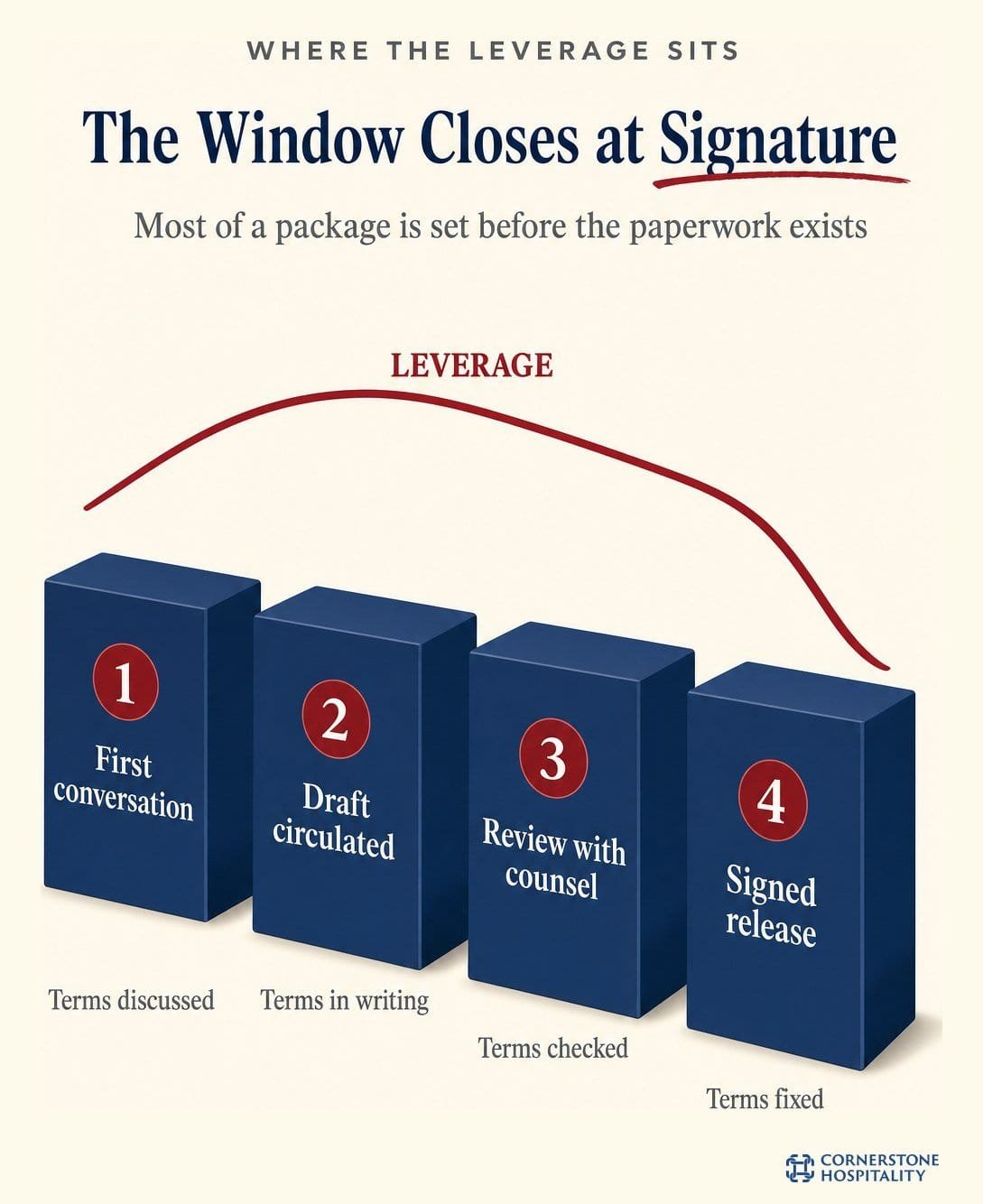
Whatever language reaches the board or the market first is the version people remember. Agreeing the wording, and roughly when it goes out, before anyone drafts it protects a leader’s reputation more than any clause added later.
Why This Matters
Reference checks and non-disparagement terms
Most companies now manage reference requests through a neutral reference policy. It confirms only dates of employment and job title. It withholds any commentary on performance, behavior, or the circumstances of the departure [6]. That policy exists partly to protect the company from defamation exposure. It also shields the departing employee from informal, undocumented negative comments. A formal reference process would never allow them [6].Confirm that a neutral reference policy applies. Then agree exactly on which dates and title the company will confirm. Together, those steps close off one of the more common sources of surprise later in a search.Senior separation agreements typically also include a non-disparagement clause, usually mutual. The clause prevents either side from making negative public or private statements about the other going forward. Combined with an agreed reference script, this clause actually protects a leader’s reputation through the next search. It does so more than the size of the severance figure does.Both terms in a career transition package are worth reading carefully rather than accepting as standard boilerplate. The exact wording is what a future employer’s reference check will actually encounter, not just the presence of a clause.What the agreement actually protects
Severance replaces income for a defined period. The reference and announcement language is what a search committee actually reads six months later. Both belong in the same career transition package negotiation. Do not treat either as settled just because the other one is.
Why a lawyer should review any career transition package
Employment law varies significantly by country and, within the US, by state. It governs severance minimums, notice requirements, and the enforceability of restrictive covenants. A federal law, the WARN Act, requires 60 days’ advance notice of a covered plant closing or mass layoff. It applies to employers with 100 or more full-time employees [5].A number of US states have their own additional notice laws that go further. They set lower employer-size thresholds or longer required notice than the federal standard [5].None of that changes the individual negotiation described above. It is exactly why a lawyer who practices employment law in the relevant jurisdiction should review any actual agreement before signing. No general guide, this one included, substitutes for that review.Confirm the neutral reference policy covers only dates and title, and agree the exact wording of any internal or external announcement before it circulates. Both steps close off the kind of surprise a search committee finds later.
Frequently asked questions
Is severance always negotiable at senior hospitality level?
Should I negotiate outplacement support if it is already being offered?
What happens to my bonus and unvested equity if I leave partway through the year?
Who should review the agreement before I sign it?
What is the difference between garden leave and payment in lieu of notice?
Can a leader negotiate a career transition package when resigning rather than being let go?
When in the process should a career transition package actually get negotiated?
Bringing a career transition package together
None of these terms move much on their own. A slightly larger severance number, agreed upon in isolation, is worth less. The same conversation held across all seven or eight parts of the career transition package is worth more.In practice, the agreement itself treats every part together. The leader living with its terms will later read it that way, and so will the search committee reading the reference it produces. Some parts of the career transition package are easy to overlook. They include bonus and equity treatment, the length and scope of outplacement, and the exact reference wording.Raising them before the paperwork exists is what tends to separate two outcomes. One is a package that only pays for a few months of runway. The other actually supports the transition to what comes next.Read next
Cornerstone Hospitality
Negotiating a senior hospitality exit?
Cornerstone’s career transition coaching works alongside departing leaders on the full package, not just the severance number, and on what comes after it.
Information in hospitality hiring and career transitions changes frequently, and every situation, and every jurisdiction’s employment law, is different. This article describes general practice and is not legal advice. Please contact us, and a qualified employment lawyer, for guidance suited to your exact circumstances.
About this analysis
The statistics in this guide come from third-party research: a workplace-policy survey on severance practice, an executive-negotiation resource, severance-benchmarking data, legal analysis of federal and state notice law, and a guide to executive outplacement services. Cornerstone did not commission or run any of these studies.
Every figure is attributed inline and listed in full, with its original source, in the sources section below.
Sources 1 to 3: how often severance is paid, and what a typical formula looks like
- SHRM: Severance Tied to Tenure and Position as Formal Policies Decline: reports that 88% of companies pay severance when termination is due to a reduction in force or corporate restructuring, against 13% for a termination for cause and 6% on retirement. It finds that a formal, written severance policy covered 55% of employers, down from 65% a few years earlier, even though 97% of companies offered severance in some form, that roughly two-thirds of employers offered outplacement services across employee levels, that 92% required a signed release in exchange for severance, and that 52% extended medical coverage for previously enrolled employees who were terminated: shrm.org/topics-tools/news/benefits-compensation/severance-tied-to-tenure-position-formal-policies-decline
- Chief: How to Negotiate a Severance Package That Protects Your Money and Reputation Up Front: advises negotiating severance terms early, ideally at the point of taking a role rather than only on the way out, and reports that executive job searches at the C-suite and vice-president level “typically take six months to a year.” It recommends requesting earned but unpaid incentives, prorated future bonuses, accelerated vesting, and negotiated outplacement support as part of the same conversation: chief.com/articles/how-to-negotiate-a-severance-package-that-protects-your-money-and-reputation-up-front
- SeveranceCalc: Average Severance Package in 2026: an online severance-benchmarking resource that aggregates public surveys and reports the most common US severance formula as “1 to 2 weeks of pay per year of service” for general staff, with executive and C-suite packages commonly modeled at roughly double that base multiplier. These are general industry benchmarks rather than a legal entitlement or a peer-reviewed study, and actual terms depend on the individual contract and jurisdiction: severancecalc.com/blog/average-severance-package
More sources 4 to 5: bonus, equity, and notice requirements
- Brody Wilkinson PC: Key Considerations in Executive Severance Agreements: advises that a departing executive should consider requesting payment of an earned bonus or a pro rata portion, and notes that “it may be an easier ask to request the accelerated vesting or the extension of a period to exercise an option rather than arbitrarily requesting additional months of severance pay.” It also notes that executive severance agreements typically include or reaffirm restrictive covenants, including non-competition, non-solicitation, confidentiality, and non-disparagement terms, and that their scope and length are themselves negotiable: brodywilk.com/key-considerations-in-executive-severance-agreements
- Thomson Reuters Legal: What is the WARN Act?: explains that the federal Worker Adjustment and Retraining Notification Act “requires that workers receive an advance notice of 60 calendar days” of a covered plant closing or mass layoff, applying to employers with 100 or more full-time employees, and that a number of US states operate their own mini-WARN laws that extend the notice period or apply to smaller employers, citing New York’s requirement of 90 days’ notice for businesses with more than 50 employees where 25 or more will be affected: legal.thomsonreuters.com/en/insights/articles/what-is-the-warn-act
Final sources 6 to 7: reference policy and executive outplacement
- fynk: Neutral Reference: Key Considerations for Contract Clauses: defines a neutral reference clause as a provision limiting an employer’s response to a reference request to “dates of employment and job title, without any positive or negative commentary,” explaining that employers adopt this approach “to avoid potential legal risks associated with defamation or discrimination claims that can arise from more detailed references”: fynk.com/en/clauses/neutral-reference
- Relevante: The Complete Guide to Outplacement Services in 2026: describes executive outplacement programs as typically including executive career coaching, leadership branding, executive resume development, board-opportunity guidance, personal networking strategy, and compensation negotiation support, and notes that “senior leaders face unique career transition challenges. Executive roles often involve longer hiring cycles, confidential searches, and greater emphasis on professional networks,” with program length varying “from a few weeks to several months” depending on what the employer funds: relevante.com/complete-guide-to-outplacement-services-in-2026-relevante