


The 90-Day Onboarding Roadmap an Assessment Report Should Deliver
The most useful section of a strong executive assessment report comes after the hiring decision. It is a 90-day onboarding roadmap built for the specific leader who got the job.


A 90-day onboarding roadmap turns an executive assessment from a verdict into a working plan. That plan covers a leader’s first quarter on the property. Michael Watkins’s research on leadership transitions underpins most of what the industry now calls a first-90-days plan. He puts the unaided breakeven point at up to six months [1]. The breakeven point is the month at which a new leader has contributed as much value as they have consumed. Few tools can shorten that window rather than simply describe it. A 90-day onboarding roadmap section built directly from the assessment itself is one of them.
How a 90-Day Onboarding Roadmap Shortens the Window
The evidence on what actually shortens it is specific rather than general. A study tested a structured integration model against ordinary onboarding. The model cut the average time new executives took to reach full performance by 40%. In the same work, fewer than a third of the organizations studied were actively helping their executives adjust to the culture and politics of a new business, rather than just handling the administrative basics [2]. A 90-day roadmap section inside an assessment report is one of the more direct ways a board or a hiring business can move itself into that better-supported group.
What a structured roadmap changes
Key insight
What a 90-Day Onboarding Roadmap Section Actually Is
A 90-day onboarding roadmap section is the part of an executive assessment report that turns findings into a plan. It takes what the assessment found about this specific leader and sets out their first quarter on the property. This is not a generic 30-60-90 template, the kind HR hands to every new hire regardless of role. Instead, the section draws on the same evidence that produced the hire or promote decision. It then says what that evidence means for the leader’s first ninety days.
The distinction shows up quickly once you look for it. Take two general managers. One is strong on operational grip but light on stakeholder patience. The other has the opposite profile. Each needs a different first month. A generic onboarding checklist treats both the same because someone wrote it before either of them existed as a hire.
A generic onboarding checklist treats both the same because someone wrote it before either of them existed as a hire.
A roadmap section built from the assessment does not treat them the same. It starts from what the assessment already knows about the person walking through the door.
Why a 90-Day Onboarding Roadmap Belongs Inside the Assessment Report
That is also why the section belongs inside the assessment report, not in a separate onboarding document. Somebody who never saw the assessment would write that document later. A structured interview, a set of exercises, or a battery of assessment tools surfaces three things. It shows where a candidate is genuinely strong and where they will need support. It also shows what kind of manager or board relationship gets the best out of them. A different document, a different person, and a different time all mean the same thing. Most of that detail never makes the trip.
What Format the Roadmap Section Takes
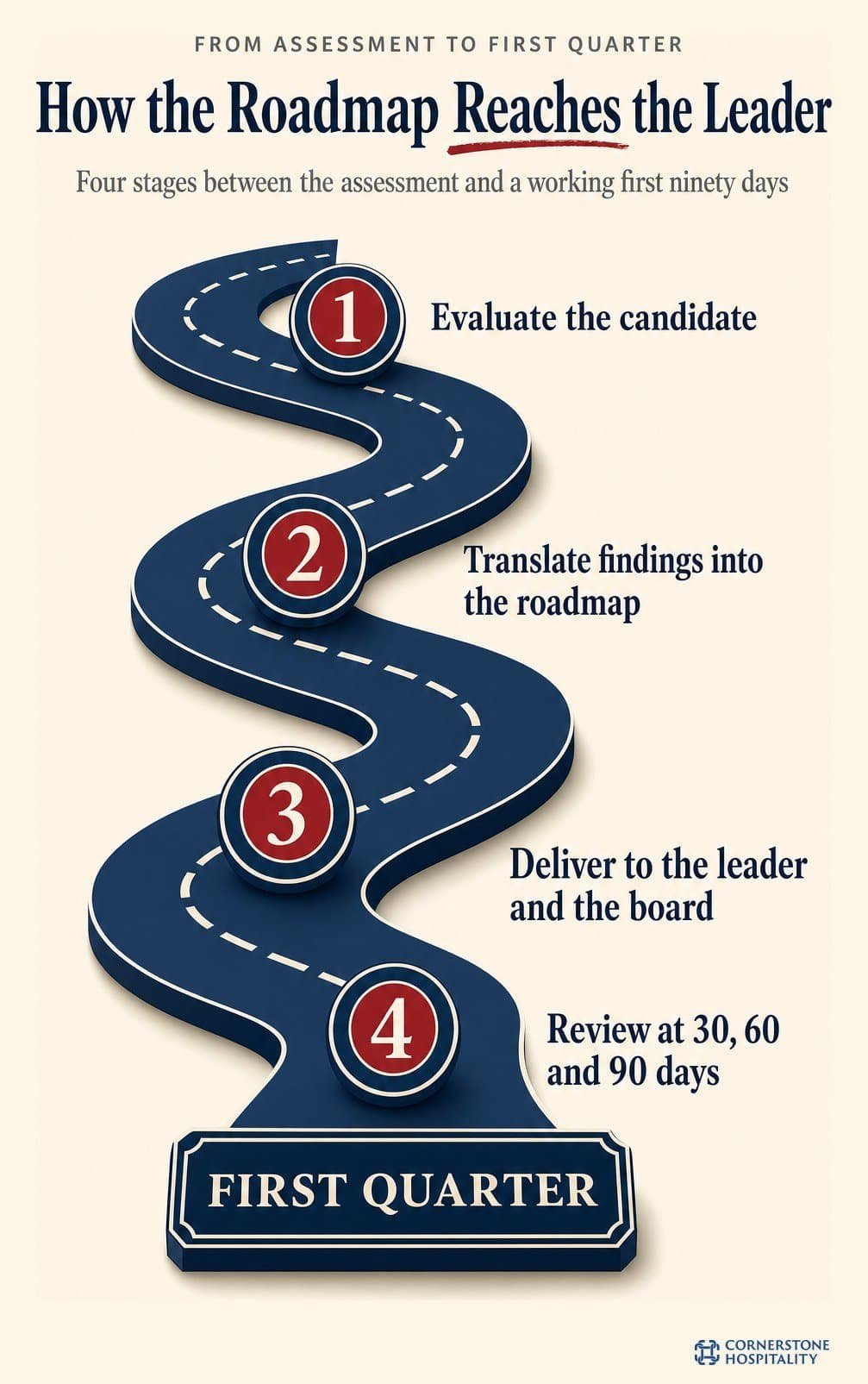
The format matters as much as the content. A 90-day onboarding roadmap works as a short, specific reference the leader can reopen in week six. It is not a closing paragraph tacked onto the evaluation. Two pages is usually enough. Those pages cover what the assessment found that is relevant for the first quarter. They also give the markers at thirty, sixty, and ninety days and name who reviews progress against them. Any longer, and the section starts to compete with the evaluation itself for the reader’s attention. It should be the thing they actually pick back up on a Monday morning.
An assessment already contains the raw material for a first-quarter plan. A 90-day onboarding roadmap section is that material, translated into specific days and specific people. The alternative is a profile that nobody reopens after the hiring decision.
The Anatomy of a Strong Roadmap Section
Four things separate a usable 90-day onboarding roadmap from one that reads well and does nothing. Each one translates something the assessment already measured. None is a new piece of work invented to fill out the report.
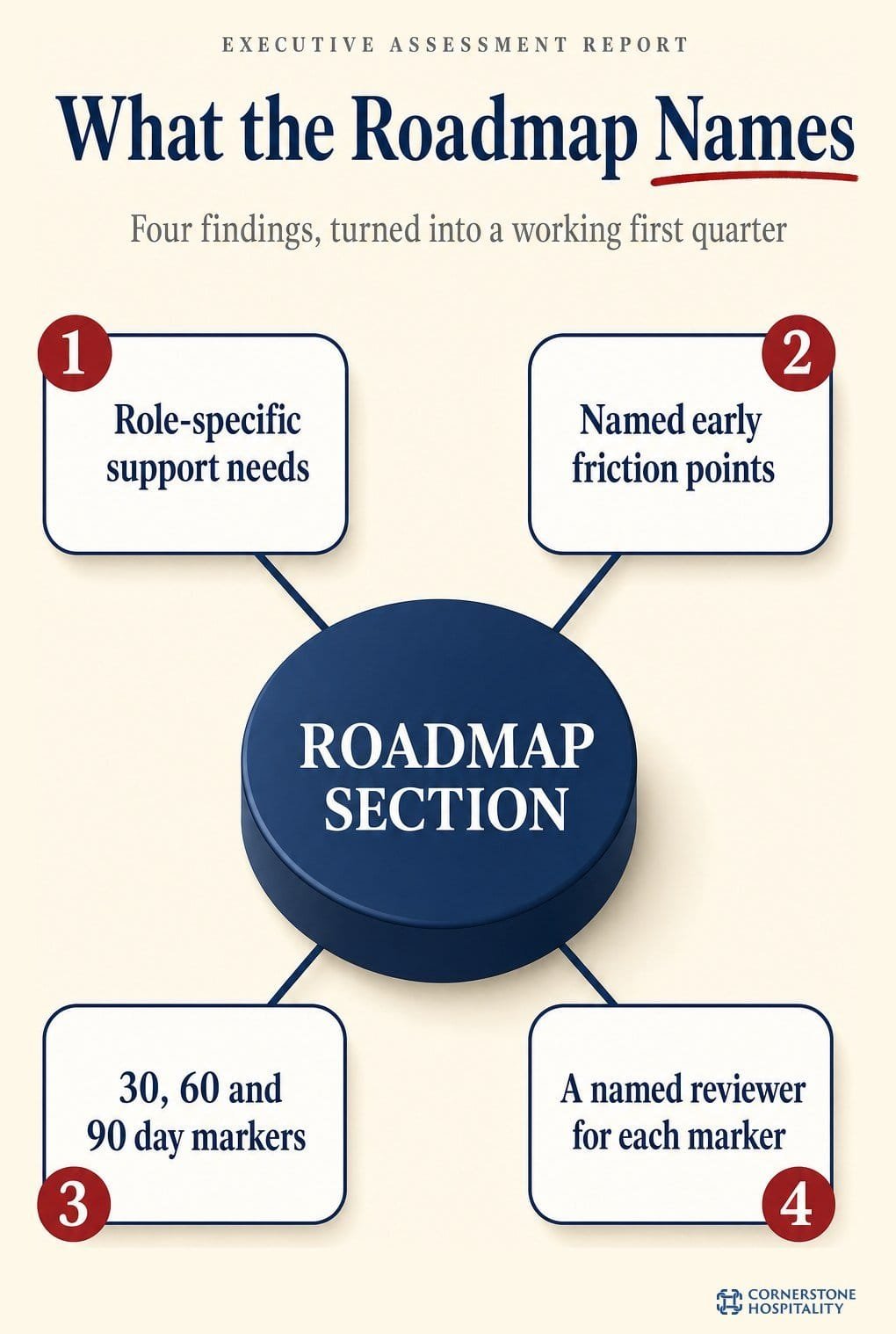
The specific support this leader will need, drawn from what the assessment surfaced rather than from a standard checklist. Suppose the assessment found a candidate strong on financial discipline but new to managing through a unionized labor environment. The roadmap then names that need. It says who is available to help with it in the first month, not the third.
The early friction points the assessment already predicted were named in advance. That way, when they appear in week two, they read as expected rather than alarming. For example, the assessment might flag a tendency to move fast on team changes. A leader who knows that in advance can pace themselves deliberately. They do not have to find out the hard way that the board is watching for exactly that pattern.
Markers and Reviewers in a 90-Day Onboarding Roadmap
Concrete markers at thirty, sixty, and ninety days. Each one is specific enough that the leader and the board can judge progress against the same yardstick. “Settling in well” is not a marker. “Has met individually with every department head and can name the property’s two most pressing margin issues” is one.
A named reviewer for each marker, one senior person accountable for having that conversation on schedule. A generic instruction to “check in periodically” is not the same thing. Research on senior leader assessment consistently finds that the gap is not in the assessment itself. It lies in what happens to the findings afterward. The academic literature describes results left “occasionally disconnected from the organizational processes they were intended to support” [3]. In a 90-day onboarding roadmap, a named reviewer is the simplest fix available for that gap.
Each of the four elements above translates something the assessment already measured. None of it is new work invented to fill out the report, which is exactly why a roadmap section costs so little to add and so much to skip.
Strong versus weak
What a Strong Section Covers, and What a Weak One Leaves Out
Producing a good psychological read of a candidate takes one skill. Turning that read into role-specific, day-by-day guidance takes another. The research on senior leader assessment names this directly. The ideal report “conveys in a straightforward manner the dimensions assessed, why these dimensions matter, and how the leader performs on each one” [3]. Getting from that description to a working ninety-day plan is a separate piece of craft. However, some assessment providers stop before that second step. Boards commissioning an assessment do well to ask whether the assessment includes a 90-day onboarding roadmap section. Its absence is easy to miss until the new leader is six weeks into the role without one.
Side by Side: What a Strong Roadmap Section Includes
| A strong roadmap section | A weak or generic one |
|---|---|
| Names the specific support this leader needs, drawn from the assessment findings | Attaches a generic onboarding checklist sent to every new hire, regardless of role |
| Names likely early friction points before they happen | Leaves the leader to discover friction points alone in week one |
| Sets concrete markers at thirty, sixty, and ninety days | Uses language like “settle in” with nothing to check progress against |
| Names a single reviewer accountable for each marker | Has no named reviewer, so no one owns the check-in |
| Written so both the leader and the board or sponsor can read it and act on it | Written only for an HR file, in language a board would not use |
| States plainly what changes for an internal promotion versus an external hire | Treats every appointment the same, regardless of how much the person already knows about the business |
Before commissioning or accepting an executive assessment report, ask to see a sample roadmap section. A provider that cannot show one is likely stopping at the evaluation. That is worth knowing before the engagement starts, not after.
The evidence
What the Research Says About the First Quarter
The case for building a 90-day onboarding roadmap section into the assessment itself rests on more than intuition. The other route is to treat onboarding as a separate HR task. A 2013 study asked more than 500 experienced executives why new hires struggled during onboarding. The answer was not competence or experience. Two reasons led the list. Executives failed to understand the real rules of the game. They also failed to build the right relationships, particularly with peers [4]. A well-run assessment already surfaces exactly this kind of finding, usually well before day one. That is precisely why the findings belong in the roadmap. Otherwise, the leader has to learn them the hard way.
What Structured Support Means for a 90-Day Onboarding Roadmap
The same body of research puts a number on what structured support is worth. Organizations that gave newly hired leaders real integration support, rather than a standard induction pack, did better. They cut the average time it took those leaders to reach full effectiveness by roughly half [4]. A 90-day onboarding roadmap is one of the lowest-cost forms that support can take. The business has already paid for the groundwork, and the assessment itself and completed it before the leader’s first day.
The research consistently points to relationships and culture, not skill, as what actually trips up a new senior leader. A 90-day onboarding roadmap that only lists operational priorities and skips the relationship map is answering the wrong question.
What changes
Internal Promotion or External Hire: What Changes
Hospitality businesses appoint senior leaders both ways. A good 90-day onboarding roadmap section reads differently depending on which one it serves. Only 20% of HR leaders report having enough ready leaders to fill their most critical roles. Internal candidates can immediately fill only 49% of critical positions when a vacancy actually opens [5]. That gap means a meaningful share of senior hospitality appointments arrive from outside. They land in a business that has not necessarily built the bench to receive them. A related question, worth asking before the appointment is finalized, is which path actually gives boards the most reliable read: internal promotion or external hire.
- Establishes authority with people who were recently peers
- Learns the job itself, not just the property
- Uses the same thirty, sixty and ninety day markers as an external hire
- Maps who to meet in the first two weeks
- Covers the property’s recent history nobody volunteers unprompted
- Surfaces where the owner’s real priorities differ from what was said during hiring
Promoting From Within: The 90-Day Onboarding Roadmap Still Matters
Where the appointment is internal, the temptation is to assume the new leader needs less support. After all, they already know the property. That is true, but they do not yet know the job. A roadmap section that treats those as the same thing misses the point. A department head promoted to general manager still has to establish authority over people who were recently peers. That leader still has to learn what an owner actually wants to hear and when. They still benefit from the same thirty-, sixty-, and ninety-day markers as someone hired from outside. The research bears this out directly. Promotions are 1.6 times more likely to succeed when a genuine assessment informs the decision, not an assumption about readiness [5]. The same assessment that informed the promotion is the fastest available basis for that leader’s roadmap.
Hiring From Outside: Where the Roadmap Carries More Weight
Where the appointment is external, the 90-day onboarding roadmap section carries more weight on relationships and context. It names who the leader needs to meet in the first two weeks. The section covers the property’s recent history, which nobody will volunteer unprompted. It also flags where the owner’s actual priorities differ from what people said during the hiring process. Neither version is generic. Both draw on the same assessment and aim at what that particular leader does not yet know.
Confirm early which path applies, promotion or external hire, and make sure the roadmap section’s weighting matches it. The thirty, sixty and ninety day markers stay the same. What changes is where the roadmap spends its early attention.
Board oversight
What the Board Should Expect to Review
Boards and ownership groups increasingly treat senior succession as a continuous responsibility, not a once-a-year discussion. The practices that separate stronger boards from weaker ones are specific. Among boards surveyed on CEO succession practices, 42% of those with stronger succession processes had a clear, documented transition plan. Across boards overall, the figure was just 12% [6]. The guidance from that research is direct. Boards should “design a comprehensive transition plan” and “work with the board to ensure onboarding, mentorship, and stakeholder alignment are built into the process from the start” [6].
What a 90-Day Onboarding Roadmap Gives the Board to Review
A 90-day onboarding roadmap section is what makes that guidance concrete rather than aspirational. It gives the board something specific to review at each marker. Without it, the board has only a general sense that the new leader seems to be doing fine. A board or ownership group should confirm three things before it finalizes the appointment. First, a roadmap section exists. Second, it names a reviewer apart from the leader themselves. Third, the review dates are actually on someone’s calendar rather than left as a standing intention.
Put the thirty-, sixty-, and ninety-day reviews on the board or ownership calendar. Do it when you confirm the appointment, not after the leader has already started. A review with no date attached rarely happens on schedule.
Reviewing a report before it goes to the board? Talk to us about what a strong roadmap section should include.
Where coaching fits
Where Coaching Fits Alongside the Roadmap
A 90-day onboarding roadmap section names what should happen at each marker. It does not, on its own, tell the leader how they are actually doing in between. That is where a short coaching relationship earns its keep during the first quarter. It checks in against the roadmap rather than starting from a blank page. Executive coaching carries strong perceived returns. 87% of surveyed professionals agree it has a high return on investment. A global survey by PricewaterhouseCoopers and the Association Resource Center found an average return of roughly seven times the cost of engaging a coach [7].
Those figures describe perceived value rather than a controlled study. Even so, the mechanism in a first quarter is straightforward. Somebody with no stake in the building tells the leader what the building is actually saying about them. They do it against the specific markers the assessment already set, and while it is still early enough to matter.
A roadmap section names the markers. A coach who is briefed on them turns the gap between reviews into an ongoing conversation, rather than three months of silence between one check-in and the next.
The hospitality context
Why Hospitality Boards Should Ask for This Section by Name
Hospitality’s staffing position makes the roadmap section more valuable, not less. More than half of hotels surveyed report being somewhat or severely understaffed. Labor costs are a top financial concern for 65% of hoteliers, and 42% name workforce shortages directly [8]. A new leader arriving into that kind of staffing pressure risks having to cover an operational gap in week one. That is exactly the period a 90-day onboarding roadmap section is meant to protect. It reserves the time for diagnosis and relationship building rather than firefighting.
A named roadmap section is one of the more practical ways to protect that time. The board reviews it on a schedule it has already agreed to. None of this pretends the staffing pressure does not exist. It gives the leader, the board, and the property the same specific document to point to. That matters when the temptation arrives to skip the diagnostic period. The front desk, after all, is short two people that week.
Seasonal Timing and the 90-Day Onboarding Roadmap
Many hospitality businesses have a seasonal shape. That adds a second reason to have this in writing rather than as a shared understanding. A general manager appointed six weeks before a property’s peak season works with a compressed version of the diagnostic thirty. The roadmap section can say so directly. It can name which markers still apply and which move to the shoulder season once the immediate operational demand passes. A leader appointed into a quieter stretch of the calendar has more room to run the markers as written. Neither situation is a reason to skip the roadmap. Both are reasons to write one that fits the actual calendar the leader is walking into. It should not be a template built for a year-round office role.
Check the appointment date against the property’s calendar before the roadmap is finalized. A leader starting six weeks before peak season needs a different diagnostic window than one starting into a quieter stretch.
Want a second read on whether a roadmap section is doing its job? Bring us a report you already have.
In their words
What clients and leaders say
A roadmap section is only as good as the search and the assessment behind it. Here is what two leaders who have worked with us have said.
“Over the years I have worked with Florian and he has continually provided a service second to none. The caliber of individuals he recommends is always spot on, as he ensures that he understands not only the requirements and expectations of a role but also the importance of the success and growth of the business being related to people.
Daniel AylmerChief Executive Officer, Greater China
“Florian played a pivotal role in my career transition within the hospitality industry, combining deep expertise in executive search with a highly strategic advisory approach. Unlike traditional recruiters, he takes the time to truly understand your long-term ambitions, challenges your assumptions, and positions you for sustainable leadership success. His network across the global hospitality sector is exceptional, and his commitment to delivering the right long-term fit goes far beyond a transactional placement.
Stefan SavicHospitality Professional · Asset Management, Development & Strategy
Frequently Asked Questions
Is a 90-day roadmap section standard in every executive assessment report?
Not universally. Some assessment providers stop at the evaluation itself, because translating psychological findings into role-specific guidance is a separate skill from the evaluation. It is worth confirming this section is included before commissioning the assessment, and asking to see a sample.
Who is the roadmap section actually for?
Both the incoming leader and the board or sponsor overseeing the onboarding. A roadmap written only for an HR file rarely reaches either of the people who most need to act on it.
Does the roadmap replace a formal onboarding program?
No. It complements one, adding the leader-specific detail that a standard onboarding program, built to apply to every new hire, is not designed to capture.
Does a 90-day roadmap look different for an internal promotion than for an external hire?
Yes. An external hire’s roadmap carries more weight on relationships and unstated context. An internal promotion’s roadmap carries more weight on establishing authority with former peers and learning the job itself, since knowing the property is not the same as knowing the role.
How long should a 90-day roadmap section be?
Around two pages is usually enough. It should cover what the assessment found that is relevant for the first quarter, the thirty, sixty and ninety day markers, and who reviews progress against each one. Longer than that, and it starts competing with the evaluation itself for the reader’s attention.
Who should review progress against the roadmap’s markers?
A single named senior person for each marker, confirmed at the same time the appointment is finalized. A generic instruction to check in periodically is not the same thing, and research on senior leader assessment consistently finds the gap sits in what happens to the findings afterward, not in the assessment itself.
Read next
Turning an Assessment Into a Working First Quarter
In short, an assessment report earns its cost at the point where a hiring decision turns into a working first quarter. That turn happens in the roadmap section, or it does not happen at all. Building it from the assessment’s own findings is not a large ask. Neither is naming a reviewer for each marker or putting the review dates on a calendar. Those steps make the difference. One report gets read once and filed, while another actually shapes how a leader’s first ninety days go. Our team at Cornerstone builds a 90-day onboarding roadmap into every executive assessment we deliver for hospitality clients. We do it for exactly that reason.
Cornerstone Hospitality
Commissioning an executive assessment for a senior hospitality role?
Ask what the report hands the leader for their first ninety days, not only what it says about the hire.
What the figures draw on: published research on executive transitions, assessment practice, and hospitality staffing from sources including Michael Watkins, Egon Zehnder, the International Coaching Federation, DDI, the Harvard Law School Forum on Corporate Governance, and the American Hotel & Lodging Association, referenced in full below.
The practice behind the guide is drawn from Cornerstone Hospitality’s retained executive search and assessment work with senior hospitality leaders and the boards appointing them.
Sources 1 to 3: the first-quarter research and what a strong assessment report contains
- The Future Organization, interview with Michael Watkins: The First 90 Days: Strategies for Leaders in Transition: records Watkins stating that “unaided, the process for leaders to reach the breakeven point can take up to six months,” the breakeven point being where a leader creates as much value for the company as they have consumed: thefutureorganization.com/the-first-90-days-strategies-for-leaders-in-transition
- Egon Zehnder, press release: Egon Zehnder and The First 90 Days Author Release Onboarding Effectiveness Assessment to Improve New Executive Integration: reports that “less than a third of organizations actively support their executives to adapt to the cultural and political climate,” and quotes partner Lena Triantogiannis that the tested integration model can “reduce the amount of time to reach full performance by an average of 40 percent,” with partner Mark Byford noting that “too many businesses believe they are successfully bringing newly hired executives into the fold, when in reality they are simply covering administrative basics”: egonzehnder.com/press-release/egon-zehnder-and-the-first-90-days-author-release-onboarding-effectiveness-assessment-to-improve-new-executive-integration
- Reynolds, D. H., McCauley, C. D., & Tsacoumis, S. (2018): A Critical Evaluation of the State of Assessment and Development for Senior Leaders, Industrial and Organizational Psychology, 11(4), 630 to 652: states that a strong senior leader assessment report “conveys in a straightforward manner the dimensions assessed, why these dimensions matter, and how the leader performs on each one,” while noting that in current practice, assessment results are “occasionally disconnected from the organizational processes they were intended to support”: cambridge.org/core/journals/industrial-and-organizational-psychology/article/critical-evaluation-of-the-state-of-assessment-and-development-for-senior-leaders
More sources 4 to 6: onboarding support, succession readiness, and board practice
- IMD Business School: How Transition Programs Accelerate Executive Onboarding and Integration: reports that structured integration support “can halve the time it takes for newly hired leaders to get up to speed” and cites a 2013 Egon Zehnder survey of more than 500 experienced executives finding that new hires struggled mainly because they “didn’t understand ‘the real rules of the game’ and/or failed to build critical relationships, especially with peers,” rather than for reasons of competence or experience: imd.org/research-knowledge/organizational-behavior/articles/how-transition-programs-accelerate-executive-onboarding-and-integration
- DDI: Succession Planning Best Practices: How to Close the Leadership Readiness Gap, drawing on the Global Leadership Forecast 2025: reports that “only 20% of HR leaders say they have leaders ready to fill their most critical roles” and that internal candidates “can fill only 49% of critical positions immediately,” while “promotions are 1.6X more likely to succeed when assessments inform leadership selection”: ddi.com/blog/succession-planning-best-practices
- Huang, A., & Nyberg, A., Harvard Law School Forum on Corporate Governance: CEO Succession: 10 Pitfalls Boards Must Avoid, and the CHRO Practices That Help, reports that among boards with stronger succession practices, 42% had a clear, documented transition plan in place, against 12% of boards overall, and advises boards to “design a comprehensive transition plan” so that “onboarding, mentorship, and stakeholder alignment are built into the process from the start”: corpgov.law.harvard.edu/2025/07/09/ceo-succession-10-pitfalls-boards-must-avoid-and-the-chro-practices-that-help
Final sources 7 and 8: coaching returns and the hospitality staffing backdrop
- International Coaching Federation: Coaching Statistics: The ROI of Coaching in 2024: reports that “87% of survey respondents agreed that executive coaching has a high return on investment,” citing a PricewaterhouseCoopers and Association Resource Center global survey finding “an average ROI of seven times the cost of employing a coach”: coachingfederation.org/blog/coaching-statistics-the-roi-of-coaching-in-2024
- American Hotel & Lodging Association: Rising Cost, Staffing Challenges Persist for Hotels as Travel Demand Expected to Hold Steady: surveys 246 hoteliers in late February 2026, finding that “more than half of respondents report their properties are somewhat or severely understaffed,” with labor costs a top concern for 65% and workforce shortages named by 42%: ahla.com/news/rising-cost-staffing-challenges-persist-hotels-travel-demand-expected-hold-steady