


Cross-Cultural Leadership in Multi-Property Hospitality Groups
A multi-property hospitality group runs on one brand standard, delivered through a dozen different ways of hearing an instruction. Cross-cultural leadership is what keeps both true at once.


The choices behind cross-cultural leadership
The skill that decides whether the standard survives the journey is not a personality trait. It is a set of specific choices. Some parts of a leader’s approach stay fixed everywhere. Other parts bend to the market the leader is standing in.Getting that split right is the actual work of cross-cultural leadership. Like any other executive skill, a leader can learn it rather than leave it to instinct.Cross-cultural leadership, in numbers
Key insight
Cross-Cultural Leadership: What It Actually Asks of a Multi-Property Leader
Picture a regional director overseeing properties in, say, Bangkok, Dubai, and London. That director is not choosing between being the Bangkok leader or the London leader. They are running one operating philosophy through three different sets of local expectations about authority, feedback, and pace.Each property team judges them on two things separately. One is whether the standard makes sense. The other is whether the way it arrives makes sense.Two things have to be true at the same time for cross-cultural leadership to work in a multi-property group.- The guest experience in one property has to resemble the guest experience in another. It has to be close enough that the group’s name still means something when a guest moves between properties.
- The way a leader manages the people delivering that experience has to make sense to the people receiving the instruction. It must work in their own cultural context, not in the leader’s.
Why do the two goals of cross-cultural leadership pull apart
Those two goals pull in different directions. A single, unbending management style delivered identically in every market produces consistent instructions and inconsistent understanding. A fully localized style in every property produces the opposite problem. Teams feel led well, yet the brand no longer behaves like one brand.The tension in cross-cultural leadership does not resolve by picking a side between consistency and localization. It resolves by sorting the parts of leadership that are the standard from the parts that are the delivery. Then it treats those as two different design problems.
The research behind it
Two Frameworks Behind Why the Same Style Lands Differently
A leadership style that works cleanly in one market and lands badly in another is not a mystery. Two long-running research programs describe why it happens with a fair amount of precision. Both are useful working tools for cross-cultural leadership in several countries. They are not just academic background reading.Hofstede’s dimensions of national culture
Geert Hofstede’s research surveyed more than 100,000 employees of a single multinational company across dozens of countries. It sorts national culture into six measurable dimensions. One is power distance, which is how comfortable a society is with an unequal distribution of authority. Two more are individualism against collectivism and uncertainty avoidance, which is a society’s tolerance for ambiguity [4].Hofstede did not design any of the six dimensions with hospitality in mind. Even so, every one of them shows up on a property floor. Power distance alone predicts a great deal about how a direct instruction from a manager reads. It can read as clarity or as coldness.It also predicts whether a junior team member will tell a manager a plan is wrong. That may happen before the plan fails or only after.The GLOBE study’s leadership dimensions
A later and much larger research program, the GLOBE study, surveyed more than 17,000 middle managers across 62 societies. It asked which leadership behaviors people in each culture actually expect from an effective leader [5].The answers are grouped into six leadership dimensions. Four are charismatic and value-based leadership, team-oriented leadership, participative leadership, and humane-oriented leadership. The other two are autonomous leadership and self-protective leadership, which centers on status and standing.The dimensions themselves are universal. Every culture in the study recognized all six as things a leader does. What differs by market is the ranking, which dimension a team expects first from someone new. That ranking is the part a regional leader has to learn market by market rather than assume from the head office.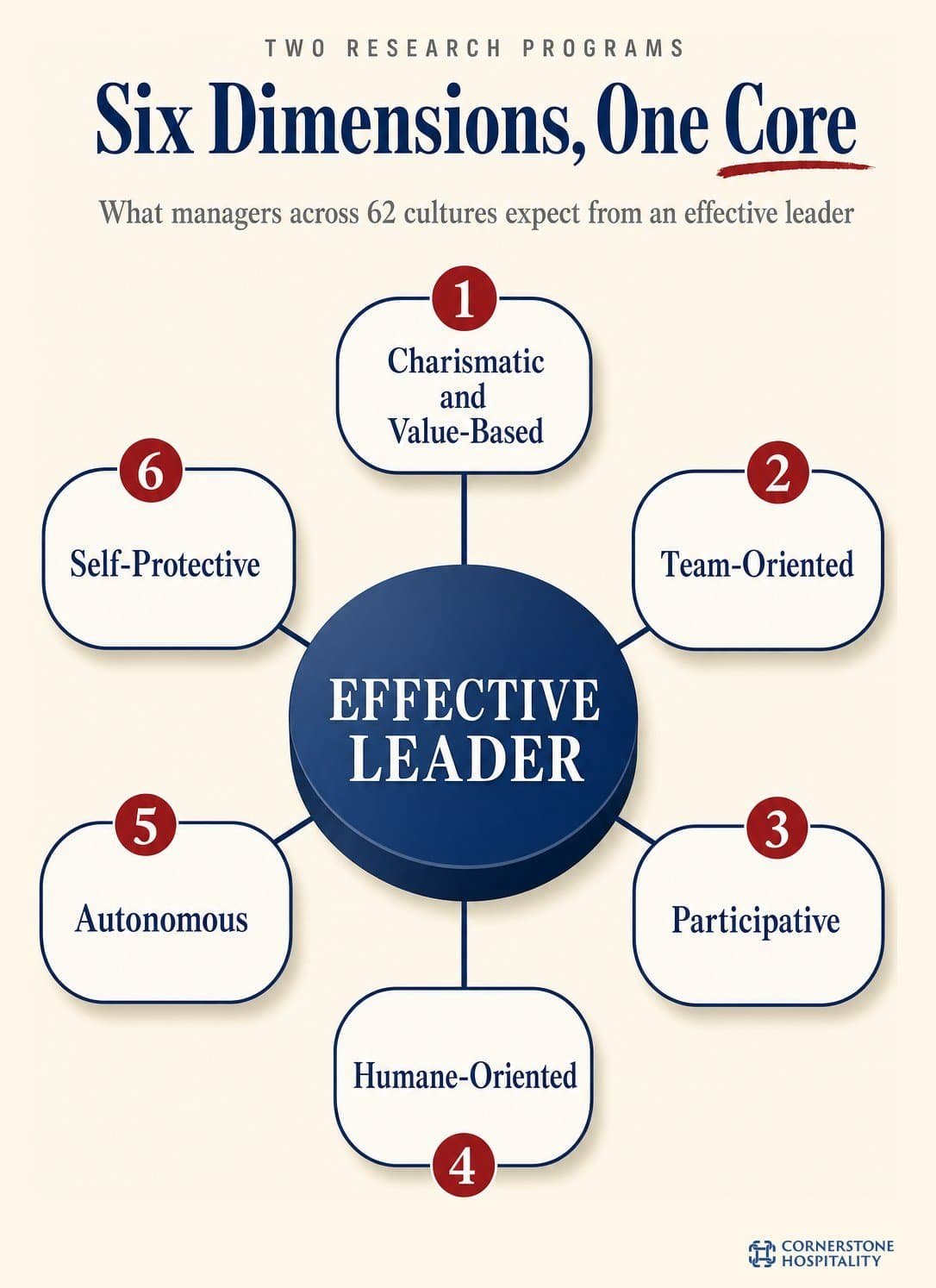
How both frameworks shape cross-cultural leadership
Read together, the two frameworks make the same point from different directions. Hofstede explains why the same instruction lands differently. GLOBE explains why teams expect the same leader to behave differently before that leader has said anything at all.A leader moving between properties in different markets operates inside both effects at once. That is true whether or not the leader has a name for either one.“The leaders who struggle across markets are rarely the ones who lack judgment. They are the ones who never separated their judgment from the way they were taught to express it, so they assume the second one travels along with the first.”
Florian Kittler, Managing Partner, Cornerstone Hospitality
Hofstede explains why an instruction lands differently from one market to the next. GLOBE explains what a team expects of a new leader before that leader has said anything. A leader who knows both frameworks can tell which friction is a market signal, and which is simply a different way of expressing the same judgment.
What travels
What Tends to Travel Well Across Markets
Three parts of cross-cultural leadership move across a border with comparatively little loss. The same three come up again and again once a leader has run properties in more than one market.A clear operating philosophy, stated once and repeated
Markets read what “good service” means at a given property differently. That holds unless the group writes it down in specific, observable terms, not as a shared understanding. “We treat guests with warmth” survives translation badly, because warmth looks different delivered in Zurich and delivered in Bangkok.By contrast, “We greet a returning guest by name within the first thirty seconds” does not have that problem. It names a behavior rather than a feeling. The philosophy travels. The example used to illustrate it usually needs to change property by property.Structured delegation
A clear decision rights framework says who can approve what spend, what service recovery, and what schedule change without escalation. It travels well because it removes the guesswork that culture would otherwise fill in unevenly.Where markets differ is not whether decision rights exist. It is how much local teams expect a leader to ask before using the authority the leader already has.A leader who does not separate the two ends up in one of two places. One is overcentralizing, where the local team expected latitude. The other is leaving a decision-shaped hole where the local team expected direction.A listening-led management style
Research compares leaders who perform well across cultures with those who do not. It points less at fixed personality traits and more at a small set of learnable habits. The chief habits are tolerance for ambiguity and a reduced tendency to judge unfamiliar behavior against a home-market baseline [6].In practice, cross-cultural leadership shows up as a leader who asks the same diagnostic questions in every new market. That leader does not import conclusions from the last one. Instead, they treat an unfamiliar response as information about the market, not as a problem with the team.Cornerstone’s leadership development work with multi-property groups spends real time on exactly this habit. A leader can build it deliberately. It is not something a leader either has or does not.What to do
Write the operating philosophy down as observable behavior, build one decision rights framework for every property, and coach the listening habit on purpose. These three travel with a leader into any market, so they are worth getting right once rather than reinventing them property by property.
What needs adapting
What Needs Local Adaptation
Four parts of cross-cultural leadership do not travel well unchanged. Each one often causes friction when a leader who has only operated in one market moves into a regional role.Communication directness
Direct feedback that reads as clear and efficient in one market can read as harsh or disrespectful in another. None of this means one approach is wrong. It means the same words, delivered the same way, genuinely land differently depending on where someone says them.A leader who has only ever operated in one market often does not notice the gap. By then, it had already caused friction with a team.Hierarchy expectations
Hierarchy expectations vary by market in three ways. Teams differ on how formally they expect a leader to address them. They also differ on how much distance they expect a leader to keep from day-to-day operational detail. Finally, they differ on whether an open-door policy reads as accessible or as a loss of authority.Consider a leader who flattens hierarchy everywhere because it worked at their last property. That leader can read as approachable in one market and as unserious in another.Decision-making pace
Some markets expect a fast, centralized call from a senior leader. Others expect visible consultation before a leader announces a decision. They treat a fast solo call as a leader who did not bother to ask.Neither pace is more professional than the other. Each is what the local team reads as competent. Mismatching the pace to the market’s expectation costs credibility, even when the eventual decision is the right one.Guest-service norms
The promise made to a guest, prompt, warm, discreet, and attentive, travels as a philosophy. How the group delivers that promise needs local calibration.That covers how much small talk accompanies it. It also covers how quickly staff approach an arriving guest and how formal the language is. Without calibration, it reads as either intrusive or cold to guests from the local market. That is true regardless of how well guests from elsewhere receive it.| Dimension | What tends to travel | What needs local adaptation |
|---|---|---|
| Operating philosophy | The standard itself, written down and repeated consistently | The specific example used to illustrate it |
| Delegation structure | Clear decision rights and a defined escalation path | How much a local leader is expected to ask before deciding |
| Feedback and correction | Regular, specific, tied to the written standard | How direct it sounds delivered face to face |
| Decision-making pace | A defined cadence for major calls | How much visible consultation happens before the call lands |
| Listening and diagnosis | Asking the same questions of everyone, every market | What people are willing to say and in front of whom |
| Guest-service norms | The promise made to the guest | How warmly, formally, or quickly that promise is delivered |
The table above is the working map for a regional leader. The left column is what the group writes down once. The right column is what gets rebuilt, deliberately, in every new market a leader enters.
Building the skill
Building Cultural Intelligence, Not Relying on Instinct
The ability to handle cross-cultural leadership well has a name in the research literature. It is cultural intelligence, usually shortened to “CQ.” The Cultural Intelligence Center built and maintains the most widely used CQ measurement tool.The Center does not treat cross-cultural skill as an innate trait some leaders happen to have. Instead, it defines CQ as a measurable and improvable skill set for navigating differences across perspectives and cultures [7].That framing matters for a hospitality group making appointment and development decisions about cross-cultural leadership. The right development can close the gap between leaders who read a new market well and those who do not. That gap is not a fixed trait to select for and otherwise hope about.Why coaching builds cross-cultural leadership habits
What closes that gap in practice is closer to coaching than to classroom training. A useful definition of cultural competence describes it as the ability to function in cross-cultural situations. That means valuing diversity and staying aware of others’ cultural identities as well as one’s own [8].A strong coaching culture rests on active listening and curious questioning rather than instruction. Reports find that organizations with one are more than twice as likely to be high performing as those without [8]. Coaching a leader to ask rather than assume builds a habit. The leader carries that habit into a new market automatically, because it was never market specific in the first place.Building cross-cultural readiness before the move
What to do
Build the listening habit before the leader needs it in a new market. Use structured coaching rather than a one-off briefing. It is the one cross-cultural leadership skill a leader does not need to relearn for every country they move into next.
Where it breaks down
Where Multi-Property Groups Get This Wrong
Two patterns account for most of the cross-cultural leadership friction Cornerstone sees when a leader moves between markets inside the same group.Standardizing everything from head office
Mandating identical execution down to the script removes local judgment along with local variation. Teams notice the difference between a standard applied with judgment and one applied without it.The properties that hold their standard best over time usually share one trait. The head office is explicit about which parts stay fixed and silent about the rest. It does not try to specify every detail.Moving a leader across markets without preparing the move itself
Estimates say 40% of international leadership assignments fail. The research consistently points to cultural adjustment rather than technical competence as the deciding factor [2].Groups usually choose a leader to open or run a property in a new market. The choice rests on a strong track record in the leader’s previous market. That track record is a poor predictor of how quickly the leader will read an unfamiliar one.A survey documents the gap at the level of intent. A large majority of senior executives say their organization needs stronger global leadership capability. Only a small fraction believe their own company is currently developing it well [3].Yet very few multi-property groups treat a cross-border move as its own transition. It needs its own preparation, distinct from whatever onboarding a same-market appointment would get.What to do
Treat a cross-border appointment as its own transition, with its own preparation, rather than folding it into standard onboarding. A strong track record in the last market is not the question that predicts success in the next one.
Before the appointment
Reading Cross-Cultural Leadership Potential Before the Appointment
A generic leadership assessment can genuinely misread a strong leader operating in a different cultural context. That happens when its authors built and calibrated it in only one market.Calibrating for local norms matters as much as calibrating for the role itself. That is because an assessment may flag a behavior as a weakness in one cultural setting. In another, that same behavior can be exactly the right read of the room.What to look for in cross-cultural leadership potential
This is where assessment and executive search work meet leadership development rather than sitting apart from it. The more useful question is rarely whether a candidate is a strong leader. This holds before a multi-property group appoints someone into a cross-market role. It is closer to whether the candidate has shown they can separate what they believe from how they learned to say it.That is the specific capability the new market is going to test. Cornerstone’s assessment work with hospitality groups looks for evidence of that separation directly. It looks at how a candidate has actually adjusted their approach in past roles. It does not rely on how candidates describe themselves.A strong track record in one market says less than it seems about how a leader will perform in another. What predicts the cross-cultural leadership outcome is evidence of adaptation, not evidence of past results.
Cross-market rotation as a development tool, not just a posting
The fastest way most multi-property groups build cross-cultural leadership in a rising leader is early exposure to a second market. That exposure comes well before that leader carries full regional responsibility.Take a department head who has run a shift in one country and then a second in another. That person has already made most of the small adjustment mistakes at a level where they cost little. That happens long before those same mistakes would cost a property’s performance or a team’s trust.Some groups wait until a leader is senior to give them a first cross-border posting. They are asking someone to build cultural range and carry full accountability at the same time. That is a harder combination than it needs to be.Cornerstone sees the same pattern from the search side. Candidates who show early, low-stakes cross-market experience on their record consistently interview better on the specific questions that matter here. This is not because the posting itself taught them everything. It is because the posting gave them a first real test of whether they separate their judgment from their delivery. That test comes well before a board is watching the answer.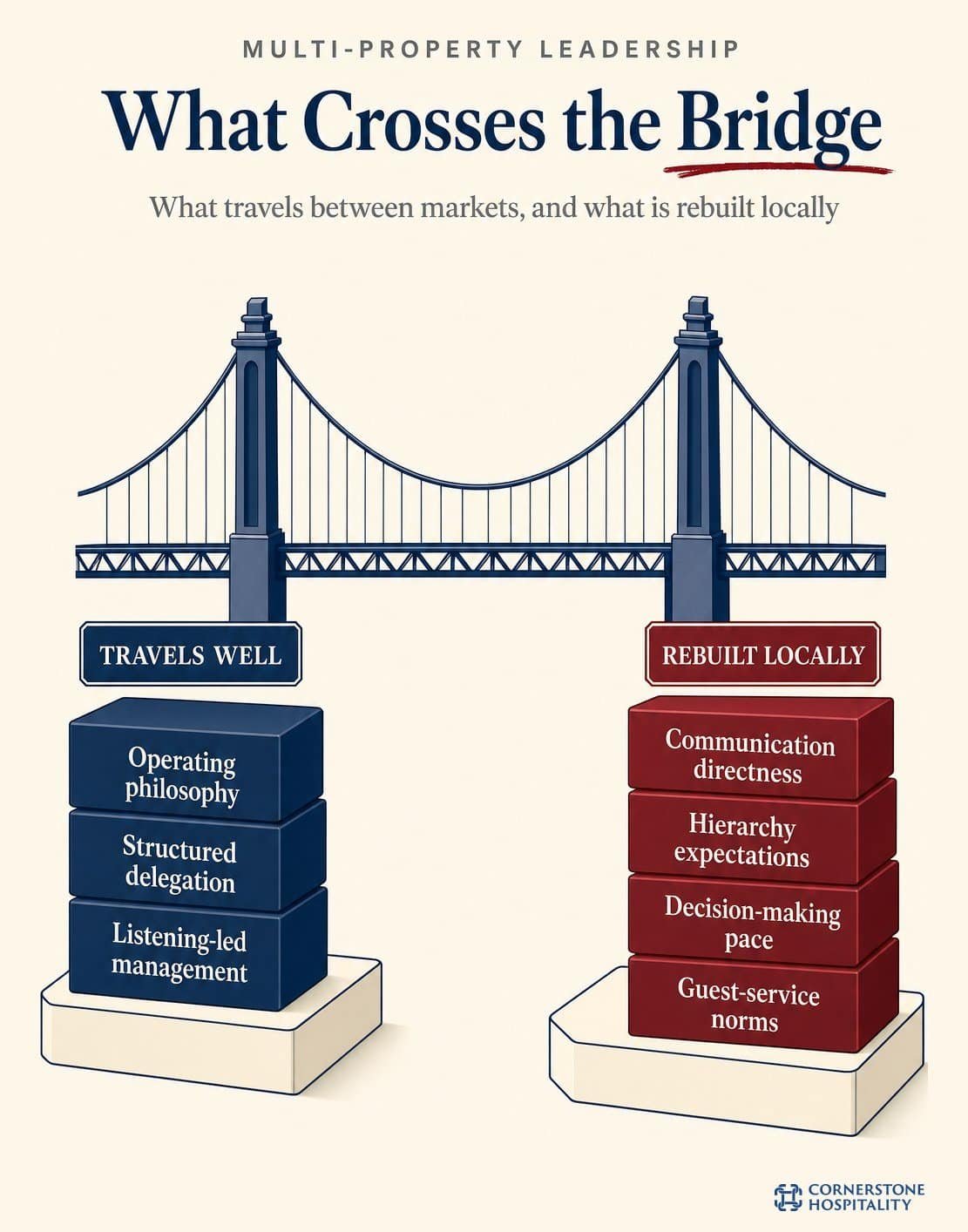
Early, low-stakes cross-market exposure teaches a rising leader to separate judgment from delivery before a board is watching the answer. That is a far cheaper place to learn the lesson than a senior regional appointment.
Cornerstone Hospitality
Appointing a leader across markets?
A structured assessment and onboarding approach helps a leader separate the standard they are carrying from the way they are used to delivering it.
In their words
What clients and leaders say
Leading across markets is easier to judge from the outside than from the inside. Here is what two leaders who have worked with Cornerstone across multiple properties have said.
“Over the years I have worked with Florian and he has continually provided a service second to none. The caliber of individuals he recommends is always spot on, as he ensures that he understands not only the requirements and expectations of a role but also the importance of the success and growth of the business being related to people.
Daniel AylmerChief Executive Officer, Greater China
“Grand Hyatt Dubai was a very demanding opening, however Florian took it in his stride and played a major role in ensuring its success. He worked long hours in planning and executing the training, and also stood by the team to guide them through the daily operations and with dealing with guests.
Vishal MehraCluster and Portfolio General Manager, Luxury Hospitality
Frequently Asked Questions
Does a leadership style that works well in one market translate to another?
How can a multi-property group keep its brand consistent across different cultural markets?
What is cultural intelligence, and can it actually be developed?
Why do leadership assessments sometimes misread a strong leader from a different market?
What is the fastest way to build cross-cultural leadership before a cross-border move?
How should a multi-property group decide which leadership behaviors stay fixed and which adapt by market?
Information in hospitality leadership and executive assessment changes frequently, and every organization is different. Individual results vary. Please contact us for guidance suited to your exact situation.
What cross-cultural leadership comes down to
Cross-cultural leadership is not a personality some leaders happen to have and others do not. In a multi-property hospitality group, it is a specific discipline. Keep the operating philosophy, the delegation structure, and the listening habit constant. Treat communication directness, hierarchy expectations, decision-making pace, and guest-service delivery as the parts you rebuild in every new market.The leaders who do this well are not the ones with the most experience in the most countries. They worked out early which half of their leadership is the standard, and which half is the accent.Read next
Appointing or developing a leader for a role that spans more than one market? The conversation starts with the properties and markets you are managing, not with our process.
What the figures draw on: published research on national culture and leadership, including Geert Hofstede’s cultural dimensions research; the GLOBE study of leadership across 62 societies; the Journal of World Business; the Cultural Intelligence Center; the International Coaching Federation; McKinsey Quarterly; Learnlight and INSEAD; and the World Travel & Tourism Council, referenced in full below.
The practice behind the article is drawn from Cornerstone Hospitality’s retained executive search, assessment, and leadership development work with senior hospitality leaders operating across multiple markets.
Sources 1 to 3: the scale of global hospitality and the readiness gap
- World Travel & Tourism Council: Global Travel & Tourism Growth to Outpace Wider Economy by 1.5 Times Over the Next Decade: forecasts that the sector will “support 376 million jobs worldwide in 2026, representing one in nine jobs globally”: wttc.org/news/global-travel-tourism-growth-to-outpace-wider-economy-by-1-5-times-over-the-next-decade
- Learnlight: Why 40% of Overseas Assignments Fail and What You Can Do to Prevent It: reports that “40% of all overseas assignments” fail, citing INSEAD business school estimates placing the failure rate at 40% to 50% of all overseas deployments: learnlight.com/en/articles/overseas-assignments
- Fisher College of Business, The Ohio State University, Lead Read Today: Global Leadership Competencies: reports that “according to a survey of senior executives, 76 percent believe their companies need to develop global leadership competencies, but only 7 percent think they are doing so effectively,” citing Ghemawat, P., “Developing global leaders,” McKinsey Quarterly: fisher.osu.edu/blogs/leadreadtoday/global-leadership-competencies
More sources 4 and 5: the two research frameworks
- Geert Hofstede, official site: The 6-D Model of National Culture: sets out the six dimensions of national culture, power distance, individualism, masculinity, uncertainty avoidance, long-term orientation and indulgence, built from Hofstede’s original research across a single multinational company operating in dozens of countries: geerthofstede.com/culture-geert-hofstede-gert-jan-hofstede/6d-model-of-national-culture
- The GLOBE Project: 2004, 2007 Studies: describes the GLOBE research program surveying more than 17,000 middle managers across 62 societies, consolidating findings into six global leadership dimensions including charismatic and value-based, team-oriented, participative, humane-oriented, autonomous and self-protective leadership: globeproject.com/study_2004_2007.html
Final sources 6 to 8: cross-cultural competency and how it is built
- Caligiuri, P.: Dynamic Cross-Cultural Competencies and Global Leadership Effectiveness, Journal of World Business: finds that dynamic cross-cultural competencies, tolerance of ambiguity, cultural flexibility and reduced ethnocentrism, mediate the relationship between cross-cultural experience and supervisor ratings of global leadership effectiveness.
- The Cultural Intelligence Center: About: describes cultural intelligence, CQ, as “a measurable and improvable skill set” for navigating differences across perspectives and cultures, developed by co-founders David Livermore and Linn Van Dyne through the CQ Scale: culturalq.com/about
- Harvard Business Review, sponsored content from the International Coaching Federation: Effective Global Leaders Need to Be Culturally Competent: defines cultural competence as the ability to “function in cross-cultural situations by valuing diversity and staying aware of others’ cultural identities and their own,” and reports that organizations with strong coaching cultures are more than twice as likely to be high performing: hbr.org/sponsored/2021/06/effective-global-leaders-need-to-be-culturally-competent