


From Property to Corporate: The Identity Shift That Catches Even Great Leaders Off Guard


The move from a property to corporate hospitality leadership role is the most underestimated identity shift in a senior career. Apparently, on paper it reads like a promotion: bigger title, more responsibility, more compensation. However, in practice, it is a different story. The career trajectory still points upward. Meanwhile, the leader’s day-to-day stellar execution that worked on property no longer translate. So the leader has to learn to adapt on the fly. Consequently, getting the transition wrong, and the leader is joining a failure statistic: 27 to 46% of executive transitions count as failures or disappointments two years in [5].
In practice, Cornerstone Hospitality has walked many leaders through this transition. Some arrive through a search engagement that placed them in the new seat, while others enter into standalone coaching engagements commissioned by the board following their transition. Across both paths the pattern is consistent, so a clear progression is easy to identify. First comes the identity shift required to step into the new role. This is followed by the defining moments in the first six months that put that shift to the test. Finally, the focus turns to translating the instincts into the mindset, presence, and posture of a corporate leader.
The transition is challenging, yet it is also one of the highest-leverage moments in a hospitality career. When managed effectively, the move from property to corporate leadership can open the door to the next two decades of career growth. When handled poorly, however, it can stall a career that otherwise had every potential to continue advancing.
What the research says
Industry data on executive transition outcomes, root-cause failure modes, senior-hire washout, and the hospitality leadership scarcity around the move. The full source list sits at the foot of the article.
- Career transition support for senior hospitality executives
- The first 14 days after a senior hospitality exit
- Leadership Development & Coaching: the pillar
Where’s your career going? Let’s find out together.
Have a short, private conversation with our AI assistant. It asks 7 questions, takes 6 to 8 minutes, and you leave with a personalized read on your next move, sent straight to your inbox.
The Shift
From property to corporate hospitality: same person, different operating system
The move from property to corporate hospitality leadership may appear to be a natural continuation of the same career. In reality, it represents a fundamental shift. The role operates on a different system, draws on a different source of authority, follows different feedback loops, and demands an entirely new definition of what constitutes a successful day.
The leader remains the same person, but many of the instincts and reflexes developed at the property level must be re-examined. Each one needs to be tested against the demands of the new altitude: Does this instinct still create value in a corporate environment, or has its usefulness run its course?
Broader research on the transition from functional or operational leadership to enterprise leadership describes this as one of the most challenging shifts a leader can make. The scale of the adjustment is such that Harvard Business Review has characterized the move as “seismic,” underscoring just how deeply the nature of leadership changes at this level. [6].
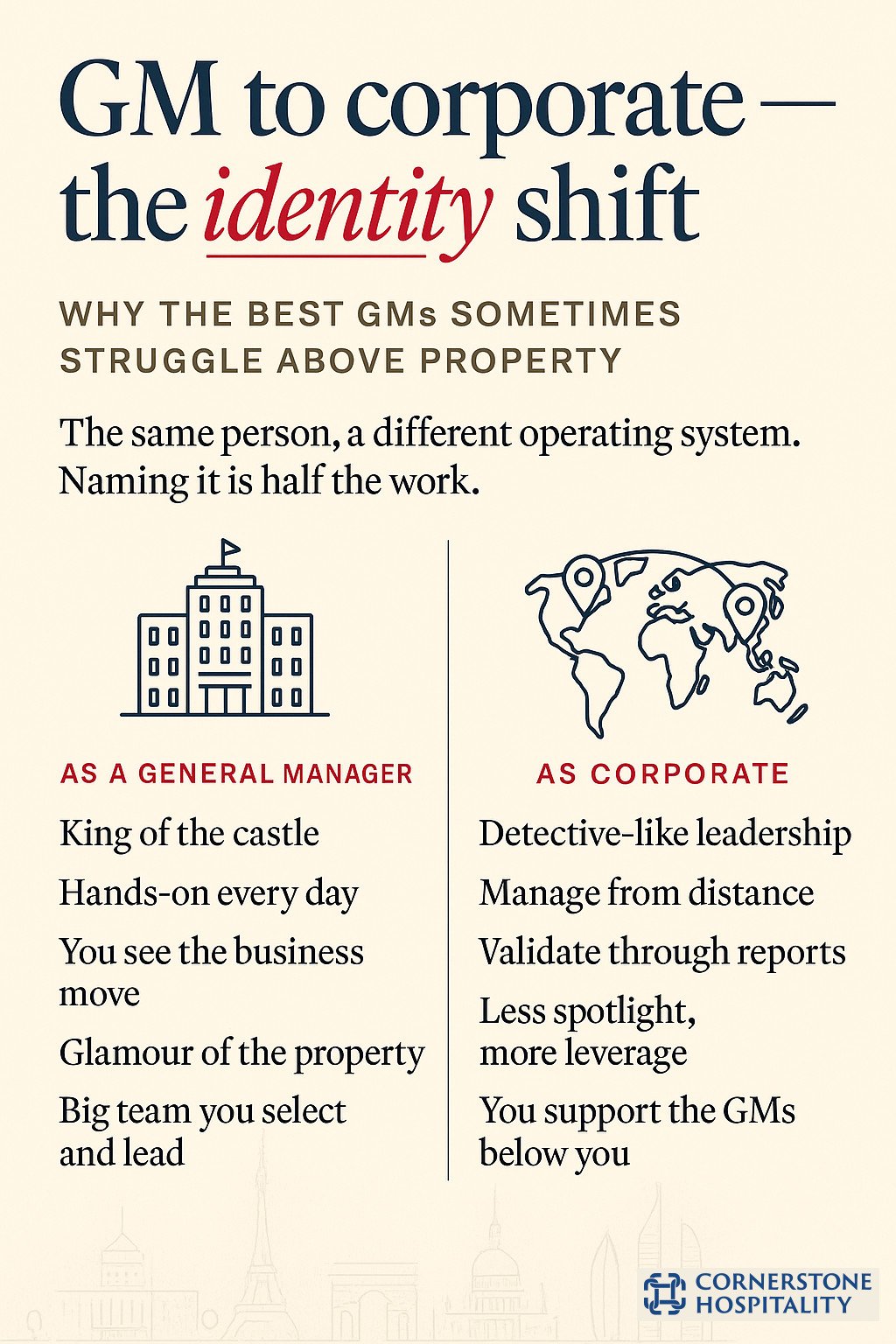
In practice, for example, as a GM, the leader is the king of the castle. Because they are hands-on every day, they see the business in motion. They also hold the team they selected in the property they run. There is ceremony: the morning walk, the lobby presence, the guest recovered personally, and the owner’s dinner. Consequently, authority flows from presence and visibility. At the same time, feedback is immediate: the night audit, the GSS scores, the F&B covers, the next morning’s staff briefing.
The identity shift
The GM to Corporate identity shift that catches even great hospitality leaders off guard.
| Dimension | General Manager | Corporate leader |
|---|---|---|
| Feedback loop | Same day, guest to hallway to fix | Weeks or quarters, filtered through owners. |
| Authority | Direct, positional, king of the castle | Earned, indirect, through influence. |
| Team | On the floor, visible daily | Distributed across brands and time zones. |
| Wins | Nightly service, weekly forecast, monthly RevPAR | Portfolio moves that pay back in years. |
| Posture | Decide, act, move on | Ask, gather, decide, sponsor. |
The corporate seat, a quieter form of authority
By contrast, as a corporate or regional leader, the spotlight becomes less direct. Leadership is exercised from a greater distance, with performance validated through reports, data, and structured reviews rather than frequent presence on the floor. Instead of being the GM, the leader is responsible for enabling and supporting the GMs who report to them.
Authority also comes from a quieter and more nuanced source: the quality of their judgment, the strength of their network, and the trust they build with leaders they may see in person only every few weeks. At the same time, feedback operates on a longer cycle. Often, it is filtered through multiple layers of leadership, each with its own perspective and priorities regarding what is shared and how it is communicated.
A side-by-side view of the two operating systems
| Dimension | GM operating system | Corporate operating system |
|---|---|---|
| Source of authority | Presence, visibility, holding the team. | Judgment, network, and the trust of leaders met in person every few weeks. |
| Feedback cycle | Daily, night audit, GSS, the staff briefing. | Monthly or quarterly portfolio reviews, board cadence, and owner meetings. |
| Definition of a good day | Something visible done, service moment, guest recovered, problem solved. | A GM enabled to do something visible; the win belongs to the leader on the property. |
| Control of the outcome | Directly, the leader can move the dial themselves. | Indirectly, the leader influences the people who move the dial. |
| Calendar shape | Anchored to one property and one team. | Anchored to a matrix, properties, functions, owners, board, peers. |
| Energy source | Hands-on solving. | Pattern reading, coaching, building the bench. |
Why this matters
The McKinsey research finds that 68% of executive transitions founder on politics, culture, and people [5]. In that data, the GM-to-corporate move is one of the cleanest examples. The leader is technically more than capable; they have already run the operation. Instead, what trips them up is the new social geometry of the role. That means the matrix of stakeholders, the indirect control, and especially the quieter forms of authority. None of it is visible from inside the GM seat.
The Instinct
The detective-like instinct that replaces the GM reflex
In practice, the job becomes almost detective-like. The most effective corporate leaders we work with describe it in precisely these terms; they identify patterns across multiple properties, validate what the GMs report against what the data shows, and surface the issues that nobody has yet brought to a meeting. In the end, the posture is one of curiosity and triangulation, instead of immediate action.
This represents a fundamental departure from the instincts required to run a hotel, rather than an extension of them. The transition demands deliberate practice, because the reflexes that were highly rewarded at the GM level can no longer be relied upon in the same way. At the corporate level, effective leadership requires the discipline to pause, investigate, connect the dots, and influence outcomes rather than instinctively stepping in to solve the problem.
Three habits behind the detective posture
In practice, this instinct is built on three core habits. First, reading across rather than down. The corporate leader examines the same metric across multiple properties and asks what the broader pattern reveals about the brand, region, or category, not simply what it says about any individual GM.
Second, validating laterally. Before responding to an issue raised by one GM, the leader tests the same hypothesis against evidence from elsewhere in the organization. This may involve speaking with the regional finance lead, consulting the brand standards team, or comparing perspectives with a peer from another property.
Finally, exercising restraint. Effective corporate leaders resist the urge to intervene immediately, allowing sufficient time for the underlying pattern to emerge. As in good detective work, the first suspect is not necessarily the culprit.
Look at the same metric across multiple properties. Then ask what the pattern says about the portfolio, not about any one GM.
Before responding to a single GM’s read, triangulate elsewhere. Check with regional finance, brand standards, and a peer from another property.
Let the pattern declare itself. A detective doesn’t arrest the first suspect, and a corporate leader doesn’t take over the first property they visit.
The Managing Partner’s read
“The hardest thing for a new corporate leader is to resist the urge to take over. You go into a property and your hands itch. The job is to not touch it. Instead, the job is to coach the GM who runs it. That feels wrong for the first six months, and then one day it feels right, and from that day on the leader is a corporate.”
Florian Kittler, Managing Partner, Cornerstone Hospitality.
Why this matters
In senior-hire failure data, the leading cause is attitudinal and behavioral mismatch rather than technical capability. The numbers bear this out, because 89% of failed hires fail for attitudinal reasons, not the ability to do the job [2]. The GM-to-corporate transition is a near-perfect case study. Here, the technical capability is already proven. So the failure mode, if it comes, sits in the behavioral reflexes the new role demands.
The Matrix
The stakeholder matrix at the new altitude
In practice, the stakeholder count is another major adjustment. The move from GM to corporate hospitality leadership multiplies the number of people the leader answers to. As a GM, the leader has a small, familiar number of reporting lines. It includes the owner, the asset manager, the brand team, the executive committee, as well as the staff. Each one has a face and is usually reachable through a phone call.
By contrast, as a corporate leader, the number multiplies. There are owners across every property, institutional, family office, private equity, and single-asset owners, each with their own cadence and tolerance. In addition, there are also GMs of varying tenure and varying openness to coaching and feedback. Above them sits a board or a chief operating officer. Alongside them are functional partners across revenue, brand, design, HR, development, whose priorities don’t always align. Besides, there are the external stakeholders: rating agencies, brokers, and the trade press. The leader may not have engaged with these before. Consequently, each one expects access. Similarly, each one has their own definition of a good corporate leader.
One owner, one asset manager, one brand contact. Also one exec committee and one staff body. Each one has a face, and each one is reachable.
Many owners with different appetites and many GMs at different tenures. Also a board above, functional partners across, and external stakeholders alongside. Each has their own definition of a good corporate leader.
Influence in twenty-minute windows
In practice, influence at this altitude is patient, indirect and earned in brief moments. When the leader is in a room, it is rarely long enough to dominate the conversation. Instead, they have to leave a clear impression in twenty minutes. That impression must hold up across the months between meetings. Consequently, that asks for a different communication discipline. It means tighter framing and more written follow-through, while relying less on physical presence to carry the message.
What to do
- Map the stakeholder matrix in week one. Names, expectations, cadence, the one thing each stakeholder needs from the new corporate leader in the first ninety days.
- Decide where the leader’s “face-time budget” goes, and protect it. At the new altitude, attention is the scarce resource, not energy.
- Build the written-follow-through habit early. The corporate leader who keeps a clean record of every commitment made in a meeting builds trust faster. By comparison, the leader who relies on charisma to carry the memory builds it more slowly.
The Tests
Three moments in the first six months that test the shift
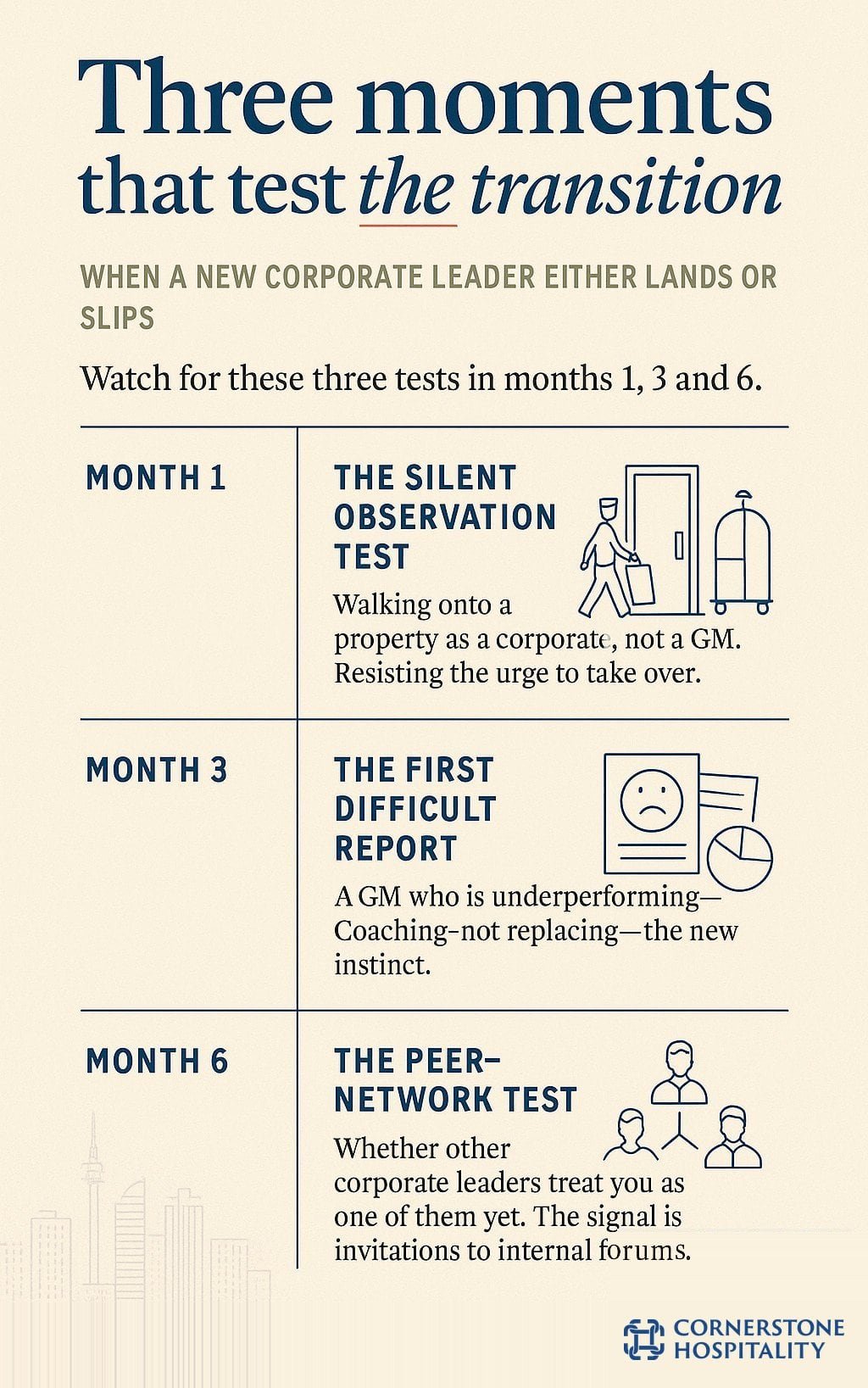
The shift doesn’t happen in one conversation. Instead, the identity shift in the move from GM to corporate hospitality leadership happens through a series of moments. Those moments arrive during the first six months. Each one forces the leader to choose between the old reflex and the new posture. Three of them come up reliably enough to plan for, and to coach around.
Six-month stress tests
Three moments in the first six months that test the GM to Corporate identity shift.
-
Weeks 4 to 6: the first cross-brand escalation.
A property crisis lands on the new leader’s desk and the GM instinct is to fly in and fix it. The corporate move is to hold the pen on the brief and let the operator run the play.
-
Weeks 10 to 14: the first portfolio decision with no daily feedback.
The leader has to make a capital call or brand-mix decision. However, the answer will not be visible for a year. The GM instinct is to postpone until the data lands. The corporate move is to decide with the evidence available and defend it.
-
Weeks 20 to 26: the first quiet quarter.
Nothing is on fire and there is no operational rhythm to fill the calendar. The GM instinct reads it as underperformance. The corporate move is to use the quiet to write the next 18-month agenda.
Three observation windows in the first six months
- ✓Month 1, the silent observation test. The leader walks onto a property as a corporate, not a GM. The old reflex says diagnose and fix; the new posture says watch, ask and read the pattern.
- ✓Month 3, the first underperforming GM. Now the leader inherits a GM who isn’t hitting the brief. Here the old reflex says replace. Meanwhile, the new posture says coach, and give them the picture they may not yet see. Then escalate only after the coaching has had a real run.
- ✓Month 6, the peer-network test. The leader notices whether other corporate-level leaders treat them as one of the room yet. That includes peers in the same group, on the brand side, and on the owner side. The honest read on the peer-network test is the most reliable signal that the identity shift has actually landed.
Why the three moments matter
Why this matters
Each of the three moments is the whole identity shift in miniature. When a leader chooses the new posture in all three, they have crossed the bridge. By contrast, some leaders revert to the GM reflex in one of the moments, especially the third. Those leaders tend to stall in the corporate role even when the technical work is going fine. Ultimately, the peer network is the harshest mirror. It reflects back the social position the leader has actually earned, instead of the one the title implies.
Making the jump from GM to corporate or regional? Or supporting a leader who is? The conversation starts with where in the shift the leader actually sits, not with where the title says they are.
What to do
Five tells of a GM to corporate hospitality transition that lands
The pattern repeats. Across the leaders Cornerstone has walked through this shift, the ones whose transition genuinely lands typically share five observable habits. Those habits show up during the first six months. Each one is small enough to act on this week and consequential enough to compound over the year. Currently, 82% of surveyed hotels report a staffing shortage [4]. As a result, the corporate leaders who make this transition cleanly become the talent the industry quietly competes for.
- They name the loss of the GM role out loud.
The leaders who land soonest acknowledge the loss plainly. They admit they miss the property, the ceremony, the team, the daily feedback. Naming the loss is what frees the leader to stop trying to recreate it from the corporate seat.
- They build a written stakeholder map in week one.
Names, cadence, expectations, the one thing each stakeholder needs in the first ninety days. The leader refreshes the map monthly, and it shapes the calendar from then on.
- They visit properties without taking over.
In practice, the first property visit is a watching exercise. The leader asks more than they answer. Consequently, the GM ends the day feeling backed, instead of assessed.
Peer network and the coaching commitment
- They build a corporate-level peer network deliberately.
Peers at the same altitude carry the conversations that no GM can. They sit inside the group, at competitor brands, and on the owner side. Meanwhile, the leader who waits for the peer network to form by accident stays lonely at the new altitude.
- They commit to coaching, on themselves and downward.
A coach for the leader, ideally retained before the move, carries the leader through the identity shift. The leader, in turn, becomes the coach to the GMs they oversee. The reflex moves from solving to enabling, and the role finally clicks.
What to do next
Are you preparing for a GM to corporate hospitality move, or sponsoring a leader who is? Then commission the coaching engagement before the move, not after. The leaders who arrive in the new seat with the identity shift already started clear the first six months. They also do it without losing momentum.
About this approach
Scope: Pre-move preparation, first-90-day intensive, full-year integration coaching.
Inputs: Identity-shift work, stakeholder-matrix mapping, peer-network design, sponsor and GM-team alignment.
Duration: Typically 9 to 12 months end-to-end, intensive in the first ninety days, tapering thereafter.
Network: Drawn from Cornerstone International Group’s global Hospitality, Travel & Leisure Practice. 60+ offices across 40+ countries, 35+ years of practice depth.
Glossary
- GM to corporate hospitality move
- The move from single-property General Manager to above-property leadership. The leader stops running one property and starts leading multiple properties or a function from a corporate or regional seat. Usually, it is the first time the industry pays a hospitality leader to influence rather than to do.
- Identity shift
- The internal re-tooling that converts a GM’s instincts into a corporate leader’s posture. The instincts are hands-on, present, directly responsible; the posture is coaching, pattern-reading, indirect influence. The component of the move that the title doesn’t change on its own.
- Detective-like instinct
- The corporate leader’s reading-and-triangulation posture. It means looking at patterns across properties, validating laterally, withholding intervention until the picture is clear. The replacement for the GM’s diagnose-and-fix reflex.
- Stakeholder matrix
- The multi-layer set the corporate leader is now accountable to. It spans owners, GMs, board, functional partners and external stakeholders. It runs broader and noisier than the single-property GM stakeholder set. That makes it the most common point of overload in the first ninety days.
- Peer-network test
- The honest month-six read on whether the new leader now counts as one of the room. It asks whether other corporate-level leaders treat them that way yet. That includes leaders inside the group, at the brand, and on the owner side. The most reliable single signal that the identity shift has actually landed.
- Sponsor
- The senior executive (CEO, owner, chair) who carries the relationship with the new corporate leader through the integration window. Distinct from the line manager and from the coach.
Frequently asked questions
Is the GM to corporate hospitality coaching done before or after the move?
Both, ideally. The strongest engagements start in the weeks before the move. Then they run intensively through the first ninety days and taper through the rest of the first year. The leaders who arrive with the identity shift already underway clear the early tests faster and with less collateral damage.
How long does the transition usually take?
Six to twelve months for the operating reflexes to fully reset. The first signs of competence usually arrive by month three. However, the full identity shift takes the full year for most leaders. That moment arrives when the peer network treats the leader as one of the room.
Can you coach the GMs the new corporate leader oversees as well?
Yes, and sometimes the most useful work is on the other side of the relationship. GMs adjusting to a new style of leader above them benefit from coaching too. In particular, coaching helps them read the new leader’s posture and calibrate what to escalate. It also helps them resist the temptation to dismiss the corporate as “not a real GM”.
On owner-operators, flagship GMs and how we measure the shift
Do you work with owner-operators making this same shift?
Yes. The move from owner-operator to corporate leader within a growing portfolio is structurally similar. Likewise, the role asks the leader to influence rather than do, on a wider matrix of stakeholders. It also shares many of the same coaching themes. The emotional component is often sharper because the property is the leader’s own.
What if the leader’s previous role was GM of a flagship property?
Flagship GMs sometimes have the hardest transition. That is because the GM role itself was already partly corporate: brand spokesperson, owner counterpart, public face. The identity shift is real even so. However, the leader now has to learn the indirect-influence and pattern-reading work. That learning runs alongside the loss of the single-property identity the flagship gave them.
Is this a coaching engagement or a search engagement?
Usually a coaching engagement, but it often arises from a search Cornerstone Hospitality has placed. Indeed, the seamless handover from search into coaching is part of how the practice works. Boards commissioning a senior corporate hire frequently scope the coaching at the same time as the search itself.
How do we know whether the shift has actually landed?
The peer-network test at month six is the most reliable signal. Look at how other corporate-level leaders respond, inside the group, at the brand, on the owner side. If they have started to treat the new leader as one of the room, the identity shift has taken. If the leader is still defaulting to GM stories in those conversations, they need more time and more coaching.
Read next
Sources
- PrimeGenesis: 40% of executives pushed out, fail, or quit within 18 months (citing Heidrick & Struggles internal study of 20,000 searches; CEO Kevin Kelly interview, Financial Times, 30 March 2009): primegenesis.com/2009/04/40-percent-of-execs-pushed-out-fail-or-quit-within-18-months
- Leadership IQ: Executive Failure Rates (study of 20,000+ new hires across 312 organizations): “46% of newly hired employees failed within 18 months while only 19% achieved unequivocal success. Attitudes drive 89% of hiring failures while technical skills account for only 11%.”: leadershipiq.com/blogs/leadershipiq/executive-failure-rates
- Plum: Schmidt & Hunter (1998) Meta-Analysis Explained: structured interview r =.51, cognitive ability r =.51, composite validity of structured interview + cognitive ability >.60: plum.io/blog/schmidt-hunter-meta-analysis
- Kapable: Statistics On Leadership In The Hospitality Industry: 82% of surveyed hotels report a staffing shortage; 73% annual U.S. hospitality turnover: kapable.club/blog/statistics/statistics-on-leadership-in-hospitality-industry
- McKinsey & Company: Scott Keller and Mary Meaney, Successfully transitioning to new leadership roles (May 2018): “between 27% and 46% of executive transitions are regarded as failures or disappointments” two years in; 68% of transitions founder on issues related to politics, culture and people: mckinsey.com/capabilities/people-and-organizational-performance/our-insights/successfully-transitioning-to-new-leadership-roles
- Harvard Business Review: Michael D. Watkins, How Managers Become Leaders (June 2012): the “seven seismic shifts” required when a leader moves from functional or operational leadership to enterprise leadership for the first time: hbr.org/2012/06/how-managers-become-leaders
Florian leads Cornerstone International Group’s global Hospitality, Travel & Leisure Practice. He brings seventeen years of senior hospitality experience, including Marriott, Hyatt, IHG, Mandarin Oriental and Shangri-La Hotels & Resorts. His background also includes sixteen years in retained executive search. He is bilingual in English and German and works across Europe, the Middle East, the Americas and Asia-Pacific.