


The ROI of Executive Coaching for Senior Hospitality Leaders
The ROI case above sits inside a broader picture. See how we structure leadership development for senior hospitality leaders for how coaching, team work and succession planning fit together across a career, not just a single engagement.


A board or a CEO may sponsor coaching for a senior hospitality leader. In that case the first question is fair. Does the ROI of executive coaching justify the spend? It does. Indeed, the independent research is generous about the size of the return, and it shows up across two timeframes. There is a measurable payback inside the first twenty-four months. Beyond that, a compounding return keeps building for a decade, because by then the leader has genuinely changed how they work.
In practice, that return holds for any leader. It applies to a newly appointed GM, a regional VP stepping into five new markets, a C-suite hire in the first ninety days, or a long-serving operator reaching for the next chapter. The more useful question is not whether coaching pays, but how the return shows up and where it lands on the P&L.
What follows is what the evidence says, and how Cornerstone Hospitality measures the ROI of executive coaching that boards sponsor. Most of all, though, it is why the gains that matter most are the ones a leader carries long after the final session.
What the research says about the ROI of executive coaching in hospitality
The Stakes: What the Research Says
Independent ROI data on executive coaching engagements, alongside the hospitality talent gap that makes leadership investment a strategic priority. Sources are listed in full beneath the article.
The four horizon view
Where’s your career going? Let’s find out together.
Have a short, private conversation with our AI assistant. It asks 7 questions, takes 6 to 8 minutes, and you leave with a personalized read on your next move, sent straight to your inbox.
The Numbers
The ROI of executive coaching hospitality boards keep asking about
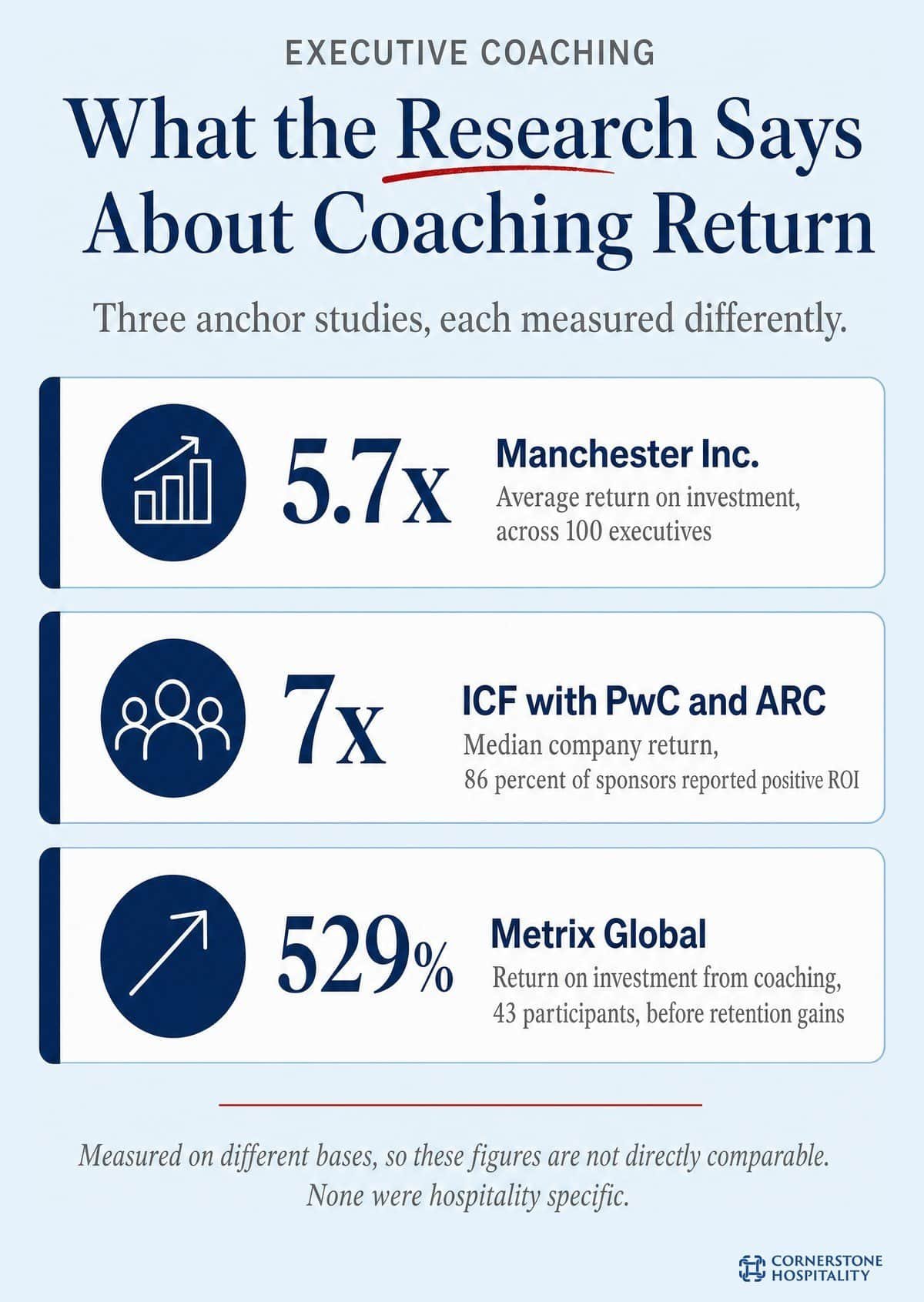
The research on coaching ROI is unusually consistent. Indeed, three of the most-cited studies land on the same picture: a well-run engagement returns a large multiple of its cost. The figures differ because each measures something different, yet the direction never does.
Four measurable signals
The return on the ROI of executive coaching that hospitality boards actually sponsor
What the three anchor studies say about executive coaching ROI in hospitality
The International Coaching Federation, together with PricewaterhouseCoopers and the Association Resource Center, surveyed coaching clients directly. It found a median company return of roughly seven times the cost of the engagement, with 86% of sponsors reporting positive ROI [5].
The Manchester Inc. study in The Manchester Review followed 100 executives, most from Fortune 1000 companies. Likewise, it put the average return at 5.7 times the initial investment, with strong gains in working relationships, teamwork, and retention alongside the financial figure [6].
The Metrix Global study by Merrill C. Anderson worked with a Fortune 500 firm and 43 leadership development participants, and documented a 529% ROI from the coaching itself, before counting the gain from better retention [7].
None of these studies were hospitality-specific, which raises a fair question: does the same mechanism work inside a hospitality leadership team? Still, in our experience it does, and it behaves the same way in a luxury resort, a select-service brand, or a global corporate office. That confidence rests on sixteen years of retained search and coaching across our Hospitality, Travel & Leisure Practice.
Where the honest ROI of executive coaching in hospitality comes from
Why this matters
The consistency is what lets a CEO or CHRO fund coaching for a hospitality leader and expect a real return. Three studies, three methods, one direction. Set that against the cost of a single wrong senior hire. The wider literature is blunt about the risk. It puts senior-executive failure as high as 40% within 18 months [1], and new-hire failure at 46% over the same window [2]. So coaching the people already in seat becomes the easy call.
The hospitality-specific multiplier on executive coaching ROI
Hospitality changes one number: how scarce the leader is. Indeed, the talent gap runs deep, with 82% of surveyed hotels reporting a staffing shortage [4] and annual U.S. hospitality turnover near 73%. Because that pressure reaches all the way up, it changes the math.
Picture a senior leader who leaves, stalls at eight out of ten, or struggles to land their next move. The cost is not only the salary. It is the empty seat, because capable replacements are simply in short supply.
Consider a coaching dollar that keeps a strong GM in seat for another three years, or lifts a regional VP from eight to nine. That dollar is worth more when the alternative is scarce. Yet boards miss this hospitality multiplier whenever they benchmark against generic cross-industry numbers. So the base return matches the literature, while the strategic value sits higher.
What to do
- When sponsoring coaching, model the return against the cost of not coaching. In particular, that includes the cost of a vacancy that cannot easily be filled in today’s hospitality market.
- Use the literature’s 5.7× to 7× range as the conservative anchor, not the ceiling. Indeed, the compounding return on a coached leader runs well past the 24-month payback window.
- Treat the scarcity premium as part of the case, not a separate calculation. Precisely because talent is scarce, a retained and sharpened leader is worth more in a thin market than in a saturated one.
The Timeframes
Two timeframes for executive coaching ROI in hospitality: the 24-month payback and the 10-year compound
Sponsors make one mistake more than any other: they fold two very different returns into one number. Specifically, the short-arc return is the one the studies describe. It is a payback inside roughly twenty-four months, visible in the operational metrics tied to the leader’s remit. The long-arc return, however, is different. It is the compounding effect on how the leader works for the rest of their career.
What each horizon actually measures
The table below sets the two horizons side by side. They answer different questions and land on different lines of the business. As a result, keeping them apart lets each part of the case stand on its own.
| Horizon | What it measures | Where it shows up |
|---|---|---|
| 0 to 24 months | Direct payback on the engagement cost, the 5.7× to 7× range the literature consistently reports. | Operational metrics on the leader’s remit: retention of direct reports, decision velocity, engagement scores, owner-relationship outcomes. |
| 2 to 5 years | Carry-over effect: the leader operates differently in every role from here forward, including any subsequent roles they hold. | Career trajectory, network strength, board-presence quality, the leader’s ability to land subsequent transitions cleanly. |
| 5 to 10+ years | Compound effect: the leader runs whatever they touch with the disciplines the coaching installed. | Long-arc P&L outcomes, the quality of the leaders that this leader promotes, the cultures they build. |
How the long-arc return actually shows up
The short-arc number gets the engagement funded, while the long-arc number makes it strategic. For instance, a GM who lets go of a limiting belief about delegation in month four runs their property differently for a decade. Likewise, a C-suite hire who lands the first ninety days cleanly sidesteps the slow cultural drift that costs hospitality organizations years to undo.
The Manchester study documented gains in working relationships (77%), teamwork (67%), peer relationships (63%), and job satisfaction (61%) [6]. Indeed, these are exactly the gains that compound.
“The leaders we coach for ten or twelve months become better operators for the next decade of their career. That is not a 24-month payback calculation. That is a 10-year payback calculation. And it is the only honest way to discuss the ROI of executive coaching hospitality boards are funding.”
Cornerstone Hospitality, senior coaching practice
Where the honest ROI of executive coaching in hospitality comes from
Why this matters
The two horizons answer two questions. Because the CFO funds the engagement, that role wants the 24-month payback math, and the literature delivers it. A CEO, by contrast, lives with the leader’s development for years. They want to know what kind of operator they get for the next decade. Blur the two and you get disappointment in the short arc and undervaluation in the long one. Held apart, each line of the case earns its own funding.
The Signals
Four signals of executive coaching ROI in coached hospitality leaders
Across the hospitality executives we coach, four signals show up again and again. Because they hold up in board reviews and honest sponsor conversations, we lead with them when scoping a new engagement. Moreover, each is measurable, grounded in the research, and clear enough that a board can see it without the coach in the room.
- ✓Multiple-times return on the cost: the literature’s 5.7× [6] to 7× [5] range, measurable within twenty-four months on operational metrics tied to the leader’s remit.
- ✓Ten-plus years of lasting effect: a coached leader runs whatever they touch differently for the rest of their career, including subsequent roles after this one.
- ✓Direct-report retention rises: 77% of coached executives in the Manchester study reported significantly improved working relationships with their direct reports [6], and retention follows that improvement.
- ✓Decision quality improves: measurable at board and ownership level, with productivity and decision-cycle gains documented in 60% of Metrix Global respondents [7].
Why these four and not others
We chose these four because a hospitality board can actually see them. For example, a multiple-times return is a number the CFO can model. Similarly, ten-plus years of lasting effect is something the CEO watches over the next few promotion cycles. Direct-report retention, meanwhile, is something HR can pull from the system, while decision quality is something the chair feels in the boardroom. That visibility is what makes the funding case honest.
Where the literature sits behind each signal
The four signals map cleanly onto what the research already documents. Manchester’s catalog of intangible benefits runs through all four [6]. The ICF/PwC positive-ROI finding sits behind the first [5], while the Metrix Global productivity and satisfaction figures sit behind the fourth [7]. So the framework is not invented; rather, it is the consistent picture the research paints, in terms a hospitality board uses every week.
Compounding over time
What the ROI of executive coaching compounds into for senior hospitality leaders
| Horizon | What the leader gains | What the business gains |
|---|---|---|
| 3 months | A clearer thesis, sharper decisions, fewer avoidable meetings | Faster resolution on one or two stuck issues |
| 6 to 9 months | Confidence in the harder conversations, cleaner delegation | Higher engagement scores on the direct-report cohort |
| 12 to 18 months | A larger platform, a bigger next role, the ability to sponsor others | Retention of the leader and the leaders below |
| 2 to 3 years | A body of work the market recognizes, a network that pulls | A senior succession bench the board no longer has to worry about |
Where the compounding ROI of executive coaching lands for hospitality leaders
These returns are real, but they show up in retention, decision quality, and team performance rather than in this quarter’s revenue. For instance, a senior team that surfaces disagreement well makes better strategic calls for years. Meanwhile, a new C-suite hire who lands cleanly delivers value a botched start would have destroyed. Even so, boards that fund coaching well know which P&L lines those returns eventually touch.
What to do
- Pick two of the four signals that map cleanest to the leader’s remit. Then measure those at baseline and at endline, but resist the temptation to measure everything.
- Build the baseline before the chemistry session, not after. Pre-engagement numbers are the only honest comparator at endline.
- Agree in writing on what counts as a signal moving, together with the sponsor. Verbal agreements about ROI otherwise evaporate the moment the leader’s next promotion comes up.
The Measurement
How Cornerstone measures the ROI of an executive coaching engagement in hospitality
The measurement framework matters, because the consistency in the research depends on it. Indeed, the studies behind those returns were structured measurements with named baselines, agreed endlines, and disciplined data collection. Likewise, engagements that produce honest numbers do the same. Skip the measurement layer and you get stories instead, and stories do not survive the board’s next budget conversation.
The four measurement layers, stacked
We run the four layers below at every engagement, in the same order, with the same instruments at baseline and endline. Ultimately, that discipline is what turns the coaching work into a number a board can defend.
First, a structured baseline at session one and a matched endline at month twelve, the leader rates themselves against the three to five outcomes in the goal contract.
Similarly, a structured conversation with the sponsoring CEO, CHRO, or board chair at month one and month twelve: What has changed in how the leader shows up.
A structured 360 at baseline and endline where the engagement warrants it. Picks up changes the leader and the sponsor cannot see from their own vantage point.
Specific business measures tied cleanly to the leader’s responsibilities, direct-report retention, guest scores, owner satisfaction, and decision velocity.
Why the four layers are stacked in this order
The order is deliberate. First of all, the self-assessment is the honest inside view. Then the sponsor view captures how the organization now experiences the leader, while the 360 adds the perspective of reports, peers, and superiors. Finally, the operational metrics anchor it all in numbers a CFO can audit. Where the four agree, the case is unimpeachable; where they disagree, that disagreement is itself the most useful data.
How the framework is run in practice
About this measurement framework
Cadence: Baseline at session one. Mid-engagement stocktake at month six. Endline at month twelve. The same instruments are run at baseline and endline so the comparison is honest.
Confidentiality: The leader’s self-assessment and 360 detail stay inside the coaching room. What is shared with the sponsor is the agreed summary against the goal contract, never the leader’s private reflections.
Reporting back: In B2B engagements, the sponsor receives a structured month-six and month-twelve summary written by the coach with the leader’s sign-off. In B2C engagements, the measurement stays entirely with the leader.
Industry context: All measurement is run by coaches drawn from inside the global Hospitality, Travel & Leisure Practice. It spans 60+ offices across 40+ countries, with 35+ years of practice across the group. Every coach brings deep first-hand hospitality experience.
Where the honest ROI of executive coaching in hospitality comes from
Why this matters
The field now counts more than 122,000 coach practitioners worldwide [5], big enough that measurement quality varies widely. Consequently, the ROI that holds up in a board review comes from engagements that built the measurement in from the start. Nobody bolts credibility on at the end, so that discipline separates a compounding engagement from one that fades into a story nobody can verify.
Is your organization considering coaching for a senior hospitality leader? For an honest conversation about what the ROI of executive coaching hospitality engagements actually looks like, we are glad to scope it with you.
What to do
What to do: a sponsor’s checklist to protect the ROI of executive coaching in hospitality
What the sponsor does before the first session matters more than anything else to the return. Specifically, five disciplines are agreed up front. They almost always separate an engagement that compounds for a decade from one that ends in a polite result and a quiet wind-down. Yet none is complicated, and all five are routinely skipped.
Five disciplines the sponsor sets before session one
Each of the five below is the sponsor’s work, not the coach’s. Together they turn a well-scoped engagement into one that returns real, defensible numbers. So skip any of them, and the return drops a notch.
- Pick the leader who is already reaching.
The ROI research is built on leaders who were genuinely curious about their own development. Because of that, the return is highest with a willing leader. Meanwhile, coaching someone who has merely been told they need it produces a fraction of it. In short, the leader has to want it, so pick people who are reaching, not people who are being pushed.
- Agree to the goal contract in writing.
Three to five outcomes the leader is committing to, with the success markers used to measure them. Signed by the leader, the sponsor, and the coach. The contract is what the month-six and month-twelve stocktakes return to. Ultimately, it is the difference between a measurement and an opinion.
- Build the baseline before session one.
Direct-report retention figures, engagement scores, the leader’s 360, and the operational metrics that map to the goal contract, all captured before the work begins. Without a baseline, the endline has nothing to measure against, and the return becomes an anecdote rather than a number.
Disciplines that hold the return during and after
- Protect the calendar from day one.
Ninety minutes every two to three weeks, blocked for twelve months, treated as immovable. Some senior leaders treat coaching sessions as the first thing to move when something else comes up. As a result, they get a fraction of the literature’s ROI. The calendar discipline is itself part of the work.
- Plan the post-engagement runway.
The compounding return only compounds if the leader carries the disciplines forward after month twelve. So a written runway plan at close-out turns a strong engagement into a decade of carry-over value. It covers what the leader will keep doing, what the sponsor will check in on, and how the next stretch role connects.
What to do next
Sponsoring coaching for a senior leader in the next twelve months? Work through the five items above before the chemistry session is booked. The disciplines that produce the return go in before the work starts, and nobody retrofits them at the end.
The Proof
What our clients and candidates say
In a small global industry, the return on a senior leader is what other leaders say about them when they are not in the room. Here is what two of them have said about working with our team.
“Florian played a pivotal role in my career transition within the hospitality industry, combining deep expertise in executive search with a highly strategic advisory approach. He takes the time to truly understand your long-term ambitions, challenges your assumptions, and positions you for sustainable leadership success. His network across the global hospitality sector is exceptional, and his commitment to delivering the right long-term fit goes far beyond a transactional placement.
Stefan SavicHospitality Professional · Asset Management, Development & Strategy
“Over the years I have worked with Florian and he has continually provided a service second to none. The caliber of individuals he recommends is always spot on, as he ensures that he understands not only the requirements and expectations of a role but also the importance of the success and growth of the business being related to people.
Daniel AylmerChief Executive Officer, Greater China
Both quotes are verified public LinkedIn recommendations from clients and colleagues who have worked with Florian Kittler.
Glossary
- ROI of executive coaching
- The financial and intangible return generated by a structured executive coaching engagement, measured as a multiple of the cost of the engagement. The independent literature’s consistent range is roughly 5.7× to 7× median, with documented cases substantially above that.
- Goal contract
- A short written agreement at the start of an engagement that names the three to five outcomes the leader is committing to, with the success markers used to measure them. Signed by leader, sponsor, and coach.
- Baseline/endline measurement
- The pre-engagement and post-engagement measurement of the same instruments, leader self-assessment, sponsor view, 360 feedback, and operational metrics allows honest comparison at month twelve.
- Sponsor view
- Similarly, a structured conversation with the sponsoring CEO, CHRO, or board chair at baseline and endline, capturing what has changed in how the organization experiences the leader.
- Compounding return
- The carry-over effect of behavioral change that the coached leader takes forward into every subsequent role they hold, typically running ten years or more beyond the engagement.
- Runway plan
- The written close-out document at month twelve that sets out what the leader will continue doing, what the sponsor will check in on, and how the disciplines installed during the engagement are sustained after it ends.
Frequently asked questions
What is the realistic ROI of executive coaching hospitality boards should expect?
The independent literature converges on a median company return of roughly seven times the cost of the engagement [5]. A Fortune 1000 structured study puts the average at 5.7 times invested [6]. A Fortune 500 case study, meanwhile, documents 529% ROI from the coaching process itself [7]. In hospitality specifically, the talent-scarcity premium tends to amplify those numbers further. Holding a high-performing senior leader in seat is worth more in a market where 82% of surveyed hotels report a staffing shortage [4].
How do you measure ROI on a hospitality coaching engagement?
Through four layers of measurement agreed at the start. These are leader self-assessment, sponsor view, 360 feedback where the engagement warrants it, and operational metrics tied cleanly to the leader’s responsibilities. Each layer is captured at baseline and endline so the comparison is honest. Where the four layers agree, the case is unimpeachable; where they disagree, the disagreement itself is data.
Does coaching show up on the P&L?
Not directly, not the same quarter. It shows up over time through retention of direct reports, decision quality, owner-relationship outcomes, and team performance. Those lines affect the P&L, though nobody labels them as coaching. Still, the Manchester Inc. study documented productivity and quality gains alongside intangible benefits. It found them in 77% of coached executives’ working relationships and 67% of teamwork outcomes [6]. Those gains land on the P&L through familiar lines.
Questions about the engagement itself
What if the leader being coached leaves the organization?
It happens, and the investment still tends to pay off. The leader’s wider network and reputation often bring future business or future hires back to the organization. Coaching is not a retention tool, but it is rarely wasted, particularly in hospitality. The talent gap means a coached leader who moves elsewhere often returns to your orbit through partnerships, advisory work, or future hires.
How long does a typical engagement run, and how does the length affect ROI?
Six to twelve months for most senior hospitality leaders, with sessions every two to three weeks. Shorter engagements rarely move the needle deeply enough to produce the ten-year compounding effect that drives the strategic return. Longer engagements occasionally make sense for complex multi-year transitions. The literature’s ROI numbers are based predominantly on engagements at the six-to-twelve-month length.
Who decides the goals, leader, sponsor, or coach?
All three in the first contracting conversation. The coach holds the goals; the leader owns them; the sponsor reviews progress at agreed checkpoints. In B2B engagements, the goal contract is signed by all three before the work begins. In B2C engagements, the leader owns the contract alone.
How quickly does the ROI of executive coaching hospitality engagements actually become measurable?
The first measurable shifts typically appear at the month-six stocktake on the operational metrics tied to the leader’s goal contract. Generally, the fuller payback against the engagement cost lands inside twenty-four months, in line with the literature’s median figures. The compounding strategic return continues for the rest of the leader’s career.
Read next
Sources
- PrimeGenesis: 40% of executives pushed out, fail, or quit within 18 months (citing Heidrick & Struggles internal study of 20,000 searches; CEO Kevin Kelly interview, Financial Times, 30 March 2009): primegenesis.com/2009/04/40-percent-of-execs-pushed-out-fail-or-quit-within-18-months
- Leadership IQ: Executive Failure Rates (study of 20,000+ new hires across 312 organizations): “46% of newly hired employees failed within 18 months while only 19% achieved unequivocal success. Attitudes drive 89% of hiring failures while technical skills account for only 11%.”: leadershipiq.com/blogs/leadershipiq/executive-failure-rates
- Plum: Schmidt & Hunter (1998) Meta-Analysis Explained: structured interview r = .51, cognitive ability r = .51, composite validity of structured interview + cognitive ability >.60: plum.io/blog/schmidt-hunter-meta-analysis
- American Hotel & Lodging Association (AHLA): 82% of Surveyed Hotels Report Staffing Shortages: ahla.com/news/82-surveyed-hotels-report-staffing-shortages. Annual U.S. hospitality turnover ~73% (Kapable, Statistics On Leadership In The Hospitality Industry): kapable.club/blog/statistics/statistics-on-leadership-in-hospitality-industry
Primary ROI studies
- International Coaching Federation: Coaching Statistics: The ROI of Coaching (citing the ICF / PricewaterhouseCoopers Global Coaching Client Study): 87% of survey respondents agreed that executive coaching has a high return on investment; average ROI of seven times the cost of employing a coach (PwC / Association Resource Center survey): coachingfederation.org/blog/coaching-statistics-the-roi-of-coaching-in-2024. Field size: 122,974 coach practitioners worldwide; industry revenue: $5.34 billion USD (2025 ICF Global Coaching Study): coachingfederation.org/resources/research/global-coaching-study
- Manchester Inc.: Maximizing the Impact of Executive Coaching, The Manchester Review, 2001, Volume 6, Number 1 (McGovern et al.). Study of 100 executives, mostly Fortune 1000: average ROI of 5.7 times the initial investment; intangible benefits included improved working relationships with direct reports (77%), with immediate supervisors (71%), teamwork (67%), peer relationships (63%), and job satisfaction (61%): donnaschilder.com/manchester-study
- MetrixGlobal LLC: Executive Coaching Return on Investment Study (Merrill C. Anderson, Ph.D., conducted for a Fortune 500 firm with Pyramid Resource Group): “A 529% return on investment was produced by the coaching process (excluding the benefits from employee retention).” Target population: 43 leadership development participants; productivity cited as significantly impacted by 60% of respondents and employee satisfaction by 53%: empowermenttoolbox.com/MertrixSurvey.html
Florian leads Cornerstone International Group’s global Hospitality, Travel & Leisure Practice. He brings seventeen years of senior hospitality experience, including Marriott, Hyatt, IHG, Mandarin Oriental and Shangri-La Hotels & Resorts, and sixteen years in retained executive search. He is bilingual in English and German and works across Europe, the Middle East, the Americas and Asia-Pacific.