


Personal Branding for Hospitality Executives: Five Surfaces, One Story
Personal branding hospitality executives take seriously is not a marketing exercise. Instead, it is the small set of surfaces a recruiter, a board member, or a curious owner will check. That check happens in the first two minutes after a senior leader’s name comes up. Notably, five surfaces carry almost all of that weight: LinkedIn, conference visibility, industry-association presence, written voice, and the owner-and-network referral. That referral follows the name into the next conversation. In practice, get them aligned, and the next role finds the leader. By contrast, leave them inconsistent, and the first impression does the work without them. That gap matters, because roughly 80% of senior hospitality roles fill through the network rather than through public postings [5].

Personal branding hospitality executives take seriously is rarely loud. It shows up as a LinkedIn profile that reads like a case file, a conference introduction that gets repeated correctly, and a reputation that precedes the first call from a recruiter. Personal branding hospitality executives neglect is just as visible, in the wrong way: a stale profile, no point of view, nothing a peer could actually repeat about them.
Furthermore, the job of the personal branding for hospitality executives is not to look polished. Instead, it is to make sure the five surfaces tell the same story. So picture a board member asking a peer about the leader. The peer’s description, the LinkedIn headline, and the conference stage they last shared should all answer the same question. So should the article they last wrote and the owners they last worked for, all the same way. Ultimately, one coherent narrative across five surfaces. Anything less leaks confidence at exactly the moment the leader needs it most.
Notably, this is the framework Cornerstone Hospitality uses when a senior leader engages us for brand work. Sometimes that sits inside a career-transition engagement; sometimes it runs as a standalone tune-up while the leader is in seat. In practice, the five surfaces hold either way.
The stakes, what the research says
Industry data on the hidden senior job market, hiring-decision predictors, and the value of visible leader reputation. Sources listed in full at the foot of the article.
- Career transition support for senior hospitality executives
- The first 14 days after a senior hospitality exit
- Compensation for the next hospitality role
The Framework
Five surfaces, one story: the personal branding for hospitality executives
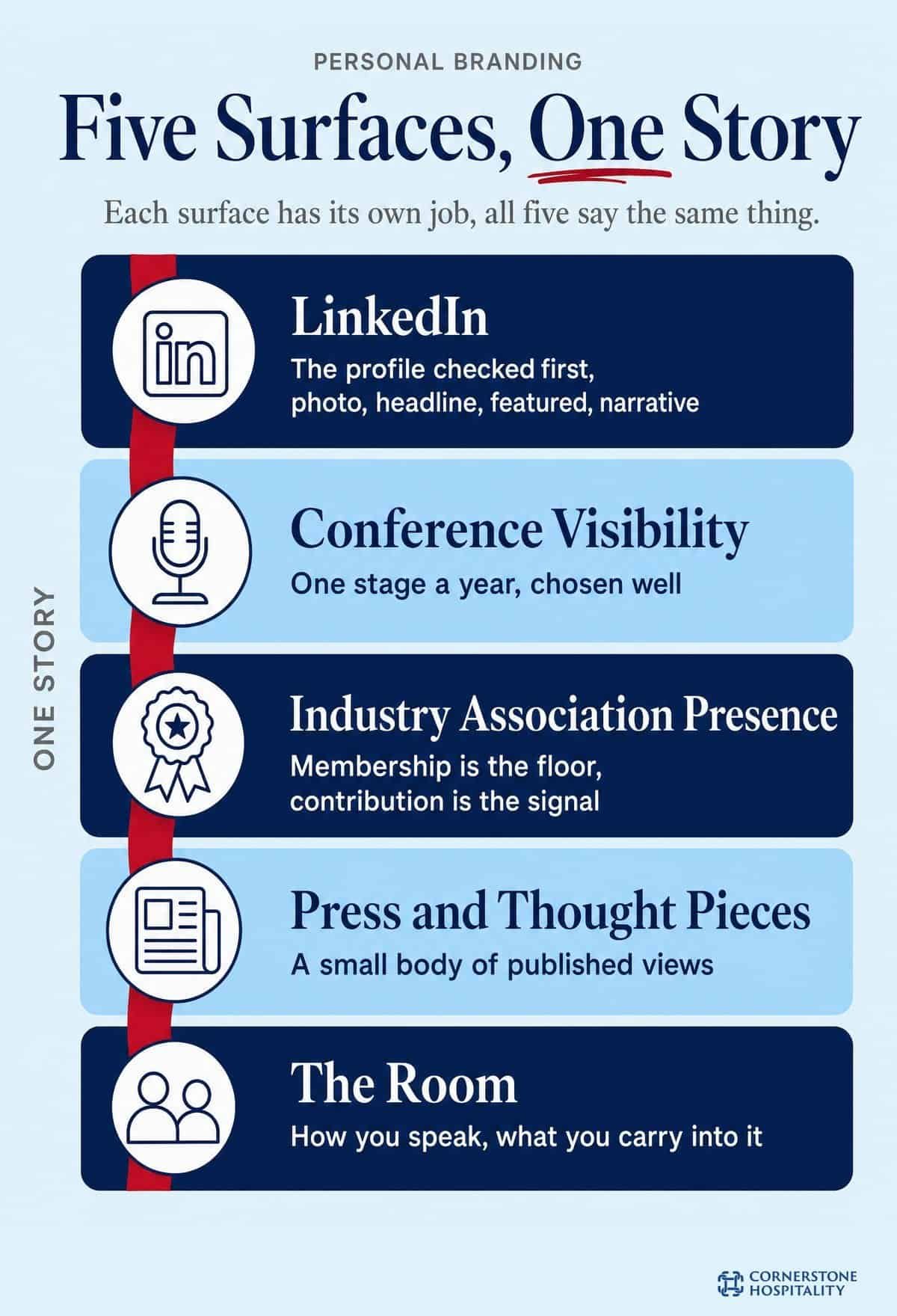
In practice, a senior leader’s personal branding for hospitality executives lives across five surfaces, instead of one. Notably, each surface answers a different question for a different audience. However, the story across them has to be the same story. Consequently, a recruiter might pull up the LinkedIn, hear the conference panel, and see the ISHC profile. Then they read the recent article and ring the last owner. Throughout, they should hear five versions of one coherent positioning, instead of five different leaders.
Five surfaces
The five surfaces where personal branding for hospitality executives is judged
The five surfaces, each with its own job
The profile a recruiter, board member, or owner checks first. Photo, headline, featured, narrative sentence, the four corners.
The rooms the leader stands in front of, ILTM, IHIF, ALIS, regional summits. One stage a year, chosen well, beats six chosen at random.
ISHC, HSMAI, AHLA, EHMA, the credentialed peer body the leader contributes to. Membership is the floor; contribution is the signal.
The one or two articles, op-eds, or thought pieces a leader has put their name to. Anchor assets, not a publishing treadmill.
What the last owner, chair, and sponsor say when an unprompted call comes in. The most decisive surface of the five.
A narrative sentence the leader has rehearsed, that travels intact across every surface. Without it, the five surfaces fragment.
Why this matters
Senior hospitality is a small global village. A board member who hears a name will check three or four surfaces inside a single coffee. The leader doesn’t get to be present for that check, the surfaces are. If they line up, the next conversation starts warm. If they don’t, the next conversation may never happen.
Surface One
LinkedIn, the profile that gets checked first
In practice, LinkedIn comes first among the five surfaces. That is because a recruiter, board chair, or owner will reach for it inside the first ninety seconds. Notably, the personal branding for hospitality executives lives or dies in four small zones on that profile. Those zones are the photo, the headline, the featured strip, and the narrative sentence threaded through the about section. Consequently, each of the four is cheap to put right, while it is expensive to leave broken.
The photo: recent, current, eyes to camera
First, taken inside the last eighteen months. Additionally, taken in a work context, instead of on holiday. Furthermore, lighting that flatters the eyes, not the suit. Notably, the photo is the first signal of whether the leader is current. It is also the cheapest signal to fix. By contrast, a conference photo from 2018 with the lanyard cut off tells its own story. No amount of headline polish can recover from it.
The headline: what they do now, not what they did last
In practice, the headline must describe the work now. So a senior leader between roles needs it updated, instead of carrying a stale job description. “Hospitality leadership advisor, hotel operations, brand development, owner-side strategy” reads better than “Former Vice President of Operations”. That holds for the entire intervening period. The headline is the snippet that travels with the leader’s name. Thereafter, it follows into every recruiter search result, every share, every InMail preview.
The featured strip: one anchor asset
The featured strip is the most under-used real estate on a senior leader’s profile. One pinned asset pulls the visiting eye past the headline into the substance. For example, a signature win, a piece of writing, or a project the leader is proud of. Three pinned assets are better than thirty, because three feel curated and thirty feel like noise.
The narrative sentence in the about section
The about section is where the narrative sentence lives. It is one line that explains everything the leader does, written in the leader’s voice. The leader memorizes it, so it shows up verbatim in interviews and on conference stages. The narrative sentence is the asset that pulls all of the other surfaces together. Recruiters lift it into shortlist emails. Meanwhile, board members repeat it back in the second-round interview. And the leader uses it as the opening of the cover letter that doesn’t need a cover letter.
“When a recruiter is on the phone for ninety seconds talking about a senior leader, the leader’s narrative sentence is what the recruiter remembers and repeats. It is the most leveraged piece of self-positioning a senior hospitality leader has, and it should live in identical wording on the LinkedIn about, the conference bio, the association profile, and the back of the business card.”
Florian Kittler, Managing Partner, Cornerstone Hospitality
Why this matters
Roughly 80% of senior hospitality roles fill through the network [5]. So the LinkedIn profile isn’t where the leader wins the role. But very often it’s the gate the leader has to pass through to reach consideration. A profile that no one has touched since 2021 silently disqualifies the leader. So it costs the leader invitations to conversations they would otherwise have joined.
Surfaces Two and Three
Where’s your career going? Let’s find out together.
Talk it through with our AI assistant. Seven questions, six to eight minutes, and a personalized summary lands in your inbox.
Conferences and industry associations: the rooms that compound
Many leaders treat these surfaces as optional. By contrast, most senior recruiters treat conference visibility and industry-association presence as decisive. Notably, together they answer the question every board quietly asks: who knows this person, and does the room respect them? Think of a leader who has chaired a panel at IHIF, presented research at ALIS, or sits on the ISHC membership roll. That leader carries a credibility marker that LinkedIn alone cannot deliver. In addition, it’s a marker the senior hospitality world is paying close attention to. Indeed, 81% of senior executives now call external leader visibility a mandate, not an optional extra, in building reputation [6].
One story, five surfaces
Before and after, the narrative sentence threaded through personal branding for hospitality executives
| Surface | Before, five different stories | After, one coherent story |
|---|---|---|
| LinkedIn headline | Generalist descriptor, buzzwords, no thesis | One line: what you do, for whom, with what outcome |
| CV summary | Chronology of titles, no through-line | Same one line, expanded into three evidence paragraphs |
| Conference bio | Written by whoever asked, in whatever tone | Same one line, rewritten to that audience |
| Published piece | One-off topic, unrelated to the rest | Sits inside the same thesis, adds new evidence |
| The room | Answers vary with mood and audience | Same one line, spoken with different examples |
Conferences: one stage a year, chosen well
In practice, the instinct of many senior leaders is to spread thin, speak at six events a year, attend twelve, sit on as many panels as the calendar allows. By contrast, the instinct of the most credibly branded leaders is the opposite. Notably, one stage a year, chosen for the right audience, with a thesis worth defending, beats six panels of platitudes. Ultimately, the senior hospitality conference world is small enough that the room remembers a substantive panel for years. Meanwhile, it forgets a generic one before the coffee break.
Furthermore, the choosing matters as much as the speaking. For example, ILTM Cannes if luxury is the leader’s axis. Similarly, IHIF Berlin if investment and owner relationships are. In addition, ALIS for the Americas track, FHS for the Middle East, HICAP for Asia-Pacific. Notably, each conference is a different audience signal. Therefore, aligning the stage with the next intended seat is the cheapest piece of strategic positioning a leader can do.
Industry associations: membership is the floor, contribution is the signal
Start with ISHC, HSMAI, AHLA, EHMA, and HVS-adjacent bodies. These credentialed peer organizations are where a leader’s professional citizenship is visible to other senior leaders. Notably, membership alone is the floor; instead, the signal is what the leader contributes. For example, the leader can chair a chapter committee or co-author an industry paper. Similarly, they can serve on a credentialing panel or mentor through a member program. Each one is a quiet act of leadership. Moreover, the network notices it without the leader needing to point it out.
What audiences check across the five surfaces
| Surface | What the audience checks | What strong looks like |
|---|---|---|
| Photo, headline, featured, narrative sentence in the about section. | Recent photo; headline describes current work; three pinned anchor assets; narrative sentence in the leader’s voice. | |
| Conferences | Which stages, which panels, what thesis the leader brought. | One well-chosen stage a year with a thesis the room remembers afterwards. |
| Industry associations | Which bodies the leader belongs to and what they contribute to those bodies. | Active contribution, chapter committee, paper, mentoring, panel role, not just a paid membership. |
| Written voice | One or two anchor pieces the leader has put their name to. | A signed op-ed, an interview, or a co-authored white paper, not a publishing treadmill. |
| Owner & network referral | What the last owner, chair, or sponsor says when called unprompted. | A warm, specific, recent reference offered freely, the most decisive surface of the five. |
| The narrative sentence | Whether the same positioning travels across all five surfaces. | Identical wording on LinkedIn, conference bio, association profile, written byline, and reference call. |
Why this matters
Conference and association presence is the surface that recruiters and board members verify through third parties. In other words, they don’t read what the leader says about themselves. Instead, they ask who else has seen the leader stand up. Third-party verification is what turns a self-described positioning into a credentialed one. And 89% of senior-hire failures trace to attitudinal and fit signals rather than technical capability [2]. In that market, the visible peer recognition built across these two surfaces is the single most useful fit signal. It is the one the leader can carry into the next conversation.
Surfaces Four and Five
Written voice and the owner referral: the surfaces that carry the most weight
The fourth and fifth surfaces are the leader’s written voice and the owner-and-network referral. These two most reward the work and most punish the absence. Together they are what a board member encounters in the deepest part of due diligence. By then, the board member has read the LinkedIn and verified the conference attendance. Both of them carry weight the other three surfaces cannot.
Written voice: anchor pieces, not a publishing treadmill
This surface does not require a leader to become a blogger. One or two anchor pieces a year do more for the brand than a year of weekly LinkedIn posts. For instance, that means a signed op-ed in a recognized trade outlet or a co-authored white paper with an industry body. A substantive interview counts too. The substance is what people quote. Similarly, it is what they forward, and what the recruiter pulls up alongside the CV. Anchor pieces are durable; posts are not.
The leader writes; the agency does not. Anything that reads like agency copy is worse than the leader’s own writing, however imperfect. Cornerstone’s role on this surface is editorial: drafting structure, suggesting cuts, placing the finished piece, never authoring the voice itself. The voice has to be the leader’s, because the audience that matters can tell the difference inside two paragraphs.
The owner referral: the most decisive surface of the five
This is the single most-checked surface in senior hospitality hiring. Still, it is the one the leader has the least direct control over. It is what the last owner, the last chair, and the last sponsor say when an unprompted call comes in. Notably, eighty percent of senior hospitality roles fill through the network [5], while the network runs on these phone calls. Consequently, a board member with a name in front of them will pick up the phone to someone they trust. That call happens before they read the CV. And the answer to it is the single biggest input into whether the next conversation happens at all.
How the owner referral is actually built
Importantly, the leader builds the owner referral years before they need it. Specifically, it grows from how they handled the last refurbishment and navigated the last ownership change. It also grows from how they treated the team on the way out. Ultimately, once the leader needs the referral, only one honest task remains. That is to brief the people who already think well of them. The briefing covers the narrative sentence, the next intended seat, and the timing. As a result, when the call comes in, the answer is warm, specific, and on-message.
- ✓LinkedIn rebuild: photo direction, headline workshop, featured-strip curation, about section in the leader’s voice.
- ✓Conference strategy: one to two stages a year, chosen against the next intended seat. We handle the introductions.
- ✓Industry-association alignment: right body, right contribution, right level of visible peer recognition.
- ✓Anchor-piece development: one to two signed pieces a year, edited not ghosted, placed in the right outlet.
- ✓Referral briefing: warm-call preparation with the people who will speak for the leader when asked.
- ✓The narrative sentence: written, rehearsed, threaded across every surface.
About this approach
Shape: A two-week sprint inside a career-transition engagement, or a standalone tune-up for leaders in seat.
Confidentiality: Default. Most brand work runs while the leader is in their current role.
Cadence: Two surfaces a week, in sequence, each signed off by the leader before the next begins.
Network: Drawn from Cornerstone International Group’s global Hospitality, Travel & Leisure Practice, 60+ offices across 40+ countries.
Updating the personal branding for hospitality executives is rarely urgent and almost always overdue. A focused sprint aligns all five surfaces in a fortnight, before the next unsolicited approach lands.
What to do
Five tells of a brand that’s pulling its weight
These are the five tells. They give a senior leader a quick read on the personal branding for hospitality executives. Specifically, is it doing the work, or quietly leaking confidence? Each one is observable in the surface itself, no consultancy required. The five tells matter more when 82% of surveyed hotels report a staffing shortage [4]. After all, the leader whose surfaces line up gets the call when those seats open.
- The LinkedIn photo is recent and looks like the leader the room would meet today.
A photo over eighteen months old, or one from a previous brand, leaves the profile doing uphill work. Still, the photo is the cheapest surface to repair.
- The headline describes the work the leader does now, not the title they held last.
A senior leader between roles still has work, advisory, board, transition, that belongs in the headline. A “former” headline for nine months running means the brand has drifted.
- There is a recognizable narrative sentence the leader can say out loud.
First, ask the leader to describe what they do in one sentence. However, if the sentence varies each time, the narrative isn’t finished. In contrast, a finished sentence sounds the same on LinkedIn, on stage, and on a reference call.
Anchor pieces and the reference call, the last two tells
- There is at least one anchor piece of writing or speaking the leader will point to.
One signed op-ed, one panel chair, one industry paper. The anchor is what travels with the leader’s name when the leader isn’t in the room.
- The owner-and-network referral can be predicted without anxiety.
If the leader can confidently name three people whose unprompted answer to “tell me about so-and-so” would be on-message and warm, the fifth surface is in order. If they can’t, the briefing work starts there.
What to do next
Walk through the five tells against the leader’s own surfaces this week. Where the answer is “no” on more than two, the brand is doing less work than it should, and is a candidate for a focused sprint before the next conversation lands unexpectedly.
What to do, first 30 days
- Refresh the LinkedIn photo and headline this week. The other three LinkedIn zones can follow.
- Pick one conference stage and one industry-association contribution for the next twelve months. One of each, no more.
- Identify the three people whose unprompted reference would be most decisive. Then brief each one on the narrative sentence and the next intended seat.
Glossary
- Personal branding for hospitality executives
- The coherent positioning of a senior hospitality leader across the five surfaces. Those surfaces are LinkedIn, conference visibility, industry-association presence, written voice, and owner-and-network referral. In short, it is what recruiters, boards, and owners check when the leader’s name comes up.
- Narrative sentence
- A single rehearsed sentence that explains what the leader does. Lives in identical wording on the LinkedIn about, conference bio, association profile, written byline, and reference call. The thread that holds the five surfaces together.
- Anchor asset
- A durable piece of work that the leader points to as evidence of their thinking. For example, a signed op-ed, a panel chair, or a co-authored white paper. Distinct from social-media posts, which fade.
- Featured strip
- The pinned-asset zone at the top of a LinkedIn profile. Most under-used real estate on a senior leader’s page. Ideally, it holds three curated assets that pull the visiting eye past the headline into the substance.
- Industry-association presence
- Active contribution to a credentialed peer body, ISHC, HSMAI, AHLA, EHMA, etc. Membership is the floor; chairing, mentoring, authoring, or sitting on a panel is the signal.
- Owner-and-network referral
- The unprompted reference a board member receives when they ring someone they trust about a leader. The single most decisive surface in senior hospitality hiring; built years before it’s needed.
- Sprint
- A focused two-week engagement that puts all five surfaces into alignment. Used inside a broader career-transition engagement or as a standalone tune-up while the leader is still in seat.
What our clients and candidates say
A strong personal brand is what other leaders say about you when you are not in the room. Here is what two of them have said.
“Florian played a pivotal role in my career transition within the hospitality industry, combining deep expertise in executive search with a highly strategic advisory approach. Unlike traditional recruiters, he takes the time to truly understand your long-term ambitions, challenges your assumptions, and positions you for sustainable leadership success. His network across the global hospitality sector is exceptional, and his commitment to delivering the right long-term fit goes far beyond a transactional placement.
Stefan SavicHospitality Professional · Asset Management, Development & Strategy
“Over the years I have worked with Florian and he has continually provided a service second to none. The caliber of individuals he recommends is always spot on, as he ensures that he understands not only the requirements and expectations of a role but also the importance of the success and growth of the business being related to people.
Daniel AylmerChief Executive Officer, Greater China
Both quotes are verified public LinkedIn recommendations from clients and colleagues who have worked with Florian Kittler.
Frequently asked questions
Do you write the LinkedIn copy for the leader?
The leader drafts & edits; we refine. The voice has to be theirs. Anything that reads like agency copy is worse than the leader’s own writing, however imperfect. The audience that matters can tell the difference inside two paragraphs.
How do you pick the photographer for the profile shot?
We brief a photographer locally, wherever the leader happens to be. The constraints are the lighting, the wardrobe, and the framing. Specifically, these are the variables that make the difference between an executive headshot and a personal photo.
What if the leader hates LinkedIn?
Many do. The work is to find the lightest possible footprint that still serves them. Sometimes that is a properly built profile and zero posting. Sometimes it is a quarterly piece of thinking. Both are valid. The profile still has to be current; posting does not.
On confidentiality, timing and scope of the sprint
Is this brand work confidential?
Yes. Most of the brand work runs while the leader is still in their current role. Discretion is the default. Therefore, we sequence the visible changes to avoid signaling intent to the current employer prematurely.
Do you do brand work for leaders who are not in transition?
Yes, often the most useful sprints happen for leaders who are not looking. Then the unsolicited approach lands, and it catches them flat-footed with a LinkedIn profile that is six years old. The personal branding for hospitality executives compounds when the leader keeps it current, not when they reactivate it under pressure.
How long does a brand sprint take?
Two weeks end-to-end as a focused standalone piece. Inside a broader career-transition engagement, we weave it through the first six weeks. So the surfaces are ready by the time the leader starts taking introductions.
Does the brand work include conference and industry-association placement?
Yes. We map the right stage and the right body against the leader’s next intended seat. Then we handle the introductions and prepare the leader for the contribution. The placement is part of the work, not an after-the-fact suggestion.
Read next
Sources
- PrimeGenesis: 40% of executives pushed out, fail, or quit within 18 months (citing Heidrick & Struggles internal study of 20,000 searches; CEO Kevin Kelly interview, Financial Times, 30 March 2009): primegenesis.com/2009/04/40-percent-of-execs-pushed-out-fail-or-quit-within-18-months
- Leadership IQ: Executive Failure Rates (study of 20,000+ new hires across 312 organizations): “46% of newly hired employees failed within 18 months while only 19% achieved unequivocal success. Attitudes drive 89% of hiring failures while technical skills account for only 11%.”: leadershipiq.com/blogs/leadershipiq/executive-failure-rates
- Plum: Schmidt & Hunter (1998) Meta-Analysis Explained: structured interview r =.51, cognitive ability r =.51, composite validity of structured interview + cognitive ability >.60: plum.io/blog/schmidt-hunter-meta-analysis
- Kapable: Statistics On Leadership In The Hospitality Industry: 82% of surveyed hotels report a staffing shortage; 73% annual U.S. hospitality turnover: kapable.club/blog/statistics/statistics-on-leadership-in-hospitality-industry
- Emu Search: The Hidden Executive Job Market: Why 80% of Leadership Roles Are Never Advertised: industry data on senior-leadership roles filled through retained search, network and direct referral rather than public posting: emusearch.com.au/insights/the-hidden-executive-job-market-why-80-of-leadership-roles-are-never-advertised
- Weber Shandwick: 81% of global executives report that external CEO engagement is now a mandate for building company reputation (The CEO Reputation Premium research): “chief executive officer engagement and visibility is recognized as particularly critical to company reputation, according to 81 percent of senior executives worldwide”: webershandwick.com/news-insights/81-of-global-executives-report-that-external-ceo-engagement-is-now-a-mandate-for-building-company-reputation
Florian leads Cornerstone International Group’s global Hospitality, Travel & Leisure Practice. He brings seventeen years of senior hospitality experience, including Marriott, Hyatt, IHG, Mandarin Oriental and Shangri-La Hotels & Resorts. Additionally, he brings sixteen years in retained executive search. He is bilingual in English and German and works across Europe, the Middle East, the Americas and Asia-Pacific.