


Board Relationship Review: Why Aligned Leadership Teams Still Get Blindsided


A board relationship review looks at something most leadership assessments skip. Not what each leader is like alone, but what happens between two capable people once real pressure hits. Every board has had at least one relationship that worked fine, until it didn’t[8]. A downturn or a delivery failure showed it hadn’t been working at all. Not because anyone behaved badly. Because the disagreement never got voiced, and silence was read as consensus.
That gap, between individual capability and relationship quality, is exactly where senior teams get blindsided[8][7]. In hospitality leadership specifically, most of the conversation focuses on finding the right GM, the right CEO, the right Chair. Far less attention goes to the relationships between those capable people[7]. Yet it’s usually the relationship, not the individual, that decides whether decisions get made well and challenge happens early enough to matter.
Industry research on senior-leadership failure, hiring-decision predictors, and the labor market boards are hiring into. Full sources listed at the foot of the article.
Key insight
The pattern a board relationship review is built to catch
One leader becomes increasingly committed to a direction. The other has concerns, but senses the decision is already closed. Rather than pushing, they go quiet, or start working around it independently. That silence gets read as agreement, so the disagreement never surfaces. Months later, it resurfaces anyway: as delayed action, retrospective criticism, avoidable rework, or a trust deficit nobody can quite name.[8]
Two competent people simply misread each other under pressure. That is the part most leadership assessments miss, because they evaluate individuals in isolation and stop there.[6][5]
Why this matters
A capability gap shows up in a CV or an interview[5]. A relationship gap does not. Instead, it only shows up once two people are under real pressure together, by which point the cost has usually already landed.
Key insight
Two people, one dynamic
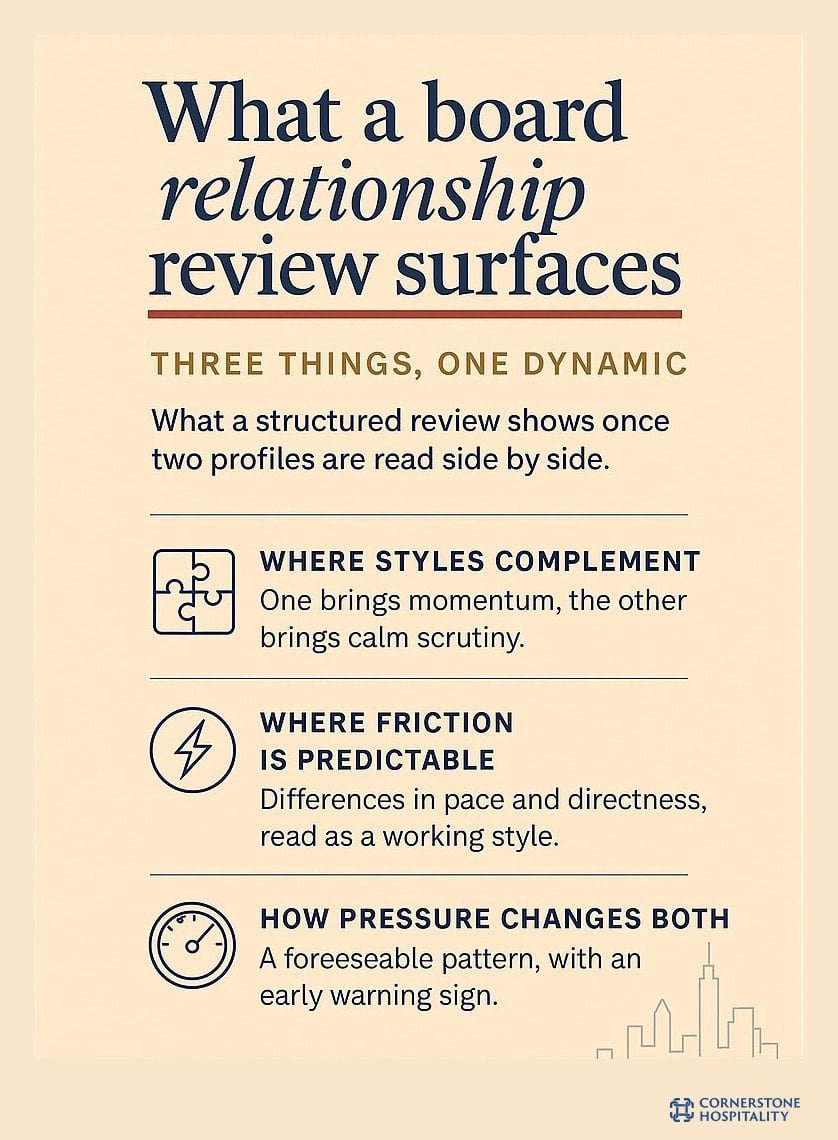
A stronger approach looks at the relationship itself. Specifically, it looks at how two individual psychometric profiles interact, not just what each says on its own[3]. Done well, this surfaces three things.
Why this matters
None of these three things is visible from a CV, a reference call, or even a strong interview[6]. They only become visible once two profiles are compared side by side, which is precisely what an individual assessment does not do.[6][5]
Why this matters
Why this matters more at team level
Moreover, extend this across a full executive team, and a second, quieter risk shows up[9]. Namely, apparent strengths that actually depend on one or two people. Consequently, a team can look strong on quality, on stakeholder relationships, on pace. Then the one person actually carrying that contribution moves on, and nobody else was ever expected to.
The same mapping that reveals complementarity between two individuals also reveals where a team is over-concentrated. It shows where a contribution is quietly missing because everyone shares the same blind spot. Often the most uncomfortable finding is how the leader’s own instincts shape who gets heard. This is also why the pattern shows up repeatedly in how hospitality boards make leadership decisions. A board that only assesses candidates one at a time never sees how the resulting team will actually operate together.[9][7]
The question is never only whether this is the right person. It is whether these two people, working together, actually produce better decisions than either would alone. It is also whether anyone knows what happens between them under pressure.
Florian Kittler, Managing Partner, Cornerstone Hospitality
What to do
As a practical first step, map who on the current team is quietly carrying a strength nobody else has been asked to build. That gap is the one a new hire, or a reshuffled reporting line, is most likely to expose.
What to do
How you actually get ahead of it
Spotting the pattern after the fact is easy; anyone can explain a failed decision in hindsight[7]. Spotting it before it costs a decision, a deadline, or a piece of trust is the harder problem. This is what a properly structured relationship review is built to solve.
Individual psychometric data earns its keep here, not as a personality label, but as raw material for comparison[3][5]. Two profiles, read side by side, show where two people are likely to reinforce each other. They also show where instincts will predictably clash. Most importantly, they show how each person is likely to behave once a decision is contested or going badly.
| What it looks at | An individual assessment alone | Individual assessment plus a relationship review |
|---|---|---|
| Unit of analysis | One person, on their own | Two profiles, compared side by side |
| What it can predict | Leadership style, decision-making preferences, likely derailers | All of that, plus where two styles reinforce or clash under pressure |
| Team concentration risk | Not visible | Surfaced, since it maps who is quietly carrying a shared strength |
| Output | An individual report | A facilitated conversation and a working agreement between both people |
| Best used for | A single hiring decision | A new pairing, a succession moment, or a team that already feels the friction |
Three things that make it stick
Separating insight that sits in a drawer from insight that changes behavior.
Crucially, the finding gets tested with both people together, not delivered to them separately[9]. A facilitated discussion converts it into a working agreement.
Likewise, the same mapping runs from one relationship to the whole team, revealing where the group depends too heavily on one or two people.
There is no compatibility score and no verdict. The goal is to stop a working-style difference being misread as resistance or a lack of trust.
About this analysis
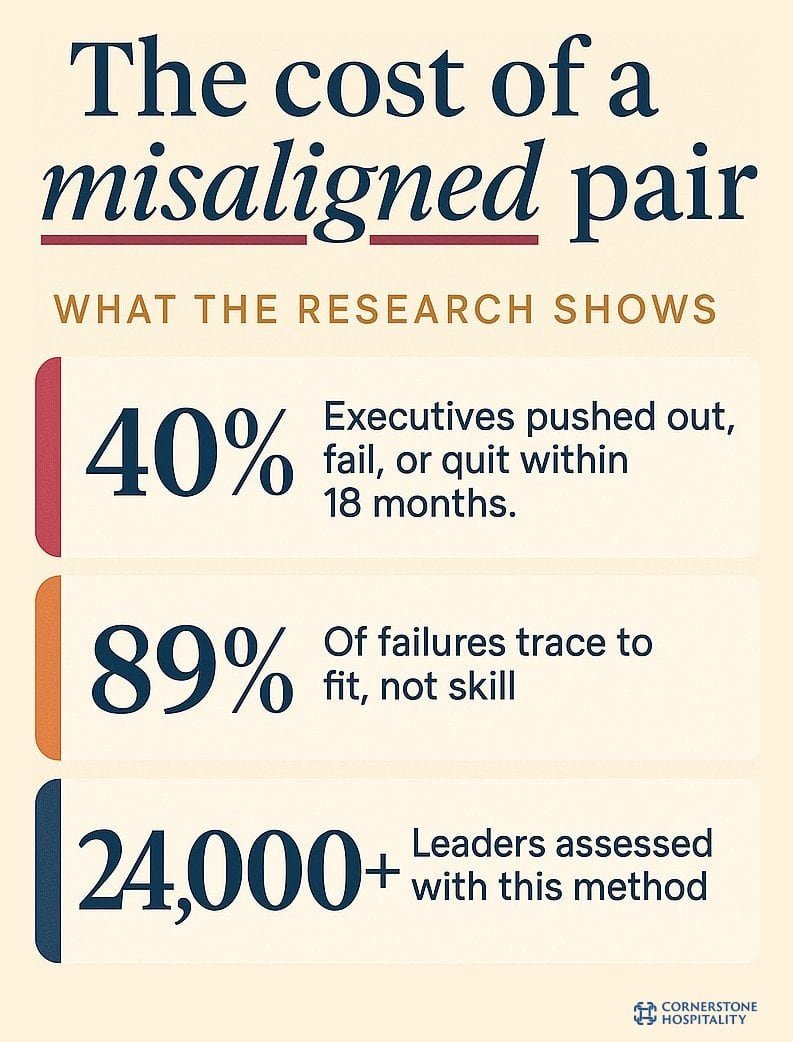
The 40% and 89% figures above come from third-party workplace research, not a Cornerstone survey. The first is PrimeGenesis, reporting an industry study of 20,000 executive searches. The second is Leadership IQ’s study of over 20,000 new hires across 312 organizations, which independently puts the 18-month failure rate at 46%. The 24,000-plus figure and the underlying psychometric model are attributable to Cornerstone’s own assessment partner, a Chartered Occupational Psychologist. Full citations sit in the sources section below.
Why this matters
A relationship review does not replace the individual assessment; it sits alongside it. The individual report still answers “can this person do the job.” The relationship review answers the question that comes right after it.
Key insight
What a board relationship review changes in practice
None of this is about scoring relationships as good or bad, or forcing people into fixed roles. Instead, the value is in making the pattern visible before it costs something. Before a hire is made because nobody challenged the brief. Before a restructuring stalls because two key leaders are managing around each other instead of with each other. Before a new executive spends their first year decoding a team dynamic nobody briefed them on.
Organizations getting this right treat relationship quality between senior leaders as a governance issue, not a soft one[7][8]. They apply the same discipline they would apply to succession planning, the same discipline covered in our piece on executive assessment in senior hospitality hiring. Instead, they ask not just “is this the right person,” but “do these two people, working together, actually produce better decisions than either would alone? Do we know what happens between them under pressure?”
This is the thinking behind our executive assessment practice. Boards, executive teams and leaders all navigate succession, restructuring and new appointments. For them, that question is worth asking deliberately, rather than finding out the answer the hard way.[1][10]
What to do
What a Cornerstone board relationship review includes
In practice, a board relationship review runs alongside Cornerstone’s wider executive assessment work. Each person completes an online psychometric questionnaire built on the Big Five model, the standard framework in modern personality science[3]. Cornerstone’s assessment partner is a Chartered Occupational Psychologist who has personally assessed more than 24,000 leaders. That partner reads the two profiles side by side rather than in isolation. Then they lead a facilitated discussion with both people together, rather than handing a report down to each of them separately.
The same approach supports the wider team, not only a single pairing. For that reason it complements the coaching work covered in our piece on hospitality leadership development and coaching. Where a review surfaces a working agreement between two people, coaching is often what turns that agreement into a lasting habit.
- ✓Individual profiles: a Big Five-based psychometric assessment for each person involved.
- ✓Side-by-side interpretation: bespoke comparison by a Chartered Occupational Psychologist, not an automated compatibility score.
- ✓A facilitated discussion: both people in the room, converting the finding into a working agreement.
- ✓Team-level mapping: the same method extended across a full executive team when needed.
- ✓A developmental frame throughout: no verdict, no ranking, a working agreement instead.
What to do
A new pairing, a succession decision or a restructuring may be on the calendar in the next two quarters. If so, that is the moment to schedule a relationship review. Book it before the pairing is locked in, rather than after it starts to strain.
Glossary
- Board relationship review
- A structured comparison of two or more individual psychometric profiles, used to surface how senior leaders are likely to complement or clash under pressure. Developmental, not evaluative.
- Individual assessment
- A psychometric and behavioral evaluation of a single candidate or leader, on their own, against the requirements of a role.
- Big Five model
- The standard modern framework in personality psychology, used as the foundation of the psychometric instrument behind Cornerstone’s assessment work.
- Team concentration risk
- A situation where an apparent team strength actually depends on one or two individuals, invisible until a relationship or team-level review maps it.
What our clients and colleagues say
Trust in the process starts with trust in the people running it. Here is what two of them have said.
“Florian played a pivotal role in my career transition within the hospitality industry, combining deep expertise in executive search with a highly strategic advisory approach. Unlike traditional recruiters, he takes the time to truly understand your long-term ambitions, challenges your assumptions, and positions you for sustainable leadership success.
Stefan SavicHospitality Professional · Asset Management, Development & Strategy
“Over the years I have worked with Florian and he has continually provided a service second to none. The caliber of individuals he recommends is always spot on, as he ensures that he understands not only the requirements and expectations of a role but also the importance of the success and growth of the business being related to people.
Daniel AylmerChief Executive Officer, Greater China
Both quotes are verified public LinkedIn recommendations from clients and colleagues who have worked with Florian Kittler.
Frequently asked questions
What is a board relationship review?
It is a structured comparison of two or more individual psychometric profiles. The comparison shows how senior leaders are likely to complement each other and where friction is predictable. It also shows how each is likely to behave once a decision is contested or going badly.
How is it different from an individual leadership assessment?
Who should be included?
Most often two people in a close working pairing, a Chair and a CEO, or two members of an executive team[9]. The same method also extends to a full executive team when the concern is team-level rather than a single pairing.
Does it produce a compatibility score?
No. The review stays developmental rather than evaluative, on purpose. There is no score and no verdict. The goal is to stop a working-style difference being misread as resistance or a lack of trust, rather than to rank the relationship.
What does the process actually involve?
Each person completes an online psychometric questionnaire built on the Big Five model. Cornerstone’s assessment partner is a Chartered Occupational Psychologist. That partner compares the two profiles and leads a facilitated discussion with both people together, converting the finding into a working agreement.
Is a board relationship review confidential?
Yes. In practice, the findings are shared with the people involved and, where relevant, the board or panel sponsoring the review, not circulated more widely than that.
When is the right time to run one?
Before a new pairing is locked in, ahead of a succession decision, or during a restructuring, is when a review does the most good[7]. It is also useful for an existing pairing where the friction is already visible and nobody has named it yet.
Does this replace individual executive assessment?
No, it sits alongside it. The individual report still answers whether a person can do the job. The relationship review answers the question that comes right after: whether this person and the people they will work with actually make each other better under pressure.
Related reading
This sits inside our Executive & Board Search work, which covers the fuller picture beyond this one piece.
Sources
- PrimeGenesis, 40% of executives pushed out, fail, or quit within 18 months (2 April 2009): the origin of the 40% figure shown above, reporting an industry study of 20,000 executive searches first quoted in a Financial Times interview of 30 March 2009: "40 per cent of executives hired at the senior level are pushed out, fail or quit within 18 months". The cost is described as expensive both "in terms of lost revenue" and "in terms of the individual’s hiring".
- Leadership IQ, Executive Failure Rates (4 March 2026): an independent study of more than 20,000 new hires across 312 organizations, tracked at 6, 12, 18 and 24 months. It reports that "46% of new hires failed within 18 months; only 19% achieved unequivocal success", and that "attitudes accounted for 89% of failures; technical skill deficiencies accounted for 11%", the source of the 89% figure above, and a close independent corroboration of the 40% rate.
- LINC Personality Profiler (LPP), instrument documentation: the psychometric instrument behind Cornerstone’s assessment work. It implements "the Big 5 model as a standard model of modern personality psychology" and reports "very good construct validity and high scale reliability (.80)". LINC is a spin-off from the Leuphana University of Lüneburg, and the profile covers character traits, motives and skills rather than a single summary type.
- American Hotel & Lodging Association, 82% of surveyed hotels report staffing shortages: the source of the 82% figure shown above, and the reason a misaligned senior pairing is harder to resolve by replacement in hospitality than in most sectors. When four in five properties report being short-staffed, removing one half of a senior relationship is rarely a clean or a fast option: the replacement has to be found in the same tight market, and the working relationship has to be built again from nothing while the property keeps trading.
- Schmidt, Oh & Shaffer, The Validity and Utility of Selection Methods in Personnel Psychology: Practical and Theoretical Implications of 100 Years of Research Findings (working paper, 2016): the primary academic source for the selection-validity hierarchy, updating the widely cited 1998 meta-analysis across roughly a century of personnel-selection research. It reports validity for 19 separate selection procedures and for paired combinations of them, and the finding that matters most here is that methods used together predict performance materially better than any single method used alone. That is the empirical case for reading two assessments side by side rather than one at a time.
- Society for Industrial and Organizational Psychology, Is Cognitive Ability the Best Predictor of Job Performance? New Research Says It’s Time to Think Again: the professional body’s account of Sackett, Zhang, Berry and Lievens (2022), who found earlier meta-analyzes had systematically overcorrected for range restriction. The revised ranking puts structured interviews first at r = .42, ahead of job knowledge tests (.40), biodata (.38), work samples (.33) and cognitive ability (.31). "Structured interviews emerged as the strongest predictors of job performance."
- Harvard Law School Forum on Corporate Governance, Effective Board Leadership: The Art of Doing It Well and the Risks of Getting It Wrong (PwC, 8 October 2025): identifies groupthink, poor CEO relationships and underperforming directors as the failure signals boards must act on. 59% of directors think board leadership manages assessment effectively, only 34% say leadership is very effective at dealing with underperforming directors, and only 22% say their board uses an independent third party to facilitate assessment. "Outstanding board leadership is not accidental: it is intentional, exacting and indispensable."
- Harvard Law School Forum on Corporate Governance, Board Effectiveness: A Survey of the C-Suite (PwC and The Conference Board, 500+ executives, 23 June 2025): quantifies precisely the gap this article describes. 93% of executives say at least one director should be replaced and 78% want two or more, while directors themselves put it at 49% and 25%. 32% say directors overstep into management, double the prior year, yet 93% of directors believe they understand the boundary. "What directors see as thoughtful oversight; executives may interpret as second-guessing or micromanagement."
- Deloitte Insights, Board effectiveness and the chair of the future (300+ board chairs across 16 countries): sets out why the chair-CEO pairing is the relationship boards most depend on, and how fragile it is. CEOs need "a trusted and confidential sounding board in the chair, and be willing to be vulnerable without fear of repercussions", while chairs must still ask difficult questions before a decision and move to support after it. As one Belgian chair puts it: "the relationship between chair and CEO needs to function. Only then can you realize an added value."
- Harvard Business Review, The Biggest Mistakes New Executives Make (Sabina Nawaz, 15 May 2017): frames the scale of the risk in the first eighteen months of a senior appointment, noting there is roughly a 50% chance a new executive leaves the organization in that window. It locates the cause in how a new leader reads and is read by the team around them, rather than in technical capability, which is the same distinction this article draws.
- American Hotel & Lodging Association, Rising Cost, Staffing Challenges Persist for Hotels (Front Desk Feedback, 246 hoteliers, late February 2026): the current read on the same labor market, and the most recent survey available. More than half of responding hoteliers describe their properties as somewhat or severely understaffed, and 42% name workforce shortages among their operating pressures. Hotels are countering with higher wages (70%), flexible scheduling (54%), hotel discounts (54%) and enhanced benefits (31%), which shows how much is now being spent to hold a team together rather than rebuild one.
- Hotel Dive, Hospitality industry could face 8.6M workforce shortfall by 2035: WTTC (9 October 2025): reports World Travel & Tourism Council research that "the hospitality industry, in particular, is expected to face a gap of 8.6 million workers, approximately 18% below the required staffing levels" by 2035. A structural shortage of this size is what makes replacing a senior leader an expensive last resort rather than a first response.
- World Travel & Tourism Council, Global Travel & Tourism Growth to Outpace Wider Economy by 1.5 Times Over the Next Decade: sets the demand backdrop against which these appointments are made. The sector is forecast to grow 3.2% in 2026 against 2.4% for the global economy, to contribute $12TN, and to support 376 million jobs, roughly one in nine worldwide. Almost 89 million new jobs are expected over the decade, about a third of all new jobs created anywhere, which means the number of senior pairings being formed each year keeps rising.
- Lodging Econometrics, Global Hotel Pipeline Reaches Record High (Q4 2025): records a global construction pipeline at an all-time high of 15,922 projects/2,437,354 rooms, with 6,140 projects already under construction and 3,845 scheduled to start within twelve months. LE analysts forecast 2,617 new hotels/389,175 rooms to open during 2026, followed by 2,630 in 2027. Every one of those openings creates another senior pairing, formed at speed, whose working relationship nobody has yet examined.
- Hospitality Net, Evolving Workforce and its Culture (Professor Robert O’Halloran, East Carolina University): describes the shift in what senior people now expect from the teams they join, with baby boomers approaching retirement while Generation Z reshapes workplace norms. 79% of executives agree organizations should create value for workers as human beings, and 80% say skills-based decisions would reduce bias, both of which raise the premium on how a senior pairing actually functions day to day.