


How Hospitality Boards Make Better Leadership Decisions: A Guide to Executive & Board Search Done Well


A board engaging a hospitality executive and board search firm at C-suite or non-executive director level faces one consequential decision. It is not who gets hired. Instead, it is how the firm thinks. The board can usually evaluate a candidate’s CV. However, one thing stays hidden until the wrong person is in the seat. Did the search firm operate as a transactional intermediary, or as a calibration layer between leadership intent and market reality?
This is a guide for hospitality board chairs, owners, principal investors, and lead independent directors. Specifically, it is for anyone evaluating an executive and board search firm at the highest level of the leadership system. It draws on what we have learned at Cornerstone International Group across hundreds of senior mandates. In particular, it distills what separates the searches that produce stabilizing leaders from those that produce expensive churn.
The real question isn’t “who do we hire?”
In hospitality, leadership decisions rarely present themselves as hiring problems. Instead, they appear as a leadership gap after an unexpected resignation, or a succession moment following a retirement. Sometimes they arrive as an integration challenge after an acquisition, or the need to reposition a business in a competitive market. Beneath each of these moments sits the same underlying question, and it is not who do we hire.
The real question at the executive and board level is different. Which leadership outcome does the business actually require? And is the market aligned with that expectation?
This is the gap most senior searches fail to close. The board writes the brief. The job description follows. Then the search firm executes. Six months later, the board is reviewing why the placement isn’t performing. More often than not, the answer is the same. The original brief described a leader the market could not realistically deliver, or wasn’t motivated to.
Calibration over assumption
Most search firms begin every mandate with a job description. We begin with a hypothesis about leadership. The brief is not a finished document we execute against. Rather, it is a starting hypothesis, one we test against actual market behavior before the search even begins.
“We do not treat the initial mandate as fixed. We treat it as a starting hypothesis to test against market behavior.”
Florian Kittler, Managing Partner, Cornerstone Hospitality
Before formal execution starts, we engage the market on the client’s behalf. First, we test how the market perceives the role, and whether the brief aligns with what it will accept. Then we test where candidate availability and motivation actually sit. Finally, we ask whether the expectations encoded in the original brief are structurally realistic. This early sensing isn’t a courtesy step. It’s the difference between a brief that wins the right candidate and one that quietly disqualifies them.
The output of calibration is sharper than the output of assumption. It changes what the board is looking for. The compensation envelope moves. So does the geography. And the candidate experience changes too, because everyone in the process now knows what good actually looks like.
What changes at board level
Board searches are not senior management searches scaled up. They are a different category of work. At the executive level, the search firm is helping the business identify operational leaders who will execute strategy. At board level, however, the work shifts. Stewardship, oversight, independence, and the quality of challenge inside the leadership system take over.
In fact, boards rarely engage on a board search knowing exactly what they need. The first conversation typically centers on a vague sense of “we need another voice” or “we need to refresh the board.” What we find, almost without exception, is that the board’s stated need and its actual need are different. Our job is to surface the difference, what we call the missing piece.
The seven “missing pieces” boards typically discover during calibration
- Digital and platform expertise: for groups confronting the operating-model shift from real estate to platform
- International growth experience: for businesses scaling into unfamiliar geographies or segments
- Capital markets knowledge: for owners and groups preparing for transaction or institutional capital
- Luxury hospitality credentials: for brands repositioning into the upper tier
- Governance discipline: for boards moving from family-owned informality to institutional rigor
- A challenger voice: for boards that have become too comfortable with internal consensus
- Succession readiness: for businesses where the next CEO transition is closer than the board realizes
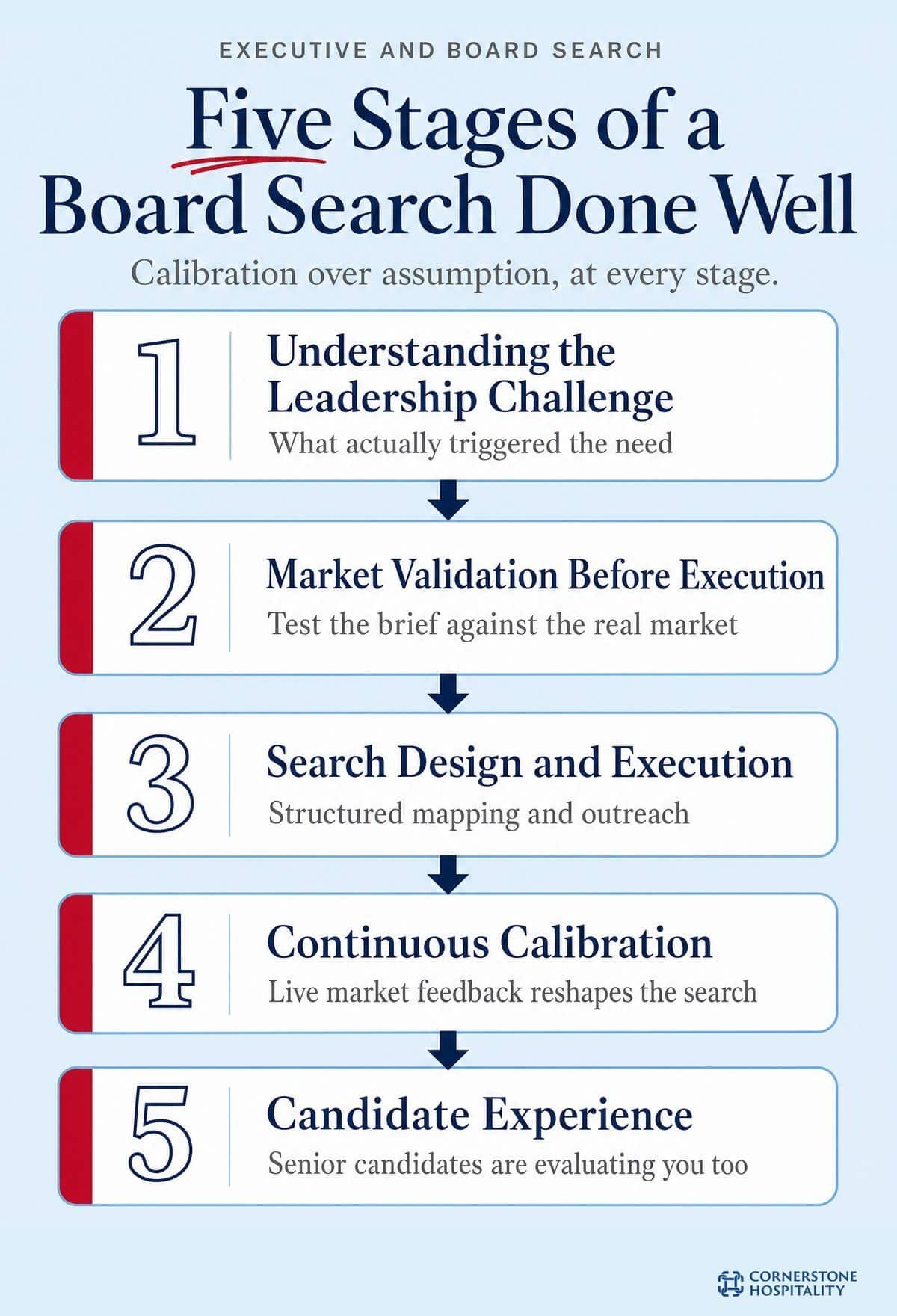
The methodology: five stages of a hospitality executive and board search done well
Our process is structured, but not linear. It is built around a continuous feedback loop between three dimensions: the board’s expectations, market reality, and candidate intelligence. The five stages below are how we operate that loop.
1. Understanding the leadership challenge
We work directly with decision-makers to understand what has actually triggered the search. Moreover, we map what success must look like in 12 to 24 months. We also surface the constraints beyond the brief, and the assumptions that need testing. This stage is diagnostic, not transactional. We do not simply take briefs, we interrogate them.
2. Market validation before execution
Before finalizing direction, we engage the market again. This time we test candidate availability and motivation, compensation reality versus expectations, and appetite for the opportunity beyond title or brand perception. In addition, we read the early behavioral signals from the talent pool. This creates a reality check that informs the final search design. Most firms compress or skip this step. Compressing it is the most common single reason a senior hospitality search produces the wrong shortlist.
3. Search design and execution
Once calibrated, we build a structured search strategy. It covers detailed market mapping, competitor analysis, and company and opportunity profiling. On top of that sits a targeted longlist drawn from sector expertise and network depth, plus multi-channel candidate identification. A tailored team leads every mandate, matched on sector, geography, and language capability.
4. Continuous calibration during the search
The search evolves through live market feedback. Candidate reactions and motivations feed back into the brief. So do interview insights from both sides of the table, early reference intelligence, and shifting organizational requirements. We treat every interaction as data, not just progression. As a result, we refine the brief continuously until the right appointment becomes clear. We never hold the original brief rigid and force imperfect candidates into it.
5. Candidate experience as a strategic factor
At executive and board level, candidates are evaluating more than the role. They are evaluating the system they are entering. We ensure consistency between client narrative and candidate experience, with disciplined communication and feedback loops. Similarly, we run high-quality interview processes that match the level of the role, and keep expectation and reality aligned throughout. Poor candidate experience is not just operational risk, it is hiring risk. The strongest candidate will walk away from a misaligned process. The wrong candidate will accept anything.
Where hospitality executive and board searches fail
In our experience across hospitality executive and board searches, failed mandates do not fail because of a lack of candidates. They fail because of:
Misalignment between internal expectations and market reality
The brief described a leader the market couldn’t deliver. Or wouldn’t accept the role at the offered terms. Surfaced too late, this becomes a long-list of compromises.
Unstable or politically influenced decision criteria
The criteria shift mid-process. What was important in week 1 quietly disappears by week 6. Strong candidates read the instability and disengage.
Overreliance on brand or title prestige
Optimizing the shortlist for prestige rather than fit. The candidate with the most recognizable name on the CV is rarely the right leader for the specific context the business is in.
Compensation disconnected from market motivation
The package came from internal benchmarks rather than market evidence. The candidates the board would actually want are unmotivated to engage at those terms.
What success looks like
Placement alone does not define a successful executive and board search. Instead, success rests on a clearly calibrated leadership requirement, a transparent decision-making process, and strong candidate engagement throughout. Above all, it rests on a leader who performs and remains effective beyond the first twelve months. The appointment becomes not just a hire, but a stabilizing force for the business.
Our role
We act as an advisor, not a vendor. Our responsibility is to ensure boards make leadership decisions with clarity, market intelligence, structured challenge, and continuous recalibration against reality. We do not simply present options. We help boards see which option is most likely to succeed, and why.
Weighing an executive or board-level search in hospitality? For a confidential conversation about calibrating your brief before engagement, see our overview of Executive & Board Search or contact the team directly. Initial conversations are confidential, free of charge, and focused on understanding the role and the strategic context.
Frequently asked questions
What is the difference between an executive search and a board search in hospitality?
An executive search places operational leadership, CEO, COO, CFO, CCO, regional managing directors, the people who execute the strategy. A board search places non-executive directors and board advisors who provide stewardship, governance, and independent perspective. The two require different methodologies: execution-level search is about operational fit; board-level search is about complementary capability and intellectual challenge inside the leadership system.
How long does an executive or board search typically take?
Most senior hospitality mandates run 10 to 16 weeks from kick-off to signed offer. Board-level non-executive searches can run longer because alignment on the “missing piece” takes time at the front of the process. Compressing the calibration stage to save weeks at the beginning typically costs months of underperformance at the back end.
On calibration and confidentiality
What is “calibration” in the context of executive search?
Calibration is the discipline of testing the brief against actual market behavior before, during, and after the search runs. It includes early market sensing to validate candidate availability, compensation, and motivation; continuous recalibration as candidate feedback comes in; and a willingness to refine the brief based on market evidence rather than forcing the market to fit the original brief.
What level of confidentiality does Cornerstone Hospitality maintain in board-level searches?
Board-level work requires absolute confidentiality. We approach candidates one-to-one, share the role context but never the client name until the candidate has indicated serious interest, and operate under signed engagement letters that govern information handling on both sides.
Florian leads Cornerstone International Group’s global Hospitality, Travel & Leisure Practice. He brings seventeen years of senior hospitality experience, including Marriott, Hyatt, IHG, Mandarin Oriental and Shangri-La Hotels & Resorts, and sixteen years in retained executive search. He is bilingual in English and German and works across Europe, the Middle East, the Americas and Asia-Pacific.
Connect with Florian on LinkedIn →