


Executive Outplacement in Hospitality: Senior Exits, Handled with Dignity
Outplacement is rarely the whole story. Many of the executives we support here also draw on the leadership development support we build around senior transitions once they are settling into a new role, so the transition and the growth that follows are handled by the same team.


In practice, executive outplacement in hospitality is the work of taking a senior leader out of a role with their dignity intact, their next move credible, and the relationship between leader and former employer preserved on both sides. Notably, if done well, the leader lands in a brand they would actually pick, while the firm protects the reputational ground it has earned with owners and the network, and the people who watched the exit from the outside take note of how it was handled. By contrast, done badly, the leader spends nine months explaining themselves, and the firm carries a story it cannot unwrite, because in a sector where roughly 40% of senior executives fail, quit, or are pushed out within their first eighteen months [1], almost every hospitality firm will face this exit at least once, and almost always more than once.
Importantly, an outplacement program at this level is not a benefits package. Instead, it is a relationship-preservation program. In practice, the leader who lands well after a Cornerstone Hospitality outplacement program is the leader who can still be a brand ambassador for the firm that let them go, introducing future hires, recommending the brand to peers, and opening doors quietly long after the formal engagement is over. Consequently, that intact relationship, in a small global industry, is worth real money over a multi-year horizon.
Ultimately, this is how executive outplacement in hospitality runs at Cornerstone: the two recipients of the same program, the twelve-week core engagement, the longer support window where it earns its keep, and the five tells that separate decision-grade outplacement from a paper benefit on an exit letter.
The stakes, what the research says
Industry data on senior-executive exit frequency, time-to-land in the current market, supported-transition outcomes, and the hospitality leadership supply gap. Sources are listed in full beneath the article.
Where’s your career going? Let’s find out together.
Have a short, private conversation with our AI assistant. It asks 7 questions, takes 6 to 8 minutes, and you leave with a personalized read on your next move, sent straight to your inbox.
The Recipients
Two recipients of the same program, the leader, and the firm
An executive outplacement in hospitality has two recipients of the same program: the leader who is leaving and the organization that is letting them go. Both pay a price when the exit is mishandled, and both gain when it is run well. Cornerstone Hospitality designs every engagement with both sides explicitly in view, because in a global industry of 60+ offices across 40+ countries where the same names appear in adjacent rooms five years apart, the cost of a bruised exit compounds in ways the severance line never captures.
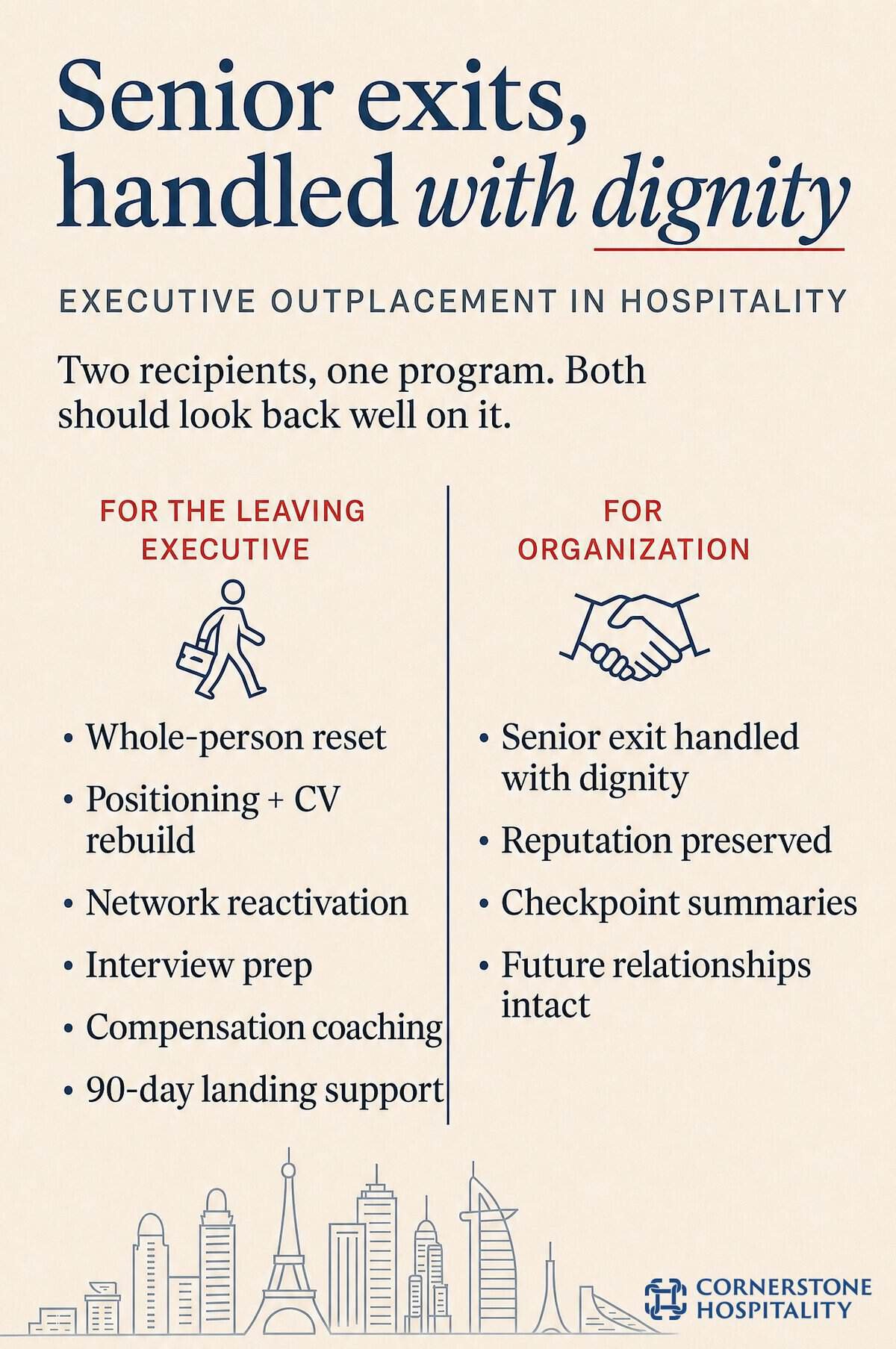
Two recipients, one program
Executive outplacement in hospitality, who the same program actually serves
| Dimension | The leaving executive | The organization |
|---|---|---|
| What they receive | A whole-person reset, next role secured with dignity | A senior exit was handled without reputational damage |
| What is measured | Time to placement, quality of the next role, confidence restored | Retention of remaining leaders, legal risk closed, brand intact |
| Time horizon | Twelve weeks of structured support, longer if the market is thin | The story told inside the business for the next twelve months |
| Definition of success | The next role is the right one, chosen, not settled for | Peers see the exit and choose to stay |
1. For the leaving executive, a whole-person reset
Notably, a senior hospitality leader loses identity, structure, and momentum overnight when a role ends. Consequently, the first job of the outplacement program is to absorb that landing instead of starting to produce CVs in week one and to allow the leader the room to register what has happened and then begin to rebuild from the ground up. In practice, the work that follows is a sequence: first, decompression and honest emotional landing; second, narrative reconstruction (CV, LinkedIn, the three sentences a leader will repeat for ninety days); third, disciplined network reactivation; and finally, interview and compensation coaching as the offers begin to arrive.
Ultimately, the leader the program produces at week twelve is not the leader who walked in at week one. In practice, the CV is sharper. Additionally, the LinkedIn is aligned. Furthermore, the references are warm. Moreover, the five conversations that matter most have been identified, briefed, and activated. In addition, the leader has practiced the interview answers and the compensation rehearsal that the next four months will demand. Notably, the 92% landing-equal-or-better rate that supported transitions consistently produced [5] is the downstream of this work, instead of the start of it.
Why this matters
In the current market, the average time-to-land after a senior exit runs around twenty weeks [6], and longer still for the most senior hospitality roles, up to a year for a true C-suite or brand-president seat [6]. A leader who is rebuilt in the first twelve weeks runs that window with intent and direction; a leader who is left to improvise the same window often arrives at month nine still explaining the exit instead of describing the next role.
2. For the organization, a senior exit handled with dignity
The firm receives a parallel program of its own. Engagement summaries are delivered at agreed checkpoints, the work is happening, the cadence the leader is keeping, and the themes that are surfacing, without breaching the confidentiality of the leader’s sessions. The exit narrative the firm and the leader agreed on at the announcement is reinforced in every conversation the leader has because the leader has been coached on it and is using it consistently. The owners, brand presidents, and chairs who hear the leader speak in the months after the exit hear a story that is consonant with the firm’s own version, not a competing one.
Where the reputational payoff actually shows up
Notably, the reputational pay-off shows up in places the severance budget does not anticipate: the warm reference the leader gives to a future hire of the firm two years later, the introduction the leader makes to an owner the firm has been trying to reach, and the conversation in an industry forum where the leader speaks about the firm in measured rather than colored terms. Consequently, in a sector where 82% of surveyed hotels report a staffing shortage [4], every senior relationship the firm preserves is a strategic asset; by contrast, every one it burns is a search that becomes harder to run next time.
Why this matters
The senior hospitality network is small and durable. A leader who walks out of a brand and into a comparable seat at a competitor within twelve months becomes, in effect, a peer; the original firm now has to work alongside on owner committees, association boards, and industry panels. Whether that future contact is a brand ambassador or a quiet detractor is largely set in the first ninety days after the exit, which is exactly the window the outplacement program is built to govern.
What to do
- Treat outplacement as a relationship-preservation line item, not a benefits line item; price it accordingly, and fund it from the strategic budget rather than HR.
- Build the engagement summaries into the firm’s post-exit governance; the chair or sponsor should be reading a brief update at each checkpoint.
- Agree to the exit narrative with the leader before the engagement begins, and let the outplacement program reinforce it consistently across every conversation the leader has.
The Difference
What dignity-first executive outplacement in hospitality actually changes
Dignity is a word that does a lot of work in exit conversations and not always with much substance behind it. In Cornerstone Hospitality’s practice, it has a concrete meaning: the leader keeps control of the narrative, the references, the visibility cadence, and the pace of re-entry, rather than having any of those four taken out of their hands by an unsupported exit. The contrast below is the simplest way to make the difference visible because it shows what changes in week one, week six, and the year-on view.
What a dignity-first exit changes, week by week
| Dimension | Without a supported program | With dignity-first outplacement |
|---|---|---|
| The narrative | Three versions of the exit story in circulation by week two, each one written by a different listener. | One paragraph, delivered identically, by the leader and reinforced by the firm. |
| The visibility cadence | LinkedIn headlines changed in the first forty-eight hours; broadcast posts that telegraph the wrong tone. | Visibility re-entered on days twelve to fourteen, with intent, one piece of thinking, and one industry event. |
| The reference pack | References are discovered cold, mid-process, when a recruiter calls them. | References are pre-warmed and briefed on the narrative before the first call is taken. |
| The next conversation | A diffuse outreach to a wide list, signaling weakness across the network. | Five focused conversations, each with one named ask, signaling intent and direction. |
| The relationship with the firm | Bruised. Quiet detractor in industry forums for years. | Preserved. Future ambassador, warm introducer, ongoing referrer. |
| Time for a next role | Drifts through the average twenty-week window [6], often longer for senior roles. | Runs the same window with direction; 92% land equal-or-better when supported [5]. |
Why this matters
The unsupported exit and the dignity-first exit reach the same calendar destination by very different routes; one preserves both sides of the relationship, the other quietly burns capital on both. In a sector this small, the relationship is the asset; protecting it is what executive outplacement at the senior level actually does.
The Program
Twelve weeks, six work streams, the core engagement
In practice, the core outplacement engagement of Cornerstone Hospitality runs twelve weeks across six work streams. Notably, the work streams are constants, while the cadence is bespoke. Additionally, most leaders need every stream addressed, but the weighting flexes: for example, one leader needs three weeks on narrative and one on references, and another the reverse. Ultimately, the framework below is what governs the rhythm, instead of dictating it.
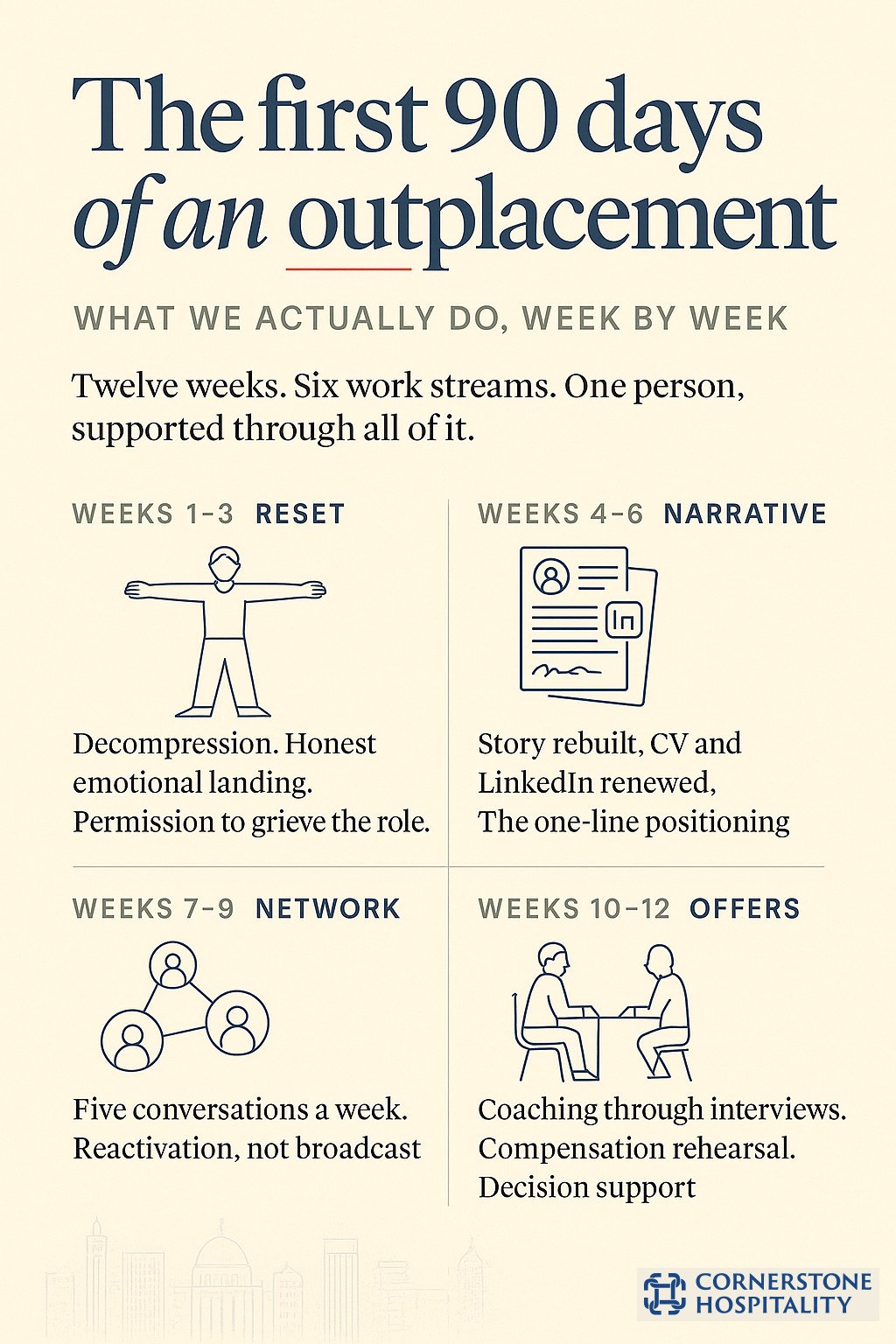
First 90 days
Twelve weeks, six work streams, the Cornerstone executive outplacement in hospitality program
- Weeks 1 to 2, orientation and stabilization.
First conversation, situation assessment, immediate emotional support, calendar structured.
- Weeks 3 to 4, narrative and positioning.
The three sentences, the LinkedIn refresh, and the CV rebuilt around outcomes and not titles.
- Weeks 5 to 6, market map and target list.
Companies, roles, and geographies were scoped; retained-search firms were briefed; references were warmed.
- Weeks 7 to 8, activation and outreach.
The five surgical conversations, board contacts, and one published piece if it fits the brand.
- Weeks 9 to 10, interviews and negotiation prep.
Interview rehearsal, offer scenarios, and the walk-away number set before the calls begin.
- Weeks 11 to 12, decision and onboarding plan.
Offer evaluated across all three compensation layers, the first 90 days of the new role planned.
The six work streams, one card each
Decompression, honest emotional landing, permission to grieve the role, before any production work begins.
Three-sentence story rebuilt; CV refreshed; LinkedIn aligned; one-line positioning written for the next twelve months.
Reference list shaped, each name pre-warmed and briefed on the narrative, ready to take the recruiter call when it comes.
Five conversations a week with named senior contacts, reactivation rather than broadcast, each with one specific ask.
Interview coaching, compensation rehearsal, and decision support when the offer letters and the term sheets begin to arrive.
Published thinking, industry presence, and association engagement are governed weekly so the leader is visibly available, not searching out loud.
- ✓Engagement summary at week 4: cadence confirmed, themes emerging, narrative work landed.
- ✓Engagement summary at week 8: network conversations active, references in place, visibility on the calendar.
- ✓Engagement summary at week 12: program close, leader status, recommended next-stage support.
- ✓Confidentiality preserved throughout: the firm receives that the work is happening, never the content of the conversations.
The Cornerstone Hospitality read on why the program pays
“Outplacement at the senior level is not a benefits package. Instead, it is a relationship-preservation program. In practice, the leader who lands well after a Cornerstone outplacement is the leader who can still be a brand ambassador for the firm that let them go, and that asset, in this industry, is worth real money over five years.”
Cornerstone Hospitality, senior outplacement practice
Why this matters
The twelve-week framework is fixed, yet the weighting flexes to the leader in front of us. That is the difference between a program that simply produces a sharper CV by week twelve and one that produces a leader who is genuinely ready for the next conversation. The structure carries the discipline, while the bespoke cadence carries the person.
The Tail
Beyond ninety days, where the program earns its keep
In practice, the twelve-week core engagement is where the heavy lifting happens, while the work that follows is where executive outplacement in hospitality earns the rest of its keep. Notably, in the current senior-hospitality market, the average time-to-land sits at roughly twenty weeks for the wider workforce and can stretch beyond a year for the most senior roles [6]. Consequently, the leader who finishes the core twelve weeks and then walks out the door without further support is the leader who often arrives at month seven with the assets in place, while no one is alongside them in the interview, the term sheet review, or the decision to accept.
Importantly, Cornerstone Hospitality designs every engagement so the leader can stay alongside the work through to the actual landing, instead of stopping at the offer stage, and through the first ninety days of the new seat where it would help. In practice, the cadence eases from weekly to fortnightly to monthly, while the cost is modest, and the support is shaped by what the leader is actually facing: for example, an offer to weigh, a counter to navigate, a new owner to read, and a first town hall to plan.
Four windows the extended engagement covers
Fortnightly coaching cadence. Interview rehearsal as opportunities land. Compensation strategy ahead of the term sheet conversation.
Multiple-offer triage, counter-offer strategy, sponsor and chair reads, getting the right decision, not just any decision.
Stakeholder mapping in the new role, first-impression coaching, and the conversations the leader holds before week four arrives.
Two coaching sessions to anchor the early operating cadence and lock the trajectory the leader signed up for, not the one circumstance writes.
Why this matters
The senior-hire failure literature shows that nearly half of newly hired executives fail within their first eighteen months [2], and that 89% of those failures are driven by attitudes, fit, and judgment rather than technical capability [2]. Extending the outplacement program into the first ninety days of the next seat puts a coach alongside the leader at exactly the point in the calendar where most of those failures actually begin, turning a placement into a landing.
If your organization is preparing a senior hospitality exit and wants it handled with care, or you are a leader facing this window yourself, the conversation can start today. Confidential, no obligation.
What to do
Five tells of decision-grade executive outplacement in hospitality
If a chair, an owner, or an HR head is commissioning executive outplacement in hospitality for the first time or comparing programs, these are the five tells that separate decision-grade work from a generic benefits add-on. Each one is observable in the proposal stage, before the engagement begins. The hospitality context sharpens every one of them.
- The program has a hospitality-specific frame, not a generic corporate template.
Senior hospitality leaders are read by hospitality boards, owners, and brand head offices, not by generalist corporate HR. A program that draws on the actual operating realities of brand-DNA, owner relationships, and the senior-hospitality network produces a leader the market actually recognizes.
- Both sides of the relationship are designed into the engagement from day one.
The leader receives the work; the firm receives the engagement summaries and the preserved relationship. A program that treats the firm as the payer and the leader as the recipient misses three-quarters of the value the engagement is supposed to produce.
- Confidentiality of session content is absolute and structurally enforced.
In practice, the firm hears that the work is happening, never the specifics of what was discussed. Notably, without that structural confidentiality, the leader cannot do the honest emotional work the first three weeks require, while the rest of the program is downstream of those three weeks.
The final two tells, extension and honest limits
- The engagement extends through to the actual landing, not just to the offer stage.
A program that closes when the offer letter arrives leaves the leader unsupported through the term sheet conversation, the counteroffer, and the first ninety days of the new seat, the exact window where senior hires most often come unstuck.
- No placement guarantee, and a clear, honest reason why.
No outplacement firm at this level should guarantee a placement; the landing depends on the market, the leader’s discipline, and timing. What a reputable firm guarantees is the support, the readiness, and the dignity-first cadence, not an outcome it cannot fully control.
What to do next
If you are commissioning executive outplacement in hospitality, ask the prospective firm about all five tells before committing to the work. The answers tell you whether you are buying a benefits line item or buying a relationship-preservation program that will earn its keep for years.
The Proof
What our clients and candidates say
In a small global industry, a senior leader’s reputation is what other leaders say about them when they are not in the room. Here is what two of them have said.
“Florian played a pivotal role in my career transition within the hospitality industry, combining deep expertise in executive search with a highly strategic advisory approach. Unlike traditional recruiters, he takes the time to truly understand your long-term ambitions, challenges your assumptions, and positions you for sustainable leadership success. His network across the global hospitality sector is exceptional, and his commitment to delivering the right long-term fit goes far beyond a transactional placement.
Stefan SavicHospitality Professional · Asset Management, Development & Strategy
“Over the years I have worked with Florian and he has continually provided a service second to none. The caliber of individuals he recommends is always spot on, as he ensures that he understands not only the requirements and expectations of a role but also the importance of the success and growth of the business being related to people.
Daniel AylmerChief Executive Officer, Greater China
Both quotes are verified public LinkedIn recommendations from clients and colleagues who have worked with Florian Kittler.
Glossary
- Executive outplacement
- A structured program of senior coaching, narrative work, network reactivation, and offered support delivered to a leader leaving a role, commissioned by the organization as part of the exit package, owned in content by the leader.
- Dignity-first exit
- A senior departure in which the leader keeps control of the narrative, references, visibility cadence, and pace of re-entry, rather than having any of those four taken out of their hands by an unsupported exit.
- Engagement summary
- The agreed checkpoint update the firm receives during the outplacement engagement, that the work is happening, the cadence, and the themes, without breaching the confidentiality of the leader’s sessions.
- Relationship-preservation program
- The framing Cornerstone Hospitality uses for senior outplacement: the engagement is not a benefits line item but a strategic investment in keeping the future relationship between leaver and firm valuable to both sides.
- Onboarding sponsor support
- The extension of the outplacement program into the first ninety days of the leader’s next seat, stakeholder mapping, first-impression coaching, anchoring the operating cadence the leader committed to.
- The three sentences
- The single most portable narrative artifact the program produces in weeks 4 to 6: what the leader did, why the role ended, what they are looking for next. Repeated identically across every conversation.
Frequently asked questions
Who pays for the outplacement program?
Almost always the organization, as part of the leader’s exit package. It is one of the highest-leverage line items in a senior severance; for what it does to both sides of the relationship across a multi-year horizon, the cost is small compared to the strategic value of keeping the network intact.
Is the program confidential to the leader?
Yes. Sessions and content are confidential to the leader. The organization receives engagement summaries at agreed checkpoints, the work is happening, the cadence the leader is keeping, and the themes that are surfacing, but never the specifics of what was discussed.
Does Cornerstone Hospitality guarantee a placement at the end?
No reputable firm should at this level. The commitment is to the support, the readiness, and the dignity-first cadence. The landing itself depends on the market, the leader’s own discipline, and the timing of the seats that open during the engagement window. What we do commit to is that the leader will be more ready for the next conversation than they were on day one.
On extension, scope, and how to engage
Can the program be extended beyond ninety days?
Yes. Many engagements run six months or longer, and the extension is one of the highest-value parts of the program; it puts a coach alongside the leader through the offer, the counter-offer, and the first ninety days of the new seat. The cadence eases, the cost is modest, and the support is shaped by what the leader is actually facing rather than by a template.
Do you handle outplacement outside hospitality?
Yes. Our practice focuses on hospitality and adjacent areas, branded residences, leisure assets, and hospitality-driven real estate. We occasionally take on cases where the leader’s background or the firm’s footprint sits cleanly alongside our practice. Our 60 partner offices cover outplacement across a multitude of sectors.
Can the leader engage Cornerstone Hospitality directly if the firm is not funding it?
Yes. In some engagements, the leader self-funds, either because the exit package did not include outplacement or because they want a hospitality-specific program rather than the generic option the firm has nominated. The program structure is the same; the engagement summaries become a private artifact for the leader rather than a deliverable to the firm.
How early should the firm bring Cornerstone in?
As early as the exit conversation is genuinely in view, ideally before the announcement. The strongest engagements begin the week before the formal exit, when the narrative can be shaped quietly, the references warmed in advance, and the leader walks into day one of the public exit with a plan already moving rather than improvised in the moment.
Read next
About this analysis
The figures in this article are drawn from published research on senior-executive exits, outplacement outcomes, and the hospitality leadership market. Senior-exit frequency and failure data come from Heidrick & Struggles and Leadership IQ studies of thousands of executive appointments. Time-to-land and supported-transition outcomes come from Right Management, LHH, and Korn Ferry outplacement data. The hospitality staffing figure is drawn from surveyed-hotel leadership research.
Every source is listed in full below, and every statistic in the article links to the source it came from. The Cornerstone Hospitality program details describe how our team runs senior outplacement engagements.
This sits inside our Career Transition work, which covers the fuller picture beyond this one piece.
Sources
- PrimeGenesis: 40% of executives pushed out, fail, or quit within 18 months (citing Heidrick & Struggles internal study of 20,000 searches; CEO Kevin Kelly interview, Financial Times, 30 March 2009): primegenesis.com/2009/04/40-percent-of-execs-pushed-out-fail-or-quit-within-18-months
- Leadership IQ: Executive Failure Rates (study of 20,000+ new hires across 312 organizations): “46% of newly hired employees failed within 18 months while only 19% achieved unequivocal success. Attitudes drive 89% of hiring failures while technical skills account for only 11%.”: leadershipiq.com/blogs/leadershipiq/executive-failure-rates
- Plum: Schmidt & Hunter (1998) Meta-Analysis Explained: structured interview r =.51, cognitive ability r =.51, composite validity of structured interview + cognitive ability >.60: plum.io/blog/schmidt-hunter-meta-analysis
- Kapable: Statistics On Leadership In The Hospitality Industry: 82% of surveyed hotels report a staffing shortage; 73% annual U.S. hospitality turnover: kapable.club/blog/statistics/statistics-on-leadership-in-hospitality-industry
- LHH: Top 5 Outplacement Trends to Watch in 2025, supported by Korn Ferry career-transition data: 92% of laid-off employees with structured career-transition support found a job better than or equal to the one they left (kornferry.com/capabilities/business-transformation/career-outplacement-services): lhh.com/en-us/insights/top-outplacement-trends-data
- Right Management: Executive Outplacement Services: Crucial Support For Leaders: “The average time to secure employment in 2024 was 20.6 weeks (approximately five months) following a layoff,” with executive timelines often extending to 12 months or longer: right.com/insights/executive-outplacement-services
Florian leads Cornerstone International Group’s global Hospitality, Travel & Leisure Practice. He brings seventeen years of senior hospitality experience, including Marriott, Hyatt, IHG, Mandarin Oriental, and Shangri-La Hotels & Resorts, and sixteen years in retained executive search. He is bilingual in English and German and works across Europe, the Middle East, the Americas, and Asia-Pacific.