


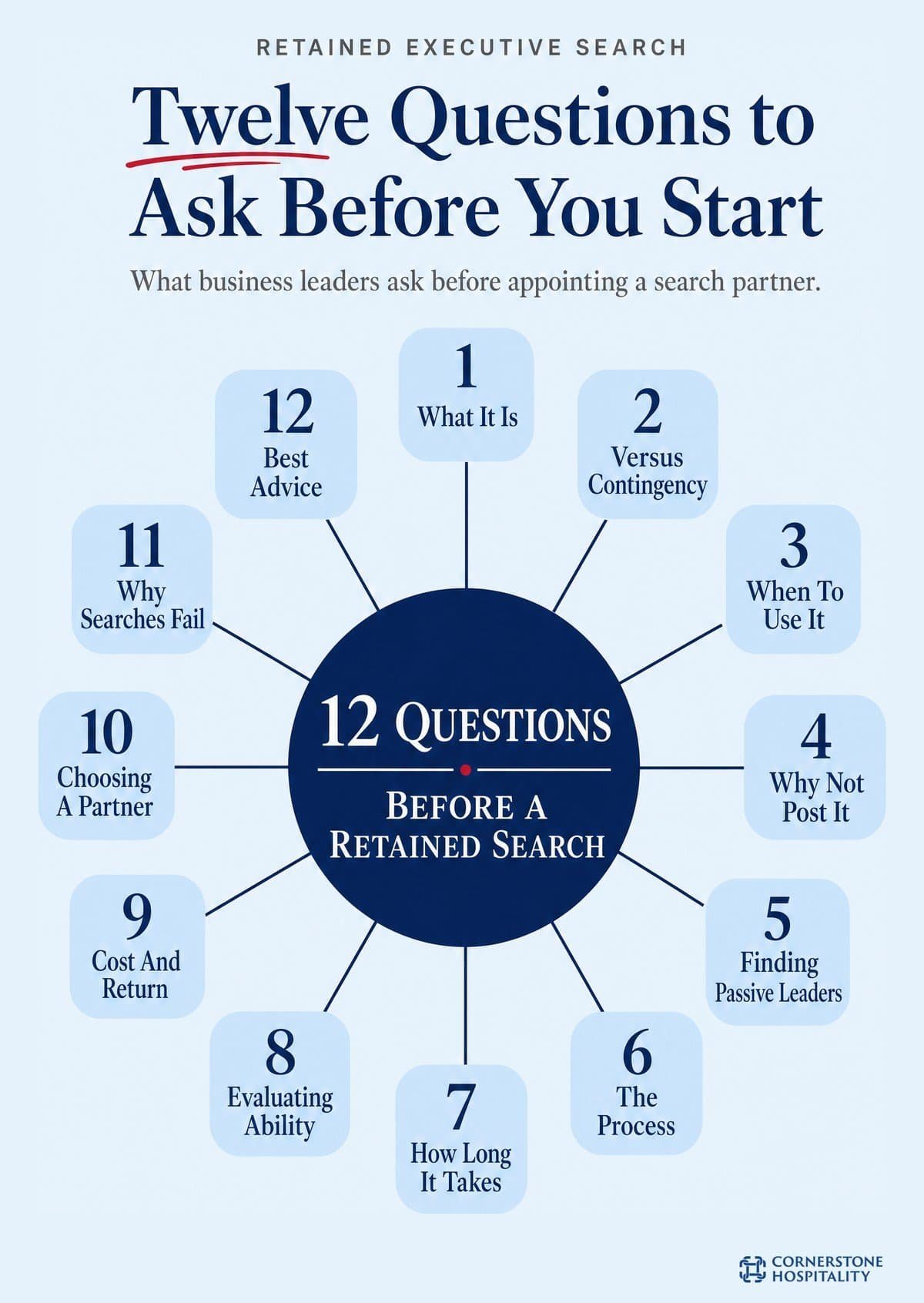
Executive Recruiting Explained: 12 Questions Business Leaders Ask Before Starting a Retained Search
This article was first featured on LinkedIn by Dan Heiman, Global President and Managing Partner of Cornerstone Executive Search, a fellow practice within the Cornerstone International Group network. We are sharing it here for hospitality leaders who are weighing whether retained executive search is the right approach for an important leadership hire. You can read the original on LinkedIn here.


Retained executive search and executive recruiting can feel unfamiliar if you have never worked with an executive search firm, or if you are deciding whether outside support is the right approach for an important leadership hire.
To help demystify the executive recruitment process, we asked Dan Heiman, owner of Cornerstone Executive Search and a retained executive search professional with more than 20 years of experience, to answer some of the questions business leaders ask most often before beginning an executive search.
Why the stakes are high
The stakes behind a critical leadership hire, and why more organizations turn to retained executive search. Full sources are listed beneath the article.
- How the Cornerstone Hospitality practice runs a global search, the main service page covering our full delivery model.
- Executive and Board Search, our C-suite and board-level discipline.
- Why the specialist difference matters in hospitality search, the case for a sector-focused firm.
The Cornerstone Hospitality team runs retained executive search built on a personal, relationship-driven approach. We are glad to learn about your organization, answer your questions, and help you decide on the best next step.
Talk to usAbout this analysis
The figures on executive hiring risk and hospitality staffing come from independent studies by Leadership IQ [2], Heidrick & Struggles reported through PrimeGenesis [1], the American Hotel & Lodging Association [4], and selection-validity research summarized by Plum [3]. The retained search timeline and fee ranges reflect standard practice across the Cornerstone Hospitality, Travel & Leisure Practice and the wider network of retained firms [5]. Full citations are listed beneath the article.
The basics
1. What is retained executive search?
Retained executive search is a dedicated partnership focused on identifying and recruiting the best possible leader for a critical role, not simply finding someone who is available.
Think of it as building a custom home rather than buying one already on the market. We begin with the blueprint: the company’s strategy, culture, challenges, and expectations. Then we go into the executive talent market to find and recruit the leader who fits that specific assignment.
Unlike traditional hiring methods that primarily attract active applicants, retained executive recruiting is designed to reach highly qualified leaders who may not be actively looking for a new position.
Why this matters
The word “retained” describes the commitment, not just the fee. Because the firm is engaged for the whole assignment, the work is built around your role and your market, rather than around whoever happens to be looking this month.
2. How is retained search different from contingency recruiting?
The biggest difference is commitment.
A contingency recruiter is typically paid only if one of their candidates is hired. That model can work well for certain positions, particularly when there is a larger pool of active candidates.
A retained executive search firm is engaged exclusively and paid to manage the entire search. We research the market, approach passive candidates, assess leadership capability, advise the client, and stay involved through interviews, negotiations, and onboarding.
Contingency recruiting often asks, “Who can we introduce?” Retained executive search asks, “Who is the best leader for this organization, and how do we recruit that person?”
The right fit
3. When should a company use a retained executive search firm?
Retained executive search makes sense when the cost of getting the hire wrong is significantly greater than the cost of conducting the search correctly.
That is usually the case in six situations. The navy cards below set them out at a glance.
Six signs
When retained search is the right approach
High-stakes role
The seat has a meaningful impact on strategy, culture, or financial performance.
Hard-to-reach talent
The right candidates are unlikely to respond to a job posting.
Confidentiality matters
The search needs to stay discreet while it runs.
Specialized or dispersed market
The talent pool is niche, senior, or spread across regions.
Objective market insight
You want an experienced advisor and a real read on the market.
No room to settle
The best candidate matters far more than the best available applicant.
Retained search is most often used for senior leadership recruitment, including CEO, President, C-suite, vice president, and other business-critical executive positions.
What to do
Before you brief anyone, ask one question: if this hire goes wrong, what does it cost us in lost momentum, team turnover, and time. When that number is large, a retained search is the lower-risk path.
4. Why can’t a company simply post the position and manage the executive search internally?
Sometimes it can, and we are always honest about that.
But a job posting is a little like putting a “For Sale” sign in the yard. It reaches the people who happen to be driving by and are already interested. It does not reach the high-performing executive who is busy succeeding somewhere else and has no reason to browse job boards.
Internal talent acquisition teams can be excellent, yet they are often managing many priorities at once. A retained executive search firm provides dedicated capacity, specialized research, external market access, and the ability to approach senior leaders discreetly.
For critical leadership hiring, the question is not simply whether the company can generate applicants. It is whether it can identify, reach, and recruit the strongest executives in the market.
“Contingency recruiting often asks, who can we introduce? Retained executive search asks, who is the best leader for this organization, and how do we recruit that person?”
Dan Heiman, Managing Partner, Cornerstone Executive Search
Reaching leaders
5. How do executive recruiters find leaders who are not actively looking?
We do not “post and pray” and wait for candidates to find us. We map the market and go find them.
That involves identifying relevant companies, industries, and adjacent sectors, researching leadership teams, drawing upon our relationships, and having direct, confidential conversations with executives who may not be considering a move.
These individuals are often called passive candidates, but that does not mean they are uninterested in the right opportunity. It simply means they are not actively applying for jobs.
Passive executive candidates rarely respond to a generic opportunity. They engage when someone connects the role to their experience, ambitions, and personal motivations. Executive recruiting is not a transaction, it is a series of trust-building conversations.
Why this matters
The strongest leader for your role is usually already employed and performing well. Reaching that person takes research and a trusted introduction, which is exactly the work a retained search is built to do.
The process
6. What happens during the retained executive search process?
A strong executive search begins with listening.
We first work to understand the business, its culture, the leadership team, the strategic priorities, and what success should look like in the role. We then build the position profile, research the executive talent market, identify and approach potential candidates, evaluate their fit, and present a qualified slate for consideration.
From there, we help manage interviews, gather feedback, conduct references and leadership assessments as appropriate, support offer negotiations, and stay connected during the executive transition.
The executive search process is a funnel. We may identify hundreds of potential prospects, speak with dozens, and ultimately introduce only the handful we believe deserve the client’s time.
The search funnel
From a mapped market to one recruited leader
7. How long does an executive search typically take?
Most retained executive searches take approximately 60 to 90 days from kickoff to an accepted offer, although timing varies based on the complexity of the role, geography, candidate availability, and the speed of the client’s decision-making process.
The calendar is often less important than the cadence. Executive searches lose momentum when feedback is slow, expectations keep changing, or candidates go weeks without communication.
A good executive recruitment process should be thorough, but it should never feel like it is drifting.
What to do
Protect the cadence from day one. Agree who gives feedback, how fast, and when interviews happen, so a strong candidate is never left waiting while a competing offer moves.
8. How do executive search firms evaluate leadership ability, cultural alignment, and long-term fit?
A resume tells us where someone has been. It does not necessarily tell us how they lead, make decisions, or respond when things get difficult.
We use structured interviews, career-pattern analysis, professional references, and, when appropriate, leadership assessments. Structured interviews are among the strongest single predictors of on-the-job performance, with a validity coefficient of roughly 0.51 in the selection research [3]. We look for specific evidence: What changed because this person was there? How did they build a team? How did they handle resistance? What did they learn from failure?
Cultural alignment does not mean hiring someone who looks and thinks exactly like everyone else. It means determining whether the candidate’s values and leadership approach will work in the organization, and whether that person can strengthen the culture rather than simply blend into it.
Successful executive hiring requires evaluating not only whether someone can perform the role, but whether they can lead effectively within the company’s specific culture, strategy, and stage of growth.
The investment
9. How much does retained executive search cost, and what does the investment include?
Most retained executive search fees are based on a percentage of the position’s anticipated first-year compensation, often around one-third, although executive recruiting fee structures vary by firm and assignment.
That investment should include much more than candidate introductions. The table below sets out what a well-run retained engagement covers and what each part means for you.
| What the fee covers | What it means for you |
|---|---|
| Market research and mapping | A full picture of who the leaders are, where they sit, and what it takes to move them. |
| Executive outreach | Direct, discreet approaches to passive leaders who would never see a job posting. |
| Candidate assessment | Structured interviews, career-pattern analysis, and leadership assessment where it helps. |
| Project management and advising | A single accountable partner keeping the search on cadence and giving honest counsel. |
| Referencing and offer support | Thorough references and hands-on help closing the offer cleanly. |
| Onboarding and a placement guarantee | Support through the executive transition, backed by a guarantee on the placement. |
The search fee is easy to measure. The cost of a poor executive hire is much harder to calculate: lost momentum, missed opportunities, team turnover, customer disruption, and the need to begin the leadership search again.
The real value of retained executive search is reducing hiring risk while improving the quality of the leadership decision.
Why this matters
Weigh the fee against the true cost of a wrong hire, not against a job-board posting. With senior-hire failure rates near 40% to 46% [1] [2], the search fee is often the smaller number.
Choosing a partner
10. What should a company look for when selecting an executive search partner?
Industry experience matters, but curiosity, judgment, and trust matter just as much.
Look for an executive search partner who asks thoughtful questions, understands your business, communicates candidly, and is willing to challenge assumptions respectfully.
You should also understand:
- Who will actually conduct the executive search.
- How the firm researches and maps the talent market.
- How it identifies and approaches passive executive candidates.
- How often you will receive search updates.
- How candidates will be assessed.
- What the firm’s off-limits restrictions may be.
- What support is provided during offer negotiations and onboarding.
Most importantly, choose an executive recruiting partner you would want beside you when the search gets complicated, because almost every important leadership search has a few twists and turns.
What to do
Ask each firm to walk you through a recent search in your sector. The way they describe the work, the setbacks, and the outcome tells you more than any credentials slide.
11. What most often causes an executive search, or the resulting hire, to fail?
Failure usually begins with a lack of alignment.
If the board, CEO, and hiring team have different definitions of the role, the executive search firm receives conflicting signals and candidates experience a moving target.
Other common executive hiring problems include an unrealistic compensation package, a slow interview process, inconsistent candidate communication, and hiring primarily for experience while overlooking leadership style.
Sometimes companies create what executive recruiters call a “purple squirrel” profile, an unrealistic combination of every possible qualification in one imaginary candidate.
The better approach is to distinguish between what is truly essential, what can be learned, and what would simply be nice to have.
Why this matters
Most searches that stall fail on alignment, not on talent. Get the board, the CEO, and the hiring team to agree on the role in writing before the first candidate is approached, and the whole search runs cleaner.
The best advice
12. What is the most important advice you would give a company preparing to make a critical leadership hire?
Get clear about the destination before choosing the driver.
Do not begin an executive search with a job description that has been sitting in a file for five years. Begin with the business: Where are we going? What must change? What will this leader need to accomplish during the first 12 to 24 months? What kind of executive leadership will the organization need for its next chapter?
The best executive searches are not merely efforts to fill a leadership opening. They are opportunities to step back, think carefully about the future, and recruit a leader capable of helping the organization get there.
At Cornerstone, we often say that we help great companies recruit great leaders. The word “great” matters on both sides, and so does the work required to bring them together.
Thinking through a critical leadership hire in hospitality, travel, or leisure? We are glad to talk it through and help you decide on the best next step.
The proof
What our clients and candidates say
In a small global industry, the measure of a search partner is what leaders say about them afterward. Here is what two of them have said about working with our team.
“Florian played a pivotal role in my career transition within the hospitality industry, combining deep expertise in executive search with a highly strategic advisory approach. He takes the time to truly understand your long-term ambitions, challenges your assumptions, and positions you for sustainable leadership success. His network across the global hospitality sector is exceptional, and his commitment to delivering the right long-term fit goes far beyond a transactional placement.
Stefan SavicHospitality Professional · Asset Management, Development & Strategy
“Over the years I have worked with Florian and he has continually provided a service second to none. The caliber of individuals he recommends is always spot on, as he ensures that he understands not only the requirements and expectations of a role but also the importance of the success and growth of the business being related to people.
Daniel AylmerChief Executive Officer, Greater China
Both quotes are verified public LinkedIn recommendations from clients and colleagues who have worked with the Cornerstone Hospitality team.
Glossary
- Retained executive search
- A dedicated, exclusive engagement in which a search firm is retained to manage a senior leadership hire end to end, from mapping the market to supporting onboarding.
- Contingency recruiting
- A model in which a recruiter is typically paid only if one of their candidates is hired. It can work well for roles with a larger pool of active candidates.
- Passive candidate
- A high-performing leader who is not actively applying for jobs but may engage with the right opportunity when it is connected to their ambitions.
- Position profile
- The blueprint for the search, built from the company’s strategy, culture, and definition of success in the role, before any candidate is approached.
- Purple squirrel
- Recruiter shorthand for an unrealistic profile that combines every possible qualification in one imaginary candidate.
- Placement guarantee
- A firm’s commitment to stand behind a placement for an agreed period, and to re-run the search if the hire does not work out within that window.
Frequently asked questions
What is retained executive search in simple terms?
Retained executive search is an exclusive partnership in which a firm is engaged to manage a senior hire from start to finish. Rather than waiting for applicants, the firm maps the market, approaches the strongest leaders directly, assesses them, and supports the offer and onboarding. It is designed for roles where getting the hire right matters most.
How is retained search different from contingency recruiting?
The difference is commitment. A contingency recruiter is usually paid only if their candidate is hired, which suits roles with many active candidates. A retained firm is engaged exclusively and paid to run the whole search, including approaching passive leaders, assessing capability, and advising through interviews, negotiation, and onboarding. Both models have their place, for different kinds of roles.
How long does a retained executive search take?
Most retained searches run about 60 to 90 days from kickoff to an accepted offer. The exact timing depends on the complexity of the role, geography, candidate availability, and how quickly the client makes decisions. A steady cadence of feedback usually matters more to the outcome than the raw calendar.
How much does retained executive search cost?
Retained fees are usually based on a percentage of the role’s anticipated first-year compensation, often around one-third, though structures vary by firm and assignment. The fee covers market research, executive outreach, assessment, project management, referencing, offer support, and onboarding, typically backed by a placement guarantee.
How do recruiters reach leaders who are not job hunting?
By mapping the market and reaching out directly and discreetly. That means identifying relevant companies and leadership teams, drawing on existing relationships, and having confidential conversations that connect the role to a leader’s own ambitions. Passive candidates rarely respond to a generic posting, so the approach is personal and trust-based.
What does a placement guarantee usually cover?
A placement guarantee is the firm’s commitment to stand behind the hire for an agreed period. If the placement does not work out within that window, the firm re-runs the search. It is one of several things a retained fee should include, alongside assessment, referencing, and onboarding support.
Read next
Sources
- PrimeGenesis: 40% of executives pushed out, fail, or quit within 18 months (citing a Heidrick & Struggles internal study of 20,000 searches, CEO Kevin Kelly interview, Financial Times, 30 March 2009): primegenesis.com/2009/04/40-percent-of-execs-pushed-out-fail-or-quit-within-18-months
- Leadership IQ: Executive Failure Rates (study of 20,000 plus new hires across 312 organizations): 46% of newly hired employees failed within 18 months, while attitudes drove 89% of hiring failures and technical skills accounted for only 11%: leadershipiq.com/blogs/leadershipiq/executive-failure-rates
- Plum: Schmidt & Hunter (1998) Meta-Analysis Explained: structured interview validity r = .51, cognitive ability r = .51, composite validity above .60: plum.io/blog/schmidt-hunter-meta-analysis
- American Hotel & Lodging Association (AHLA): 82% of Surveyed Hotels Report Staffing Shortages: ahla.com/news/82-surveyed-hotels-report-staffing-shortages
- Association of Executive Search and Leadership Consultants (AESC): insights and standards of professional practice for retained executive search: aesc.org/insights
- Gallup: This Fixable Problem Costs U.S. Businesses $1 Trillion, on the business cost of voluntary turnover and the value of retaining strong people: gallup.com/workplace/247391/fixable-problem-costs-businesses-trillion
Dan Heiman leads Cornerstone Executive Search, a retained search practice within the Cornerstone International Group network. For more than 40 years the firm has helped organizations hire the leaders who move their businesses forward, with over 1,600 completed searches across manufacturing, agriculture, banking, financial services, healthcare, nonprofit, and private equity. Based in Kansas City and serving the Midwest with global reach, the team takes a personal, relationship-driven approach to C-suite and senior leadership recruiting.
Read the original article on LinkedIn →