


How Long Does It Take to Hire a Hotel General Manager?


Owners and operators almost always ask the same thing before they set out to hire a hotel general manager: how long will it take. The honest answer is that a senior search runs to a realistic range rather than a fixed date, because the timeline is shaped by the role, the market, the package, and the notice the chosen leader has to serve. A well-run search to hire a hotel general manager typically takes three to six months from the first briefing to the leader’s start date, and every part of that range is decided by choices the client and the search firm make along the way. A firm that promises a single number before it has seen the brief is guessing, and a guess is a poor basis for one of the most important appointments a property makes.
The timeline at a glance
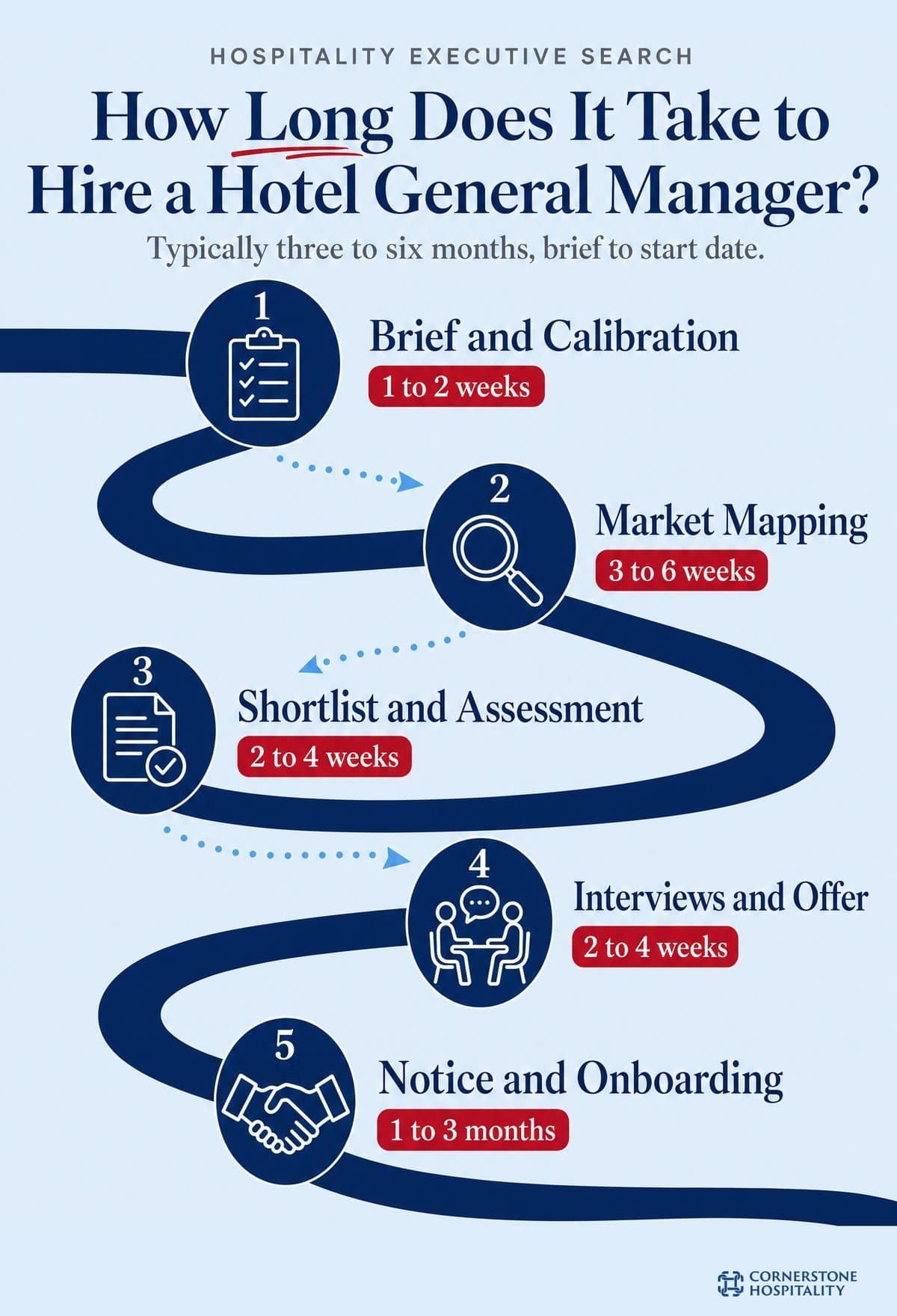
How long it takes to hire a hotel general manager
Typical ranges for a retained hotel general manager search. The exact figure moves with the market, the package, and how quickly the client decides.
- The wider discipline behind senior hotel appointments sits on our Executive and Board Search practice.
- Owners wondering how a senior approach actually works can read our guide to engaging a hospitality headhunter.
- If you are still deciding who to trust with a search, our overview of how to evaluate hospitality recruiting firms sets out what to look for.
This guide walks the five phases a hotel general manager search actually moves through, gives the typical time each phase takes, and explains what lengthens or shortens it. It also sets out why a realistic timeline is worth more to an owner than a confident promise. Cornerstone Hospitality is the Hospitality, Travel and Leisure practice of Cornerstone International Group, and the perspective here comes from a team of consultants who came into search after full careers as operators with groups such as Mandarin Oriental, Shangri-La, Hyatt, Marriott and Hilton. They have hired general managers, and they have been hired as general managers, so the timeline below is the one they have lived on both sides.
Phase one
Phase one: the brief and calibration
Every good search starts with a proper briefing, and the quality of that conversation sets the tempo for everything after it. The consultant sits down with the owner or operator to agree what the role really needs, which is rarely just a list of years of experience. A resort repositioning after a refurbishment needs a different leader from a stable city hotel protecting its rating, and a property opening in a new market needs different instincts again. The briefing establishes the brand and location history that will matter, the commercial targets the leader will own, the compensation the group is willing to offer, and the cultural and family realities that decide whether a senior candidate will actually accept and stay.
This phase usually takes one to two weeks, and the time is spent well when the client is clear and available. A group that has already agreed internally on what it wants and can compensate at the market rate moves quickly here. A brief that is still being argued over between owner and operator, or a compensation band that has not been settled, keeps the search paused before it has begun. Calibration is the cheapest place to spend time in the whole process, because a brief agreed properly at the start prevents weeks of wasted approaches later.
What to do
Agree the brief and the compensation band internally before the search begins. A role settled at the start moves at pace, while a brief still being debated keeps the clock running before any candidate has been approached.
Phase two
Phase two: market mapping and the approach
With the brief agreed, the search moves into its longest and most demanding phase. The consultant maps the relevant market across every geography the role spans, building a picture of who is running comparable properties well and who has the profile the brief calls for. The strongest general managers are almost never active applicants, because they are busy running successful hotels and have no reason to answer a job board. Reaching them means a discreet, direct approach through trusted channels, and that approach has to respect the confidentiality of a leader who cannot risk their current employer hearing about an early conversation.
Market mapping and outreach commonly run three to six weeks, and this is where the width of the market decides the pace. A general manager role in a major hospitality hub with a deep field of qualified leaders fills its pipeline faster than a niche resort role in a remote location where only a handful of people have run anything comparable. A search that spans several countries takes longer than a single-market one, because the mapping, the approaches, and the scheduling all multiply across time zones. The work in this phase cannot be safely rushed, because it is the part that reaches the passive leaders a job advertisement never will.
Why this matters
This is the phase that reaches the leaders who are not looking, and those are the leaders worth hiring. Rushing it means settling for whoever happened to be available rather than whoever was right for the property.
A realistic timeline is not a slower one. It is the timeline that reaches the leaders who are not looking, and those are the leaders worth hiring.
A principle Cornerstone Hospitality works by
Phase three
Phase three: shortlist and assessment
Once a field of genuine candidates has responded to the approach, the search narrows. Each candidate is assessed properly before any name reaches the client, and in hospitality that assessment goes beyond a resume read. The consultant weighs a candidate’s brand and location history the way an operator weighs it, tests their commercial track record against the targets the role will own, and forms an honest view of whether the person will fit the culture of the group and the market. References are taken, and the picture that emerges is one the client can trust, because the filtering has already been done.
Assessment and shortlisting typically take two to four weeks. A tightly defined brief speeds this up, because the consultant knows exactly what a strong fit looks like and can present a short, confident list rather than a long, hedged one. A brief that keeps shifting slows it down, because candidates already assessed have to be measured against a moving target. The output of this phase is a shortlist of assessed leaders rather than a stack of resumes, and the point of the depth is to save the client from spending its own senior time interviewing people who were never the right fit.
The five phases, in brief
The five phases of a hotel general manager search
Phase four
Phase four: interviews and the offer
The client now meets the shortlist, and the pace of this phase sits largely in the client’s hands. Senior interviews take coordination, because a general manager candidate is often still running a hotel and a hiring panel often spans an owner, an operator, and a regional executive. Arranging first meetings, second meetings, and any property visits around several busy diaries is the single most common place a search stalls. The candidates are ready and assessed, and the delay, when there is one, is almost always about calendars rather than people.
Interviews and the offer commonly run two to four weeks when the client moves decisively, and considerably longer when feedback drips out over weeks or a decision keeps being deferred. Speed here protects the search, because the strongest candidates are in demand and a long silence after a good interview is often read as a lack of interest. A group that gives prompt feedback, agrees its decision quickly, and puts a fair offer on the table keeps its preferred leader engaged. An offer that is negotiated well, with the compensation, the terms, and the start date settled cleanly, closes this phase and moves the search to its final stretch.
The short version on timing
A hotel general manager search typically runs three to six months from brief to start date. The search phases themselves usually take two to four months, and the notice period the chosen leader has to serve adds the rest. The number moves with the market, the package, and how quickly the client decides.
What to do
Keep your decision-makers available and give prompt feedback after each round. The strongest candidates are in demand, and a long silence after a good interview is often read as a lack of interest.
Phase five
Phase five: notice period and onboarding
An accepted offer is not the same as a leader in the seat, and the gap between the two is the notice period. A sitting general manager owes their current employer a proper handover, and senior notice periods in hospitality commonly run one to three months, sometimes longer for a leader mid-way through a critical project or a peak season. This time is fixed by the candidate’s existing contract and their professionalism, and it is not something a search firm can compress. A client counting the weeks to a start date has to build the notice period into the plan rather than treat the signed offer as the finish line.
The onboarding that follows is where a good appointment is protected. A leader who starts well is the entire point of the exercise, so the strongest searches carry through the first months in the seat rather than ending at the signed contract. The chosen general manager is introduced to the owner’s expectations, the property’s commercial position, and the team they will lead, and the search firm stays close enough to catch any early friction before it becomes a problem. This is the phase most timelines forget, and it is the one that decides whether the months of search actually deliver a leader who holds the role.
Why this matters
The notice period is the one factor no search firm can shorten, so it has to be planned for rather than wished away. Building it into the timeline from the start is what turns a signed offer into a leader who actually holds the role.
The levers
What lengthens a search, and what shortens it
The three to six month range is wide because a handful of factors decide where inside it a given search lands. The single biggest lever is the brief. A role agreed clearly at the start, with a settled compensation band and internal alignment between owner and operator, moves at pace. A brief that keeps changing forces the search to double back, re-map, and re-assess, and every change costs weeks. Compensation set at the market rate attracts the right leaders quickly, while a package below the market keeps strong candidates politely declining and stretches the search while the band is revisited.
Decision speed is the second lever. A client that gives prompt interview feedback and agrees its choice quickly keeps its preferred candidate engaged and closes the search cleanly. Slow feedback loses momentum and sometimes loses the candidate. Geography is the third: a single-market search is faster than a cross-border one, where relocation, work authorization, and family considerations all add time. The notice period is the fourth, and it is the one factor largely outside anyone’s control, set by the chosen leader’s existing contract. Understanding these levers lets an owner shorten the parts of the search they can influence and plan honestly around the parts they cannot.
What shortens a search, and what lengthens it
The four levers that move the timeline
| Lever | Shortens the search | Lengthens the search |
|---|---|---|
| The brief | Clear, agreed, aligned between owner and operator | Shifting requirements that force a re-map |
| Compensation | Set at the market rate from the start | A below-market package that stalls approaches |
| Decision speed | Prompt feedback and a quick, clear choice | Deferred decisions that lose the candidate |
| Geography | A single-market role with a deep field | Cross-border relocation and work authorization |
| Notice period | A leader with a short contractual notice | A long notice, fixed by the leader’s contract |
Want an honest timeline for your own general manager search?
Tell us about the property, the role, and the market. We will map the phases against your situation and give you a realistic range, not a promised number.
Talk to usThe honest case
Why a realistic timeline beats a promised number
A search firm that promises to fill a general manager role in a fixed few weeks is either working from a shallow pool of active applicants or planning to cut the phases that matter. The leaders worth hiring are rarely on a job board, and reaching them, assessing them properly, and letting them serve a fair notice period simply takes time. A promised number that ignores this tends to deliver one of two outcomes: a fast placement of whoever was available rather than whoever was right, or a broken promise a few weeks in when the shallow pool runs dry. A wrong appointment made quickly is far more expensive than a right one made on a realistic schedule.
A realistic timeline lets an owner plan properly around a leadership transition. A property that knows its search will run three to six months can arrange interim cover, manage the outgoing leader’s exit with dignity, and brief its team with confidence rather than lurching from an over-optimistic promise to a scramble. The value of honesty at the start is that it removes the nasty surprises later. A firm that tells you the truth about how long a good search takes is showing you the same discipline it will bring to the search itself.
The right leader hired on a realistic schedule always costs less than the wrong leader hired on a promised one.
A principle Cornerstone Hospitality works by
About this analysis
Where the ranges come from: the phase timings above reflect how a retained hotel general manager search runs in practice, drawn from the team’s own engagements and from published guidance on the retained search process [1] and time-to-hire [2].
What moves them: every range is typical, not fixed. The market, the compensation, the client’s decision speed, and the chosen leader’s notice period all shift the final figure.
Who wrote it: consultants inside the Cornerstone Hospitality practice who have hired general managers and been hired as general managers, backed by the Cornerstone International Group partner network.
How we work
How Cornerstone Hospitality runs a general manager search
Cornerstone Hospitality runs senior hospitality appointments on a retained basis, and a general manager search follows the five phases above with one accountable team from start to finish. An engagement begins with a structured briefing about the property, the role, and the outcome the appointment needs to deliver. The team calibrates that brief against real market conditions, maps the search universe across every geography the role spans, approaches passive leaders discreetly, and presents a shortlist of assessed candidates rather than a stack of resumes. Global reach comes through the Cornerstone International Group partner network, so a search can follow a role across borders while staying with one team that owns the result.
The work does not stop at the signed offer. The engagement carries through the notice period and the leader’s first months in the seat, and every search is backed by a placement guarantee that runs from six to twelve months, set out in the engagement letter at the start of each assignment. For hospitality groups hiring a general manager, a regional director, or leadership at VP, C-suite or board level, this discipline sits within the practice’s Executive and Board Search work, where senior-level access, confidentiality, and an honest timeline matter most.
Planning a general manager appointment?
Tell us about the property and the role. We will give you an honest timeline for your specific search, and explain what an engagement would look like.
Start the conversation →The proof
What our clients and candidates say
In a small global industry, the return on a senior leader is what other leaders say about them when they are not in the room. Here is what two of them have said about working with our team.
“Florian played a pivotal role in my career transition within the hospitality industry, combining deep expertise in executive search with a highly strategic advisory approach. He takes the time to truly understand your long-term ambitions, challenges your assumptions, and positions you for sustainable leadership success. His network across the global hospitality sector is exceptional, and his commitment to delivering the right long-term fit goes far beyond a transactional placement.
Stefan SavicHospitality Professional · Asset Management, Development & Strategy
“Over the years I have worked with Florian and he has continually provided a service second to none. The caliber of individuals he recommends is always spot on, as he ensures that he understands not only the requirements and expectations of a role but also the importance of the success and growth of the business being related to people.
Daniel AylmerChief Executive Officer, Greater China
Both quotes are verified public LinkedIn recommendations from clients and colleagues who have worked with our team.
Glossary
- Retained search
- An executive search run on an exclusive, committed basis, where the firm maps the whole market and works one assignment through to completion rather than competing for a fee against other agencies.
- Calibration
- The opening phase where the consultant and the client agree what the role really needs: the brand and location history, the commercial targets, the compensation, and the cultural fit that will decide whether a senior candidate accepts and stays.
- Market mapping
- The systematic picture of who is running comparable properties well across every geography the role spans, built so the strongest leaders, who are rarely active applicants, can be approached directly and discreetly.
- Notice period
- The time a sitting general manager owes their current employer before they can start a new role, commonly one to three months in senior hospitality, fixed by the candidate’s existing contract and outside the search firm’s control.
- Placement guarantee
- A commitment, set out in the engagement letter at the start of an assignment, that the firm stands behind the appointment for a defined window, typically six to twelve months.
Frequently asked questions
How long does it take to hire a hotel general manager?
A well-run hotel general manager search typically takes three to six months from the first briefing to the leader’s start date. The search phases themselves, from brief to accepted offer, usually run two to four months, and the notice period the chosen leader has to serve adds the rest. The exact figure depends on the width of the market, the compensation on offer, how quickly the client makes decisions, and the number of geographies the role spans.
Can a general manager search be done faster?
Parts of it can, and parts of it cannot. A client can shorten the search by agreeing a clear brief up front, setting compensation at the market rate, and giving prompt interview feedback so a decision is reached quickly. The notice period the chosen leader has to serve is largely fixed by their existing contract and cannot be compressed. A search firm that promises to fill the role in a few weeks is usually drawing from a shallow pool of active applicants rather than reaching the strongest leaders, who are rarely looking.
What are the phases of a hotel general manager search?
There are five: the brief and calibration, market mapping and the approach, shortlist and assessment, interviews and the offer, and the notice period with onboarding. The brief usually takes one to two weeks, market mapping three to six weeks, assessment two to four weeks, and interviews and offer two to four weeks. The notice period commonly adds one to three months on top before the leader can start.
Why does the market mapping phase take so long?
The strongest general managers are almost never active applicants, because they are running successful hotels and have no reason to answer a job board. Reaching them means mapping the relevant market and making a discreet, direct approach through trusted channels, while protecting the confidentiality of a leader who cannot risk their current employer finding out. That work takes time, and it is the part of the search that reaches the passive leaders an advertisement never will.
Does a notice period really add that much time?
Yes. A sitting general manager owes their current employer a proper handover, and senior notice periods in hospitality commonly run one to three months, sometimes longer for a leader in the middle of a critical project or a peak season. This time is set by the candidate’s existing contract and cannot be shortened by the search firm, so it has to be built into the plan rather than treated as an afterthought once the offer is signed.
Should we choose speed or fit when hiring a general manager?
Fit, in almost every case. A wrong appointment made quickly is far more expensive than a right one made on a realistic schedule, because a leadership mismatch damages the commercial performance and the culture of the property and then costs a second search to correct. A realistic timeline lets an owner arrange interim cover and plan the transition properly, which is a far better position than rushing to a placement that does not hold.
How can we make our own search move faster?
Agree the brief and the compensation band internally before the search begins, respond to shortlists and interviews promptly, and keep your decision-makers available for scheduling. Those three things address the parts of the timeline you control. Being honest about the notice period your chosen leader will serve, and planning interim cover around it, addresses the part you do not.
Cornerstone Hospitality is the Hospitality, Travel and Leisure practice of Cornerstone International Group. Its consultants came into executive search after full careers as operators with groups such as Mandarin Oriental, Shangri-La, Hyatt, Marriott and Hilton, and the practice works across four disciplines: Executive and Board Search, Leadership Development, Career Transition, and Executive Assessment. Global reach comes through the Cornerstone International Group partner network.
Every search is backed by a placement guarantee that runs from six to twelve months, set out in the engagement letter at the start of each assignment.
- Association of Executive Search and Leadership Consultants, guidance on the retained search process and timelines. aesc.org
- Society for Human Resource Management, time-to-hire and talent acquisition resources. shrm.org
- Harvard Business Review, research on hiring and executive selection. hbr.org
- U.S. Bureau of Labor Statistics, Occupational Outlook Handbook, Lodging Managers. bls.gov
- EHL Hospitality Insights, commentary on hospitality leadership and talent. hospitalityinsights.ehl.edu
This sits inside our Hospitality, Travel & Leisure work, which covers the fuller picture beyond this one piece.