


Retained vs Contingency Executive Search for Hospitality Hires
Retained vs contingency executive search is the first decision in any senior hospitality hire, and it settles who carries the risk.
Retained vs contingency executive search is not just a fee structure question, it is a question of whose interests the search firm serves first. Under retained vs contingency executive search, a retained firm is paid to find the right person even if that takes longer, while a contingency firm is paid only on placement. Choosing between retained vs contingency executive search well starts with naming which risk your organization can least afford: a slow search, or a rushed one.


Contents
- What retained executive search means
- What contingency recruiting means
- The core difference: incentives, not price
- When contingency recruiting is the right choice
- When retained search is the right choice
- How much a hospitality executive search costs
- Who pays the headhunter, and how the fees work
- What a search guarantee should cover
- Which model Cornerstone Hospitality uses
- Frequently asked questions
Every senior hospitality appointment eventually raises the same practical question: how should the search itself be paid for and run. Two engagement models dominate the market, and the retained vs contingency executive search decision shapes far more than a budget line. A retained search asks a client to commission one firm exclusively and pay in stages as the work progresses[1][2]. A contingency search hands the same brief to one or more agencies. So the agency collects a fee only if it places a candidate[4]. The labels sound like billing details, yet the choice actually shapes which candidates you reach and how deeply the firm assesses each one. It also decides how much risk sits with the client once the leader starts[6][7].
This guide explains what retained and contingency search each mean and where each model genuinely fits. In fact, the model matters more at senior levels than most owners expect. It also answers three questions that come up in almost every first conversation. What does the search cost, who pays the fee, and what should a guarantee cover? Cornerstone Hospitality is the Hospitality, Travel and Leisure practice of Cornerstone International Group. The perspective here comes from a team of consultants who came into search after full careers as operators. Their backgrounds span groups such as Mandarin Oriental, Shangri-La, Hyatt, Marriott and Hilton.
About this analysis
The figures and standards referenced in this guide come from named, published sources: the Association of Executive Search and Leadership Consultants professional standards, SHRM and Robert Half research on hiring costs, and recent AHLA and WTTC hospitality workforce data. Every cited figure links to its original source in the Sources section at the end of this article.

KEY INSIGHT
What retained executive search means
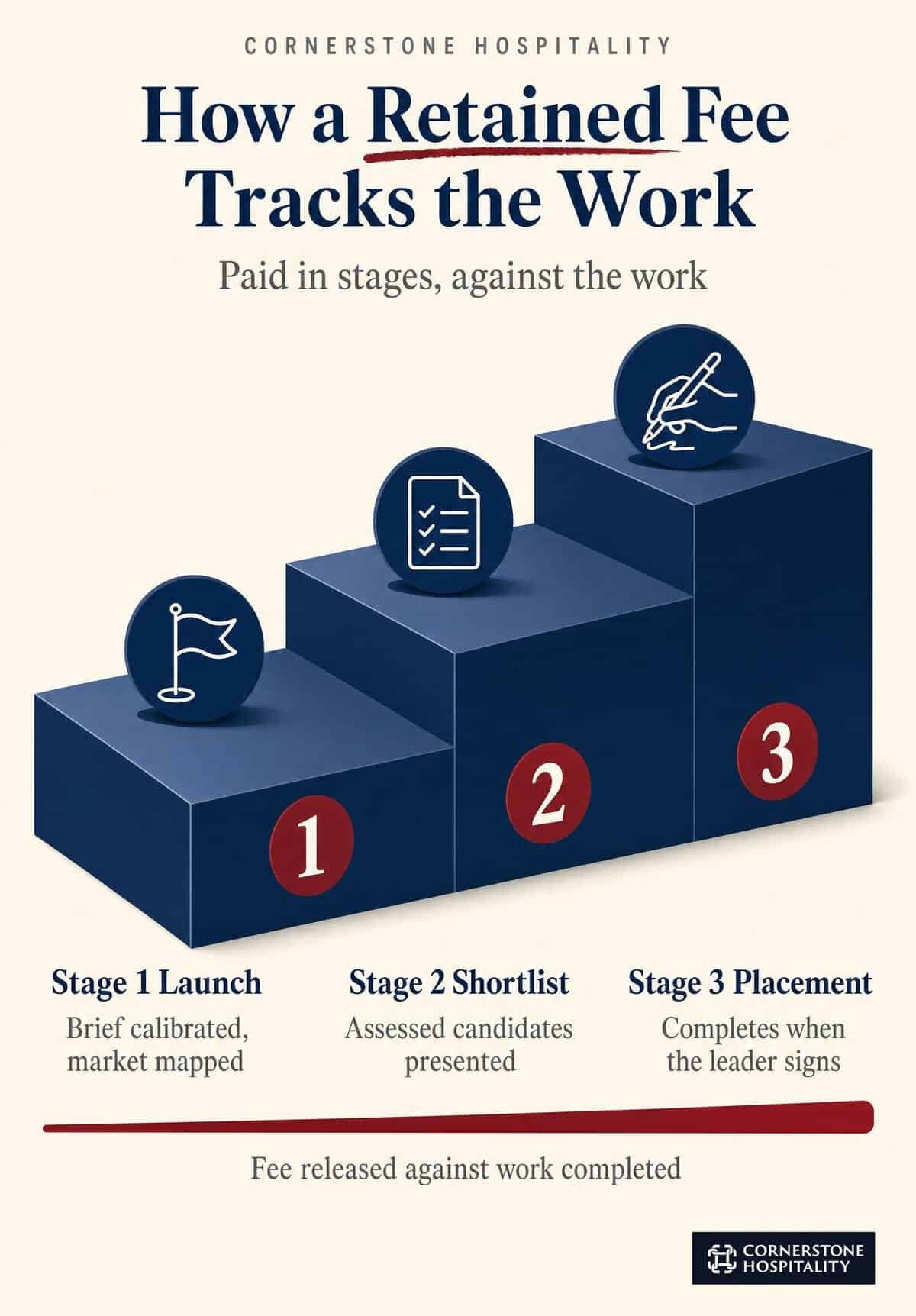
A retained search is an exclusive engagement. The client appoints one firm to run the search. That firm then carries the mandate from the first briefing conversation through to the leader’s first months in the seat. The two sides agree the fee up front[1]. So, rather than paying only when a candidate signs, they structure it in stages against the work. A first stage typically covers the launch and market mapping, then a second stage follows the presentation of a shortlist. A final stage completes on placement, and the engagement letter sets out the staging at the start of every assignment[1][2].
The firm earns its fee for running the search well, not for winning a race, so the work goes deep. The consultant maps the entire relevant market. That consultant then approaches leaders who are performing well in their current roles and are not looking to move[4]. Since the work is thorough, the consultant also assesses each candidate properly before any name reaches the client. Retained search is the standard model for board, C-suite and other senior appointments[1][2]. The reason is simple: the pool of genuinely qualified people is narrow and discretion is essential. Meanwhile, the cost of a wrong hire is high[5][6].
WHY THIS MATTERS
A retained search only works if one firm is accountable for the whole outcome. Before signing an exclusive mandate, agree the staged fee, the timeline, and what the firm owes you at each stage.
KEY INSIGHT
What contingency recruiting means
A contingency search reverses the risk. No fee changes hands unless an agency places a candidate, and the same brief goes to several agencies at once. Each one works the role alongside many others and sends across the candidates it can find quickly. So each agency collects a percentage of first-year salary only if its candidate is the one hired[4]. Speed and volume drive the model, since an agency only earns when it places. It is also competing against other agencies to get there first.
That structure suits a specific type of hire. Contingency recruiting is efficient where a role sits at a junior or mid level and the market runs deep. It also fits well where many capable applicants are actively looking and the cost of a mismatch stays modest. It puts the client in front of available candidates fast and costs nothing if none of them fit. The model is common across high-volume operational hiring in hospitality, from supervisors to departmental managers[10]. In practice, it does that job well.
WHY THIS MATTERS
Contingency recruiting rewards speed, so it is a strong fit once the role sits in a deep, active market. If a search stalls or the shortlist feels thin, that is the signal to move to a retained, one firm process instead.
The model you choose is not really about cost. It is about how far the search reaches and how deeply the firm examines each candidate. Just as important is who carries the risk if the appointment does not hold[1].
A principle Cornerstone Hospitality works by
KEY INSIGHT
Retained vs contingency executive search: the core difference is incentives, not price
The two models create different behavior because they reward different things. A contingency agency earns its pay for a result and only for a result. So its rational move is to send candidates quickly and move on if the role proves hard. A retained firm, by contrast, earns its fee to run a defined process. So its rational move is to complete every stage to a high standard, whether the search is easy or difficult[4]. Neither incentive is wrong. Each simply produces the behavior that fits the type of hire it was built for.
The table below sets out where the two models diverge in practice. Read it against the level of the role you are filling rather than as a verdict on either approach.
| How each model works | Retained | Contingency |
|---|---|---|
| Exclusivity | One firm holds the mandate | Often several agencies at once |
| When the fee is paid | In stages, against the work | Only on placement |
| Market coverage | Whole market mapped | Candidates found quickly |
| Candidates reached | Passive senior leaders | Active applicants |
| Assessment depth | Full assessment and references | Lighter, faster screening |
| Accountability | One partner owns the outcome | Shared across agencies |
WHAT TO DO
Use the table above as a checklist. Score the role on exclusivity, market depth, and how costly a wrong hire would be, then pick the column that fits before you talk about fees.
Not sure which column fits your next hire? Talk to us and we will help you work it out.
WHAT TO DO
When contingency recruiting is the right choice
Contingency works best when the market is doing part of the job for you. A hotel filling a front-office manager role in a major city has a wide field of qualified people. Many of them are open to a move and easy to reach through job boards and agency databases[11]. Paying on placement keeps the cost proportionate to a role where the team can correct a mismatch without lasting damage. For high-volume operational hiring across a portfolio, contingency and internal recruitment together handle the flow efficiently. So there is no reason to carry the cost of a retained process for roles the market fills readily.
The limits of the model appear as the role climbs. The most capable general managers, regional directors and executives are usually performing well where they are[4][14]. So they have no reason to answer a cold approach or watch a job board. A model built on active applicants and speed cannot reliably reach people who are neither applying nor looking[2][4]. At that point the efficiency that makes contingency useful for junior roles becomes the reason it struggles with senior ones.
WHAT TO DO
Reach for contingency recruiting when the role sits below senior leadership and the market is deep and active. Once the search is for a general manager, regional director, or executive, revisit that choice.
WHAT TO DO
When retained search is the right choice for senior hospitality hires
Retained search earns its place when three conditions apply together. The pool of qualified candidates is narrow, the appointment demands discretion, and a wrong hire would be expensive to unwind[8][9][10]. Senior hospitality leadership meets all three. A group replacing an underperforming general manager cannot advertise the role while that person is still in post. A leader worth attracting cannot risk their current employer hearing about an early conversation[3]. The people best suited to the job are rarely visible in any database, since they are busy running successful properties.
A retained partner exists for exactly that situation. One accountable firm maps the whole market, approaches passive leaders through trusted channels, and protects the confidentiality of both sides[1][3]. It then assesses each candidate in depth before presenting a shortlist. In hospitality that depth includes reading a candidate’s brand and location history the way an operator reads it. It also means understanding the family and cross-cultural realities that decide whether a senior leader will actually accept and stay. Those are the moments that win or lose a senior search. They are exactly the work a retained model exists to do[14].
Choose contingency when
- The role sits below senior leadership
- The market runs deep with active applicants
- A mismatch is easy to correct
Choose retained when
- The pool of qualified people is narrow
- The search needs discretion
- A wrong hire would be costly to unwind
WHY THIS MATTERS
The heavier the fallout from a wrong senior hire, the more a retained, accountable process pays for itself. That is exactly where the figures above come from.
KEY INSIGHT
How much a hospitality executive search costs
Executive search fees track the seniority and complexity of the role rather than following a fixed price list. So the honest answer to the cost question is that it depends on the mandate. Across the industry, firms commonly express retained search fees as a percentage of the placed leader’s first-year total compensation[4]. The figure then rises with the difficulty of the search, the seniority of the role, and the markets it spans. A cross-border C-suite appointment involves more work than a single-market director search, and the fee reflects that[4][12].
Cornerstone Hospitality prices each engagement on a project basis. The team structures the fee in stages against the work rather than as a single payment on placement. The reason is straightforward: a staged fee aligns what the client pays with how the team carries out the search. It also removes the pressure to rush a shortlist just to trigger a fee. The team agrees the exact figure and staging and writes them into the engagement letter before any work begins[1][2]. So there are no surprises. The right way to get a real number is a short conversation. It should cover the specific role, the market it spans, and the outcome it needs to deliver.
The short version on cost
Retained fees scale with the seniority and complexity of the role. Cornerstone sets them against first-year compensation and structures them in stages, confirmed in the engagement letter before the search starts[1].
Want a number for your specific role?
Tell us the role, the level, and the markets it spans. We will give you a straight answer on structure and cost before anything else.
WHY THIS MATTERS
Who pays the headhunter, and how the fees work
The employer pays the search fee, not the candidate. This is one of the most common points of confusion. The rule is simple across reputable executive search: the client who commissions the search carries the fee[4]. Placement or consideration never costs the candidate anything. A leader approached for a role owes nothing and pays nothing. That is one of the reasons senior people are willing to take a confidential call in the first place[3].
On a retained engagement the fee breaks into stages that follow the search. A launch stage funds the mapping and outreach, then a middle stage follows delivery of the shortlist. A final stage completes on placement. On a contingency engagement, the fee is a single payment, and it triggers only when the team makes a placement. In both cases the money flows from the hiring organization to the search firm. The difference is timing and exclusivity, not who pays whom. Understanding this up front[4] makes the commercial conversation with any search firm far easier to navigate.
WHAT TO DO
When comparing firms, ask each one to set out its fee, staging, and guarantee in writing before any work starts. A firm that hesitates on that question is telling you something.
WHAT TO DO
What a hospitality executive search guarantee should cover
A search guarantee is the firm’s commitment to stand behind the leader it places. A meaningful guarantee should set out a clear protection window and state plainly what triggers it. It should also describe what the firm will do if the placement does not hold within that window[1]. The standard remedy is a re-run of the search at no additional professional fee. So the client never pays twice for one appointment. The conditions matter as much as the headline. A fair guarantee covers a departure for reasons connected to the fit of the hire[1][16]. Though it excludes events outside the firm’s influence, such as a restructure or a change of ownership. It also excludes a shift in the client’s own circumstances.
Cornerstone Hospitality backs its searches with a placement guarantee that runs from six to twelve months. The engagement letter records the specific period and conditions at the start of every assignment. The principle behind it is that the risk of a senior appointment should not sit entirely with the client[6][7]. A firm confident in the depth of its process is willing to stand behind the result. The guarantee is where that confidence becomes a written commitment. When you evaluate any search firm, read the guarantee closely. It tells you how much the firm truly trusts its own work.
A guarantee is not a marketing line. It is the clearest signal of how much a firm believes in the depth of its own search.
A principle Cornerstone Hospitality works by
WHAT TO DO
Before signing with any firm, read the guarantee first. Confirm the protection window, what triggers it, and the exact remedy, then weigh that against the fee.
KEY INSIGHT
Retained vs contingency executive search: which model Cornerstone Hospitality uses
Cornerstone Hospitality runs senior appointments on a retained basis. The reason is simple: the leaders worth placing are almost never active applicants, and the searches almost always demand discretion[4][15]. An engagement begins with a structured conversation about the group, the role, and the outcome the appointment needs to deliver. The team then calibrates the brief against market conditions and maps the search universe across every geography the role spans[1]. It presents a shortlist of assessed candidates rather than a stack of resumes[1][6]. It then supports the client through interviews, references and the offer. Global reach comes through the Cornerstone International Group partner network. So a search can follow a role across borders while staying with one accountable team[12][13].
The work does not end at the signed offer. A leader who starts well is the point of the whole exercise[6]. So the engagement carries through the leader’s first months, and the six to twelve month guarantee backs every search. Hospitality groups often hire at VP, C-suite, board or non-executive director level. For those searches, the discipline sits within the practice’s Executive and Board Search work, where senior-level access and confidentiality matter.
Weighing up how to run your next senior search?
Tell us about the role and the group. We will explain honestly which model fits, and what an engagement would look like.
Frequently asked questions
What clients and colleagues say
Over the years I have worked with Florian and he has continually provided a service second to none. The caliber of individuals he recommends is always spot on, as he ensures that he understands not only the requirements and expectations of a role but also the importance of the success and growth of the business being related to people.
Daniel Aylmer, Chief Executive Officer, Greater China
Florian played a pivotal role in my career transition within the hospitality industry, combining deep expertise in executive search with a highly strategic advisory approach. Unlike traditional recruiters, he takes the time to truly understand your long term ambitions and positions you for sustainable leadership success.
Stefan Savic, Hospitality Professional, Asset Management, Development and Strategy
Both quotes are verified public LinkedIn recommendations from clients and colleagues who have worked with Cornerstone Hospitality’s leadership.
Related reading
How Long Does It Take to Hire a Hotel General Manager?
Once you know retained is the right model, the next question is timing. See what actually drives a senior search timeline.
Hospitality Talent Shortage 2026: Why Top Leaders Are Harder to Find
The market backdrop behind every senior search, and why the pool of ready leaders keeps getting tighter.
Executive Recruiting Explained: 12 Questions Business Leaders Ask
Twelve practical questions to ask before you commission any retained search, in hospitality or any other industry.
Written by
The Cornerstone Hospitality Team
Cornerstone Hospitality is the Hospitality, Travel and Leisure practice of Cornerstone International Group. Its consultants came into executive search after full careers as operators with groups such as Mandarin Oriental, Shangri-La, Hyatt, Marriott and Hilton. The practice works across four disciplines: Executive and Board Search, Leadership Development, Career Transition, and Executive Assessment. Global reach comes through the Cornerstone International Group partner network.
A placement guarantee backs every search, running from six to twelve months. The engagement letter sets out the terms at the start of each assignment.
Ready to talk about your next senior hire?
Tell us about the role and the group. We will explain honestly which model fits, and what working together would look like.
Sources
- Association of Executive Search and Leadership Consultants, Professional Practice Standards (October 2025): the standards every AESC member commits to on admission. It states that “AESC member firms operate on a retained and exclusive basis for executive search, providing expert advice from the beginning to the conclusion of each assignment”, and that this “exclusive, client-centered model of operation combined with deep expertise is a key to quality”. On commercial terms it requires that “the terms of the engagement should be in writing”, covering “the scope of the project, the timing, the fees and payment schedule, deliverables, and specific terms related to the assignment that might include guarantees, off-limits, conflicts, data management, and other important terms”.
- Association of Executive Search and Leadership Consultants, Client Bill of Rights: sets out what a client is entitled to expect from a member firm. It describes executive search consultants as “specialized management consultants who serve as trusted talent and leadership advisors to their clients”, confirms that members “operate on a retained and exclusive basis for executive search”, and records that they “bring unique insights and expertise on how to identify hard-to-find talent”. It also states that the terms of an engagement “should be in writing to ensure clarity on the part of the client and the consultant/consulting team”.
- Association of Executive Search and Leadership Consultants, Candidate Bill of Rights: the candidate-side counterpart to the client standards, and the reason a senior leader who is not looking will still take a call. It records that “confidentiality is a commitment to both the client and prospective candidates” and that “AESC members treat every candidate with professionalism and respect”. The protection runs to the fact of the conversation itself, which is what allows a serving general manager to explore a role without exposure to their current employer.
- Society for Human Resource Management, How to Work Effectively with an Executive Search Firm (Mark Feffer, 18 July 2016): the clearest published comparison of the two fee models. For retained search it records that “the industry’s standard fee is about 33 percent of the role’s annual salary, bonus and signing bonus”, while contingency recruiters “usually earn a fee in the area of 20 percent to 25 percent of the role’s first-year cash compensation, salary, bonus and signing bonus, and only if they succeed in filling the job”. It also notes that the retained firm “gets paid whether it finds a winning candidate or not”, and that retained searches target passive candidates “who don’t need the job” and have many years of experience in the field.
- Society for Human Resource Management, The Real Costs of Recruitment (Katie Navarra, 11 April 2022): puts a figure on what filling a role actually costs. SHRM benchmarking data gives an average cost per hire of “nearly $4,700”, but the article argues the true figure is far higher: Edie Goldberg of E.L. Goldberg & Associates estimates that “the total cost to hire a new employee can be three to four times the position’s salary”, so “if you’re hiring for a job that pays $60,000, you may spend $180,000 or more to fill that role”. Roughly 30 to 40 percent of that is hard cost and the remainder is soft cost.
- Society for Human Resource Management, The Cost of a Bad Hire Can Be Astronomical (Lisa Frye, 9 May 2017): quantifies the downside of getting an appointment wrong, citing an estimate of “$240,000” in expenses tied to a single bad hire. It also links the failure directly to process: Brandon Hall Group research found that organizations “lacking a standardized interviewing process are five times more likely to make a bad hire”, while strong onboarding “improve new-hire retention by 82 percent and productivity over 70 percent”. Separately, 43 percent of employers surveyed said they made a bad hire because they felt they needed to hire someone quickly.
- Society for Human Resource Management, Morale, Productivity Suffer from Bad Hires (Roy Maurer, 2 February 2015): reports a Robert Half survey of more than 2,100 CFOs on what a poor appointment actually costs. “Ninety-five percent of respondents said a poor hiring decision at least somewhat impacts the morale of the team, with more than one-third (35 percent) saying morale is greatly affected.” Degraded staff morale ranked as the leading concern at 39 percent, ahead of a drop in productivity at 34 percent and monetary cost at 25 percent. Supervisors “spend, on average, 17 percent of their time managing poorly performing employees”.
- Hotel Dive, Hospitality industry could face 8.6M workforce shortfall by 2035: WTTC (9 October 2025): reports World Travel & Tourism Council research finding that “the hospitality industry, in particular, is expected to face a gap of 8.6 million workers, approximately 18% below the required staffing levels” by 2035. Travel and tourism as a whole is projected to fall short by 43 million roles even while gaining 91 million new jobs.
- American Hotel & Lodging Association, Rising Cost, Staffing Challenges Persist for Hotels (Front Desk Feedback survey, 246 hoteliers, late February 2026): the most recent industry read on staffing: more than half of responding hoteliers describe their properties as somewhat or severely understaffed, and 42% name workforce shortages as an operating pressure. AHLA records that “from rising insurance and energy expenses to workforce shortages, hotels are navigating significant operational challenges”.
- American Hotel & Lodging Association, 65% of surveyed hotels report staffing shortages (282 hoteliers, 6 December 2024 to 3 January 2025): establishes the depth of the hole beneath the senior tier. 65% of hotels reported shortages and 9% described themselves as severely understaffed, with six to seven open positions per property. AHLA notes that “hotel employment is still nearly 10% below pre-pandemic staffing levels”.
- Hotel Dive, Hotel staffing to remain ‘well below’ pre-pandemic levels (7 April 2025): records that hotel employment is forecast to stay materially under its pre-pandemic level even as the sector adds jobs, which is why competition for proven operators has not eased with recovery. The shortfall is structural rather than cyclical, and it is felt hardest where the pool was smallest to begin with.
- Lodging Econometrics, Global Hotel Pipeline Reaches Record High (Q4 2025 Global Construction Pipeline Trend Report): records an all-time high in the global construction pipeline, with early planning and luxury and upper-upscale conversions at historic milestones. Every project in that pipeline eventually needs a general manager and an executive team, which is what turns a development record into a leadership-supply problem.
- World Travel & Tourism Council, Global Travel & Tourism Growth to Outpace Wider Economy by 1.5 Times Over the Next Decade: projects the sector growing at roughly one and a half times the rate of the wider economy over the coming decade. Demand for senior operators therefore rises faster than the market can produce them, which is the backdrop to every senior hospitality search.
- Hospitality Net, The Hotel General Manager of the Future (Tom Engel, 11 November 2024): records how far the top operating job has moved: “The role of a Hotel General Manager is evolving rapidly. As the industry navigates a complex landscape of economic challenges, technological advancements, and changing guest expectations, the qualities of a successful leader are undergoing a transformation.” The modern general manager is expected to combine operational command with data fluency, commercial judgment and the ability to lead multi-generational teams. The wider the brief, the smaller the pool of people who can genuinely carry it.
- Hospitality Net, Hospitality’s Talent Crisis Is a Perception Crisis (Colin Kingsmill, Managing Partner, CDR Global): argues that the sector’s shortage is a narrative problem rather than a hiring one: “This is not a recruitment problem. It is a narrative problem, and the industry has left that narrative to chance for too long.” It notes the sector needs some 90 million additional workers by 2035 while only about one in ten young people would actively pursue a hospitality career, and that “the story is there. It just hasn’t been told at scale, with conviction, by the people with the credibility to tell it.”
- Hospitality Net, Evolving Workforce and its Culture (Professor Robert O’Halloran, East Carolina University): examines what the workforce now expects of a hospitality employer: “The modern workforce wants to have positive work environments, i.e., great places to work, have opportunities for advancement and cross training, flexible work hours, and choices of remote and onsite career paths.” Retention therefore depends on competitive pay, real career pathways and visible investment in people. Relevant to any guarantee discussion, because whether an appointment holds depends as much on the receiving culture as on the candidate.
This sits inside our Hospitality, Travel & Leisure work, which covers the fuller picture beyond this one piece.