


How Long Does a Senior Hospitality Career Transition Take?
A senior hospitality career transition usually runs nine to eighteen months from deciding to move to being settled. The search is the shortest part.

A senior hospitality career transition takes far longer than the search process it contains. Most people measure it from the first serious conversation to the signed offer, which is the visible middle of it. Then find themselves surprised twice: once by how long the run-up took, and once by how long it takes to be genuinely effective in the new seat.
The honest framing is that a transition at general manager level or above has four stages, only one of which looks like a job search, and that being fully up to speed sits about two years from the start rather than at the first day. External hires need about two years to get up to speed and are paid an 18% to 20% premium for the privilege [2], and the unaided breakeven point, where a leader gives back as much value as they have consumed. Is up to six months on its own [1].
This piece sets out the four stages, what governs the length of each, and the specific things that genuinely shorten a transition rather than merely making it feel busier, including where structured career transition coaching actually moves the timeline.
The timeline, in numbers
A senior hospitality career transition: the short answer
For a general manager, regional director or corporate hospitality seat, plan on the following and adjust for your own situation rather than treating it as a rule.
| Stage | Typical elapsed time | What governs it |
|---|---|---|
| Deciding to move | Three to twelve months | Almost entirely internal. It ends when the person stops explaining to themselves why now is not the moment |
| Being in the market | Two to six months | Availability of seats at the right level, geography, and how visible the person is to the people who fill them |
| Process and offer | Six to twelve weeks | Assessment, references, owner or board scheduling, and notice arrangements at the other end |
| Notice and handover | One to three months | Contractual notice, the property’s calendar, and whether both sides agree a handover overlap |
| First day to breakeven | Up to six months [1] | How well the onboarding holds together and whether anybody owns it |
| Breakeven to fully up to speed | Up to two years from start [2] | Depth of the relationships and market knowledge the role requires |
The number most people are asking for
If the question is really “how long from deciding to move to being settled”, the answer for a senior hospitality seat is somewhere between nine and eighteen months, and being effective sits beyond that. The search itself is frequently the shortest part.
Those ranges are our own working figures from senior hospitality transitions rather than published statistics, and they vary by market and by seat. What is published, and what the ranges have to be read against. Is the evidence on what happens after the offer: up to six months to breakeven [1] and about two years to full speed [2].
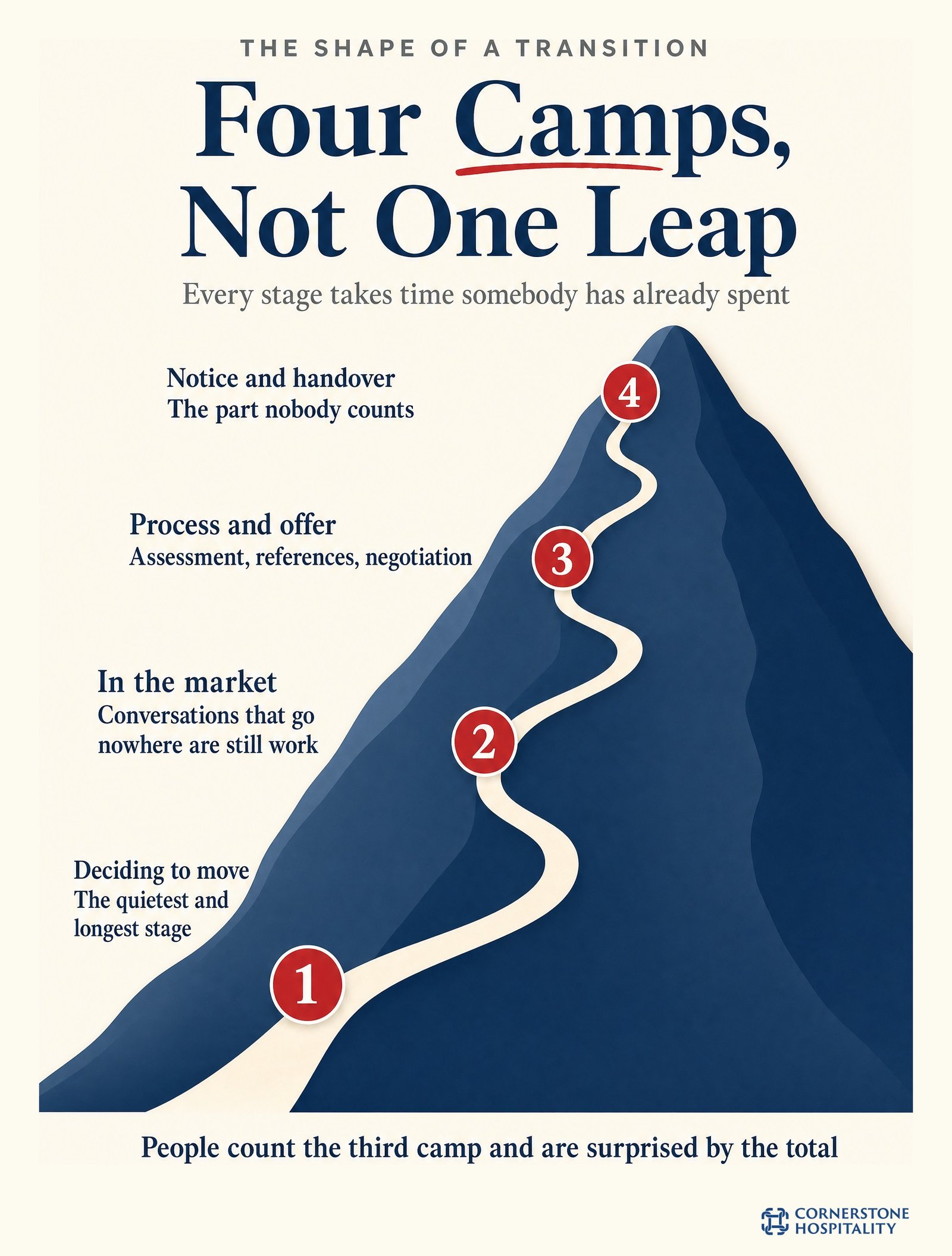
The stages of a senior hospitality career transition, and what sets each length
Stage one: deciding to move
This is the longest stage and the one least often counted, because from the outside nothing is happening. A general manager who has been quietly unsettled for eight months and has told no one has been in transition for eight months.
It runs long for a specific reason. The trigger is rarely a single event. So there is no obvious moment at which the decision becomes urgent, and hospitality supplies an unusually good excuse to defer: there is always a season coming, a refurbishment finishing, an owner review, a soft opening. The stage ends when the person accepts that there will always be one, and that is a decision rather than a discovery.
The context makes it heavier at the moment. 71% of leaders report increased stress, and 40% of stressed leaders are considering leaving leadership altogether [10]. That is a large population sitting at stage one. A meaningful share of them will resolve it by leaving the industry rather than by moving within it.
Stage two: in the market
Two to six months at senior level, and the variance is mostly about visibility rather than quality. Senior hospitality seats are not advertised in any useful volume. They fill from a map of who is credible. That means the question is not whether a person is good but whether the people filling seats know they exist and know they might move.
Conversations that go nowhere are still work at this stage, and they are not wasted. A senior candidate who has had six exploratory conversations has a far sharper read on their own market value than one who has had none, and that read is what makes the eventual negotiation straightforward.
Stage three: process and offer
Six to twelve weeks, and the length is governed almost entirely by other people’s diaries. Owner availability, board scheduling and the sheer difficulty of arranging a discreet meeting for somebody who is currently running a property account for more of the elapsed time than the assessment does.
It is worth pushing for structure inside this stage rather than speed. Structured interviews are the strongest single predictor of job performance at .42. Ahead of job knowledge and work sample tests at .40, .38 and .33 [11], and promotions are 1.6X more likely to succeed when assessments inform selection [4]. A process compressed to two conversations is faster and materially less predictive.
Stage four: notice and handover
One to three months and frequently underestimated by everyone involved. Senior hospitality notice periods are long, and properties resist releasing a leader mid-season, while the incoming group wants a start date that suits their own calendar. Where both sides agree a handover overlap, this stage lengthens deliberately, and that is a good outcome rather than a delay.
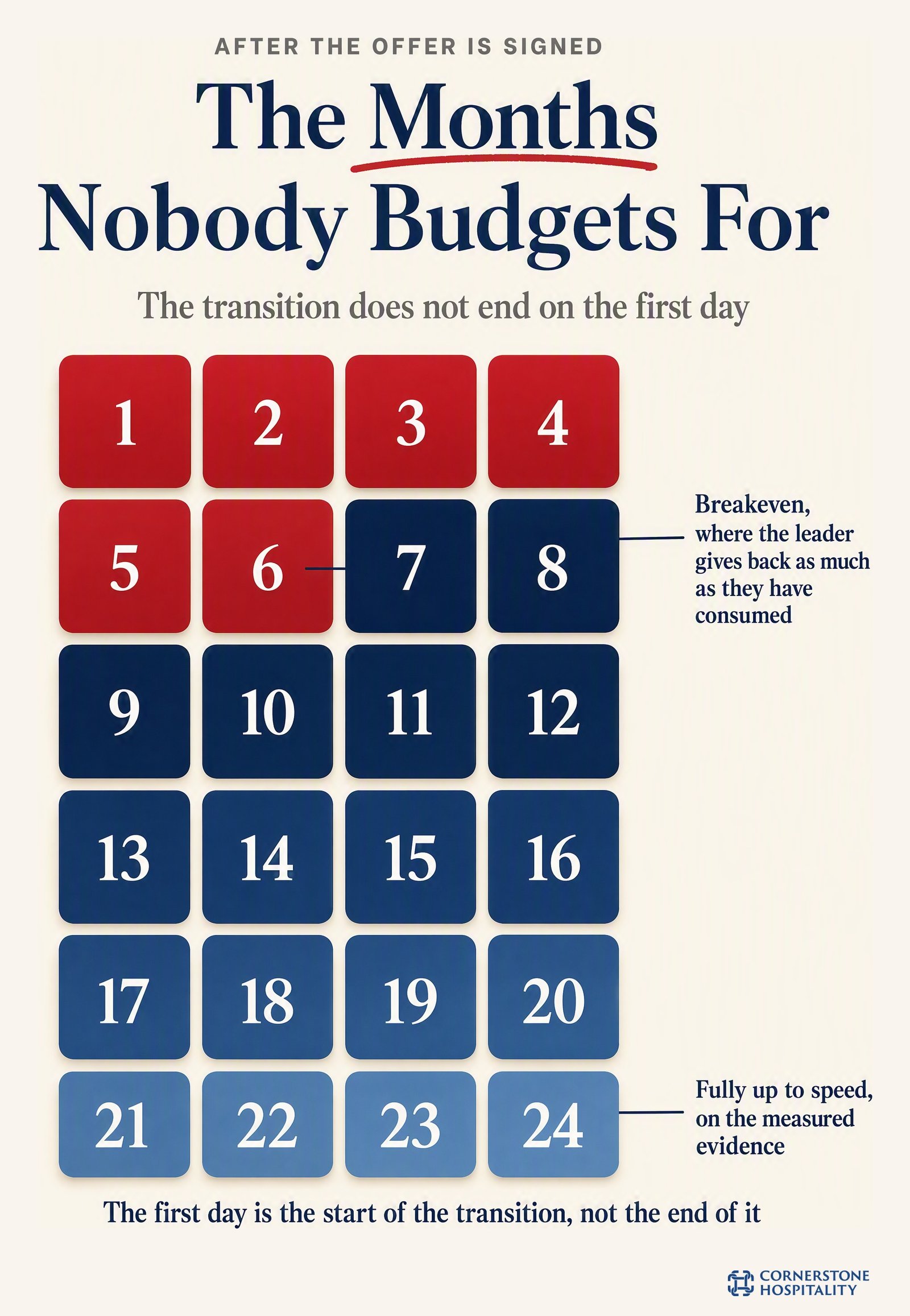
Breakeven at six months, full speed at two years
The stage that gets the least planning is the one with the most evidence attached to it.
Michael Watkins puts the unaided breakeven point at up to six months, breakeven being where a leader contributes as much value as they have consumed [1]. Bidwell’s study of personnel data finds external hires need about two years to get up to speed, alongside the 18% to 20% pay premium they command [2]. Between those two figures sits the period that determines whether the transition worked.
The risk in that window is not small. Across more than 20,000 new hires at 312 organizations, 46% failed within 18 months and only 19% achieved unequivocal success, with 89% of failures attributable to attitudinal factors and only 11% to technical skill [3].
What actually ends a senior transition badly
Coachability alone accounted for 26% of failures, emotional intelligence 23%, motivation 17% and temperament 15% [3].
What that failure profile means for the timeline
The things that end a senior transition badly are almost never capability gaps that more time would close. They are relationship and adjustment failures that show up in months two to six. That is why the six month mark is the one to plan around, and why the support that matters is heaviest in the first quarter rather than spread evenly.
Hospitality has its own version of this. 66% of executives and managers say their most recent hires were not fully prepared, with lack of experience the most common failing [7]. Some of that is selection. A good deal of it is that the receiving business had no structured plan for the first ninety days and expected the new leader to construct one while also running a property.
“Nobody schedules the thing that actually takes the time. That is learning which owner needs a call before a decision rather than after it. That is not in any handover document and it takes about a quarter to acquire.”
Florian Kittler, Managing Partner, Cornerstone Hospitality
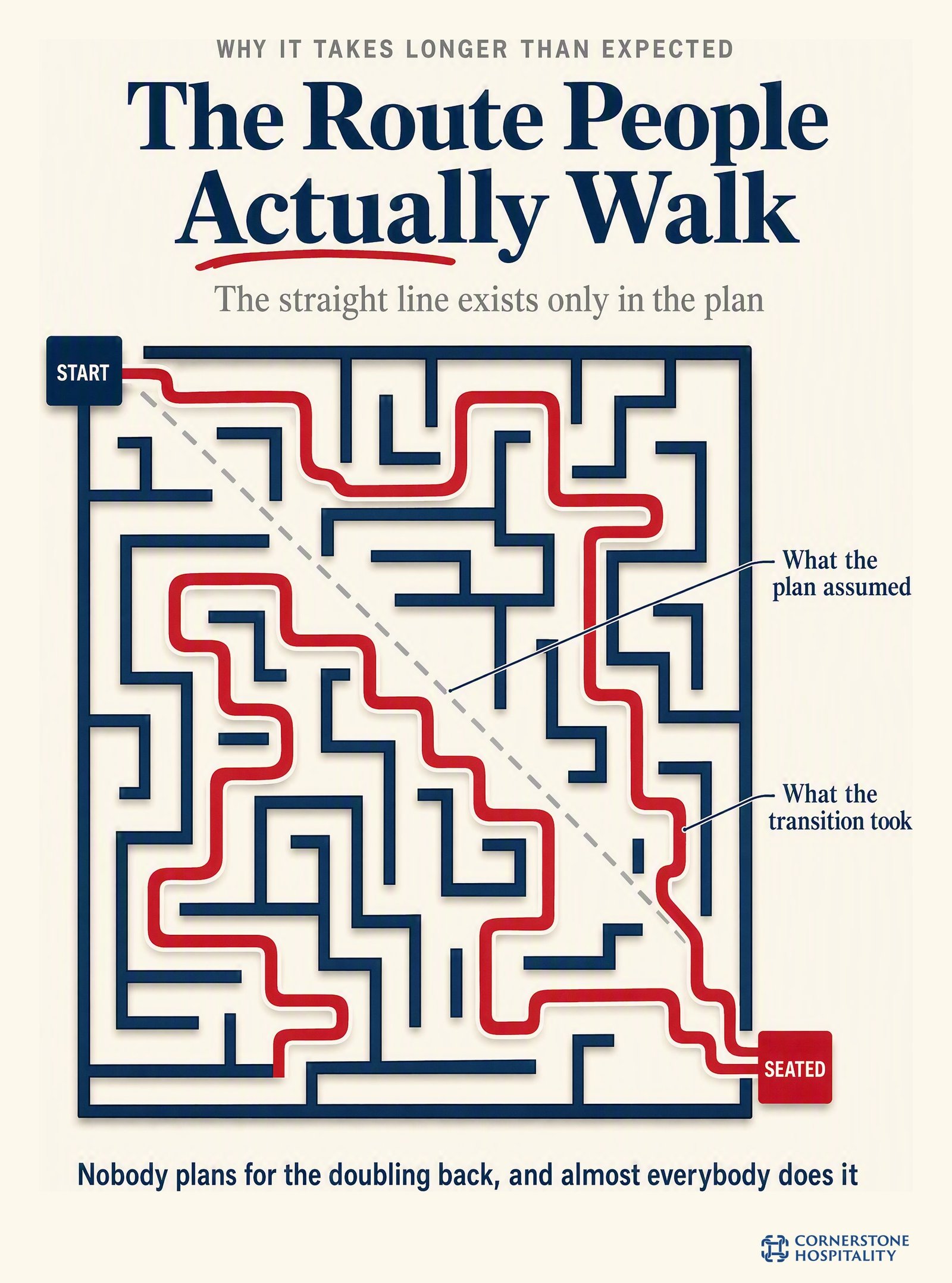
Four reasons the total always surprises people
Four reasons, and none of them is that people are slow.
The reason that does the most damage to morale
The fourth is worth sitting with, because it does the most damage to morale. A senior leader who reaches a final stage and does not get the seat reads it as a verdict on themselves. It usually is not: seats get withdrawn, owners change their minds, internal candidates emerge late, and a group restructures. Treating the first completed process as the expected outcome rather than as one of two or three sets a realistic clock and removes most of the distress.
There is also a structural reason the market moves slowly at the top. 30% of new CEOs at the world’s largest corporations are hired from outside [5], and only 20% of HR leaders say they have leaders ready to fill their most critical roles [4]. Seats stay open because benches are thin, and that thinness cuts both ways: it lengthens processes and it means a genuinely ready candidate is scarce.
What hospitality does to a senior hospitality career transition
Three effects, and they pull in different directions.
It shortens the market stage
Demand is high and supply of ready senior leaders is not. More than half of hotels report being somewhat or severely understaffed [9], and a separate survey found 65% reporting shortages with 71% carrying open positions at an average of six to seven per property [8]. The World Travel and Tourism Council forecasts 376 million jobs supported worldwide in 2026 and89 million new jobs over the next decade [13]. A credible senior hospitality leader who becomes genuinely available does not wait long.
It lengthens the notice stage
The same shortage that shortens the market stage lengthens the exit. A property that is already understaffed will resist releasing its general manager, and will negotiate hard on the date. Long notice periods are the norm at this level and they are enforced more firmly in a tight market than a loose one.
It compresses the settling-in stage, whether that is wise or not
Hospitality does not have a quiet quarter to start in. A new general manager arrives into a trading business with a season already running. The expectation of immediate operational grip is real. That expectation collides with a breakeven point of up to six months [1], and something has to give.
What usually gives is the strategic half of the role. The new leader holds the operation from week one. This is what everyone can see, and postpones the work on team, standard and bench, which nobody can see. Twelve months later the property is running and the bench is exactly where it was.
The turnover backdrop makes that costlier than it looks. Accommodation and food services recorded a monthly quit rate of 4.3% in March 2026, the highest of any industry and nearly double the private-sector average [6], and Gallup finds 52% of voluntarily exiting employees say their manager or organization could have prevented it [12]. A postponed focus on the team is not a neutral delay in this industry.
What genuinely makes a senior hospitality career transition faster
Five things, in rough order of effect. None of them is applying to more roles.
And one thing that does not make it faster, despite feeling productive: widening the search. A senior hospitality leader who broadens from one clear target to four vague ones has not increased their options. They have made themselves harder to place, because every conversation now starts with an explanation rather than a fit.
What to do while you are waiting
Stage one and stage two together are usually a year. Much of that year passes without anything specific happening on the transition. It is the cheapest development window a senior leader will ever get, and it is almost always wasted.
The most useful use of it is to close whatever gap the next seat will expose. The person usually knows what that is. Roughly 70% of development comes from challenging experiences and assignments rather than coursework [17], which means the right move is to take on something uncomfortable in the current role rather than to enroll in something.
An external coaching relationship is the other high-value use of the window, particularly where the constraint is behavioral rather than technical. 87% of respondents agree executive coaching has a high return on investment, and a PwC study found an average of seven times the cost of employing a coach [16]. Those are perceptions of value rather than controlled measurement, and they are consistent enough to be worth acting on.
The third thing is unglamorous and matters more than either: build the team you are leaving. A leader who hands over a property with a strong deputy in place leaves well. Is remembered well, and has a reference that says something specific. Given that managers account for at least 70% of the variance in engagement across business units [14] and team climate accounts for up to 31% of the variation in team-level engagement [15], the work is also the most visible evidence of leadership capability a candidate can point at.
Glossary
- Breakeven point
- The month at which a leader in a new role contributes as much value as they have consumed. Up to six months unaided on the published evidence [1].
- Up to speed
- The point at which a leader is operating at full effectiveness in the role, measured at about two years for external hires [2].
- Stage one
- The private stage before anybody knows a leader is considering a move. Usually the longest stage and never counted.
- The map
- The informal list of credible senior leaders that people filling seats work from. Senior hospitality roles are filled from it rather than from applications.
- Overlap
- The period where the outgoing and incoming leaders are both in place. Lengthens the transition on paper and shortens the time to effectiveness.
- Doubling back
- A process that runs a long way and then stops for reasons unconnected to the candidate. Normal at senior level and rarely planned for.
Frequently asked questions
How long does a senior hospitality career transition take in total?
Usually nine to eighteen months from the private decision to being settled in the new seat, with full effectiveness beyond that. The search itself is frequently the shortest part. The breakeven point in the new role sits at up to six months on its own [1].
How long does the search itself take?
Two to six months in the market at senior level, then six to twelve weeks through process and offer. The middle stage is governed more by owner and board availability than by assessment.
Why does it take two years to be fully effective?
Because the knowledge that matters is relational and local. Bidwell’s research finds external hires need about two years to get up to speed and are paid 18% to 20% more than comparable internal promotions [2].
Is it faster to be promoted internally?
Considerably. Internal candidates can fill 49% of critical positions immediately [4], with no premium and a much shorter ramp. This is the main argument for a group building its bench rather than buying externally.
What is the biggest single cause of delay?
The private decision at the start. It commonly runs three to twelve months, produces nothing anybody can see. Is not included in anyone’s estimate of the total.
Should I negotiate my notice period down?
Rarely worth it. The overlap is where the incoming leader acquires the relationships and history that determine the first year, and cutting it wins weeks while costing the part that shortens time to effectiveness.
What if a process reaches the final stage and I do not get it?
Treat it as normal rather than as a verdict. Most senior transitions include at least one process that runs a long way and stops for reasons unconnected to the candidate, and planning for two or three sets a realistic clock.
Thinking about a move and not sure of the timeline?
A confidential conversation about where you are and what the market looks like costs nothing and commits you to nothing.
Sources
- The Future Organization, interview with Michael Watkins: The First 90 Days: Strategies for Leaders in Transition: records Watkins stating that “unaided the process for leaders to reach the breakeven point can take up to six months”, the breakeven point being where a leader contributes as much value as they have consumed. He also observes that “most people spend 10 to 15 years in leadership positions before getting any formal leadership training from their organization”, with the average leader in their late thirties or early forties before any training at all: thefutureorganization.com/the-first-90-days-strategies-for-leaders-in-transition
- Knowledge at Wharton: Why External Hires Get Paid More, and Perform Worse, than Internal Staff: reports Matthew Bidwell’s study “Paying More to Get Less: The Effects of External Hiring versus Internal Mobility”, published in Administrative Science Quarterly and drawn from personnel data in a US investment banking division from 2003 to 2009. External hires are paid “about 18% to 20% more” than comparable internal promotions and need “about two years to get up to speed”, and hiring managers confirm they “typically pay 10% or 20% more to pull people out of positions” where they already have security: knowledge.wharton.upenn.edu/article/why-external-hires-get-paid-more-and-perform-worse-than-internal-staff
- Leadership IQ: Executive Failure Rates: reports a longitudinal study of more than 20,000 new hires across 312 organizations, evaluated by 5,247 hiring managers at 6, 12, 18 and 24 months, finding that “46% of new hires failed within 18 months; only 19% achieved unequivocal success” and that 89% of failures were attributable to attitudinal factors against 11% for technical skill. The leading drivers were coachability at 26%, emotional intelligence at 23%, motivation at 17% and temperament at 15%: leadershipiq.com/blogs/leadershipiq/executive-failure-rates
- DDI: Succession Planning Best Practices: How to Close the Leadership Readiness Gap: reports that “only 20% of HR leaders say they have leaders ready to fill their most critical roles” and that “80% of organizations lack confidence in their leadership bench”, while “75% of organizations prioritize internal promotion over external hiring” and internal candidates “can fill only 49% of critical positions immediately”. It also finds promotions are 1.6X more likely to succeed when assessments inform selection, and organizations with strong benches are 2.9X more likely to fill leadership roles internally and 2.8X more likely to outperform financially: ddi.com/blog/succession-planning-best-practices
- Harvard Business Review: Turning Potential into Success: The Missing Link in Leadership Development: by Claudio Fernández-Aráoz, Andrew Roscoe and Kentaro Aramaki, reports that “66% of companies invest in programs that aim to identify high-potential employees and help them advance” while “only 24% of senior executives at those firms consider the programs to be a success”. It adds that “a mere 13% have confidence in the rising leaders at their firms, down from an already-low 17% just three years ago”, and that at the world’s largest corporations “a full 30% of new CEOs are hired from the outside”: hbr.org/2017/11/turning-potential-into-success-the-missing-link-in-leadership-development
- OysterLink analysis of US Bureau of Labor Statistics JOLTS data: Hospitality Workers Quit at a Higher Rate Than Any Other Industry in the U.S.: establishes that “the quit rate for accommodation and food services reached 4.3% in March 2026, the highest among all industries” and “nearly double the private-sector average of 2.2%”. Retail trade, the next highest sector, recorded 3.1%, against healthcare at 1.9%, manufacturing at 1.4% and finance at 1.2%. Layoffs in the sector held at 1.3%, matching the national average, so roughly three-quarters of separations are people choosing to leave: prnewswire.com/news-releases/hospitality-workers-quit-at-a-higher-rate-than-any-other-industry-in-the-us
- Deloitte: Frontline Workforce Trends in Airlines, Hospitality, and Restaurants: reports that “80% of restaurant workers and 76% of hospitality workers leave their job within a year”, and that “66% of executives and managers say most recent hires were not fully prepared, and that lack of experience was the most common failing”. It also finds 82% of workers naming feeling happy and engaged at work as the key driver of productivity, and 75% hoping for greater stability in the face of change: deloitte.com/us/en/Industries/consumer/articles/frontline-workforce-human-capital-trends
- American Hotel & Lodging Association: 65% of surveyed hotels report staffing shortages: surveys 282 hoteliers between 6 December 2024 and 3 January 2025 with Hireology, finding 65% still reporting shortages, 9% describing themselves as “severely understaffed” against 13% in May 2024, hotel employment “nearly 10% below pre-pandemic staffing levels”, and 71% carrying open positions at an average of six to seven per property. Housekeeping accounts for 38% of the gaps and front desk 26%, and 72% of respondents say career opportunities in hospitality are better than ever: ahla.com/news/65-surveyed-hotels-report-staffing-shortages
- American Hotel & Lodging Association: Rising Cost, Staffing Challenges Persist for Hotels as Travel Demand Expected to Hold Steady: surveys 246 hoteliers in late February 2026 and finds that “more than half of respondents report their properties are somewhat or severely understaffed”, with labor costs a top concern for 65% and workforce shortages named by 42%. Retention incentives in use include higher wages at 70%, flexible scheduling at 54%, hotel discounts at 54% and enhanced benefits at 31%: ahla.com/news/rising-cost-staffing-challenges-persist-hotels
- DDI: Global Leadership Forecast 2025 Study Signals Looming Leadership Exodus: surveys 10,796 leaders and 2,185 HR professionals across more than 50 countries and 24 industry sectors, reporting 71% of leaders with increased stress, 40% of stressed leaders considering leaving leadership altogether, and trust in immediate managers at “just 29%, a 37% decline since 2022”. It also records high-potential intention to depart rising “from 13% in 2020 to 21% in 2024”, with high-potential talent 3.7X more likely to leave within a year where the manager does not provide regular growth opportunities: ddi.com/about/media/global-leadership-forecast-2025
- Society for Industrial and Organizational Psychology: Is Cognitive Ability the Best Predictor of Job Performance? New Research Says It’s Time to Think Again: reports the revised operational validity estimates from Sackett and colleagues, in which “structured interviews emerged as the strongest predictors of job performance” with a mean operational validity of .42, job knowledge and work sample tests follow at .40, .38 and .33, and “cognitive ability rounded out this list with a validity estimate of .31”. The article explains that earlier meta-analytic corrections had systematically inflated these figures: siop.org/tip-article/is-cognitive-ability-the-best-predictor-of-job-performance
- Gallup: This Fixable Problem Costs U.S. Businesses $1 Trillion: establishes that “the cost of replacing an individual employee can range from one-half to two times the employee’s annual salary” and describes that as “a conservative estimate”. It also reports that 52% of voluntarily exiting employees say their manager or organization could have prevented their departure, and 51% say that in the three months before leaving, neither their manager nor any other leader spoke with them about job satisfaction or their future: gallup.com/workplace/247391/fixable-problem-costs-businesses-trillion
- World Travel & Tourism Council: Global Travel & Tourism Growth to Outpace Wider Economy by 1.5 Times Over the Next Decade: published 12 May 2026 with research partner Oxford Economics, forecasts that the sector will “support 376 million jobs worldwide in 2026, representing one in nine jobs globally” and contribute “$12TN to the world economy, accounting for 9.9% of global GDP”. Over the next decade it projects “almost 89 million new jobs globally, accounting for approximately one-third of all new jobs expected” across the wider economy: wttc.org/news/global-travel-tourism-growth-to-outpace-wider-economy-by-1-5-times-over-the-next-decade
- Gallup: Managers Account for 70% of Variance in Employee Engagement: states that “managers account for at least 70% of the variance in employee engagement scores across business units”, drawn from research measuring the engagement of 27 million employees and more than 2.5 million work units over two decades. It also finds about one in 10 people possess high talent to manage, that companies “miss the mark on high managerial talent in 82% of their hiring decisions”, and that talented managers contribute about 48% higher profit than average managers: news.gallup.com/businessjournal/182792/managers-account-variance-employee-engagement
- Korn Ferry Institute: Stronger Leadership, Stronger Climate, Better Results: analyzes “data from over 2,700 individuals across 541 teams” and finds that “team climate accounted for up to 31% of the variation in team-level engagement”. It reports that the right leadership characteristics and team environment “can lift engagement scores by up to 42 percentile points”, and that leaders scoring high on Presence, Agility and Striving produced team climates “approximately 30 percentile points stronger” than lower-scoring leaders: kornferry.com/institute/stronger-leadership-stronger-climate-better-results
- International Coaching Federation: Coaching Statistics: The ROI of Coaching in 2024: reports that “87% of survey respondents agreed that executive coaching has a high return on investment” and cites a PricewaterhouseCoopers and Association Resource Center global survey finding “an average ROI of seven times the cost of employing a coach”. It further records 72% of respondents linking coaching to increased employee engagement, with approval of coaching running at 78% among senior executives and 73% among employees: coachingfederation.org/blog/coaching-statistics-the-roi-of-coaching-in-2024
- Center for Creative Leadership: The 70-20-10 Rule for Leadership Development: sets out the framework that “emerged from over 30 years of our Lessons of Experience research”, in which development divides into “70% challenging experiences and assignments, 20% developmental relationships, 10% coursework and training”. CCL notes the framework is drawn from research spanning China, India, Singapore and the United States and is used across a client base including two thirds of the Fortune 1000: ccl.org/articles/leading-effectively-articles/70-20-10-rule
About the author
Florian leads Cornerstone International Group’s global Hospitality, Travel & Leisure Practice. He brings seventeen years of senior hospitality experience, including Marriott, Hyatt, IHG, Mandarin Oriental and Shangri-La Hotels & Resorts, and sixteen years in retained executive search. He is bilingual in English and German and works across Europe, the Middle East, the Americas, and Asia-Pacific.