

Executive Leadership Development Program
An executive leadership development program for senior hospitality leaders, delivered by consultants who have run the businesses they now develop.
An executive leadership development program is worth running when the leader decides, delegates and holds a room differently at the end of it. Being better informed is the easy part, and it is not the part that changes an operating week.
Cornerstone Hospitality runs leadership development for senior people in hotels, resorts, restaurant groups and travel operators. The consultants delivering it carried operating responsibility in the sector before they moved into development work, so the conversation starts from how the week actually runs rather than from a leadership model.
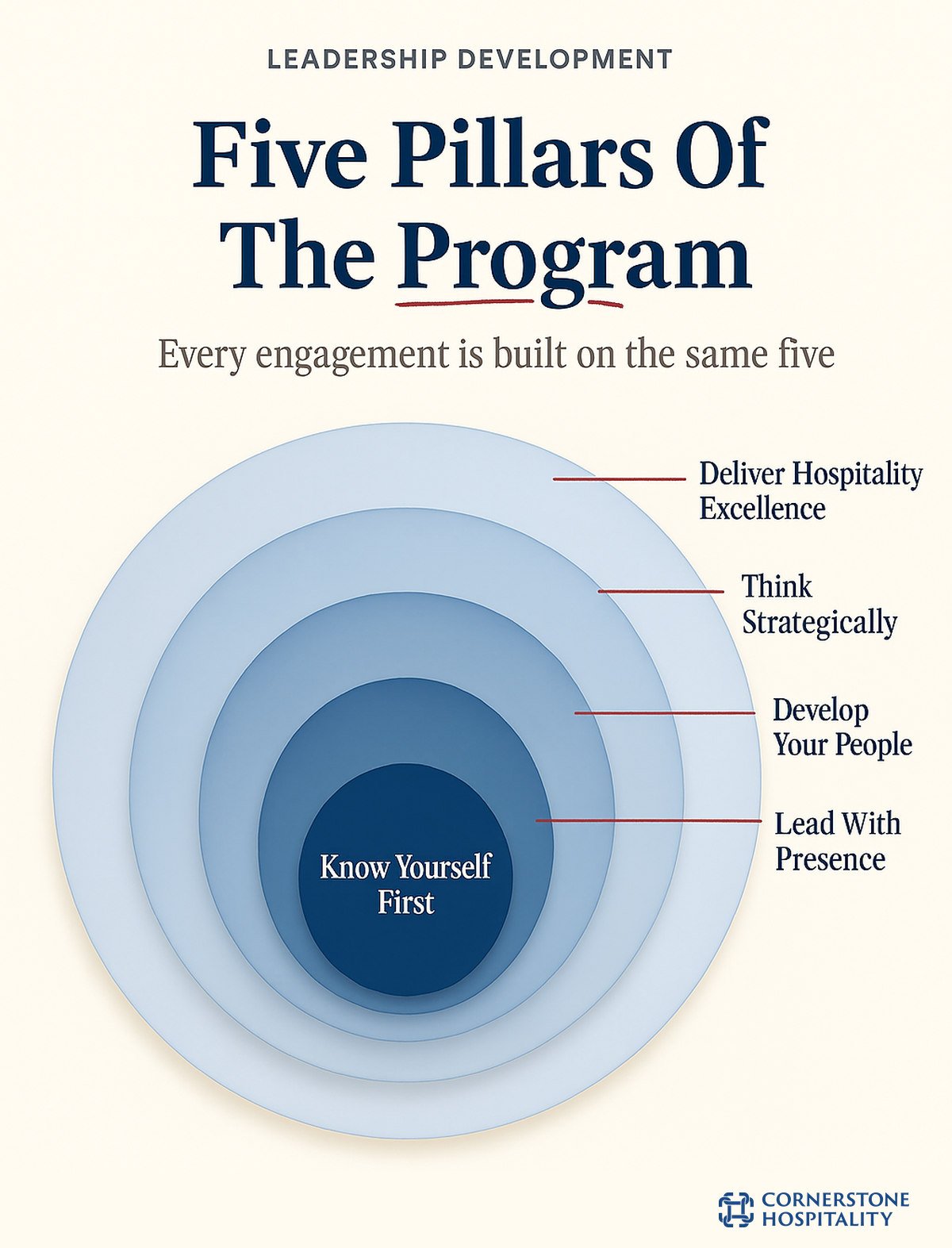
What an executive leadership development program is built on
Every engagement rests on the same five pillars, applied in the depth and combination the situation calls for rather than delivered as a fixed curriculum.
It opens with self-awareness, because a leader who misreads their own effect on a room cannot correct it. From there the work moves outward to presence and influence, which is how a leader shows up with owners, boards, peers and guests. The team comes next, because in this industry the team is the product and keeping good people is most of the job.
The fourth pillar is the step from operator to business leader, where long-horizon thinking and change leadership start to matter more than operational command. The fifth is the one that separates this from generic executive development: connecting leadership behavior directly to the service culture a property lives or dies by.
Development that lands inside the working week
Hospitality is a round-the-clock operating environment where strategy and service meet on every shift. A program that assumes clear diary space and quiet reflection time will struggle to hold its place in that week.
So the work is built to fit the week the leader actually has, with access between sessions rather than only inside them.

Considering an executive leadership development program for your senior team?
Tell us who the leaders are and what has to change. We will tell you whether this is the right instrument for it.
What an executive leadership development program includes
The parts that are fixed, and the parts written for the leader in front of us.
| What it is | |
|---|---|
| A 360 degree baseline | Structured stakeholder input before anything is agreed, so the starting point is evidenced rather than assumed. |
| A written development plan | Named behavioral targets and business outcomes, visible to the leader and to whoever is sponsoring the work. |
| Two to four sessions a month | Working sessions rather than lectures, with access between them when something real comes up. |
| Three milestone reviews | Progress measured against the plan that was written at the start, not against a feeling at the end. |
The sponsor sees the governance. What is said inside a session stays inside it.
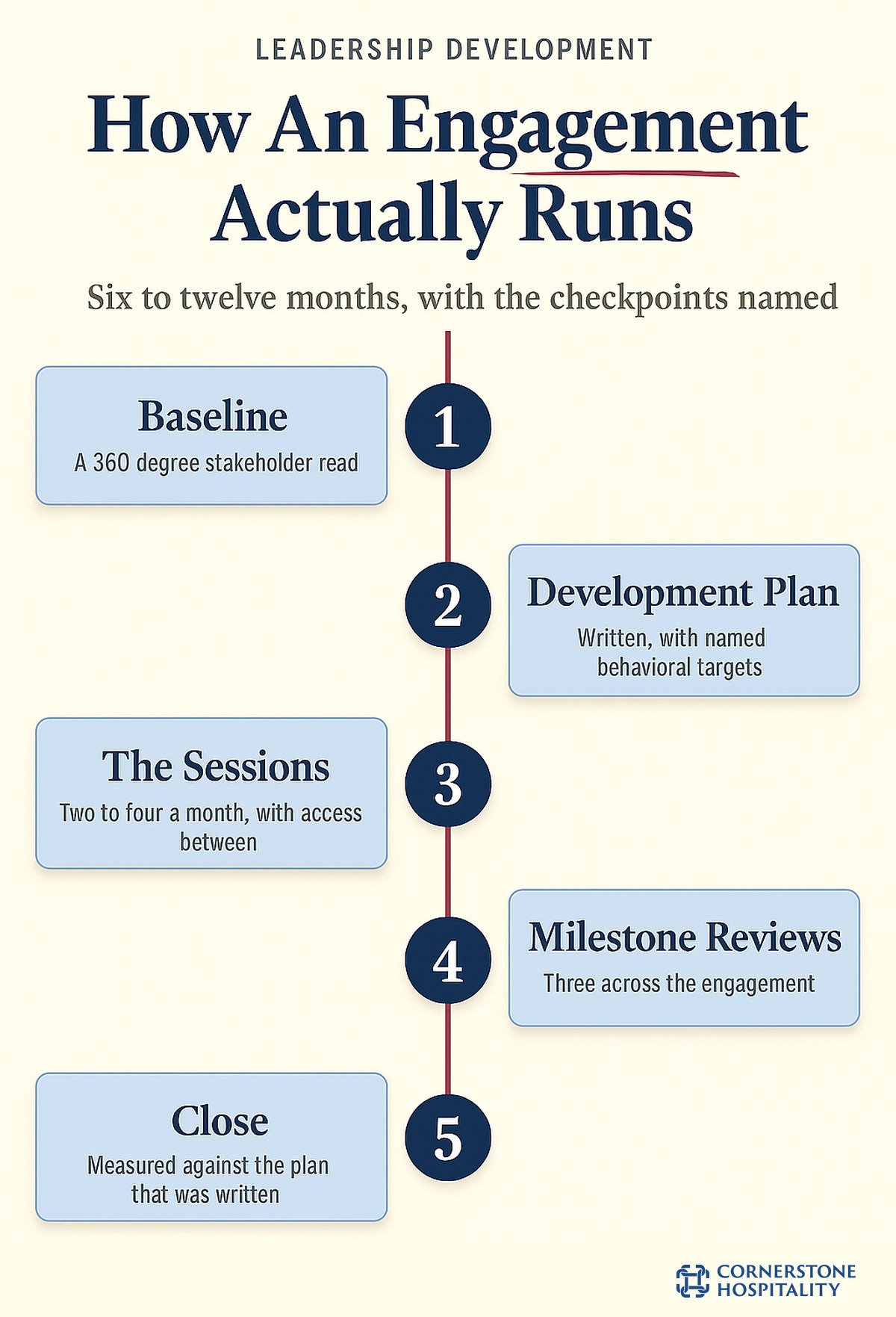
How an engagement actually runs
An engagement runs six to twelve months, which is long enough for a habit to change and short enough to stay accountable to something.
It opens with a baseline drawn from the people around the leader rather than from the leader alone. That becomes a written plan with named behavioral targets, agreed with the leader and with the sponsor, so nobody is guessing later about what success was supposed to look like.
The middle is the working part: two to four sessions a month, with access between them, because the moments that most need a second opinion rarely wait for a diary slot. Three milestone reviews sit across that period, each measuring against the written plan.
The close is a measurement, not a ceremony. If the behavior named at the start has not moved, that is the finding.
Who an executive leadership development program is for
The newly appointed
A leader who has just taken a bigger seat, where the job has changed more than the title suggests.
The strong operator stepping up
Someone who runs a property well and now has to lead at the strategic level rather than the operational one.
The team, not just the individual
An executive committee that has the talent but not yet the habits of honest challenge and shared accountability.

Frequently asked questions about executive leadership development programs
How long does an executive leadership development program run?
Six to twelve months. That is long enough for a habit to change and be tested in real conditions, and short enough that the work stays accountable to the plan agreed at the start.
How is it different from a training course?
A course delivers a curriculum to a group. This starts from a 360 degree read of one leader in one operating context and works on what is actually in the way. The content follows the diagnosis rather than the other way round.
What does the sponsor get to see?
The written development plan, the named behavioral targets and the three milestone reviews. What is said inside an individual session stays there, which is what makes the sessions worth having.
Do you work with whole leadership teams as well as individuals?
Yes. Team work happens with the team in the room over time, combining work on dynamics and communication with individual coaching, so personal growth and collective performance reinforce each other.
Who delivers the program?
Consultants who carried operating responsibility in hospitality before moving into development work, supported by ICF-credentialled coaches across a network of around 60 offices in 40 countries.
Can it run across several properties or countries?
Yes. The partner network means a resident consultant can join the work in the markets involved, while the plan, the targets and the reviews stay consistent wherever the leaders sit.
Ready to develop the leaders you already have?
Start with a conversation about the people and what has to change. We will be straight about whether a program is the right answer.
Sources and references
- Center for Creative Leadership, The 70-20-10 Rule for Leadership Development: sets out the framework that “emerged from over 30 years of our Lessons of Experience research”, in which development divides into “70% challenging experiences and assignments, 20% developmental relationships, 10% coursework and training”. CCL notes the framework is drawn from research spanning China, India, Singapore and the United States and is used across a client base including two thirds of the Fortune 1000.
- Training magazine, 2025 Training Industry Report: records that “U.S. training expenditures jumped 4.9 percent to $102.8 billion in 2025” and that “organizations spent $874 per learner this year compared with $774 per learner in 2024”, while average training received fell to “40 hours of training per year vs. 47 hours last year”. Management and supervisory training took 13 percent of the average budget. The survey covers a weighted universe of 152,572 US companies with 100 or more employees.