


Hospitality Talent Shortage 2026: Why Top Leaders Are Harder to Find

Ask any owner, board or group executive who has filled a senior hospitality role recently, and a familiar frustration surfaces. The shortlist is thinner than it used to be, and the strongest names are already committed. The search then takes longer than anyone expected. That combination is the hospitality talent shortage 2026, and it is not a matter of any one company hiring badly. Senior hospitality leadership has genuinely become harder to reach, for reasons that sit deeper than a single hiring cycle. Few people can run a flagship property, lead a region, or hold a seat in the C-suite. That already-small group has narrowed further[1]. Since several forces have combined over recent years, that group has become harder to move.
This guide sets out why the talent shortage at the top of hospitality has tightened. It also explains what is actually driving it. However, the more useful part is what owners and boards can do to stay ahead of it. The perspective here comes from a team of consultants at Cornerstone Hospitality. It is the Hospitality, Travel and Leisure practice of Cornerstone International Group. These consultants came into executive search after full careers as operators. They worked with groups such as Mandarin Oriental, Shangri-La, Hyatt, Marriott, and Hilton. The aim is to help you understand the market you are hiring into. Then your next senior search can start from strength rather than surprise.
Understanding the hospitality talent shortage 2026
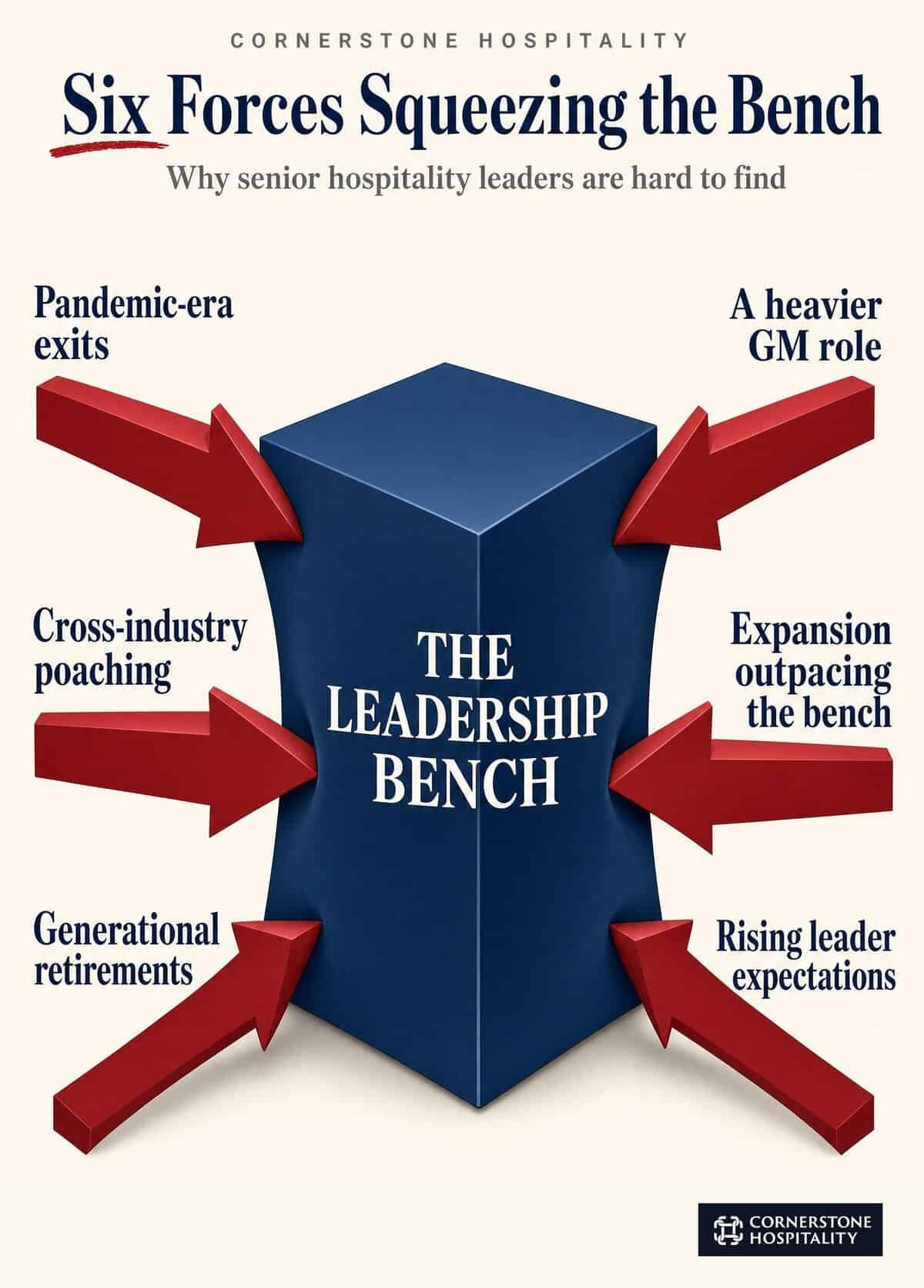
The shortage is not evenly spread. Operational and front-line roles remain competitive to fill, yet the market for those positions is deep and recovers quickly. The real scarcity sits at the leadership tier, among the general managers, regional directors and executives. These are the people who ultimately carry accountability for a property’s performance and reputation. This group was small before the sector’s disruption of recent years, and the pool has narrowed further since[1][2]. Together, a handful of structural forces now shape how difficult it is to attract a genuinely capable senior leader. Yet none of them are temporary.
Understanding those forces is therefore the first practical step for any owner or board. A search that begins with a clear reading of why the market is tight is easier to plan. It is also easier to resource properly. So the team running it can give a senior appointment the time it actually needs. The sections below work through the main drivers in turn.
The pandemic reset the leadership pipeline
The disruption of recent years did lasting damage to the way hospitality builds its leaders. When properties closed or ran on skeleton teams, a generation of capable managers left the industry[4]. Many of them did not come back. Hotel employment fell by more than 250,000 jobs against February 2020. Four years later it was still running close to 10% below pre-pandemic staffing levels. In fact, hospitality was among the industries most exposed to that outflow[4][5]. Every experienced operator who exited also took years of judgment with them. As a result, the ladder that normally carries the next tier of leaders upward lost several of its rungs[3].
Owners feel the effect most acutely one level below the top. Groups that would have promoted a seasoned deputy into a general manager role now face a gap. In practice, the deputy they were counting on has moved on. So the search widens outward as a result. The pipeline that quietly produced senior leaders for decades has thinned, and rebuilding it takes years, not quarters[5].
Other industries are poaching hospitality operators
Hospitality leaders are unusually portable, and other industries have noticed. Strong operators run a complex service business, manage large teams under pressure, and deliver a consistent guest experience. Those skills translate directly into retail, healthcare, senior living and aviation[11]. In fact, they also translate into experiential retail and premium residential services. Employers in those sectors have since learned what that experience is worth. A leader who holds a luxury hotel to standard can hold almost any customer-facing operation to standard. So they compete hard for that talent.
The result is that the market for senior hospitality operators is no longer contained within hospitality. A regional director weighing a move is not only choosing between hotel groups. The field of options has broadened to include organizations that never used to appear on the radar. That widened set of choices gives strong leaders more leverage. It also makes them harder to attract with a conventional offer[11]. Owners who assume they are competing only with other hospitality brands are reading an out-of-date map.
The best hospitality leaders are rarely looking. Reaching them is not about posting a role, it is about knowing who they are before you need them.
A principle Cornerstone Hospitality works by
A generational shift is thinning the bench
A quieter force is working alongside the disruption of recent years. A cohort of long-serving senior leaders is reaching the point of retirement, and the timing is difficult[13]. The tier that would normally replace them was already thinned by the exits described above. The industry is losing experience at the top faster than it is manufacturing it in the middle[1]. A group may need to replace a general manager who has run a property for fifteen years. The natural successors are fewer than they once were. Meanwhile, several of the strongest are already being courted for roles elsewhere.
The generational point is not only about numbers, it is also about expectations. Leaders entering the senior tier today weigh flexibility, purpose, development and quality of life heavily. Their predecessors did not weigh them the same way[13]. So they are willing to decline a role that does not offer it. An owner who wants to attract this generation has to present more than a title and a compensation figure. The offer has to speak to how the person will grow and what the work will mean[13]. That is a different conversation from the one that worked a decade ago.
The general manager role itself has grown heavier
The job at the top of a property is not the job it was. A modern general manager now holds commercial performance, brand standards, digital and revenue strategy, sustainability commitments and owner relations[12]. The role also carries the culture of a large and diverse team, often across more than one location. The weight of expectation attached to the role has grown. Every service sector now places a broader premium on leadership capability[12][15]. Hospitality sits squarely inside that trend. Each new expectation layered onto the senior role narrows the field. Fewer people can genuinely carry it all at once.
This matters for the search in a specific way. One list holds the leaders who look qualified on paper. A shorter list holds those who can actually perform against the full weight of the modern role. Distinguishing between the two takes real assessment. So a senior hospitality search cannot run on volume and speed alone. The scarcity is partly a scarcity of proven capability against a role that keeps getting broader[14].
The short version
The hospitality talent shortage 2026 is structural, not seasonal. Exits during the sector’s disruption thinned the pipeline, and other industries now poach the same operators. Meanwhile, a generation is retiring, and the top role has grown heavier. Meanwhile, forecasters expect more than 2,600 new hotels to open worldwide during 2026 alone[7]. As a result, the gap between the leaders needed and the leaders available looks set to widen rather than close.
Expansion is outpacing the leadership bench
Demand for senior leaders is climbing at the same time as supply is tightening. Development activity across the sector has recovered, and the pipeline of new and reflagged properties keeps growing. Industry data houses such as STR, CoStar and Lodging Econometrics track a substantial global hotel construction pipeline[7][8]. Every property in that pipeline will eventually need a leadership team[7]. New openings, brand conversions and portfolio growth all create senior roles. Those roles did not exist a few years ago[8][9]. So they compete for the same narrow group of proven operators.
The arithmetic is uncomfortable for owners. Each new property adds to the demand side of the ledger. The supply side is still recovering from the exits of recent years[2][6]. A group may plan to open or convert several properties over the next few years. In effect, it is committing to run several senior searches. That means entering a market where the strongest candidates are already spoken for. Still, this is a solvable problem, but only for the owners who see it coming and plan for it deliberately.

What owners and boards can do about the hospitality talent shortage 2026
The shortage is a market condition, not a verdict on any group’s ability to hire. Owners and boards who read the market clearly can still attract outstanding leaders[2]. In fact, the ones who do consistently tend to share a set of habits. The response comes down to four moves: starting earlier, widening the map, investing in assessment and development, and retaining proactively. Each one addresses a specific driver of the shortage described above.
Start the search earlier. The single most common mistake is beginning a senior search only once a seat is empty. In a tight market, the best candidates are passive, committed elsewhere, and slow to move by design[11]. So the timeline for reaching and winning one runs longer than owners expect. Beginning the conversation with a search partner months ahead of a known transition changes the shape of the work. A rushed reaction becomes a planned appointment. It also means building a live picture of the market before the role becomes urgent. A search that starts early can afford to wait for the right leader instead of settling for the available one.
Widen the map. Given that other industries now compete for hospitality operators, the smart owners return the favor. Some of the strongest candidates for a senior hospitality role are elsewhere. They may be operating brilliantly in an adjacent service business, or in a different geography. They may even be under a brand you would not have thought to approach. A search that maps only the obvious set of direct competitors is fishing in the smallest possible pond. Reaching across industries and borders opens up a much larger field of capable leaders[11]. Someone who understands how those experiences translate makes that reach usable.
Invest in assessment and development. The modern senior role is unusually broad. A resume rarely shows the difference between a leader who looks qualified and one who will actually perform. Serious assessment, structured against the real demands of the role, protects an owner from an expensive mismatch. It also gives a board genuine confidence in a decision. Investing in the tier below the top rebuilds the pipeline the sector’s disruption damaged[14][15]. Capable deputies grow into leaders you can promote. Assessment and development are both long-term habits that pay off precisely when the market is tight.
Retain proactively. The cheapest senior search is the one you never have to run. Owners who keep their best leaders engaged, developed and fairly recognized lose fewer of them. Rivals now competing for that talent win fewer[2]. Retention is not only a compensation question. It also rests on how well a group supports a leader. The work needs meaning, and the leader needs to see a future inside it. Getting that right removes roles from the search market before they ever reach it. That is the surest hedge against the shortage.
The table below sets out how each driver of the shortage maps to a practical response. So the reading of the market translates directly into a plan.
| Driver of the shortage | What it means for your next search | The response that works |
|---|---|---|
| Thinned pipeline | Fewer ready successors below the top | Develop the tier below and promote it |
| Cross-industry poaching | More employers chasing the same leaders | Widen the map across sectors and borders |
| Generational retirements | Experience leaving at the top faster | Plan succession years ahead of a gap |
| A heavier senior role | Fewer leaders proven across the whole role | Assess seriously against real demands |
| Expansion outpacing supply | More senior seats than proven operators | Start each search earlier than feels necessary |
A shortage rewards the prepared. The owners who plan their leadership pipeline in calm periods hire well when the market is tight.
A principle Cornerstone Hospitality works by
How Cornerstone Hospitality helps groups get ahead of the shortage
A specialist retained search partner exists exactly for a tight market like this one. When the strongest leaders are passive, committed and cautious about moving, reaching them takes an accountable firm. That firm must map the whole market and approach senior people discreetly through trusted channels. It must assess each one properly before any name reaches the client. Cornerstone Hospitality runs senior appointments on that basis. The team’s operator background shapes how it reads a candidate. It weighs brand history, market experience and readiness for a broader role the way an owner does. Global reach comes through the Cornerstone International Group partner network. As a result, a search can follow a role across borders while staying with one team.
The practice works across four disciplines that together address the shortage from more than one angle. Executive and Board Search reaches the leaders the open market cannot. Leadership Development strengthens the tier below the top. Career Transition supports people through change. Executive Assessment tells the leaders who look qualified apart from the ones who will genuinely perform. Every search carries a placement guarantee that runs from six to twelve months. The engagement letter sets it out at the start of each assignment. So the risk of a senior appointment does not sit entirely with the owner. Groups planning senior hires can explore this within the practice’s Executive and Board Search work.
Facing a senior hospitality hire in a tight market?
Tell us about the role and the group. We will give you an honest reading of the market and what it will take to attract the right leader.
Frequently asked questions
Related reading
- The discipline that reaches leaders the open market cannot sits on our Executive and Board Search practice.
- Owners wondering how a senior approach actually works can read our guide to engaging a hospitality headhunter.
- Choosing who to trust with a search in a tight market matters. Our overview of how to evaluate hospitality recruiting firms sets out what to look for.
Written by
The Cornerstone Hospitality Team
Cornerstone Hospitality is the Hospitality, Travel and Leisure practice of Cornerstone International Group. Its consultants came into executive search after full careers as operators. They worked with groups such as Mandarin Oriental, Shangri-La, Hyatt, Marriott and Hilton. Today the practice works across four disciplines: Executive and Board Search, Leadership Development, Career Transition, and Executive Assessment. Global reach comes through the Cornerstone International Group partner network.
Every search carries a placement guarantee that runs from six to twelve months. This is set out in the engagement letter at the start of each assignment.
Sources
- Hotel Dive, Hospitality industry could face 8.6M workforce shortfall by 2035: WTTC (9 October 2025): reports World Travel & Tourism Council research finding that "the hospitality industry, in particular, is expected to face a gap of 8.6 million workers, approximately 18% below the required staffing levels" by 2035. Travel and tourism as a whole is projected to fall short by 43 million roles even while gaining 91 million new jobs, and one in three net new jobs added globally over the decade is expected to sit within the sector.
- American Hotel & Lodging Association, Rising Cost, Staffing Challenges Persist for Hotels (Front Desk Feedback survey, 246 hoteliers, late February 2026): the most recent industry read on staffing: more than half of responding hoteliers describe their properties as somewhat or severely understaffed, and 42% name workforce shortages as an operating pressure. AHLA records that "from rising insurance and energy expenses to workforce shortages, hotels are navigating significant operational challenges", with hotels offering higher wages (70%), flexible scheduling (54%), hotel discounts (54%) and enhanced benefits (31%) to recruit and retain.
- American Hotel & Lodging Association, 65% of surveyed hotels report staffing shortages (282 hoteliers, 6 December 2024 to 3 January 2025): establishes the depth of the hole left below the senior tier. 65% of hotels reported shortages and 9% described themselves as severely understaffed, with six to seven open positions per property and housekeeping the top hiring need at 38%. AHLA notes that "hotel employment is still nearly 10% below pre-pandemic staffing levels".
- American Hotel & Lodging Association, Hotels on hiring spree with better wages, benefits, flexibility (27 February 2023): quantifies the exodus that thinned the management pipeline: "hotel employment is down by more than 250,000 jobs compared to February 2020". At the time 79% of hotels reported shortages, 22% severely, 81% could not fill open roles despite incentives, and average national hotel wages had passed $23 per hour, having risen faster than wages in the wider economy.
- Hotel Dive, Hotel staffing to remain ‘well below’ pre-pandemic levels (7 April 2025): draws on AHLA, Oxford Economics, STR and Bureau of Labor Statistics data to show the recovery is partial: hotels added more than 467,000 direct employees over four years against more than 680,000 lost during the pandemic, and only two states were projected to exceed pre-pandemic staffing. AHLA President and CEO Rosanna Maietta is quoted that "the hospitality sector has made significant strides in rebuilding its workforce and creating opportunities for career advancement, but staffing shortages continue to present significant challenges".
- American Hotel & Lodging Association, New Survey: Majority of Hoteliers Scaling Back Development Plans (387 owners and operators, 21 to 29 August 2025): shows the pressure running in both directions. 56% of owners were delaying (32%) or scaling back (24%) development plans, while 49% still reported being understaffed. Maietta: "hotels are eager to invest in their properties and communities, but rising costs and uncertain demand are forcing many to put projects on hold".
- Lodging Econometrics, Global Hotel Pipeline Reaches Record High (Q4 2025 Global Construction Pipeline Trend Report): the demand side of the shortage, in numbers. "The global hotel construction pipeline reached a new all-time high project count with 15,922 projects/2,437,354 rooms, a 1% increase in projects year-over-year." 6,140 projects are already under construction and 3,845 are scheduled to start within twelve months. LE forecasts 2,617 new hotels/389,175 rooms to open in 2026 and 2,630 new hotels in 2027, each of which needs a leadership team.
- Hotel Dive, US led global hotel construction pipeline in Q4 as luxury drove growth: breaks the same Lodging Econometrics data down by segment, which matters because the shortage bites hardest at the top end. Luxury reached a record 1,328 projects/252,544 rooms, up 8% by project count year-over-year, and upper upscale a record 1,883 projects/391,391 rooms, up 9%. The global conversion pipeline hit a record 2,815 projects, up 13%, and early-stage planning reached a record 5,937 projects.
- Lodging Econometrics, Europe’s Hotel Construction Pipeline Grows (Q1 2026): the European picture behind the same pressure. Europe closed Q1 2026 with 1,731 projects/255,354 rooms, up 3% year-over-year, and a record early-planning stage of 604 projects. Germany holds 144 projects/24,923 rooms and the United Kingdom leads with 268 projects/39,024 rooms. "LE analysts forecast a total of 319 new hotels/44,156 rooms to open by year-end 2026."
- World Travel & Tourism Council, Global Travel & Tourism Growth to Outpace Wider Economy by 1.5 Times Over the Next Decade: sets the growth backdrop that keeps senior demand rising. "Travel & Tourism is forecast to continue outpacing wider economic growth in 2026, with the sector expected to contribute $12TN to the world economy." The sector is forecast to grow 3.2% against 2.4% for the global economy, to support 376 million jobs, roughly one in nine worldwide, and to add almost 89 million new jobs over the decade, about a third of all new jobs created.
- Hospitality Net, Hospitality’s Talent Crisis Is a Perception Crisis (Colin Kingsmill, Managing Partner, CDR Global): explains why the funnel is not refilling from below, and why rival sectors recruit successfully from hospitality. Only one in ten young people would actively choose hospitality as a career, against a sector that needs 90 million additional workers by 2035. Kingsmill: "This is not a recruitment problem. It is a narrative problem, and the industry has left that narrative to chance for too long."
- Hospitality Net, The Hotel General Manager of the Future (Tom Engel, 11 November 2024): documents how far the top job has broadened. The piece argues "the GM of the future needs a wide range of skill sets" and must be "a multifaceted leader with a strong business acumen, exceptional communication skills", spanning sales, marketing, labor management, revenue optimisation and guest relations, areas that historically carried their own specialists rather than being carried by one executive.
- Hospitality Net, Evolving Workforce and its Culture (Professor Robert O’Halloran, East Carolina University): sets out the generational shift on both sides of the bench, with baby boomers nearing retirement while Generation Z reshapes what a senior offer has to contain. "The modern workforce wants to have positive work environments, i.e., great places to work, have opportunities for advancement and cross training, flexible work hours, and choices of remote and onsite career paths." 79% of executives agree organizations should create value for workers as human beings, not only shareholders.
- EHL Insights, Hotel General Management Program, leadership development (EHL Graduate School, 30 September 2024): makes the case for rebuilding the tier below the top rather than only buying it in. "With hospitality suffering from a talent shortage since the pandemic, it is essential to nurture and develop the careers of existing employees who have the potential to become industry leaders." The school frames its purpose as "developing the leadership capabilities of employees so they can step into management roles".
- Hospitality Net, Leadership development in Hotel Management (3 October 2024): describes what structured senior development now covers: hospitality industry dynamics, financial and operational effectiveness, and people management, with electives in stakeholder and revenue management and individual coaching. The program leads state that the skills involved "really enable participants to tackle the strategic dimension of managing a hospitality business, as well as the leadership skills needed to manage people".