

Hospitality Executive Search: Why the Specialist Difference Matters
If you’ve ever sat across from an executive search firm, listened to their pitch, and walked away thinking, ”They’re nice, but I don’t think they understand my business”, If so, you have met the gap this article is about. In practice, a hospitality-focused executive search firm is running a hospitality assignment not alongside a banking one and a legal one. A specialist firm lives inside hospitality every working day. It stays connected with candidates and hears their stories. As a result, it keeps an ear on the ground for the next trend developing in the industry. The choice is rarely about price. Above all, it’s about whether the firm you engage actually understands you and your world.
Cornerstone Hospitality is the Hospitality, Travel & Leisure Practice of Cornerstone International Group. Our team came into search from inside the industry. Most arrived after successful careers as operators at Mandarin Oriental, Shangri-La, Hyatt, Marriott, Hilton and equivalent groups. Together, the practice has combined global hospitality leadership between its consultants with cross-border executive search experience. The depth matters. In hospitality executive search, most assignments are won or lost in the work hidden underneath the process. That means the calibration, the candidate management and the cross-cultural negotiation.
- Our Hospitality, Travel & Leisure Executive Search practice, the main service page covering the full global delivery model.
- Executive & Board Search, the practice’s C-suite and board-level discipline.
- Inside the 2026 Cornerstone Global Partner Meeting, where global executive search is headed.
What “specialist” actually means in hospitality executive search
When looking at the search process on paper things look the same as in other sectors. In short, the difference shows up in three specific places.
First, in how the consultant reads a CV. A hospitality specialist looks at a candidate’s brand history and reads it the way a sommelier reads a wine list. The tiers run luxury, upscale, midscale, independent boutique, big chain and owner-operated. Moreover, each tier carries cultural weight inside the industry. The same applies to locations. Singapore, Shanghai and Hong Kong are three different operating realities. Which ones a candidate has worked in tells you how they would handle the move you are considering. As a result, the specialist sees the unspoken pattern that might be less obvious to the untrained eye.
Second, in whether the candidate picks up the phone. Hospitality is a small world. Senior people in this industry return certain calls. They answer a recruiter who has worked alongside them on an opening team, sat next to them at an industry event, or shares a credible mutual contact. Indeed, they are far more likely to engage when the call comes from someone from the inside. The phrase the team hears most often from passive candidates is some version of “I’ve been approached by many recruiters, but you’re one of the only ones I actually have a conversation with.” That access advantage is real. Moreover, it compounds with every year a firm operates as a specialist.
“Most hospitality candidates at the senior level are not actively looking. Instead, the question is whether they trust the person calling them enough to have a real conversation. In practice, specialist firms earn that trust by being inside the industry long enough that the candidate already knows who they are.”
Florian Kittler, Global Practice Leader, Cornerstone Hospitality
Third, in how the consultant interprets the brief. In practice, senior hospitality clients often arrive with a brief that is partly accurate and partly inherited from the previous hire’s CV. A good firm tests it. Where is the budget genuinely flexible? For instance, is the title boundary real, or is the candidate at a level below who’s ready for the stretch? Is the location truly non-negotiable, or is it the result of an assumption no one has challenged? Specialists treat the brief as a hypothesis to validate. Experience has taught them one lesson above all. The version of the role that ends up filled is rarely the version that arrives on day one.
The cross-continent reality of senior hospitality hiring
One quiet truth about hospitality executive search: the candidate pool is global, and the moves we manage are rarely down the road. The team has supported senior leaders making career-changing decisions across countries and even continents. Those moves run Shanghai to Dubai, Paris to New York, London to Mumbai. Above all, each of those moves is, in practical terms, a life decision before it’s a career decision. Schools for the children. The trailing spouse’s career or visa situation. Health insurance portability. Distance from elderly parents. The cost of a private school in the new market versus the public school they’re leaving. Specialist hospitality recruiters know exactly when an assignment stalls. It is the moment a candidate’s family stops being on board with a move. For that reason, they manage that conversation in parallel with the client’s brief. For that reason, the team’s coaching background helps here, the same listening skills that surface what a candidate is really weighing.
Where a specialist hospitality firm shines
- ✓Reading brand and location history the way the clients read it
- ✓Access to passive senior candidates
- ✓Brief calibration based on actual market conditions, not the previous hire’s CV
- ✓Cross-cultural and family-context management throughout the engagement
- ✓Reference work that goes deeper than the standard “call two referees” pass
- ✓A consultant who speaks the industry’s language from the inside
Holding the tension between client and candidate
An assignment lands when both the client and the candidate end up feeling like they got the better end of the deal. That outcome is rarely accidental. The team has a working metaphor for the search consultant’s role. We call it the bubble. It is a deliberately flexible space that holds tension between two parties and pushes it slowly toward common ground. The bubble hears what the client says and what the candidate says. Then it surfaces the gap between them in language that makes neither party defensive. Finally, it finds the slow path to alignment.
That work is mostly invisible from the outside. Meanwhile, from the client’s side, it looks like a recruiter who is unusually patient about clarifying questions. Likewise, from the candidate’s side, it looks like a recruiter who already understands what they’re worried about. From the inside, there are hundreds of small adjustments. The consultant reframes the title, surfaces a comp structure the candidate did not know was on the table, and finds language for a concern the client had not yet articulated. In short, the bridging work is what makes the process actually conclude.
How a Cornerstone Hospitality engagement actually runs
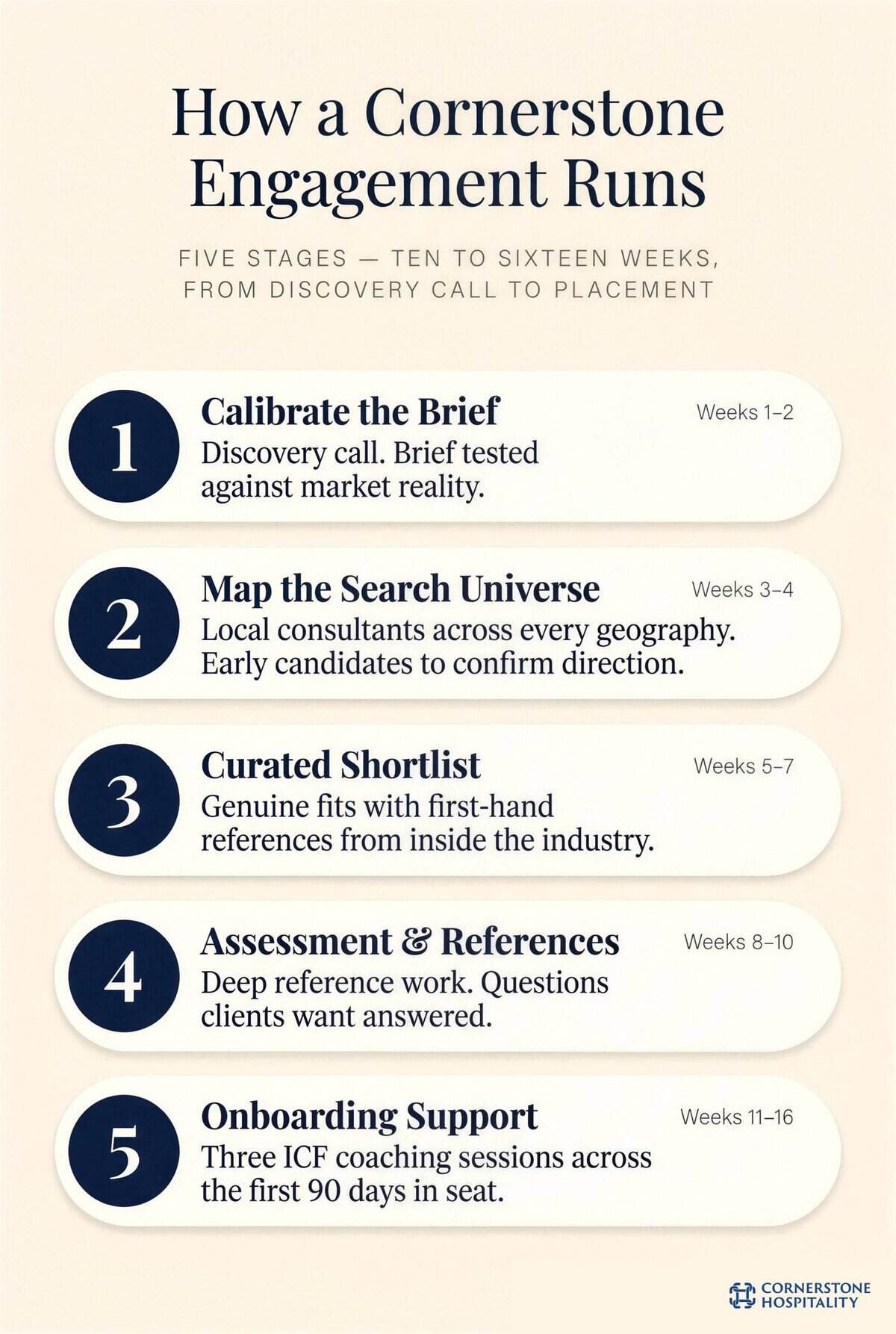
1. We talk and calibrate the brief
When you get in touch, we arrange a structured discovery conversation with a hospitality expert. We explain who we are, what the practice does, and most importantly what we will do for your specific search. Then we answer your questions about the candidate market, timing, and process. Once engaged we take the brief and test it against current market realities, map stakeholders and set success criteria. In practice, the role that gets filled is often subtly different from the one written down at the start.
2. We map the search universe
Built from current industry knowledge, we map the search universe with our local-market consultants across every geography the role spans. As a result, you see exactly who is in scope, why, and how we plan to approach each candidate set. We present one or two candidates early to confirm direction before going deep. That way nobody burns time on a shortlist that misses the mark.
3. You see a curated shortlist
We bring you a shortlist of candidates who genuinely fit the brief. Each one arrives with a high-level assessment report and first-hand references from colleagues who know that candidate’s home market. The choice is yours. Even so, we make sure the choice is informed.
4. Assessment and references
First-hand reference work from inside the industry, including the questions clients want to get answered but don’t always know how to phrase.
5. Supporting the hiring process and onboarding
Packaging the right deal requires a fine touch and our involvement on both sides. Therefore, we start these discussions early in the process to make the offer stage an easy step. We stay close to the leader after the placement. Our ICF-certified coach then runs three onboarding sessions across the first 90 days in the seat, as part of the engagement. In other words, the placement isn’t done at the offer; it’s done when the leader is operating.
Considering a senior hospitality leadership hire? Start with a conversation with a specialist.
Speak with a Hospitality Leadership Advisor →Related service: Executive & Board Search
Some groups hire at VP, C-suite, board or non-executive director level. For them, the Executive & Board Search practice combines the specialist depth described here with the discretion and access these searches demand.
How you get the right hospitality leader placed
Senior hospitality search does not have to be complicated. We help you understand exactly what our service entails and make sure the leadership decision protects what matters most to your business.
No pushy sales tactics. We have a structured conversation, walk you through the search landscape, and explain the different ways the engagement can be shaped. You move at your own pace. CEOs and owners choose to work with us for one reason. We guide them through their options and help them feel confident about the leader they bring in.
We will walk you through the realistic timeline, so you are not caught off guard. We will explain the fee structure so you know what you will pay and when. We also help you navigate the candidate market across whatever geographies the role spans, from Sydney to Dubai to Singapore to New York. Behind that sits the network support of our 60 offices in 40 countries.
Frequently asked questions
What does specialist hospitality executive search actually deliver that gets the right leader placed?
A specialist firm lives inside the hospitality industry every working day. That depth shows up in three places. First, in how the consultant reads a CV, with brand-tier fluency and regional context. Second, in the relationships that let passive senior candidates take the call. Third, in the brief calibration that adjusts the role against real market conditions. The result is a shortlist of leaders who fit the specific operating context of your business. It is not a generic match against a job description.
How long does a senior hospitality executive search typically take?
Most senior hospitality mandates run 10 to 16 weeks from kick-off to signed offer. The first three weeks go to market mapping and candidate identification. Weeks four through eight cover candidate engagement, interviews and shortlisting. The final weeks handle client interviews, reference checks and negotiation. Cross-border or C-suite searches can run slightly longer.
What is included in the engagement?
A Cornerstone engagement covers the full search cycle. That runs from discovery and brief calibration through market mapping, candidate identification and approach, assessment and shortlisting. It then covers client interview support, reference work and offer negotiation. Finally, the placed leader receives three onboarding coaching sessions across the first 90 days in seat. The work doesn’t end at the offer letter; it ends when the leader is performing.
Do you work across regions, or only in your local market?
Many hospitality recruiting firms operate from a single country or region. Cornerstone’s hospitality practice is global, our hospitality specialist team sits in different regions from EMEA, to The Americas to APAC. Roughly 70% of our hospitality searches involve at least one cross-border element, placing an international hire into a local market or vice versa.
How does the discovery call work?
A structured 30-minute conversation with a hospitality expert from the team. We explain who we are and what the practice does. Then we ask about the role and your strategic context. We answer your questions on timing, fees and the candidate market. Finally, we outline what an engagement would look like. There is no obligation. The discovery call exists so both sides can decide whether engaging Cornerstone is the right next step.
What happens if the placed leader doesn’t work out?
Every Cornerstone retained search comes with a replacement guarantee. A placed candidate may leave within the agreed protection window. Where the reasons are not attributable to the client’s circumstances, we re-run the search at no additional professional fee. The specifics of the guarantee period and conditions are covered in the engagement letter at the start of every assignment.

Florian leads Cornerstone International Group’s global Hospitality, Travel & Leisure Practice. He brings seventeen years of senior hospitality experience, including Marriott, Hyatt, IHG, Mandarin Oriental and Shangri-La Hotels & Resorts, Alongside that, he has sixteen years in retained executive search. He is bilingual in English and German and works across Europe, the Middle East, the Americas and Asia-Pacific.
Connect with Florian on LinkedIn →