


Owner-Operator GM or Branded GM: What Assessment Surfaces Differently


An owner-operator GM and a hotel GM from a big brand carry the same job title into two different working lives. An assessment built for one will misread the other.
An owner-operator GM and a hotel GM from a brand do the same core work, running a hotel. The daily decisions look different enough that the two are best treated as two profiles. A single generic general manager template, scored the same way regardless of the property behind it, will not serve either one well.
of branded US hotel rooms are franchised to an independent owner-operator [3]
of hotel GMs stay in the role only one to two years [9]
of a team’s engagement score traces back to the manager [6]
of hospitality executives say recent hires were not fully prepared for the role [5]
more likely a promotion succeeds when an assessment informs it [7]
Figures throughout this article are drawn from the sources list at the end.
Roughly four out of five branded hotel rooms in the United States are franchised out to an independent owner-operator [3]. Most of the remainder are run under a management agreement, where a brand or management company supplies the general manager’s operating system [3]. At any given time, a large share of the GM population is doing one of these two jobs. Research on how the two actually work confirms they do not draw on quite the same strengths. Independent-hotel GMs carry more decision latitude on operational, marketing, and HR calls than GMs inside management companies, who report comparatively little say over the biggest financial and strategic questions [1].
Confusing the two profiles costs something real in a search. This guide covers what each role rewards, where a leadership assessment should weight them differently, and where they share a foundation.
Why one title covers two different jobs
The title on the org chart says less about a hotel general manager role than two other facts do. One is who the GM answers to. The other is how much of the operating system somebody already decided before the GM arrived.
An owner-operator GM typically reports directly to one principal, a PE firm, the owner, or a small ownership group. Research describing this structure calls it a comparatively simple one: one principal, rather than several, setting the direction [2]. Most of what the property does day to day is still open to the GM’s judgment, because nobody has already written the playbook for it.
A hotel GM from a brand sits inside a different structure. The GM answers to the owner and to the brand or management company at the same time, and the two do not always want the same thing at the same moment. Researchers who studied this tripartite relationship found that GM autonomy rises and falls with owner and operator agreement on what the property should do, and that alignment only improves performance when the GM also carries the authority to act on it [2].
That second structure is also the more common one across branded hotels. Most branded rooms in the United States sit under a franchise or management arrangement rather than direct brand ownership [3]. So a career spent mostly inside brands is a career spent mostly inside that tripartite structure, answering to more than one principal at once.
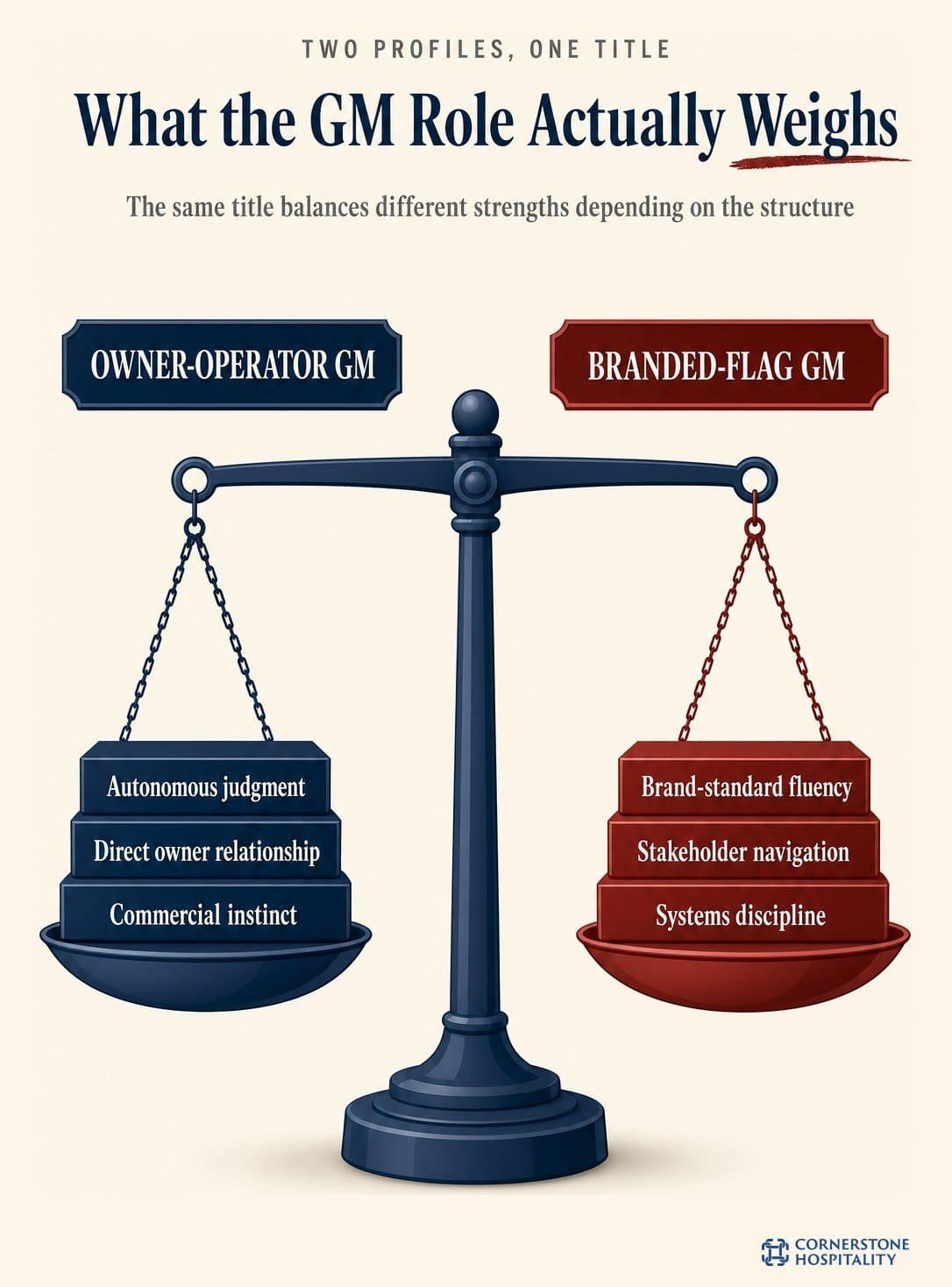
Why this matters
An assessment that does not first ask which structure a GM role sits inside is scoring against the wrong picture before a single candidate is interviewed. If a search brief for your next GM hire has not named that structure yet, talk to us before it goes further.
Owner-Operator GM
One principal to answer to, wide latitude on day-to-day calls, and a direct commercial stake in the outcome.
Branded-Flag GM
A tripartite reporting line, a system already built by someone else, and results delivered through influence as much as instruction.
What the owner-operator GM role actually rewards
An owner-operator GM answers to one person, or a small group, whom the GM can reach directly. That owner is usually as invested in the outcome as the GM is. This closeness changes what the role rewards.
Independent-hotel GMs carry more decision latitude than their branded counterparts on the calls that shape a guest’s day: operations, marketing, and HR. They carry comparatively less say on the largest strategic and financial calls, which usually still sit with the owner [1]. The owner-operator GM role rewards a GM who is comfortable making smaller and mid-sized calls without a corporate playbook, and who knows precisely which decisions are theirs to make and which ones belong to the owner.
Decision latitude that experience earns on its own
The same research found that in independent hotels, more experienced GMs carry more authority across the board, and education alone did not move the figure much. Experience earns latitude in this structure by itself. Inside a management company, however, it does not always work that way: there, combining strong education with strong experience is what produces a meaningful gain in authority [1]. A leadership assessment built for owner-operator GM candidates should weight demonstrated judgment under real conditions more heavily than credentials alone. That is what the role itself already rewards.
Working directly for the person who carries the risk
The owner-operator GM’s other defining feature is proximity. In many owner-operator structures, the owner is close to the operation, and the pattern the GM sets with that owner in the first few months tends to last for the whole tenure. A GM who reports well, who brings bad news early and plainly, builds a relationship that survives a difficult season. A GM who reports only good news is setting a pattern that becomes hard to break later, and an owner who is close to the business usually finds out anyway.
That directness rewards a specific kind of judgment: knowing what the owner needs to hear and when, with no corporate communications function standing between the two of them. The role is also unforgiving of the opposite instinct, waiting for cover, or deferring upward a call the property is paying the GM to make.
Opening a search for an owner-operator GM or a branded GM?
A short conversation can test which profile the role actually needs before the assessment is built.
What the branded hotel GM role actually rewards
A branded-flag GM inherits a system somebody else built, covering room design, service sequence, technology stack, and loyalty program. It also sets a detailed standard for most of what happens on property. The role does not reward reinventing that system. It rewards running it exceptionally well, and knowing precisely where the small amount of local discretion actually sits.
Skilled execution inside a system the GM did not design
The branded GM’s decision latitude is narrower by design, and narrowest on the financial and strategic questions an owner-operator GM would decide alone. Management-company GMs report comparatively little say over financial or strategic calls, because those questions sit with a brand and ownership structure above the property [1]. The competency this rewards is not less judgment. It is judgment applied inside a tighter box: reading which brand standard is genuinely load-bearing for the guest experience and which one flexes in practice, and delivering results without appearing to fight the system that produced them.
Managing upward and sideways at once
The defining feature of the branded role is the number of people the GM answers to at the same time. A GM inside a management company is managing a tripartite relationship: the owner wants a return, while the brand or management company wants consistency across hundreds of properties, and the two do not always want the same thing at the same moment [2]. Researchers who studied this relationship found that a GM’s authority to act is what actually moves property performance. Alignment between the two principals on its own does not [2].
That structure has moved further in one direction. Hotel leadership increasingly runs through regional, cluster, and matrix reporting lines, where a GM can carry responsibility for the property’s result without carrying complete authority over the decisions that produce it [4]. The role rewards a GM who can get a decision made through influence and relationship rather than through direct instruction, reaching across a regional office, a brand standards team, and an ownership group. A candidate who is excellent at commanding a room and less practiced at negotiating a matrix will find this structure harder than an owner-operator GM role with the same gap.
Why this matters
A strong individual contributor is not automatically a strong branded GM. The role asks for influence across a regional office, a brand standards team, and an ownership group at once, and that is a distinct, testable skill.
Nine competencies, weighted differently by role
The owner-operator GM profile and the branded-flag profile are not opposites. Most of what makes a strong general manager, in either structure, still matters in both. What changes is how heavily an assessment should weigh each competency, given what the role structurally rewards.
| Competency | Owner-operator GM | Branded-flag GM |
|---|---|---|
| Autonomous decision-making | Central. Most operational calls are the GM’s to make, with no standard to fall back on | Present, but bounded. Applied inside a system already built by the brand |
| Commercial and ownership mindset | Central. The GM often thinks and reports like a part-owner of the result | Present, exercised through forecasting and revenue tools inside brand parameters |
| Brand-standard fluency | Not applicable in the same way. Standards are largely self-set | Central. Knowing which standards protect the guest experience and which are procedural |
| Corporate stakeholder management | Light. One or two direct relationships, usually with the owner | Central. Regional office, brand standards team, and ownership at once |
| Systems and technology fluency | Useful. The GM often chooses and configures the stack | Central. An inherited stack, frequently non-negotiable |
| Direct owner communication | Central and frequent, with no layer between the GM and the owner | Present, but often mediated through a management company layer |
| Team-building without a playbook | Central. HR decisions sit mostly with the GM | Bounded by brand HR standards and management-company policy |
| Influence without full authority | Rarely tested. Authority and responsibility mostly sit together | Central. Responsibility for results without complete authority over every input |
| People leadership day to day | Central, and tested the same way regardless of structure | Central, and tested the same way regardless of structure |
The one competency an owner-operator GM and a branded GM share
The last row matters as much as the eight above it. Eight of the nine competencies shift in weight between the two profiles. The ninth, how a leader actually runs a team day to day, does not. No assessment should let a strong showing on the other eight substitute for it.
What to do
Before weighting the other eight competencies for a specific search, confirm that people leadership day to day is tested the same way for every candidate, regardless of which profile they come from.
What a leadership assessment should weigh differently
A single generic GM assessment, scored the same way regardless of role, will systematically favor one profile over the other. Consider an owner-operator GM candidate who is decisive without much structure to lean on. That candidate will read as ideal against a template built around independent judgment, and will score poorly on any dimension that rewards navigating a matrix. A branded candidate who excels at working a system will show the reverse pattern. Neither read is wrong on its own, but both are incomplete unless the assessment first asks which job is actually open.
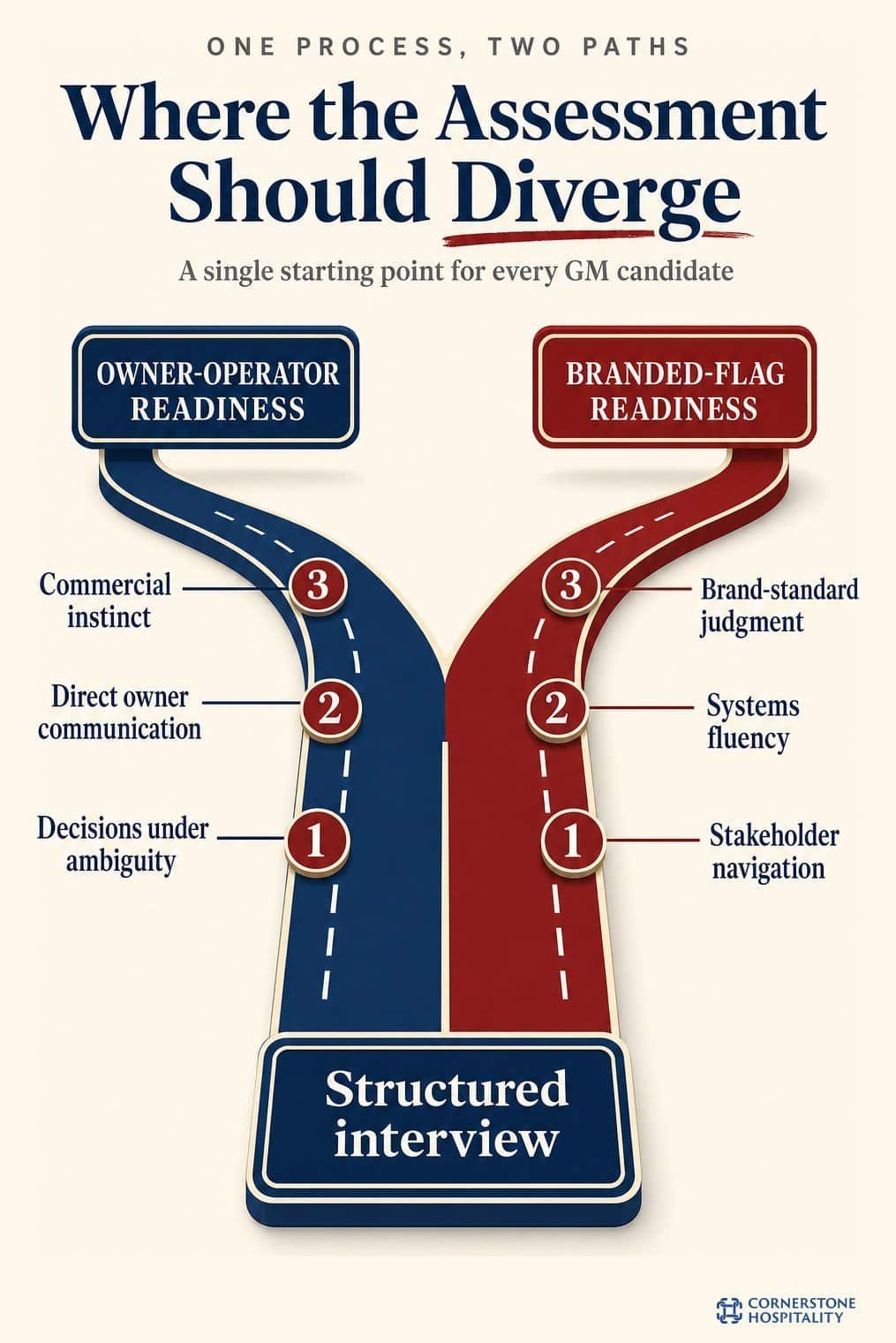
Weighting for the owner-operator profile
For an owner-operator GM search, the assessment should weight autonomous decision-making heavily, in particular decision-making under incomplete information, since there is no brand standard to fall back on for most calls. The assessment should also weigh direct communication skills, because the relationship with one owner carries more of the job than it does in a branded structure, and a pattern of avoiding bad news costs more here than in a role with more people positioned to catch a problem. Commercial instinct matters too. An owner-operator GM operates closer to a part-owner than an employee, and the assessment should test for that instinct directly, rather than assume it from a title on a resume.
Weighting for the branded profile
For a branded search, the assessment should weight stakeholder management and influence without full authority more heavily, because the GM is managing a tripartite relationship rather than a single reporting line [2]. The practical shape of hotel leadership now also runs increasingly through regional and matrix structures, where responsibility can outrun direct authority [4]. The assessment should also weigh the comfort of operating inside somebody else’s system: the ability to read which brand standard genuinely protects the guest experience and which is procedural, without becoming either a rigid enforcer or a candidate who quietly ignores the parts they dislike.
How to test an owner-operator GM and a branded GM fairly
Assessment method matters as much as the weighting itself. In structured interviews, every candidate answers the same competency-specific questions in the same order. Recent validity research identifies them as the strongest single predictor of job performance, ahead of job knowledge tests and general cognitive ability measures [8]. Deciding which competencies matter for the role before the first interview is what makes a weighting real rather than a stated intention, and is part of why an assessment-informed decision succeeds more often than a promotion made on reputation alone [7].
This is the part of a leadership assessment our team builds around every hospitality search. It is not a single template scored the same way for every general manager candidate. It is a weighting built for the specific reporting structure the role sits inside, tested with a consistent, structured process rather than an impression formed across one long conversation.
A title on an org chart says nothing about who the GM actually answers to. An assessment that skips that question is scoring the wrong job.
Florian Kittler, Managing Partner, Cornerstone Hospitality
Where the two roles share the same foundation
None of this makes one role harder than the other, and neither one is a step up from the other. They are two different jobs that happen to share a title. An assessment that treats the branded GM and the owner-operator GM as junior, or the reverse, applies a hierarchy that does not actually exist in the work itself.
What an owner-operator GM and a branded GM both need
What both roles share matters just as much as where they differ. Whoever holds the title still shapes, more directly than anyone, how the team experiences the job day to day. Research spanning millions of employees and business units points one way: the manager accounts for most of the variance in team engagement scores, more than compensation and more than the brand on the building [6].
That effect does not care whether the GM answers to one owner or to a brand and an owner together. It is present in both structures. So the core of any GM assessment still has to test how a candidate leads people day to day, regardless of role type: how they set expectations and handle a difficult conversation, and how they build a team capable of performing when they are not in the room [4].
The two role types also share the same underlying stakes when the fit is wrong. A GM placed in the wrong structure for their strengths does not usually fail because they lack capability. They struggle because the structure asks for different instincts than the ones that made them successful somewhere else, and nobody tested for the mismatch before the offer went out.
Moving from one profile to the other
A career in hospitality leadership rarely stays inside one profile for its whole length. A GM who has run an independent property for a decade receives an approach about a branded role. A branded GM inside a large company receives an offer of a smaller, owner-operated property with more latitude and less scaffolding. Both moves are common, and both are a real adjustment rather than a straightforward transfer of the same skill set.
Branded into owner-operator
Usually already has operational discipline from running inside a tight system. Has to build the instinct for making calls nobody has pre-approved, and the direct, unfiltered owner relationship a branded role rarely required.
Owner-operator into branded
Usually already has the independent judgment. Has to build tolerance for decisions somebody else has already made, and patience for a matrix that will not move at the speed of a single-owner conversation.
What tenure patterns suggest about a mismatch
Tenure patterns hint at how often people miss this adjustment before someone catches it. More than a third of hotel general managers stay in the role for only one to two years [9]. Short tenure has several causes, but a mismatch between what a role structurally rewards and what the incoming GM is actually built for is a common, quiet contributor. It rarely shows up as one dramatic failure. It shows up as a GM who is technically doing the job while structurally unsuited to it, and a generic assessment focused on general leadership quality will not surface that gap. The candidate may genuinely be a strong leader working in the wrong structure.
The same readiness gap shows up more broadly in how prepared new hires feel once they start. Across frontline hospitality roles, most executives say their most recent hires were not fully prepared for the role they stepped into [5]. A structural mismatch between GM profile and property type is one of the more preventable versions of that same problem. Testing for the specific profile a hotel GM search requires can catch it ahead of time, which is cheaper than catching it after a difficult first year.
Signs an assessment is using the wrong template
A few patterns suggest an assessment process is scoring a candidate against the wrong profile for the role.
The first is a candidate who scores strongly on independent judgment, yet less well on stakeholder navigation, where the assessment is for a branded role inside a large matrixed company. That combination is not necessarily a weak candidate. It is very possibly a strong owner-operator GM profile that a branded scorecard is measuring.
The second is the reverse: a candidate who excels at working within a system, executing consistently and managing up cleanly, where the assessment is for an owner-operator GM role. Most of that job is deciding things nobody has decided yet, and that candidate can struggle for months. The role centers on the exact strength the process failed to test for: tolerance for ambiguity.
The third is simpler and more common. It is an assessment that never asks at all which of the two jobs this is, structurally, before scoring the candidate against it. Using a single generic GM template for both role types is one of the fastest ways to make that error, and it can place a genuinely strong leader into a structure they were never built for.
Strong alone, weak across a matrix
Independent judgment scores high, stakeholder navigation scores low, on a branded scorecard. Likely an owner-operator profile.
Strong in a system, slow without one
Executes and manages up cleanly, then stalls on an owner-operator scorecard that rewards deciding things nobody has decided yet.
The question never gets asked
No one names which of the two jobs is open before scoring starts. The most common error of all.
What to do
Name the structure before naming the competencies. A search brief that starts with “owner-operator” or “branded-flag” produces an assessment that tests for the right instincts, not a generic GM scorecard applied twice.
Which job is open: an owner-operator GM or a branded-flag GM
The title on the job posting is the same either way. The job underneath it is not. That difference is structural rather than a matter of one candidate simply being better than another. An assessment should start by naming which of the two jobs is actually open, and only then start scoring candidates against that job. This gives a search a real chance of finding the leader who is built for the property in front of them, not just a leader who interviews well in general.
Not sure which profile your next search is open for?
Tell us about the property and the ownership structure. We will help name the job before the assessment is built.
What clients and candidates say
Florian played a pivotal role in my career transition within the hospitality industry, combining deep expertise in executive search with a highly strategic advisory approach. He takes the time to truly understand your long term ambitions and positions you for sustainable leadership success. His network across the global hospitality sector is exceptional.
Stefan Savic, Hospitality Professional, Asset Management, Development and Strategy
Over the years I have worked with Florian and he has continually provided a service second to none. The caliber of individuals he recommends is always spot on, as he ensures he understands not only the requirements of a role but the importance of the business behind it.
Daniel Aylmer, Chief Executive Officer, Greater China
Both are verified public LinkedIn recommendations.
About this analysis
What the figures draw on: published research on hotel GM decision autonomy and ownership structure from EHL Hospitality Business School, Cornell Hospitality Quarterly, the International Journal of Hospitality Management, Deloitte, Gallup, DDI, Statista, and the Society for Industrial and Organizational Psychology, referenced in full below.
The practice behind the guide: drawn from Cornerstone Hospitality’s retained executive search and assessment work across both owner-operator and branded hospitality leadership roles.
Frequently asked questions
Related reading
Ready to name the job before you score the candidates?
Tell us about the property, the ownership structure, and what the role actually needs. We will help build the assessment around it.
Written by
Sources
- EHL Hospitality Business School, summarizing Demian Hodari, Who’s in Charge Now? The Decision Autonomy of Hotel General Managers, Cornell Hospitality Quarterly 55(4), 2014, pp. 433 to 447: reports that among 116 GMs in independent and hotel-management-company upscale and luxury European hotels, independent-hotel GMs had greater autonomy on operational, marketing, and HR decisions, while GMs in management-company hotels had comparatively little say on financial or strategic issues. It also finds that in independent hotels, GM experience alone increased autonomy, while in management-company hotels only the combination of education and experience produced a substantial gain: insights.ehl.edu/hotel-general-manager
- EHL Hospitality Business School, summarizing Demian Hodari, Mary Turner, and Michael Sturman, published in the International Journal of Hospitality Management 61(2), 2017, pp. 119 to 128: describes independent hotel GMs answering to “only one principal, the hotel owner,” against a “complex, tripartite relationship between the hotel owner, the management company, and the general manager” in management-company hotels. Drawing on a 64-hotel survey, it finds that greater owner-operator alignment is associated with greater GM autonomy and that autonomy is positively related to performance, an effect that strengthens when GMs also hold expanded decision authority: insights.ehl.edu/hotel-general-managers-owners-operators
- Statista: Branded Hotel Room Share in the US and Worldwide: reports that in the United States, four out of five branded hotel rooms are franchised, a further 19% are chain-managed, and about 1% are owned or leased directly by the parent hotel company: statista.com/chart/32462/branded-hotel-room-share-in-the-us-and-world
- Hospitality Net, Dr. Ajay Khatter, William Angliss Institute: Beyond the Traditional GM: How Hotel Leadership Is Being Redefined, 20 August 2024: describes hotel leaders increasingly working “across regional, cluster, and matrix structures” where they “may have responsibility without complete authority,” requiring influence and relationship-building, and argues the goal is “a team capable of performing when I am not in the room”: hospitalitynet.org/opinion/4134033/beyond-the-traditional-gm-how-hotel-leadership-is-being-redefined
- Deloitte: Frontline Workforce Trends in Airlines, Hospitality, and Restaurants: reports that “80% of restaurant workers and 76% of hospitality workers leave their job within a year” and that “66% of executives and managers say most recent hires were not fully prepared, and that lack of experience was the most common failing”: deloitte.com/us/en/Industries/consumer/articles/frontline-workforce-human-capital-trends
- Gallup: Managers Account for 70% of Variance in Employee Engagement: states that “managers account for at least 70% of the variance in employee engagement scores across business units,” drawn from research measuring the engagement of 27 million employees and more than 2.5 million work units: news.gallup.com/businessjournal/182792/managers-account-variance-employee-engagement
- DDI: Succession Planning Best Practices: How to Close the Leadership Readiness Gap: reports that “only 20% of HR leaders say they have leaders ready to fill their most critical roles” and that promotions are 1.6X more likely to succeed when assessments inform the selection decision: ddi.com/blog/succession-planning-best-practices
- Society for Industrial and Organizational Psychology: Is Cognitive Ability the Best Predictor of Job Performance? New Research Says It’s Time to Think Again: reports the revised operational validity estimates from Sackett and colleagues, in which “structured interviews emerged as the strongest predictors of job performance” with a mean operational validity of .42, ahead of job knowledge and work sample tests, and ahead of cognitive ability at .31: siop.org/tip-article/is-cognitive-ability-the-best-predictor-of-job-performance
- OysterLink: Hotel General Manager Demographics and Statistics: reports, from a sample of 5,282 US hotel general managers, that 34% remain in the role for one to two years, and that 80% held another role at the same property before receiving the GM title: oysterlink.com/career/hotel-general-manager/demographics
This sits inside our executive assessment work, which covers the fuller picture beyond this one piece.