

Executive Assessment for Hospitality Leadership
Executive assessment for hospitality leadership: independent evidence on the senior appointments a group cannot afford to get wrong.
Executive assessment for hospitality leadership answers the part of a senior appointment that a track record cannot: what somebody is motivated by, and how they behave when the operation is under real pressure.
Senior hospitality appointments rarely fail on capability. The candidate could do the job. They fail on fit, on motivation, and on how a leader holds up in the third difficult month. Executive assessment for hospitality exists to put evidence under exactly those three things. Cornerstone Hospitality runs assessment alongside executive search and as a standalone piece of work, conducted by Chartered Psychologists rather than by the consultant running the process.
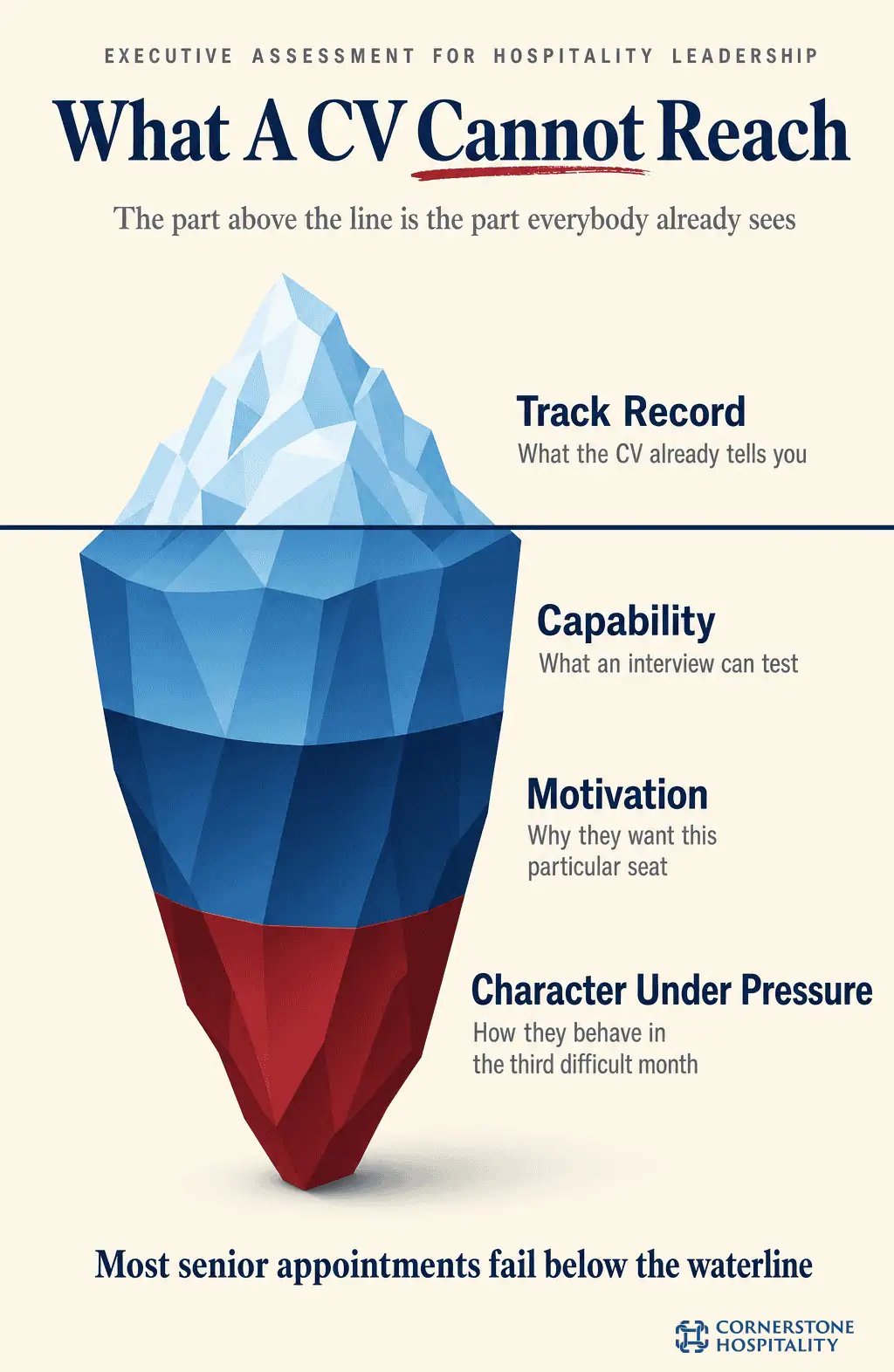
What a CV cannot reach
Every hiring process reads the same top layer. The track record is on the CV, and two hours of interview will test capability well enough. Those layers are real, and they are also the layers every competing bidder for that candidate has already seen.
The layers underneath are where senior appointments actually turn. Motivation explains why a strong operator wants this particular seat, in this particular group, at this point in their career. Character under pressure explains what they do when occupancy drops, when a key report resigns, or when the owner changes the brief nine weeks in.
An assessment reaches those layers deliberately, using structured instruments and a long conversation, rather than hoping the pattern surfaces on its own.
Where executive assessment for hospitality earns its place
Executive assessment for hospitality earns its place in four situations, and the question is different in each one
Appointing from a shortlist
A second, independent read on the final two or three, on the dimensions an interview is least able to test. Most valuable when both look equally strong on paper and the group is choosing on instinct.
Promoting from inside
Performance history tells you how somebody did in the seat they hold, but not how they will do in the one above it, which is a different job.
Starting a coaching relationship
A precise starting point. A coach working from an assessment reaches the useful conversation in weeks rather than months, because the pattern is already on the table. This is how most of our executive coaching begins.
Reading a leadership team
Where the profiles interact. Which strengths overlap, where two people share the same blind spot rather than one covering it, and which tensions are structural rather than personal. Most team coaching starts here.

How executive assessment for hospitality is actually done
A Chartered Psychologist runs executive assessment for hospitality here, rather than the consultant managing the search, so the read stays independent of the pressure to fill the seat.
The work combines validated psychometric instruments with a structured interview that goes considerably deeper than a hiring conversation. Crucially, it calibrates against your specific role rather than a generic leadership template.
What comes back is a written report you can act on. The evidence sits on the page, the risks carry plain names, and a closing view sets out what this person would need in the first ninety days to succeed in your group.
An appointment you cannot afford to get wrong
Tell us about the seat and the shortlist. We will tell you honestly whether assessment will change the decision, and what it would involve.
What hospitality makes harder
A generic read misses in predictable places
| What the sector rewards | What it can hide |
|---|---|
| Decisiveness and visible presence on the floor | A reluctance to delegate, which stops working the moment the span of control widens |
| Comfort with constant interruption | Difficulty holding a long strategic thread when nobody is interrupting |
| Tolerance of unsociable hours and heavy seasons | Endurance being mistaken for engagement, which is where senior burnout begins |
| Loyalty to a brand standard | Discomfort when an owner wants the standard challenged rather than defended |
None of these are faults. They are the predictable shadow of the traits the operating environment selects for, and they are the reason a corporate assessment template reads a hospitality leader poorly.
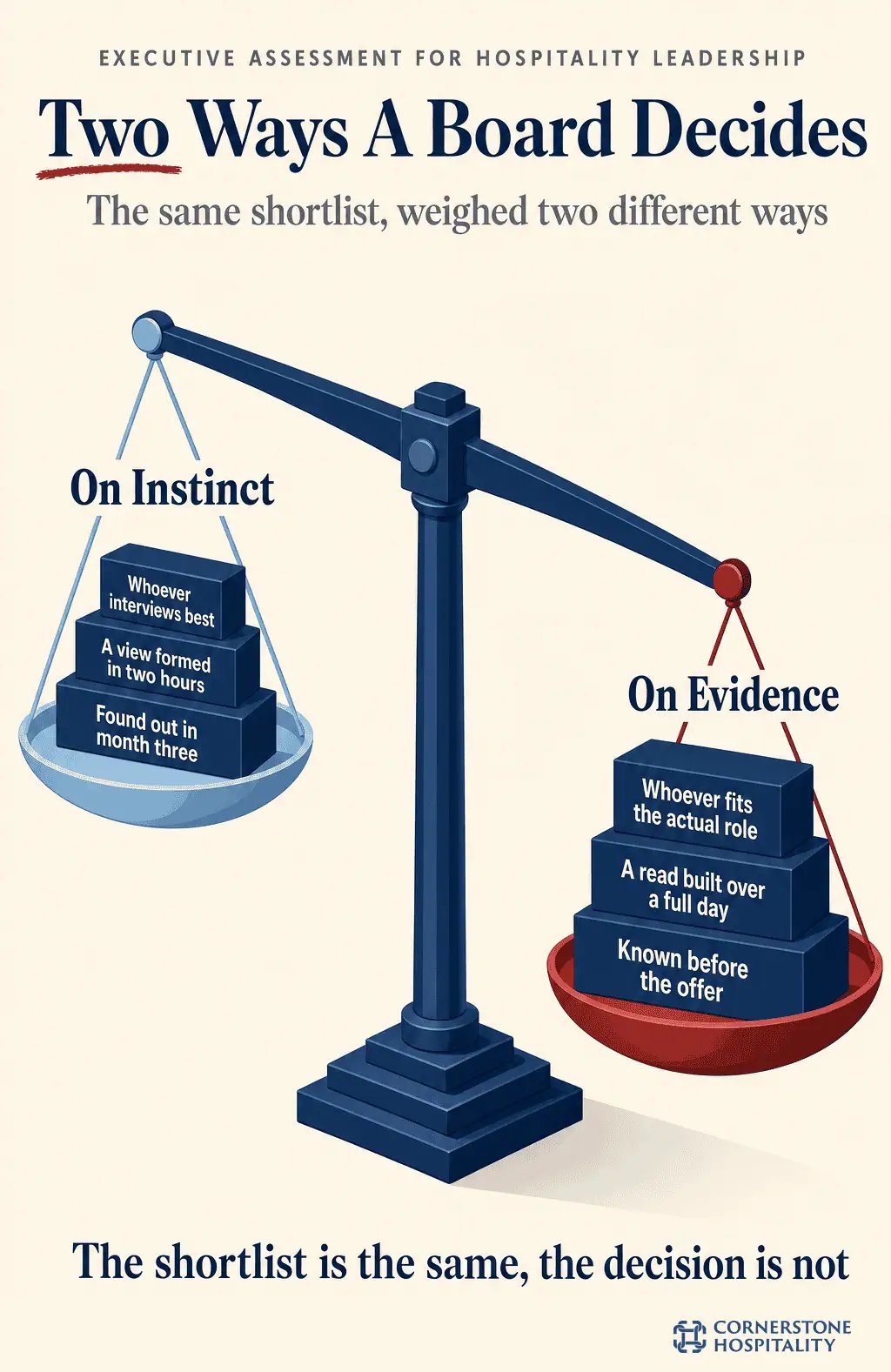
Two ways a board decides
Every board already has a method for choosing between two strong candidates. Very often that method is instinct, formed in a couple of hours, by people who are good at reading a room and who have been right before.
Instinct is not worthless, simply narrow, and whoever interviews best influences it heavily. The candidate who presents most confidently is not reliably the candidate who performs most reliably, and the gap between those two things is usually discovered somewhere around month three.
Assessment does not replace the board’s judgment. Instead it widens the evidence that judgment works from, so the conversation moves from who impressed us to who fits the role we actually have.
Common questions
How is this different from the psychometrics we already run?
Most off the shelf testing produces a profile and stops there. An assessment interprets the instruments against the actual role, adds a long structured interview, and carries the signature of a Chartered Psychologist who takes a position. Therefore you get a judgment, not a set of scores to read yourself.
Do you assess internal candidates as well as external ones?
Yes, and the internal read is often the more valuable of the two. You already know how an internal candidate performs in their current seat. What you do not know is how they will operate one level up, where the job changes shape.
Does the candidate see the report?
The candidate always receives feedback. We treat that as a condition of the work rather than a courtesy, because it is also the moment a strong candidate decides whether the group takes leadership seriously.
Can you assess without running the search?
Yes. Executive assessment for hospitality is frequently commissioned on its own, including on shortlists produced by another firm or by an internal team.
How long does it take?
Scheduling is usually the constraint rather than the work. Once a candidate books in, we turn the assessment and the written report around inside a week.
Related executive assessment pages
- Our Executive Assessment service — the full overview
- Assessing Leadership Potential Before You Promote
- C-Suite Assessment for Hospitality Boards
- Executive Assessment Services for Hotel Owners
- Succession Planning Assessment for Hospitality Groups
- Board Effectiveness Review
- What an Executive Assessment Report Actually Contains
Before the offer goes out
If the appointment matters enough that getting it wrong would cost a year, executive assessment for hospitality is worth an independent read first. Tell us about the role and we will tell you whether we can add anything to what you already know.
Start the conversation