

Board Effectiveness Review
A board effectiveness review for hospitality groups, run by people with no stake in the answer.
A board effectiveness review asks whether the board itself works, which is the one part of a hospitality business that almost never gets read with the rigor the board applies to everything else.
Boards review the operation, the accounts, the brand and the executive team. Very few review themselves, and those that do usually run a questionnaire circulated among people who all sit in the same room. Cornerstone Hospitality runs the review independently, through Chartered Psychologists, reading the board as a working group rather than as a list of individuals.

Effectiveness belongs to the table
A board can be composed entirely of capable, experienced people and still function poorly, because effectiveness is a property of the table rather than of any chair at it.
The common patterns are structural. Two voices dominate and the rest defer. A seat that should challenge the chair never does, usually for reasons of history rather than of character. The owner voice is either absent or so dominant that the rest of the board stops offering a view. Succession never reaches the agenda because it is nobody’s standing item.
None of that is visible from inside, precisely because everybody has adapted to it.
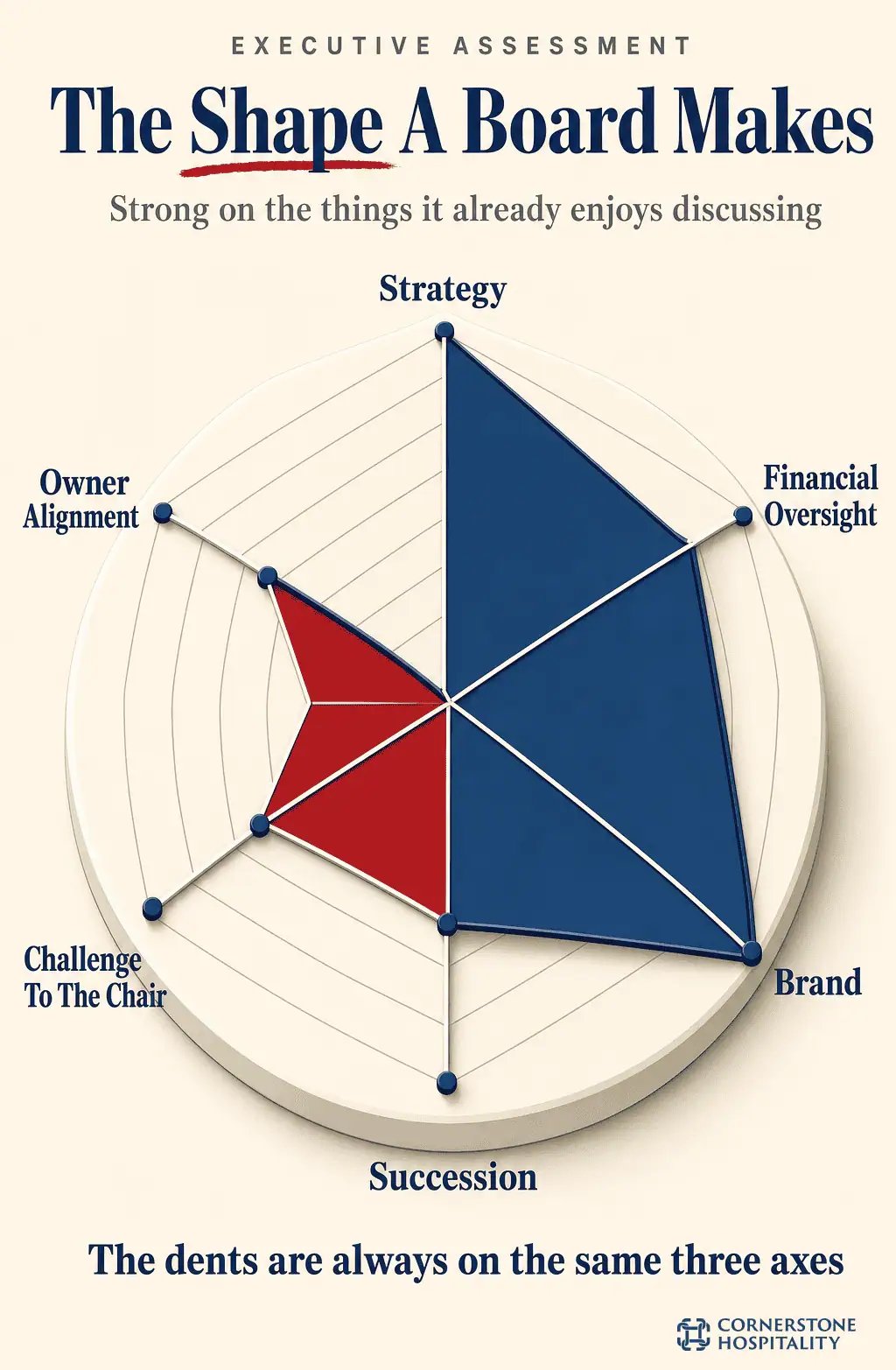
The shape a board effectiveness review usually finds
Strong on what the board enjoys discussing, thin everywhere else

How the review is run
Confidential individual conversations with every board member, conducted by the Chartered Psychologist rather than by a peer, so people say what they would not say around the table.
Observation of the board in session where the chair permits it, because how a group behaves is considerably more informative than how it describes itself. Validated instruments where individual profiles add something beyond the conversations.
The findings are then presented to the board in person, with the uncomfortable parts stated plainly. Consequently the board can question the evidence directly rather than reading a diplomatic summary.
When did the board last review itself?
If the answer is never, or a questionnaire some years ago, a proper read is overdue. Tell us how the board is composed and we will explain what is involved.
What the review covers
| Dimension | The question behind it |
|---|---|
| Composition and balance | Does the table hold the range of views the next three years need |
| Challenge and deference | Can any seat genuinely disagree with the chair, and does one ever |
| Owner alignment | Does the board and the ownership agree what the business is for |
| Succession and continuity | Is there a plan for the chair, the chief executive, and the board itself |
| Information and rhythm | Does the board receive what it needs, early enough to change anything |
| Behavior in the room | Who speaks, who does not, and what that pattern costs |
The last row is the one a questionnaire cannot reach and the one that most often explains the others.
The dents are predictable
Plotted across the dimensions that matter, most boards make a recognizable shape. They push out strongly on financial oversight, on brand, and on whatever the current chief executive is personally interested in.
They dent inward on the same three axes almost every time: succession, genuine challenge to the chair, and alignment with the owner about what the business is actually for. Those three are uncomfortable, so they slide down agendas that are always full of something more pressing.
Because the pattern is predictable, a board effectiveness review is less about discovery and more about naming plainly what most people around the table already half know, in a form the board can act on.
Common questions
Is this the same as the governance review our auditors suggest?
Related but not identical. A governance review checks process and compliance. This reads behavior and composition, which is where most boards that are compliant on paper still underperform.
Will individual comments be attributed?
No. Individual conversations are confidential and findings are reported at board level. Attribution would guarantee that nobody said anything useful.
Our chair is the problem. Can a review still work?
Yes, and it is a common reason for commissioning one. It requires the chair to agree to the review, which is itself informative, and an independent reviewer who reports to the full board rather than to the chair alone.
How often should a board do this?
Every two to three years is typical, and after any significant change in ownership, chair or chief executive.
How long does it take?
Around six weeks for a board of eight to ten, most of which is scheduling individual conversations around board members who travel.
Related executive assessment pages
- Our Executive Assessment service — the full overview
- Executive Assessment for Hospitality Leadership
- Assessing Leadership Potential Before You Promote
- C-Suite Assessment for Hospitality Boards
- Executive Assessment Services for Hotel Owners
- Succession Planning Assessment for Hospitality Groups
- What an Executive Assessment Report Actually Contains
The one part nobody reviews
The board reads everything except itself. Tell us how yours is composed and we will explain what an independent review would involve.
Start the conversation