

Hospitality Executive Search
Hospitality executive search for the board leaders who run hotels, restaurants, resorts and travel groups. Retained, confidential, and executed by people who worked in the industry before.
Hospitality executive search is a retained discipline built for one job. That job is identifying and securing the small number of senior leaders who can run a business at the highest level. Specifically, that means a hotel group, a restaurant company, a resort portfolio or a travel business. Cornerstone Hospitality runs that discipline as its whole practice. We are the Hospitality, Travel and Leisure arm of Cornerstone International Group. Every mandate we accept is a confidential, retained search for a board seat or a leadership role. In those seats, the cost of the wrong appointment runs to years rather than weeks.
The senior hospitality leaders worth appointing are almost never applicants. They are running successful properties, and they are not reading job boards. So they will take a call only from someone who understands their world. A retained search reaches those people. The client commissions the consultant exclusively. That gives the consultant time and authority to map the whole market, rather than skim the few names who happen to be active. Furthermore, a defined process runs from the first briefing through to the leader’s first ninety days in the seat.
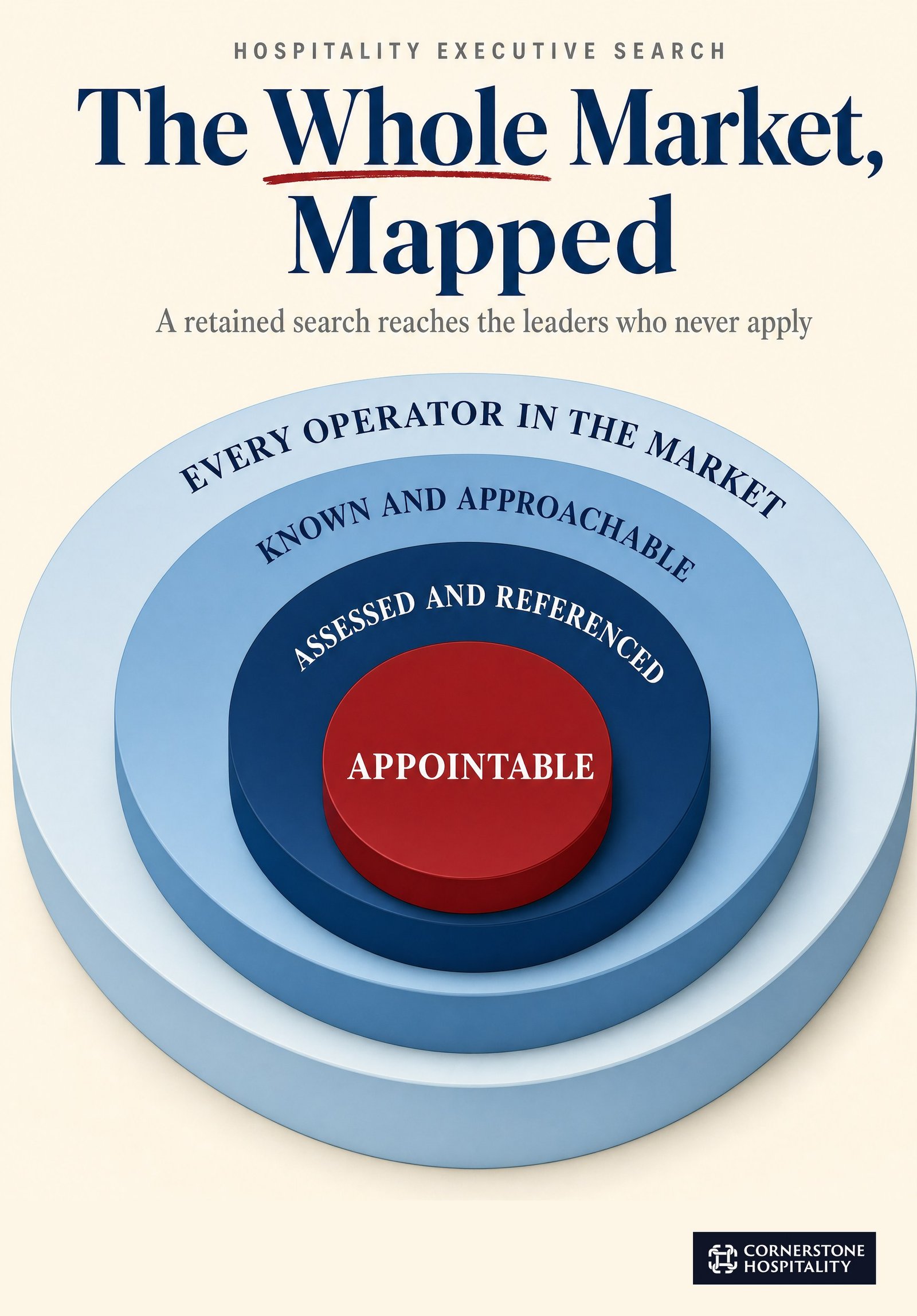
What retained hospitality executive search is
Retained search is the model the profession reserves for its most important appointments. The hiring organization engages one firm, and that firm commits to a structured search. In turn, the fee follows the work in stages rather than landing only on a placement. That structure matters at the top of a hospitality business. A board appointment or a leadership hire cannot run as a race between agencies sending competing resumes. Firstly, the strongest candidates will not enter a contest. Secondly, the discretion a sitting general manager or chief executive requires cannot survive an open process.

Cornerstone Hospitality was built for this level of work. Our consultants came into search after full operating careers. Most arrived from groups such as Mandarin Oriental, Shangri-La, Hyatt, Marriott and Hilton. That background turns the conversation with a candidate from an interview into a peer exchange. Likewise, it turns the read on a leader from a checklist into a judgment drawn from having held the job. The same experience lets us calibrate a brief honestly. Indeed, we know the gap between the manager a group asks for and the operator it needs.
CHOOSING YOUR ROUTE
Three ways a senior hospitality seat gets filled
Every route below fills a vacancy. They differ in who they reach, and in who carries the risk if the appointment is wrong.
| Advertised role | Contingency search | Retained search with Cornerstone | |
|---|---|---|---|
| Who you reach | People actively looking | People a recruiter can reach quickly | The whole mapped market, including leaders in post |
| Confidentiality | None, the role is public | Limited, several firms hold the brief | Held on both sides throughout |
| Assessment | CV and interview | Screening call | A defined stage, with a written report and first-hand references |
| Who owns the search | You do | Whoever places first | One accountable partner, brief to first months in the seat |
| If it goes wrong | You start again | You start again | A placement guarantee of six to twelve months |
Retained is the right route when the cost of the wrong appointment is higher than the cost of the search. For a senior hospitality seat, it usually is.
Making an appointment you cannot afford to get wrong?
A failed senior appointment is the most expensive hire you will ever make
Recruiting, hiring and onboarding a single executive can run as high as USD 240,000[1], before the cost of the months a property spends without a leader. That is the number a search is measured against.
Hospitality executive search, stage by stage
Every mandate follows the same discipline, calibrated to the seniority of the role. The work begins with calibration and market mapping, the phase that decides everything after it. We test the brief against the real market, then agree the profile and the success criteria. Subsequently, we map the full universe of leaders who could fill the seat. That includes the names on the record and the ones who are not. A confidential approach follows. We reach the mapped candidates directly and discreetly, and open a genuine conversation. Meanwhile, we protect the identity of the client and the candidate throughout.
Assessment sits at the center of the discipline. A strong resume shows where a leader has been, not how they lead. So we run structured assessment as a defined stage. It covers motivation, leadership style, cultural fit and operating philosophy. The calibrated shortlist that follows is short by design. We present the few candidates who genuinely fit. Each one comes with an assessment report and first-hand references from people who have worked alongside them. Interviews, the offer and the negotiation come next. The work then carries on into onboarding, because a leader who starts well is the point of the whole exercise.
The conversation a candidate will actually take
Senior leaders in post do not respond to an advertisement, and they rarely respond to a recruiter reading from a screen. They respond to a peer. Our consultants came into search after full operating careers, so the first approach is made by someone who has held the job. That is what turns a cold approach into a genuine conversation, and it is why the candidates worth placing take the call.

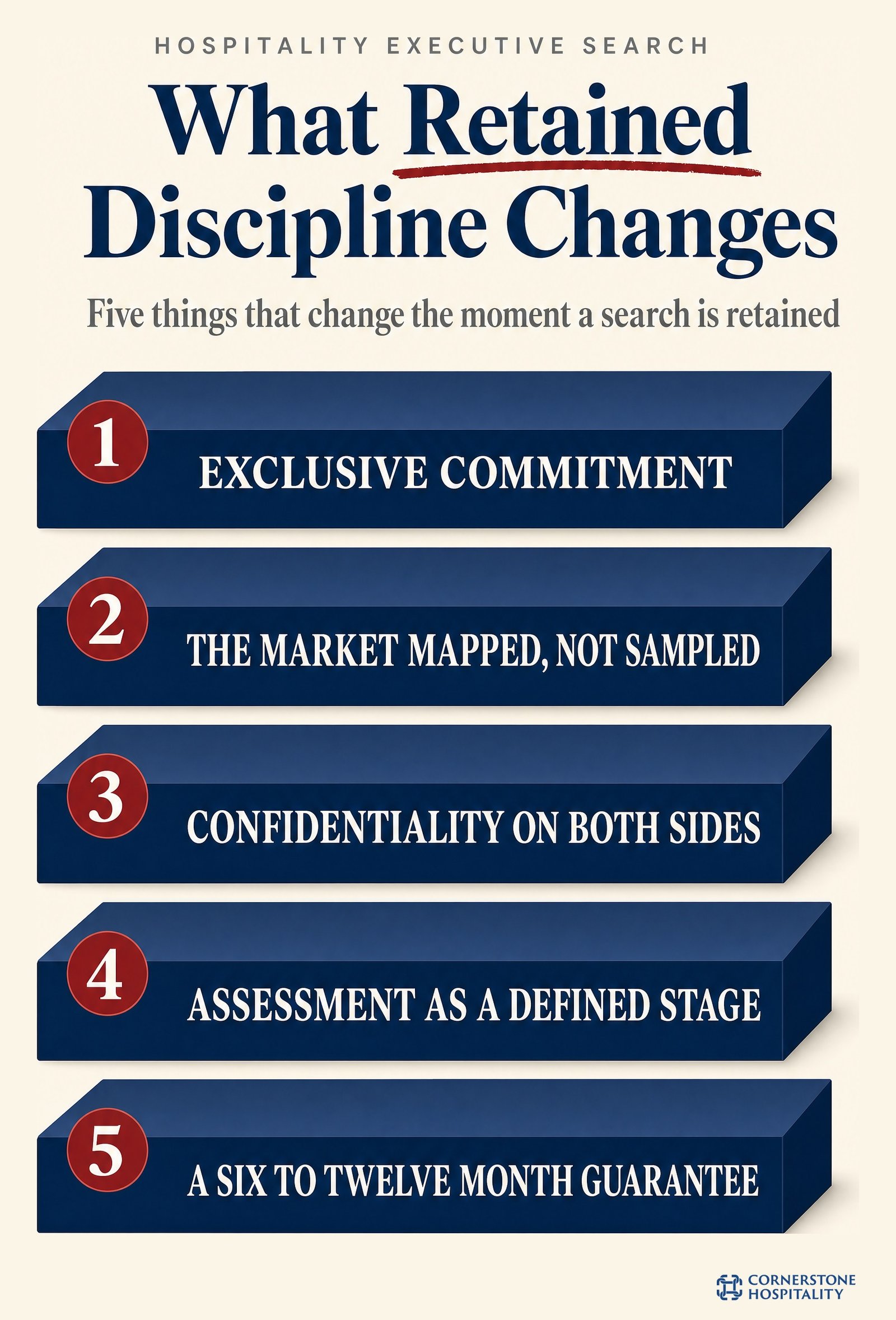
What retained discipline changes
Retained discipline changes five things. The commitment is exclusive, the market is mapped rather than sampled, and confidentiality holds on both sides. Furthermore, assessment becomes a defined stage, and the placement carries a guarantee of six to twelve months. Depth that an open process cannot reach.
HOW IT RUNS
What happens after you get in touch
STEP 1
We agree the real brief
We test the role against the market before anyone is approached, and agree the profile and the success criteria with you. Most briefs change at this stage, and it is far cheaper to change them here.
STEP 2
We map and approach quietly
We map the full universe of leaders who could fill the seat, including the ones who are not on any list, and approach them directly and discreetly. Your name and theirs stay protected.
STEP 3
We present a short list you can act on
Each candidate arrives with an assessment report and first-hand references from people who have worked alongside them. We stay with the appointment through the offer and into onboarding.
Board and Leadership appointments we lead
The practice runs the senior end of the hospitality, travel and leisure market. That includes non-executive directors and board chairs for hotel groups and hospitality investment vehicles. Similarly, it covers chief executives, chief operating officers, chief financial and chief commercial officers. Finally, it reaches the regional and corporate leaders who carry a whole portfolio. It reaches property leadership where the seat warrants a retained, confidential search. Equally, it covers succession planning, where a group prepares its next generation of leaders before the need turns urgent. Wherever a hospitality business is making an appointment it cannot afford to get wrong, one route is safer. Ultimately, the retained search discipline leads to the right leader.
WHY THIS PRACTICE
What you are getting that a general recruiter cannot offer
Operators, not screeners
The consultant running your search has sat in a leader’s chair, so the read on a leader comes from having held the job.
The market, not a database
The search reaches leaders who are in post and not looking, which is where the strongest hospitality operators almost always are.
Global reach, one standard
The Cornerstone International Group partner network extends the search across borders, so an owner in one region reaches the right leader in another.
The risk does not sit with you
Every placement carries a guarantee that runs from six to twelve months, because a serious search should stand behind its own result.
How a hospitality executive search engagement works
An engagement opens with a confidential conversation about the role, the business and the outcome the appointment needs to deliver. From that we agree the brief, the profile and the search plan. We then run the market discreetly and bring a calibrated shortlist rather than a stack of applications. We support the client through interviews, assessment, the offer and the negotiation, and we stay close through the onboarding period. Fees follow the work of the search in fair stages. Moreover, every placement carries a guarantee that runs from six to twelve months. So the risk of a senior appointment does not sit entirely with the client.
A senior hospitality search rarely stays inside one country. The candidate, the references and the relocation conversation move across borders. Therefore Cornerstone Hospitality works within the Cornerstone International Group partner network to follow them. A search that begins with an owner in one region can reach the right leader in another. Meanwhile, local knowledge sits on the ground in each market the mandate touches.
Related: This page sits within our Executive and Board Search practice. Owners weighing how to engage a firm can read our guide to working with a hospitality headhunter, and our overview of hospitality recruiting firms covers what to look for when choosing a partner.
“Florian played a pivotal role in my career transition within the hospitality industry.”
Stefan Savic
Hospitality Professional
“Over the years I have worked with Florian and he has continually delivered.”
Daniel Aylmer
Chief Executive Officer
Making an appointment you cannot afford to get wrong?
Tell us about the role. The first conversation is confidential, and there is no charge to explore whether a retained search is right for it.
Frequently asked questions
Sources
- SHRM, The Cost of a Bad Hire Can Be Astronomical: quotes Jörgen Sundberg, CEO of Link Humans, that “the cost of recruiting, hiring and onboarding a new employee can be as much as $240,000”, alongside the U.S. Department of Labor estimate putting the cost of a bad hire at 30% of first-year wages.
This sits inside our Hospitality, Travel & Leisure work, which covers the fuller picture beyond this one piece.