


How to Brief an Executive Coach for Your Senior Team


How well a sponsor can brief an executive coach decides most of what the engagement can achieve. Every senior leader who starts coaching arrives with someone else’s account of them already in the room. A one-line request, “help her become more strategic,” hands a skilled coach almost nothing to work with. In practice, a good brief names the real business context and the specific pattern, and it says what a changed pattern should look like in six to twelve months. As a result, the coach gets a starting point on day one instead of somewhere around week four.
Figures throughout this article are drawn from the sources list at the end.
Why the brief carries more weight than most sponsors assume
Most sponsors already write something before a coaching engagement starts. It might be an email to the coach, a line in a purchase order, or a sentence in an introduction call. The refinement worth making is not writing a brief where there was none. It is turning the sentence a sponsor already writes into something a coach can actually use. That is what it means to brief an executive coach well.
Who the client is when you brief an executive coach
A useful way to see what the brief does is to look at who it brings together. It is the one place where three views sit side by side before the coaching starts, the organization’s read of a leader, the leader’s own read of themselves, and a sponsor’s sense of what the business needs next.
Research on multi-party coaching contracts treats this alignment as the first job of the engagement, not a courtesy step before the real work begins. The coach’s opening question in any well-run engagement is close to “who is the client.” Coaching that serves the sponsor’s agenda and coaching that serves the leader’s own development are not automatically the same thing, so a brief that never says which one the sponsor wants leaves that question for the first session, and the coach then sorts it out on the clock [4].
Why hospitality leaders cannot wait to brief an executive coach
There is a practical reason this matters more in hospitality than in a head office role. Take a rooms division director stepping up to general manager, or a food and beverage director moving into a corporate role that covers several properties. Leaders like these usually rise quickly. They start the new role while still running the operation underneath them, and they rarely get a quiet fortnight to sit down with a coach and work out what the engagement is actually about. The brief has to do that work before the first session, because the leader’s own calendar will not.
What a strong return depends on when you brief an executive coach
The return on a well-run engagement is one of the better documented claims in leadership development. Eighty seven percent of respondents to a 2024 industry survey agreed that executive coaching delivers a high return on investment, and a separate PricewaterhouseCoopers study put the average return at around seven times the cost of the coach [2]. We look at this return in more detail in the ROI of executive coaching for senior hospitality leaders.
None of that return arrives automatically. It depends on the brief that starts the clock, and it also depends on who writes that brief. The sponsor, HR, and the leader should write it together, rather than one of them writing it alone and handing it over.
What a strong brief does for a coach, a proper brief, plain terms, no label-dressed-as-a-diagnosis, is give them a working start on day one instead of somewhere around week four. Every serious account of coaching contracting treats that shared starting picture as a requirement rather than an optional extra [4] [5].
Why this matters
A brief is not a formality before coaching begins. It is the fastest way to get a sponsor, HR, and the leader working from the same picture, and it is usually cheaper to write than to correct three sessions in. If a senior leader on your team has a coaching engagement coming up, talk to us before the brief gets written.
What a useful coaching brief actually contains
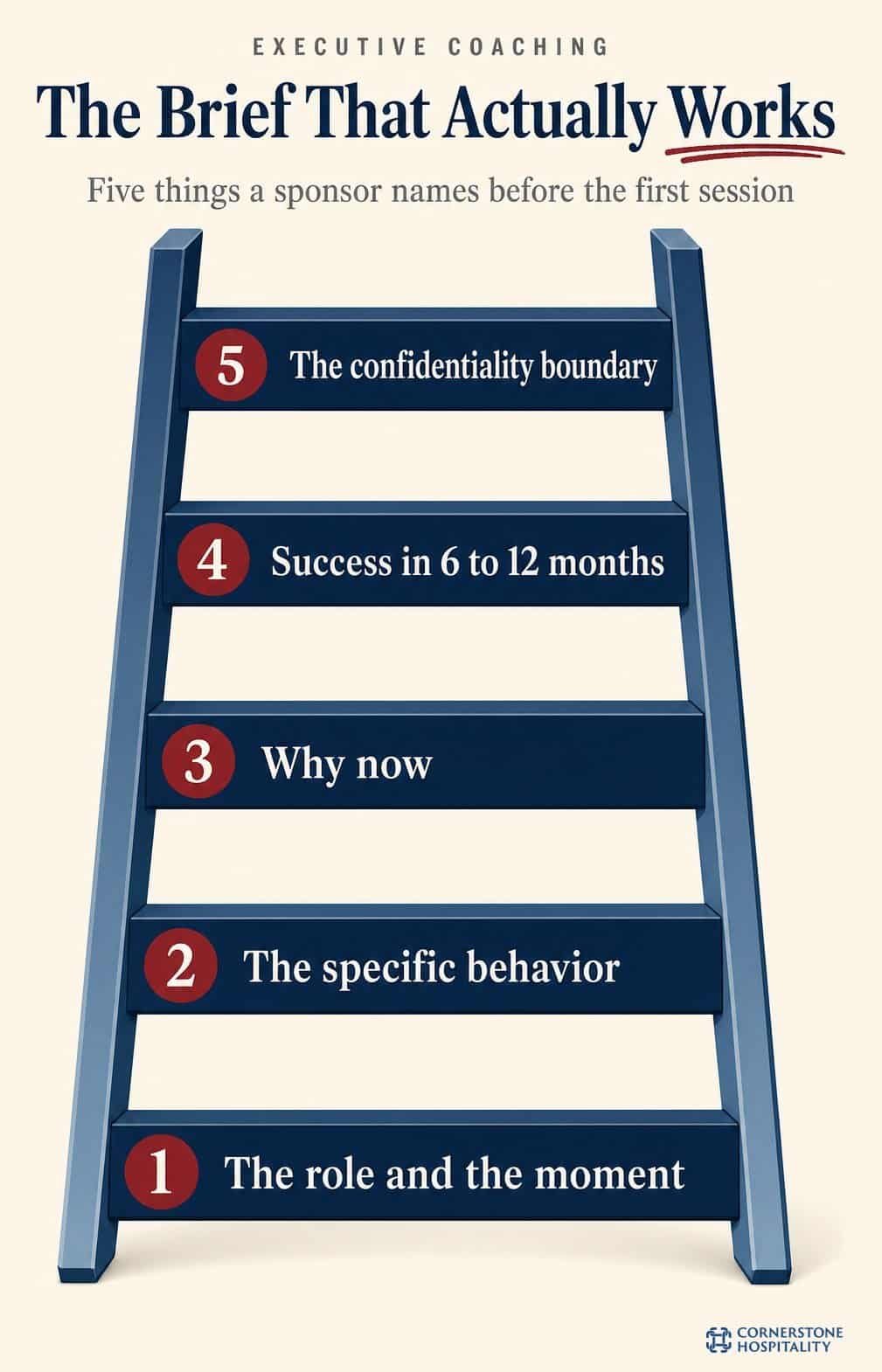
A brief does not need to be long. The most useful ones we have seen run to a page, sometimes less. What it needs is specificity in five places.
First come the business context, and the actual behavior rather than a label for it. Next come why the timing matters now, and what success looks like within a defined window. Last comes where the line sits between what the coach reports and what stays private.
If you leave one out, the coach spends part of the engagement finding it the slow way, several weeks in. Check all five before you brief an executive coach.
The business context the coach needs before session one
An external coach, however experienced, does not know that this property just moved from independent to a branded flag. Nor does the coach know that the food and beverage director now reports into a shared services structure, or that the general manager being coached inherited a team mid-season rather than building one from scratch. None of that is a secret. It is simply information the coach cannot get anywhere else, and a brief that assumes the coach will pick it up eventually costs the engagement real time.
Why timing shapes how you brief an executive coach
The context that matters most is usually the timing. A promotion, a widened scope, a restructure, or a pattern that has repeated more than once are different starting points, and they change what the first few sessions should do. A leader coached because of a recent promotion into a bigger remit needs one kind of opening conversation. A leader coached because the same complaint has come up in two reviews running needs a different one. So when you brief an executive coach, name which one applies. That saves the coach from spending the first session working it out by asking around it.
Behaviors, not labels: making the gap specific
“Needs to be more strategic” and “needs stronger executive presence” are labels, and labels are where most briefs stop. They describe an impression rather than an event, so the coach has no fixed point to work from, and often ends up asking the sponsor to describe the label again in different words during the first session.
Two examples of how to brief an executive coach on behavior
A useful brief replaces the label with something a coach could have watched happen. The label “he needs to delegate more” gives a coach little to go on. This version gives more: “he re-does the weekly forecast himself after his revenue manager has already submitted it, and the team has stopped flagging problems early because they assume he will redo the work anyway.” The next label, “she needs more presence with owners,” is just as general. Here is a version a coach can use: “she defers to her general manager in ownership calls even on questions inside her own remit, and the owner has started directing questions to the GM instead of her.”
The second version in each pair gives a coach an actual starting point. The first gives them a feeling to interpret.
On naming the behavior, not the label
What success looks like in six to twelve months
A brief that stops at the behavior still leaves open what the engagement is meant to produce. One widely discussed case from an HR leadership publication shows why. In it, the leader’s team engagement scores rose, and her sales results improved. Her manager still called the engagement unsuccessful, because the brief had specified one thing as the goal, a formal apology to a colleague, and that apology never happened [3]. The coaching worked. The brief had defined success as an event rather than a pattern, and that mismatch cost the leader credit for real change.
How to word the success picture when you brief an executive coach
The safer version names a pattern over a window, not a single moment. Here is an example: “In six months, the weekly forecast goes out on the revenue manager’s numbers without the general manager redoing it, and at least two direct reports raise a problem early rather than waiting for it to surface in the P&L review.” That is specific enough for a coach to work toward, and specific enough for a sponsor to recognize when it has actually happened, rather than arguing about whether it has.
Where the coach’s confidentiality boundary sits
The right to confidentiality in a coaching relationship belongs to the person being coached. It does not belong to the sponsor who is paying for it [6]. What a sponsor can expect to receive is usually themes, general progress, and whether the engagement is on track. What stays private is the content of individual sessions, meaning what the leader actually said, what they are struggling with, and how they are processing it [7].
A brief that is silent on this leaves the boundary for later. Someone then has to negotiate it informally, usually at the exact moment a sponsor is curious about something specific, and the coach then has to explain, for the first time, what they can and cannot say. The most common way this goes wrong is not a coach who breaches confidentiality. It is a sponsor who expects the coach to “report back” on session content, or a sponsor who treats coaching updates as an informal performance review. Neither means to cross a line they did not know was there [7].
When you brief an executive coach on the boundary, one or two sentences remove that ambiguity before it becomes an awkward conversation in month two. It also tends to make the leader more open in the room, since the leader knows in advance what will and will not travel back to their manager.
Why owners and board sponsors need to brief an executive coach on confidentiality
This matters even more at board or ownership level, where the person receiving the coach’s updates may also be the person who decides the leader’s next role. A general manager being coached with an owner as sponsor is likely to hold back in early sessions, especially if nobody ever said the confidentiality boundary out loud, and that holds whatever the coach’s own ethical standards happen to be. Writing the boundary into the brief, rather than leaving it as an assumed professional norm, turns a private understanding between the coach and the leader into something the sponsor has agreed to as well.
Why this matters
A brief that covers the role and the moment, the specific behavior, why now, the six to twelve month picture, and the confidentiality boundary gives a coach a working start on day one. Leave one out, and the coach finds it the slow way, several weeks in.
Bringing a coach in for someone on your senior team?
Cornerstone’s leadership coaching work starts with getting the brief right, together with the sponsor, HR, and the leader, before the first session is booked.
Who should write the brief
One person alone rarely writes the most useful briefs we see. They come from the sponsor, from HR or the people function, and from the leader themselves. Each contributes something the other two do not have.
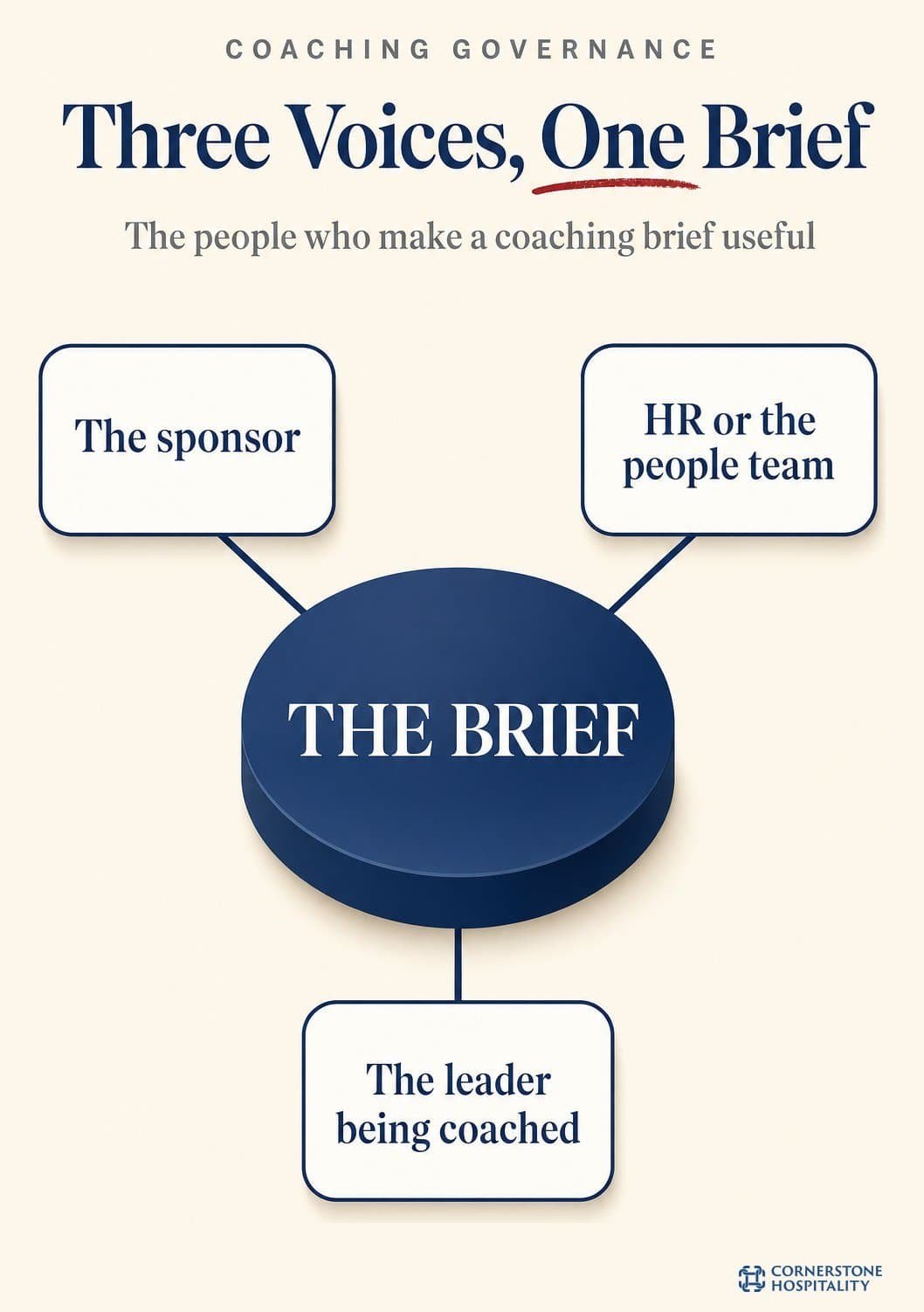
The sponsor
Confirms backing for the engagement and sets out what the business needs from it, in plain terms, before the coach and leader meet.
HR or the people team
Holds the pattern across roles and time, and keeps the brief anchored to something structured rather than personal preference.
The leader being coached
Reviews or helps write the brief, so the first session goes to the work rather than to discovering what was said about them.
The sponsor’s part
The sponsor is usually the leader’s own manager, owner, or a board member for the most senior roles. This person holds the business context and confirms the engagement has real backing behind it. Coaching literature on multi-party contracting is consistent on this point. The sponsor’s job at the outset is to confirm support for the engagement and to set out what the organization needs from it, in plain terms, before the coach and leader ever meet [4] [5].
HR’s part
HR or the people function usually holds the pattern across roles and across time. That covers whether this is the first time someone has raised this behavior, how the behavior compares with what other leaders at the same level are working on, and what has already been tried. HR is also generally best placed to insist that the brief maps against something structured. A general sense that the leader “could be better” does not meet that test, and HR can keep personal preference out of what should be a business case for coaching [3] [8].
Why the leader’s own input changes the first session
A brief written entirely by a sponsor or HR, without the leader ever seeing it, tends to produce resistance in the first session. The leader hears the framing for the first time from a stranger, not from someone they already trust. When you brief an executive coach, involve the leader, even briefly, and ask them to review or add to the brief before the engagement starts. That changes the dynamic. It does not require the leader to agree with every word, only to have seen it, so the first session goes to the work rather than to the leader discovering, mid-conversation, what was actually said about them.
The brief above is written for coaching one leader. Where it is a whole team, not just one person, that needs this groundwork, the brief and the engagement both work differently, which we cover in when team coaching works for a hospitality leadership team.
Why this matters
A brief written by one person alone misses what the other two would have caught. The sponsor holds the business context, HR holds the pattern across roles, and the leader holds the part no outsider can see from a document alone.
The mistakes that undo an otherwise good brief
Three mistakes account for most of the coaching engagements that start slowly or never quite land. All three show up in the brief itself, before a single session has happened.
The vague brief
“Help him become a stronger leader” is the single most common brief. It is close to no brief at all, because it gives a coach a direction without a destination, and it invites the coach to spend early sessions on diagnostic work the sponsor was better placed to do in five minutes. The fix is not a longer document. It is a specific one: give the behavior, the timing, and the six to twelve month picture, in a few sentences rather than a paragraph of adjectives.
No follow-up mechanism
A brief written at the start and never revisited treats the coaching engagement as a single transaction, but an engagement is something that develops. Multi-stakeholder coaching contracts that work tend to build in a return to the original goals, usually with the sponsor and the coach or coachee together, rather than assuming the initial brief still holds good several months in [4]. Without that check-in, a sponsor finds out whether the engagement worked only at the very end, the most expensive possible time to discover it needed a different focus three months earlier.
Treating a role-fit problem as a performance problem
Coaching works on behavior a leader can change. It does the wrong job when the actual issue is that the leader is in the wrong role, or when the role itself no longer matches what the property needs. Consider a general manager who is genuinely excellent at running a single high-touch property, but struggles to run three properties at once through other people. That is not a coachable performance gap. It is a fit problem.
Coaching that leader toward the old job’s strengths in the new job’s shape often makes the mismatch more visible rather than closing it. The signal worth watching for is whether the same brief, written honestly, describes a decision about the role rather than a behavior the leader needs to change within it. Naming that distinction is one of the more valuable things a sponsor or HR partner can do, when they brief an executive coach, before coaching starts, not after three sessions of a coach circling a problem coaching cannot solve.
Testing whether coaching can close the gap before you brief an executive coach
The test that tends to work is asking, in plain terms, whether the leader has clearly done the desired behavior before, even in a different setting or at a smaller scale. Take a department head who ran cross-functional meetings well at one property. If that person now struggles to do the same across three, coaching can close the gap, because the capability already exists somewhere in their history. Now take a leader who has never, in any role, delegated a decision they were entitled to delegate. That leader shows something closer to a pattern than a gap, and that distinction changes how realistic a six month timeline actually is.
A brief that stays vague
Names a feeling. “Help him become a stronger leader” gives a coach a direction with no destination, and the first sessions go to diagnosis a sponsor could have done in five minutes.
A brief that gets specific
Names a behavior, a timing, and a six to twelve month picture a coach can work toward, and a sponsor can recognize once it has actually happened.
A brief-quality checklist
The table below sets out what separates a brief that gives a coach something to work with from one that does not, element by element.
| Element | Weak version | Useful version |
|---|---|---|
| The behavior | “Needs to be more strategic” | “Still reviews every purchase order over $500 personally, so the department heads have stopped bringing forward ideas above that line” |
| Why now | No context given | “Just took on a second property, the pattern that worked running one is starting to slow both down” |
| Success picture | “Becomes a stronger leader” | “In six months, department heads bring forward two or three proposals a month without being asked” |
| Confidentiality | Left unstated, sorted out later | “Coach reports themes and progress to me quarterly, session content stays with the coach and the leader” |
| Follow-up | No review planned | “Sponsor, coach, and leader revisit this brief at the three month mark and adjust if needed” |
What to do
Before you brief an executive coach, check the brief against the five rows above. If any row is still a label rather than a specific, that is the sentence to rewrite. Do it before the engagement starts, not after the first session.
Bringing it together: how to brief an executive coach
A coaching brief is a short document and an easy one to write badly. The shortcuts all look reasonable in the moment, a job title instead of a behavior, a feeling instead of a success picture, an unstated confidentiality boundary, and they only show their cost later. That cost lands in a coach’s first few sessions, spent asking questions the brief should have already answered.
Getting it right does not take long. To brief an executive coach well, the sponsor, HR, and the leader need to agree on what the engagement is actually for, and they need to do it before the first session.
Ready to brief a coach for a leader on your team?
Tell us about the role, the moment, and what good looks like in six months. We will help you turn it into a brief a coach can actually use.
What clients and candidates say
Florian played a pivotal role in my career transition within the hospitality industry, combining deep expertise in executive search with a highly strategic advisory approach. He takes the time to truly understand your long term ambitions and positions you for sustainable leadership success. His network across the global hospitality sector is exceptional.
Stefan Savic, Hospitality Professional, Asset Management, Development and Strategy
Over the years I have worked with Florian and he has continually provided a service second to none. The caliber of individuals he recommends is always spot on, as he ensures he understands not only the requirements of a role but the importance of the business behind it.
Daniel Aylmer, Chief Executive Officer, Greater China
Both are verified public LinkedIn recommendations.
About this analysis
What the figures draw on: published research and industry reporting on executive coaching engagement design, sponsorship, and contracting from sources including the International Coaching Federation, SHRM, and the South African Journal of Human Resource Management, referenced in full below.
The practice behind the guide: drawn from Cornerstone Hospitality’s leadership coaching and executive search work with senior hospitality leaders and the sponsors and HR teams who commission it.
Frequently asked questions
Related reading
Want a second set of eyes on a brief before it goes out?
Share the draft with us. We will tell you where it is still a label instead of a behavior.
Written by
Sources
- International Coaching Federation, in partnership with PricewaterhouseCoopers: 2023 ICF Global Coaching Study, Executive Summary: based on 14,591 valid responses from 157 countries, reports that “on average, coach practitioners said that 57% of their clients are sponsored and 43% are primary clients,” a share that has risen from 52% in 2019, and that clients who are sponsored are associated with higher hourly fees and annual revenue: coachingfederation.org/wp-content/uploads/2023/04/2023ICFGlobalCoachingStudy_ExecutiveSummary.pdf
- International Coaching Federation: Coaching Statistics: The ROI of Coaching in 2024: reports that “87% of survey respondents agreed that executive coaching has a high return on investment (ROI),” and cites a global PricewaterhouseCoopers and Association Resource Center survey finding “an average ROI of seven times the cost of employing a coach”: coachingfederation.org/blog/coaching-statistics-the-roi-of-coaching-in-2024
- SHRM Executive Network, David Reimer: The End of Executive Coaching?, 22 February 2024: describes a coaching engagement in which the leader’s “leadership style, team engagement, and sales results” improved, yet the engagement was judged unsuccessful because a single predetermined goal, a formal apology, was never reached, and argues that “coaching goals are clear and shared” across HR, the manager, and the executive is the condition that prevents this kind of mismatch: shrm.org/executive-network/insights/people-strategy/end-executive-coaching
- Burger, C. and Van Coller-Peter, S., published in the South African Journal of Human Resource Management: A conceptual framework to guide the contracting process in leadership coaching engagements: states that “at the start of the coaching, the sponsor needs to confirm the line manager’s support for the client’s coaching” and needs to “clarify the organisation’s objectives and articulate the coaching expectations from an organisational perspective,” and finds that “insufficient contracting between the coach, client, line manager and sponsor can create misaligned outcomes and expectations”: sajhrm.co.za/index.php/sajhrm/article/view/1114/1776
- International Coaching Federation: How to Handle Multi-stakeholder Contracting in Executive Coaching: states that “‘who is the client?'” is the first question a coach has to address when setting up an assignment, and that “it is therefore important that the coach engages with at least some of the key stakeholders so that they understand the impact coaching will have”: coachingfederation.org/blog/multi-stakeholder-contracting-in-executive-coaching
- International Coaching Federation: Private and Confidential: The Ethical Implications: states that “confidentiality refers to the coach’s duty to not disclose any information obtained during the course of the coaching relationship without the express permission of the client,” and that “the right to confidentiality belongs to the client, not to you as a coach”: coachingfederation.org/blog/private-and-confidential-ethical-implications
- Academy of Executive Coaching: Why Coaching Confidentiality Matters: sets out that sponsors typically receive “themes, goals and progress” rather than session content, and lists common organizational missteps including “expecting the coach to ‘report back’ on session content or behaviour” and “treating coaching as an informal performance management tool”: aoec.com/knowledge-bank/why-coaching-confidentiality-matters
- SHRM: 5 Steps to Integrating Coaching into Your Talent Management Strategy: advises that organizations should “clearly set expectations with your internal coaches, individuals being coached, the executive sponsors and, of course, your managers and colleagues,” and recommends deciding how success will be measured before a coaching program starts: shrm.org/topics-tools/news/talent-acquisition/5-steps-to-integrating-coaching-talent-management-strategy
This sits inside our leadership development work, which covers the fuller picture beyond this one piece.