


The First 90 Days in a New Senior Hospitality Role
The first 90 days in hospitality buy an accurate picture of the business and a settled view of the leader who has arrived. Results come after that, and they rest on both.


The first quarter, in numbers
Why the first 90 days in hospitality, and not a year
Ninety days is not a natural unit of business time. It is a unit of attention.For roughly the first quarter, a new senior leader has something they will never have again. It is permission to ask any question without anybody reading it as a signal. After that, questions start to mean things. Asking about the banqueting margin in month one is curiosity. Asking about it in month eight is an audit, and the room adjusts accordingly.The same window works in reverse. Everything the leader does in the first quarter draws close reading from people, forming a durable view. Michael Watkins puts the unaided breakeven point, where a leader contributes as much value as they have consumed, at up to six months [1]. The first ninety days are the half of that period where the reading is happening and the contributing has barely begun.The scale of the problem is visible in the wider evidence on leadership readiness. Only 24% of senior executives at firms running high-potential programs consider them a success. Just 13% have confidence in the rising leaders at their firms, down from 17% three years earlier [14].Why the receiving business is rarely ready either
Only 20% of HR leaders say they have leaders ready to fill their most critical roles. Internal candidates can fill only 49% of critical positions immediately [12]. Most senior appointments, therefore, arrive into a business that has not built a bench and has not thought much about how somebody new becomes effective.What the quarter actually buys
Ninety days buys an accurate picture of the business and a settled view among the people in it about what kind of leader has arrived. Both are prerequisites for results, and neither comes back later at the same price.
The first quarter is the only period in which a new leader’s questions read as curiosity rather than judgment. Spending it well is what makes the next three quarters possible.
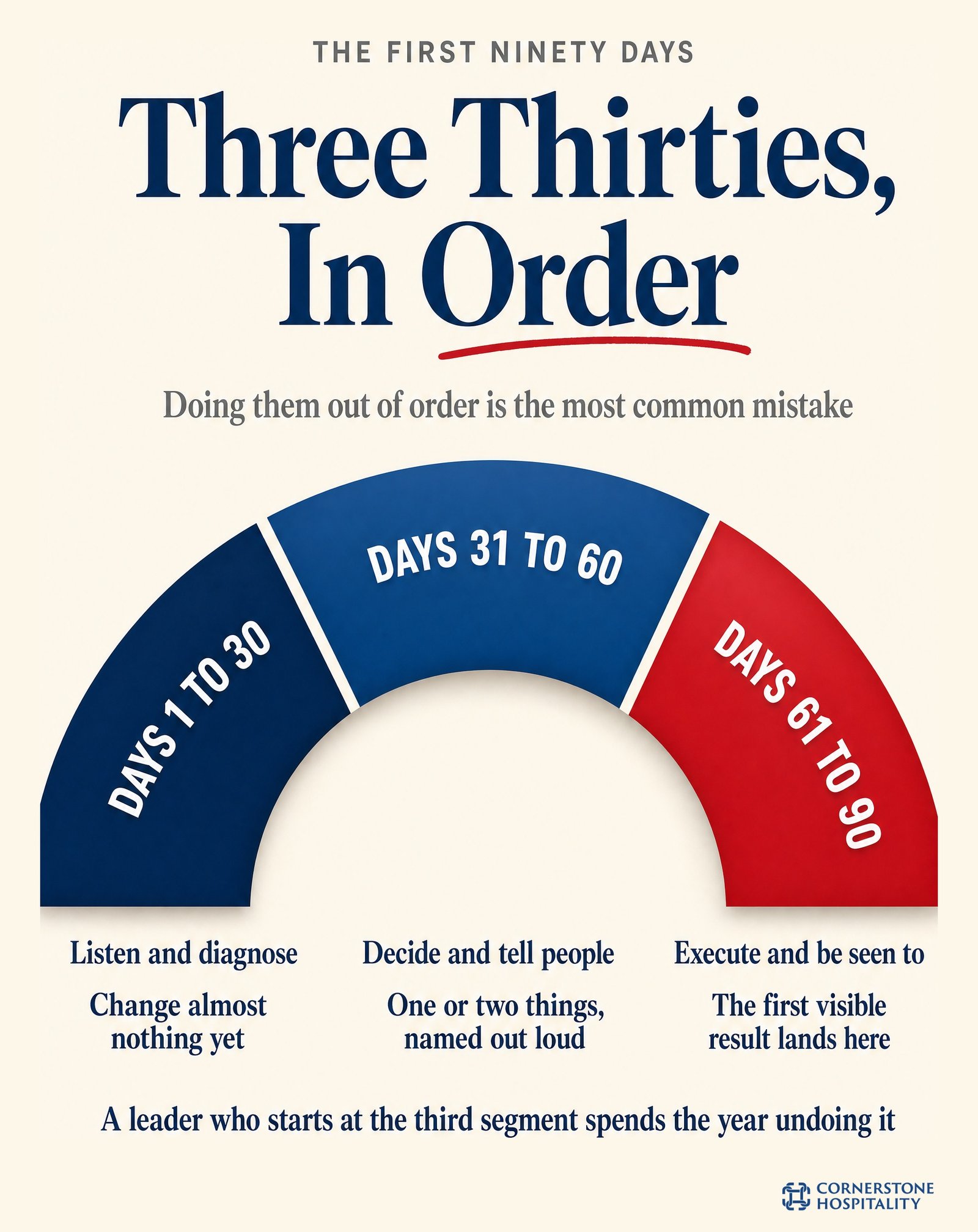
What belongs in each thirty of the first 90 days in hospitality
Days 1 to 30: listen and diagnose
The objective is an accurate picture and almost nothing else. Meet everybody who runs something in their own space rather than in the office. Read the numbers personally rather than accepting the summary, because the summary encodes somebody else’s judgment about what matters. Ask the same three or four questions of everybody and pay attention to where the answers stop agreeing.The single most useful question in this period is some version of “What would you change if you had my job?” It surfaces the things people have stopped raising because raising them went nowhere. Those are usually the real constraints rather than the ones in the handover document.The discipline in this thirty is restraint. Something will be visibly wrong in week one, and fixing it is tempting because it is easy and demonstrates competence. Fixing it also converts the leader from somebody gathering information into somebody who has started making decisions. That shapes every subsequent conversation.Days 31 to 60: decide and tell people
The second thirty is where the picture turns into a small number of decisions. “Small” is the operative word. One or two things, chosen because they matter rather than because they are achievable. Said out loud, so that everybody knows what has been decided and what has not.Saying it out loud is the part that gets skipped. A leader can quietly decide the property is going to change its approach to a department. Not telling the department creates uncertainty rather than direction. People fill silence with the least reassuring available explanation, particularly in the first quarter of a new leader’s tenure.This is also the thirty in which the relationship with the owner or the group becomes real. The initial welcome is over and the actual working pattern settles: how often, in what form, and with what warning about bad news. Setting that deliberately in month two is far easier than renegotiating it in month eight.Days 61 to 90: execute and be seen to
The third thirty is where the first visible change lands. It should be finished rather than announced, and it should be small enough to finish. A completed change of modest size does more for credibility than an ambitious one still unfinished at quarter’s end. The property is judging whether things this leader starts get finished, not how ambitious they are.Doing these in the wrong order is the most common failure. A leader who arrives with the changes already decided has skipped the first thirty. Everything they decided rests on the previous business rather than this one. The diagnosis is not a formality before the real work. It is what makes the real work aimed at anything.“The property is not asking whether the new general manager is clever. It is asking a much narrower question: when this person says something is going to happen, does it happen. The first quarter is the only cheap opportunity to answer it.”
Florian Kittler, Managing Partner, Cornerstone Hospitality
Run the three thirties in order. Diagnose first, decide second, execute third, and resist collapsing them even when the pressure to act arrives early.
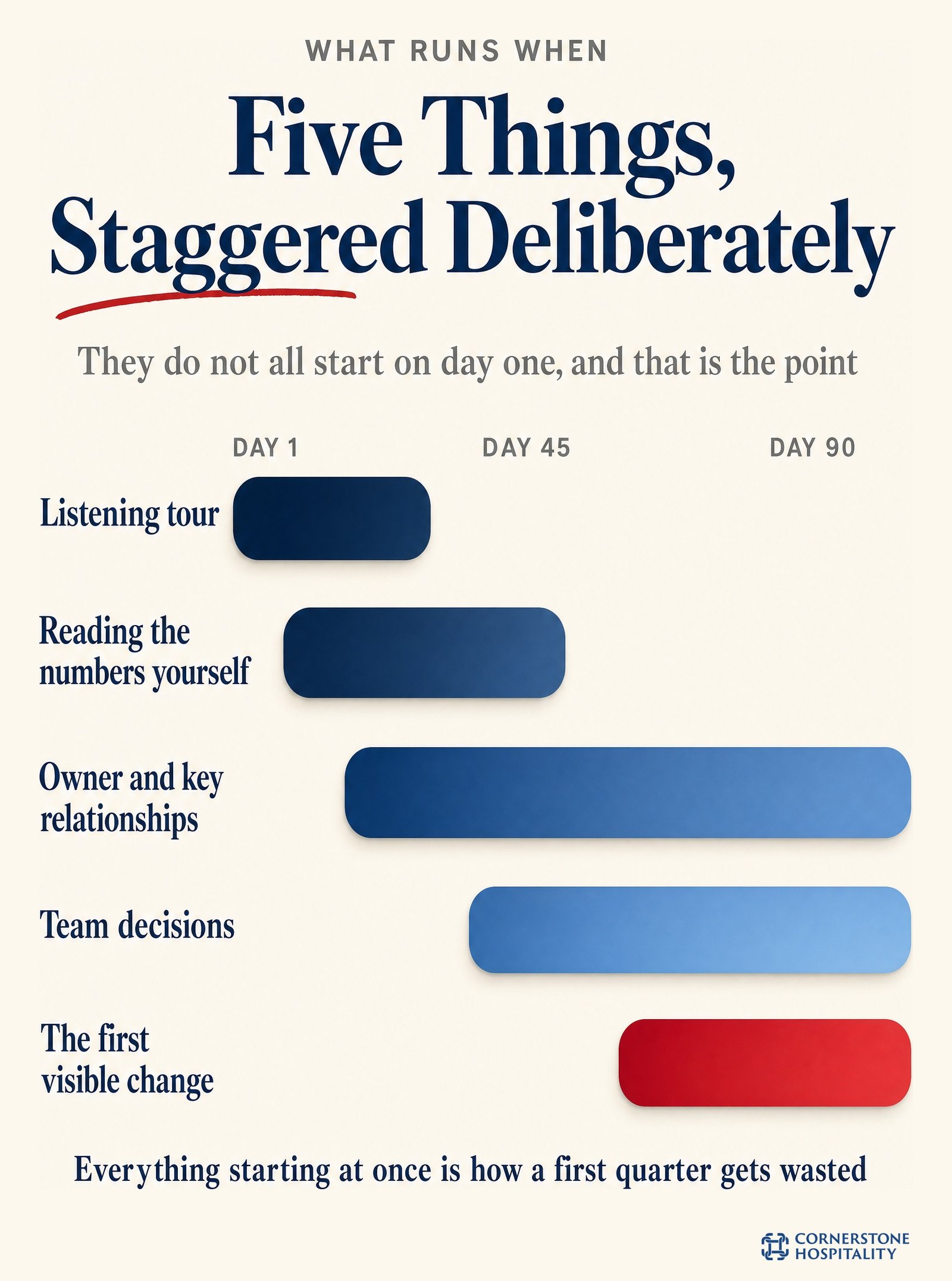
Five workstreams, and when each one starts
Five workstreams, deliberately staggered. Starting them all in week one is the second most common failure. It looks like energy while producing very little.Why month one information is never neutral
That information is real and it is not neutral: it comes from people with their own history in the building. Acting on it in month one means the new leader has made their first personnel decision using somebody else’s judgment and has taught the property that whoever briefs them first sets the agenda.When the leader does make the judgment, structure improves it. Sackett and colleagues’ revised operational validity estimates rank structured interviews as the strongest predictor of job performance, at .42. Ahead of job knowledge and work sample tests at .40, .38, and .33, with cognitive ability at .31 [13]. A new leader can spend thirty minutes with each direct report, using the same short set of questions. That gives a materially better read than impressions formed across a fortnight of corridor conversations, and it takes less time.There is a wider evidence point here too. Managers account for at least 70% of the variance in employee engagement scores across business units, from research covering 27 million employees and more than 2.5 million work units [5]. Korn Ferry finds team climate accounts for up to 31% of the variation in team-level engagement, with the right leadership characteristics lifting engagement by up to 42 percentile points [6]. The team decisions made in a first quarter set that climate for everything after.Staggering the five workstreams is not caution for its own sake. Each one lands better because an earlier one has already happened, and team decisions made too early are made on somebody else’s account of a person rather than on their work.
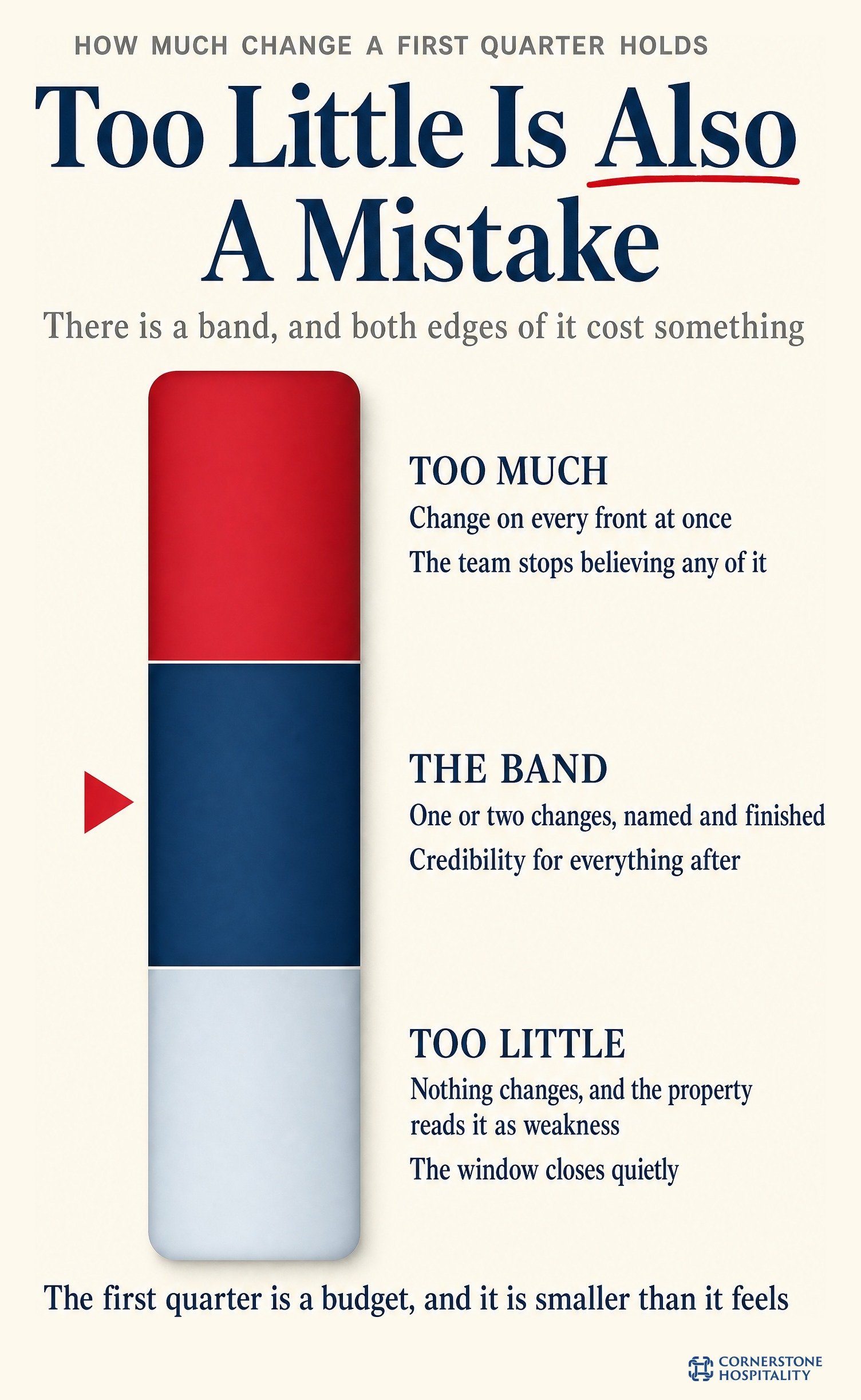
Finding the band and the cost of missing it either way
Most advice about the first ninety days warns against doing too much. Less of it warns against doing too little, and doing too little is a real failure mode with real costs.The cost of too little
A leader who changes nothing in ninety days has answered the property’s question in the negative. The reading is not that they are being careful. It is that they either cannot see what is wrong or cannot act on it. Both conclusions are difficult to reverse. The window in which a new leader can change something unopposed is short, and it closes on its own. High-potential talent is 3.7X more likely to leave within a year when their manager does not provide regular growth opportunities [9], and a first quarter in which nothing moves reads to that group exactly like that.It matters more in a business where people are actively deciding whether to stay. Accommodation and food services recorded a monthly quit rate of 4.3% in March 2026, the highest of any industry and nearly double the private-sector average of 2.2% [8]. Gallup finds 52% of voluntarily exiting employees say their manager or organization could have prevented it, with 51% reporting that nobody spoke with them about their future in the three months before they left [7]. A first quarter in which nothing visibly improves is a first quarter during which a proportion of the team quietly concludes nothing will.The cost of too much
The opposite failure is more familiar. A leader who changes everything at once produces a property that cannot tell which changes matter. It cannot complete any of them, and stops treating announcements as meaningful. The credibility cost is worse than the operational one because it is what makes the second round of changes harder. Team climate accounts for up to 31% of the variation in team-level engagement [6], and a climate of announced-and-abandoned changes is a difficult one to work out of.The band
One or two changes, named, finished inside the quarter. That is small enough to complete and large enough to answer the question. Everything else waits for a second quarter that is much easier to run once the first one has established that this leader finishes things.There is a second reason to keep it to one or two. This is that the change is also the leader’s own development. Roughly 70% of development comes from challenging experiences and assignments, 20% from developmental relationships, and only 10% from coursework [15]. A first visible change chosen well is that assignment, and it teaches the leader more about the property in eight weeks than any amount of reading.Choosing the one or two
Pick the change that most people agree is needed and nobody has done, rather than the one that most impresses. The first buys the leader the right to make a harder change later. The second buys an argument in month three that they are not yet positioned to win.
What the first 90 days in hospitality demand that other sectors do not
Three effects, all of which make the quarter harder than the general advice assumes.There is no quiet quarter to start in
A new general manager arrives at a trading business. The property is open, the season is running, and the expectation of immediate operational grip is genuine rather than unreasonable. That expectation collides with a breakeven point of up to six months [1], and it is the strategic half of the role that gives way [1].The staffing position sharpens it. More than half of hotels report being somewhat or severely understaffed, with labor costs a top concern for 65% and workforce shortages named by 42% [10]. A separate survey found 65% reporting shortages, with 71% carrying open positions at an average of six to seven per property [11]. A new leader is often absorbed into covering a gap in week one. This is the fastest possible way to lose the diagnostic thirty.The team is watching more closely than in most industries
Hospitality teams are unusually attentive to leadership change because the leader’s style affects their working day directly and immediately. In an industry where 76% of hospitality workers and 80% of restaurant workers leave within a year [4], the first quarter of a new leader is a decision point for a meaningful part of the team. They will make that decision on impressions formed in the first fortnight. Managers drive at least 70% of the variance in engagement in their units [5], so the impression made in that fortnight is not a soft matter.The demand backdrop is worth holding in view, because it changes what a poor first quarter costs. The World Travel and Tourism Council forecasts the sector supporting 376 million jobs worldwide in 2026, one in nine jobs globally, with almost 89 million new jobs over the next decade [17]. A capable leader whose first quarter goes badly in one property is not short of alternatives. That means the cost of getting the quarter wrong is frequently borne by the business rather than by the leader.The owner relationship is unusually consequential
In many hospitality structures the owner is closer to the operation than a board would be in other industries. The working pattern set in the first quarter tends to persist. A leader who begins by reporting only good news has set a pattern that becomes very hard to break at exactly the point where breaking it matters.Trust is a scarce resource here at the moment. Trust in immediate managers has fallen to 29%, a 37% decline since 2022, across a study of 10,796 leaders and 2,185 HR professionals [9]. A new leader is not starting from neutral. They are starting from a general expectation that has recently dropped, which argues for doing less and completing it rather than promising more.Treat hospitality’s three pressures, no quiet start, close team attention, and a consequential owner relationship, as reasons to protect the diagnostic thirty even harder than the generic advice suggests, not reasons to skip it.
What the receiving business owes the new leader
The first ninety days are usually written about as something the arriving leader does. A meaningful share of the outcome is determined by what the business does, and most of it costs very little.The economics that justify the effort
The economics support the effort. External hires are paid about 18% to 20% more than internal promotions and need two years to reach speed [3]. Replacing an employee costs one half to two times the annual salary, on a conservative estimate [7]. Set against those figures, a structured ninety days is inexpensive insurance on a large purchase.Where the appointment is internal, most of this still applies, and one thing changes: everybody presumes the internal candidate needs less, when they need the diagnostic thirty just as much. A promoted deputy knows the property and does not yet know the job, and being treated as though they know both is how a strong internal promotion turns into a struggling one. Promotions are 1.6X more likely to succeed when assessments inform the selection [12], and the same read that informed the decision is the fastest available basis for a ninety-day plan.A structured ninety days is inexpensive relative to what a failed appointment costs, and it works the same way whether the leader is hired in or promoted from within.
Cornerstone Hospitality
Bringing in a new senior leader?
A structured onboarding program gives the leader protected diagnostic time and the receiving business a named owner for the first ninety days.
Signs the first 90 days in hospitality are going wrong, early enough to fix
Four signals, all visible before the end of the quarter and all recoverable at that point.| Signal | What it usually means | What to do |
|---|---|---|
| Still on the listening tour in month three | The diagnosis is complete and the leader is avoiding the decision | Name one thing and finish it before day 90, even a small one |
| Nobody brings the leader bad news | The first fortnight sets a pattern, usually through how the leader handles the first piece of bad news | Ask for it explicitly, by name, and respond to the next instance visibly well |
| Every change is announced, and none are finished | Too much started at once, the third failure mode | Stop two of the three, publicly, and complete the remaining one |
| The team has not changed its behavior at all | The leader has been absorbed into the existing operating pattern | Change one visible routine, such as the shape of the daily meeting, as a signal that something is different |
All four are pattern problems, not capability problems
The common thread is that all four are pattern problems rather than capability problems. That is consistent with the failure evidence: 89% of new-hire failures are attributable to attitudinal factors, with coachability accounting for 26%, emotional intelligence 23%, motivation 17%, and temperament 15% [2]. Working harder does not fix any of that, and an observer can see all of it by week six.That is the argument for having somebody outside the business in the leader’s ear during the quarter. 87% of respondents agree executive coaching has a high return on investment, and a PwC study found an average of seven times the cost of employing a coach [16]. Those are perceptions of value rather than a controlled measurement. The mechanism in the first quarter is simple enough: somebody with no stake in the building tells the leader what the building is saying about them at a point when it is still cheap to change.Watch for the four signals in the table above by week six. All four are pattern problems rather than capability problems, which means all four are recoverable if caught before the quarter ends.
What our clients and candidates say
A first quarter built on the right support shows up later in how leaders describe the process.
“Florian played a pivotal role in my career transition within the hospitality industry, combining deep expertise in executive search with a highly strategic advisory approach. He takes the time to truly understand your long-term ambitions, challenges your assumptions, and positions you for sustainable leadership success. His network across the global hospitality sector is exceptional, and his commitment to delivering the right long-term fit goes far beyond a transactional placement.
Stefan SavicHospitality Professional · Asset Management, Development & Strategy
“Over the years I have worked with Florian and he has continually provided a service second to none. The caliber of individuals he recommends is always spot on, as he ensures that he understands not only the requirements and expectations of a role but also the importance of the success and growth of the business being related to people.
Daniel AylmerChief Executive Officer, Greater China
Both quotes are verified public LinkedIn recommendations from clients and colleagues who have worked with Florian Kittler.
Read next
Glossary
- Break-even point
- The month at which a leader in a new role contributes as much value as they have consumed. Up to six months unaided on the published evidence [1].
- The diagnostic thirty
- Days 1 to 30 build an accurate picture and change almost nothing. An operational gap most often sacrifices this stage.
- The band
- The amount of change a first quarter can absorb. One or two things, named and finished. Both edges of the band cost something.
- Named owner
- The one senior person is accountable for whether a new leader is effective at ninety days. Not the search firm and not the HR function generically.
- Overlap
- The period where the outgoing and incoming leaders are both in place, the incoming leader running something real rather than shadowing.
- The first visible change
- One completed change, delivered before day 90, chosen for whether it can be finished rather than for how impressive it is.
Frequently asked questions
What should a new senior hospitality leader do in the first 30 days?
Is it a mistake to change nothing in the first 90 days?
How many things should a new leader change in the first quarter?
More on the first 90 days
When should a new leader make decisions about the team?
What does the business owe a new senior leader?
Does any of this apply to an internal promotion?
How do I know it is going wrong before it is too late?
Appointing a senior leader and wanting the first quarter to land?
A structured ninety day onboarding costs a fraction of a failed appointment. Start with a confidential conversation.
Start a confidential conversationWhat the figures draw on: published research on executive transitions, hiring outcomes and workforce engagement from sources including Leadership IQ, Gallup, DDI, the American Hotel & Lodging Association, Korn Ferry and Harvard Business Review, referenced in full below.
The practice behind the guide: drawn from Cornerstone Hospitality’s retained executive search and onboarding work with senior hospitality leaders and the businesses appointing them.
Sources 1 to 3: the transition curve and the cost of hiring externally
- The Future Organization, interview with Michael Watkins: The First 90 Days: Strategies for Leaders in Transition: records Watkins stating that “unaided the process for leaders to reach the breakeven point can take up to six months”, the breakeven point being where a leader contributes as much value as they have consumed. He also observes that “most people spend 10 to 15 years in leadership positions before getting any formal leadership training from their organization”, with the average leader in their late thirties or early forties before any training at all: thefutureorganization.com/the-first-90-days-strategies-for-leaders-in-transition
- Leadership IQ: Executive Failure Rates: reports a longitudinal study of more than 20,000 new hires across 312 organizations, evaluated by 5,247 hiring managers at 6, 12, 18 and 24 months, finding that “46% of new hires failed within 18 months; only 19% achieved unequivocal success” and that 89% of failures were attributable to attitudinal factors against 11% for technical skill. The leading drivers were coachability at 26%, emotional intelligence at 23%, motivation at 17% and temperament at 15%: leadershipiq.com/blogs/leadershipiq/executive-failure-rates
- Knowledge at Wharton: Why External Hires Get Paid More, and Perform Worse, than Internal Staff: reports Matthew Bidwell’s study “Paying More to Get Less: The Effects of External Hiring versus Internal Mobility”, published in Administrative Science Quarterly and drawn from personnel data in a US investment banking division from 2003 to 2009. External hires are paid “about 18% to 20% more” than comparable internal promotions and need “about two years to get up to speed”, and hiring managers confirm they “typically pay 10% or 20% more to pull people out of positions” where they already have security: knowledge.wharton.upenn.edu/article/why-external-hires-get-paid-more-and-perform-worse-than-internal-staff
Sources 4 to 6: workforce readiness and the manager’s effect on engagement
- Deloitte: Frontline Workforce Trends in Airlines, Hospitality, and Restaurants: reports that “80% of restaurant workers and 76% of hospitality workers leave their job within a year”, and that “66% of executives and managers say most recent hires were not fully prepared, and that lack of experience was the most common failing”. It also finds 82% of workers naming feeling happy and engaged at work as the key driver of productivity, and 75% hoping for greater stability in the face of change: deloitte.com/us/en/Industries/consumer/articles/frontline-workforce-human-capital-trends
- Gallup: Managers Account for 70% of Variance in Employee Engagement: states that “managers account for at least 70% of the variance in employee engagement scores across business units”, drawn from research measuring the engagement of 27 million employees and more than 2.5 million work units over two decades. It also finds about one in 10 people possess high talent to manage, that companies “miss the mark on high managerial talent in 82% of their hiring decisions”, and that talented managers contribute about 48% higher profit than average managers: news.gallup.com/businessjournal/182792/managers-account-variance-employee-engagement
- Korn Ferry Institute: Stronger Leadership, Stronger Climate, Better Results: analyzes “data from over 2,700 individuals across 541 teams” and finds that “team climate accounted for up to 31% of the variation in team-level engagement”. It reports that the right leadership characteristics and team environment “can lift engagement scores by up to 42 percentile points”, and that leaders scoring high on Presence, Agility and Striving produced team climates “approximately 30 percentile points stronger” than lower-scoring leaders: kornferry.com/institute/stronger-leadership-stronger-climate-better-results
Sources 7 to 9: turnover, retention and the leadership exodus
- Gallup: This Fixable Problem Costs U.S. Businesses $1 Trillion: establishes that “the cost of replacing an individual employee can range from one-half to two times the employee’s annual salary” and describes that as “a conservative estimate”. It also reports that 52% of voluntarily exiting employees say their manager or organization could have prevented their departure, and 51% say that in the three months before leaving, neither their manager nor any other leader spoke with them about job satisfaction or their future: gallup.com/workplace/247391/fixable-problem-costs-businesses-trillion
- OysterLink analysis of US Bureau of Labor Statistics JOLTS data: Hospitality Workers Quit at a Higher Rate Than Any Other Industry in the U.S.: establishes that “the quit rate for accommodation and food services reached 4.3% in March 2026, the highest among all industries” and “nearly double the private-sector average of 2.2%”. Retail trade, the next highest sector, recorded 3.1%, against healthcare at 1.9%, manufacturing at 1.4% and finance at 1.2%. Layoffs in the sector held at 1.3%, matching the national average, so roughly three-quarters of separations are people choosing to leave: prnewswire.com/news-releases/hospitality-workers-quit-at-a-higher-rate-than-any-other-industry-in-the-us
- DDI: Global Leadership Forecast 2025 Study Signals Looming Leadership Exodus: surveys 10,796 leaders and 2,185 HR professionals across more than 50 countries and 24 industry sectors, reporting 71% of leaders with increased stress, 40% of stressed leaders considering leaving leadership altogether, and trust in immediate managers at “just 29%, a 37% decline since 2022”. It also records high-potential intention to depart rising “from 13% in 2020 to 21% in 2024”, with high-potential talent 3.7X more likely to leave within a year where the manager does not provide regular growth opportunities: ddi.com/about/media/global-leadership-forecast-2025
Sources 10 to 12: hospitality staffing and succession readiness
- American Hotel & Lodging Association: Rising Cost, Staffing Challenges Persist for Hotels as Travel Demand Expected to Hold Steady: surveys 246 hoteliers in late February 2026 and finds that “more than half of respondents report their properties are somewhat or severely understaffed”, with labor costs a top concern for 65% and workforce shortages named by 42%. Retention incentives in use include higher wages at 70%, flexible scheduling at 54%, hotel discounts at 54% and enhanced benefits at 31%: ahla.com/news/rising-cost-staffing-challenges-persist-hotels
- American Hotel & Lodging Association: 65% of surveyed hotels report staffing shortages: surveys 282 hoteliers between 6 December 2024 and 3 January 2025 with Hireology, finding 65% still reporting shortages, 9% describing themselves as “severely understaffed” against 13% in May 2024, hotel employment “nearly 10% below pre-pandemic staffing levels”, and 71% carrying open positions at an average of six to seven per property. Housekeeping accounts for 38% of the gaps and front desk 26%, and 72% of respondents say career opportunities in hospitality are better than ever: ahla.com/news/65-surveyed-hotels-report-staffing-shortages
- DDI: Succession Planning Best Practices: How to Close the Leadership Readiness Gap: reports that “only 20% of HR leaders say they have leaders ready to fill their most critical roles” and that “80% of organizations lack confidence in their leadership bench”, while “75% of organizations prioritize internal promotion over external hiring” and internal candidates “can fill only 49% of critical positions immediately”. It also finds promotions are 1.6X more likely to succeed when assessments inform selection, and organizations with strong benches are 2.9X more likely to fill leadership roles internally and 2.8X more likely to outperform financially: ddi.com/blog/succession-planning-best-practices
Sources 13 to 15: assessment validity and leadership development
- Society for Industrial and Organizational Psychology: Is Cognitive Ability the Best Predictor of Job Performance? New Research Says It’s Time to Think Again: reports the revised operational validity estimates from Sackett and colleagues, in which “structured interviews emerged as the strongest predictors of job performance” with a mean operational validity of .42, job knowledge and work sample tests follow at .40, .38 and .33, and “cognitive ability rounded out this list with a validity estimate of .31”. The article explains that earlier meta-analytic corrections had systematically inflated these figures: siop.org/tip-article/is-cognitive-ability-the-best-predictor-of-job-performance
- Harvard Business Review: Turning Potential into Success: The Missing Link in Leadership Development: by Claudio Fernández-Aráoz, Andrew Roscoe and Kentaro Aramaki, reports that “66% of companies invest in programs that aim to identify high-potential employees and help them advance” while “only 24% of senior executives at those firms consider the programs to be a success”. It adds that “a mere 13% have confidence in the rising leaders at their firms, down from an already-low 17% just three years ago”, and that at the world’s largest corporations “a full 30% of new CEOs are hired from the outside”: hbr.org/2017/11/turning-potential-into-success-the-missing-link-in-leadership-development
- Center for Creative Leadership: The 70-20-10 Rule for Leadership Development: sets out the framework that “emerged from over 30 years of our Lessons of Experience research”, in which development divides into “70% challenging experiences and assignments, 20% developmental relationships, 10% coursework and training”. CCL notes the framework is drawn from research spanning China, India, Singapore and the United States and is used across a client base including two thirds of the Fortune 1000: ccl.org/articles/leading-effectively-articles/70-20-10-rule
Sources 16 and 17: coaching return and sector demand
- International Coaching Federation: Coaching Statistics: The ROI of Coaching in 2024: reports that “87% of survey respondents agreed that executive coaching has a high return on investment” and cites a PricewaterhouseCoopers and Association Resource Center global survey finding “an average ROI of seven times the cost of employing a coach”. It further records 72% of respondents linking coaching to increased employee engagement, with approval of coaching running at 78% among senior executives and 73% among employees: coachingfederation.org/blog/coaching-statistics-the-roi-of-coaching-in-2024
- World Travel & Tourism Council: Global Travel & Tourism Growth to Outpace Wider Economy by 1.5 Times Over the Next Decade: published 12 May 2026 with research partner Oxford Economics, forecasts that the sector will “support 376 million jobs worldwide in 2026, representing one in nine jobs globally” and contribute “$12TN to the world economy, accounting for 9.9% of global GDP”. Over the next decade it projects “almost 89 million new jobs globally, accounting for approximately one-third of all new jobs expected” across the wider economy: wttc.org/news/global-travel-tourism-growth-to-outpace-wider-economy-by-1-5-times-over-the-next-decade
About the author