


Training vs Coaching, and Coaching vs Leadership Development
Training vs. coaching is one of three purchases that look interchangeable on a proposal. Ask what would have to be true twelve months on, and the answer names which one you need.
Training vs coaching gets confused because both involve conversation, but the design is different. Training transfers a defined skill against a defined standard; coaching builds judgment for situations that do not have a script yet. A hospitality group that buys training vs coaching as pure training ends up with staff who can repeat a procedure and freeze the moment it does not apply. Choosing well is not training vs coaching in the abstract, it is training vs coaching against the specific gap in front of you right now.


Training vs. coaching is a comparison of two different jobs. Each targets a different constraint, and each produces a different kind of change. Leadership development is a third job again, and people often use its name for whichever of the other two has just been bought.
The order of the conversation usually decides which of the three gets purchased. Where somebody names the constraint first, the purchase follows from it. Where somebody discusses the solution first, habit, the budget cycle, or whoever called first tends to decide instead. A third of learning and development teams describe themselves as proactive in identifying performance issues before they recommend a solution, and a quarter design using evidence-informed principles [2], which is a good reason to protect the order deliberately.
This piece separates the three properly, says what each one can and cannot reach, and gives a diagnosis rule for choosing between them. We wrote it for hotel, resort, restaurant, and travel groups, where the operating rhythm changes the answer in ways it does not in most other industries.
The three, in numbers
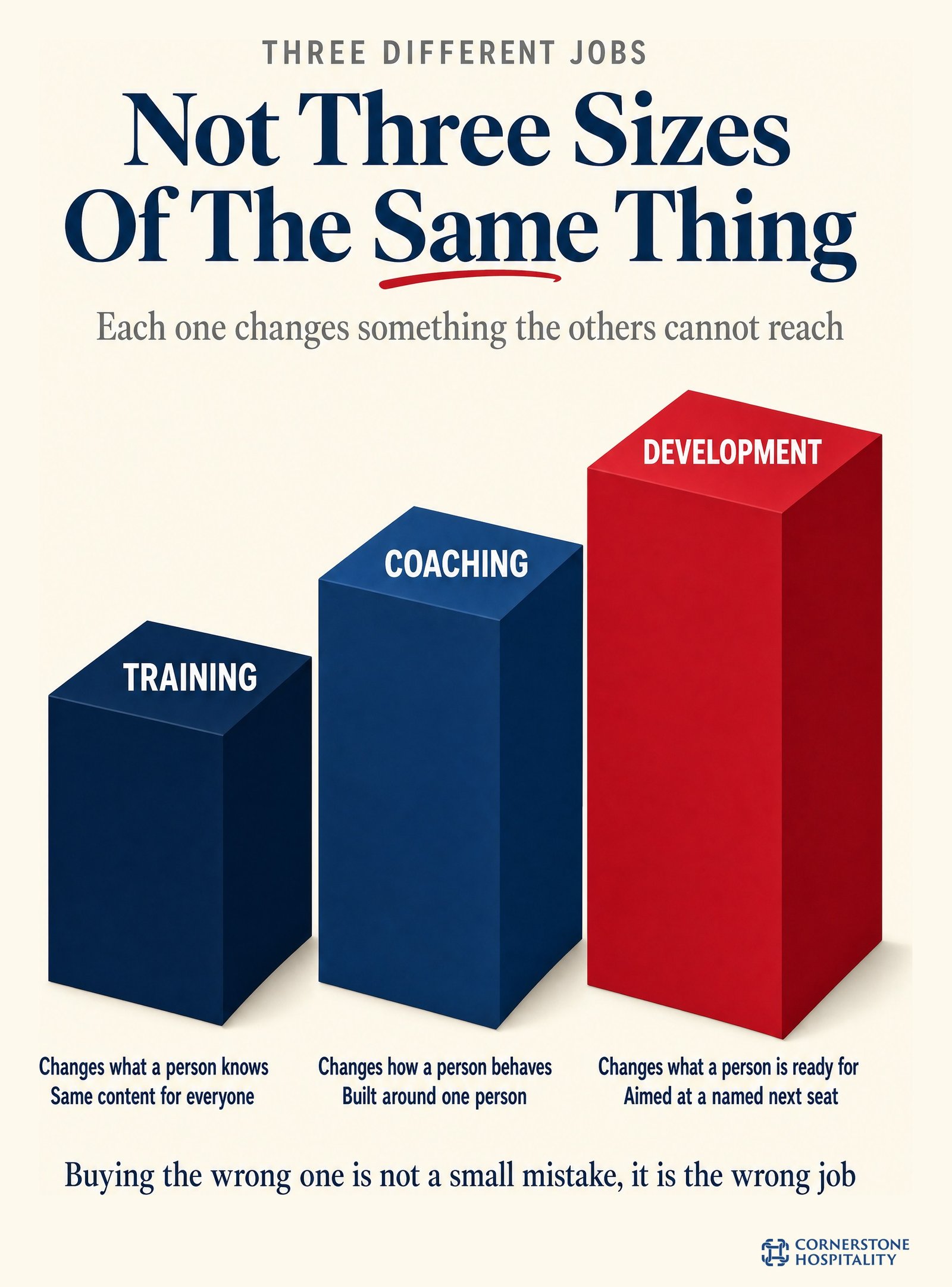
Training vs Coaching: What Each One Actually Changes
The cleanest way to hold the distinction is by what each one changes.
Training changes what a person knows. It is content delivered to a group, the same content to each of them, with a defined syllabus and a defined end. Its unit of value is transferred knowledge or method, and it is excellent at that.
Coaching changes what a person does. It is a structured relationship with one person, built around their situation, with no syllabus. Its unit of value is changed behavior under real conditions. There is no group version of it because the work addresses something specific to the individual.
Leadership development changes what a person is ready for. It is aimed at a named next seat rather than at a general improvement, and it usually contains some training, some coaching, and, critically, a real assignment.
Readiness is the unit development it is sold in
Its unit of value is readiness, tested against a role that exists.
The test that separates them
Ask what would have to be true, twelve months on, to justify the spend. If the honest answer is “they would know how to do it,” that is training. Where the answer is “They would actually be doing it,” that is coaching. If it is “they could take the bigger seat,” that is development. Three different sentences, three different purchases.
These are not tiers of seriousness. A well-run training course on revenue management is not a junior version of coaching, and coaching is not a cheap substitute for development. Treating them as a ladder is what produces the familiar pattern of a group buying progressively more expensive interventions for a constraint that the first one was already the right tool for.
There is one asymmetry worth naming, though. The three do different jobs, but they do not do them in equal proportion. Roughly 70% of leadership development comes from challenging experiences and assignments, 20% from developmental relationships, and 10% from coursework and training, a framework that emerged from more than thirty years of research into how executives actually learn [1]. So the third category, properly built, contains the largest lever. The first, on its own, contains the smallest.
Training: changing what somebody knows
Training is the most bought of the three. It does one thing extremely well, and it is worth being precise about what that one thing is before deciding whether it is what you need.
What it is genuinely good at
Transferring a defined method to several people at once, quickly and consistently. New property management system, revised food safety protocol, a change in how the group handles complaints, and a new pricing model. Everybody needs the same information; the information is not in dispute. The constraint is genuinely that people do not currently know it. Training is the correct and cheapest answer, and no amount of coaching would be a better one.
It is also the right answer for anything that has to be evidenced. Compliance, certification, and brand standard: a group needs to be able to show that a defined body of content reached a defined list of people. That is a record-keeping requirement as much as a capability one, and training suits it.
What it cannot reach
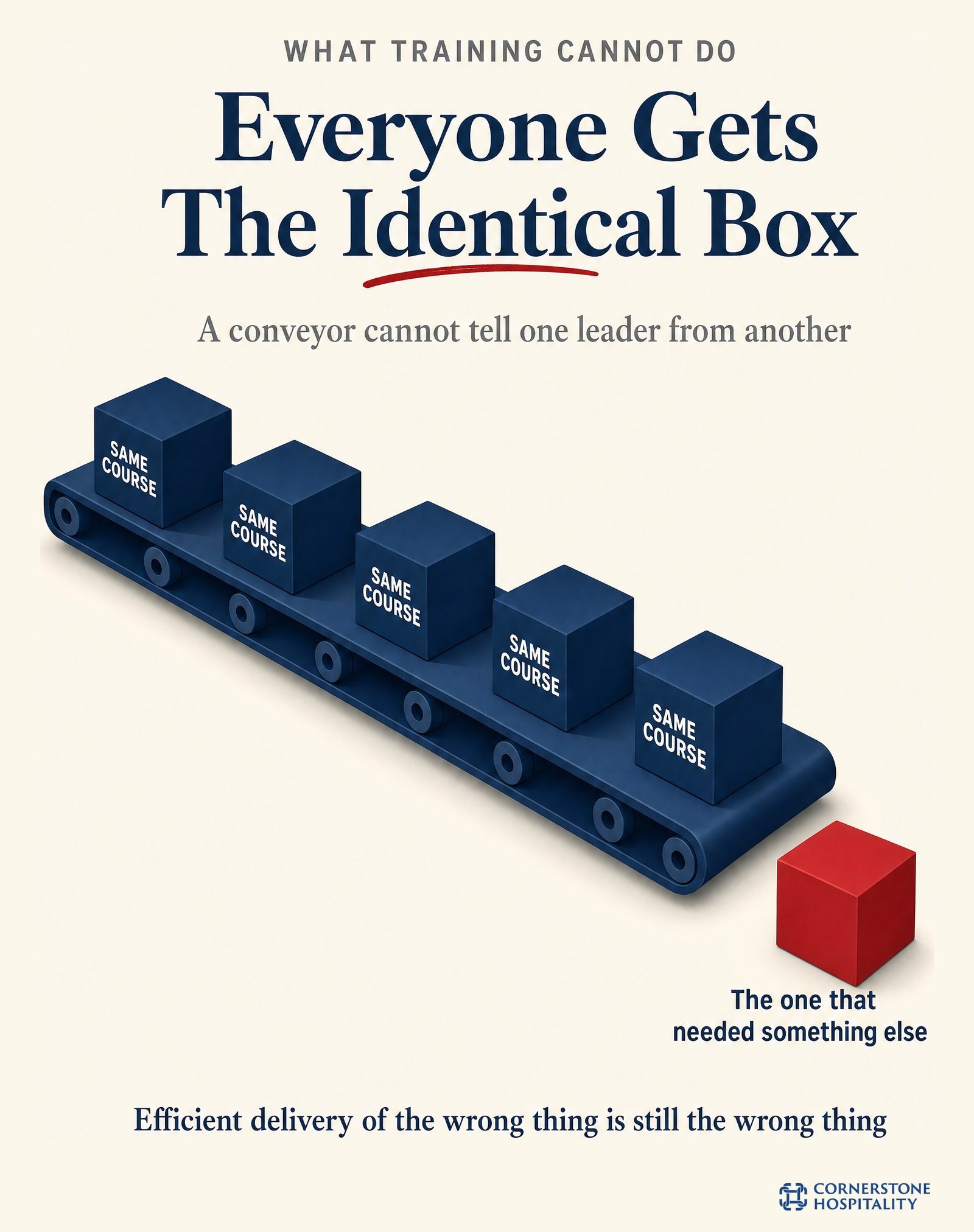
Training is efficient because everybody in the room receives the same content, which is precisely what the format sets out to do. It follows that it cannot reach a constraint specific to one person, because the format has no way of knowing who is in the room.
This matters more than it sounds, because most senior failure is not a knowledge problem. In a longitudinal study of more than 20,000 new hires across 312 organizations, 46% failed within 18 months and only 19% achieved unequivocal success, with 89% of the failures attributable to attitudinal factors and just 11% to technical skill. The leading drivers were coachability at 26%, emotional intelligence at 23%, motivation at 17%, and temperament at 15% [5]. A course aimed at what somebody knows is aimed at the 11%.
The spending pattern suggests the sector has not fully absorbed that. US training expenditure reached $102.8 billion in 2025, up 4.9%, at $874 per learner against $774 the year before, while average training received fell to 40 hours a year from 47. Management and supervisory training took 13% of the average budget [4]. Spend per head rose, time per head fell, and the leadership share stayed a small slice of a large number.
“Training is a good answer to a question about knowledge and a poor answer to almost every other question. Most of the disappointment attached to it comes from having asked it the wrong question and then blaming the answer.”
Florian Kittler, Managing Partner, Cornerstone Hospitality
Coaching: changing what somebody does
Coaching starts from the opposite premise. There is no syllabus, because the content is whatever this person is actually up against. It is one-to-one; it runs over months rather than days. Its subject is the gap between what somebody knows perfectly well and what they do when the week gets loud.
The gap it exists to close
Almost every senior leader can describe good delegation accurately. A meaningful proportion of them do not delegate, and the reason is never that the definition was unclear. It is that they are faster than the person they would delegate to, that the last time they let go it went badly, or that being the one who solves things is how they became senior in the first place. None of that is addressable by explanation. All of it is addressable by somebody credible sitting opposite them once a fortnight for six months.
That is the mechanism, and the reported returns are strong. 87% of respondents agree that executive coaching has a high return on investment, and a PricewaterhouseCoopers and Association Resource Center global survey found an average return of seven times the cost of employing a coach. Approval runs at 78% among senior executives and 73% among employees, and 72% link coaching to increased engagement [3].
A caution on that figure
Those are self-reported perceptions of value, not a controlled measurement of business outcome, and read them as such. They tell you that people who buy coaching consistently believe it worked, which is genuine evidence of something. They do not tell you it will work here, on this constraint, with this person. That still depends on the diagnosis.
Why the coach’s background matters more at the senior level
Coaching depends on the coached person accepting the premise. A general manager under real commercial pressure will extend that credit to somebody who has stood where they are standing and will withhold it from somebody working through a framework. This is not snobbery; it is a reasonable risk assessment on their part: the conversation is going to require them to be honest about something uncomfortable. They will only do that with somebody whose judgment they rate.
There is a wider trust problem underneath this too. Trust in immediate managers has fallen to 29%, a 37% decline since 2022, across a study of 10,796 leaders and 2,185 HR professionals [10]. Where a leader is less likely to speak candidly upwards, an external coaching relationship carries a conversation that is not happening anywhere else.
What coaching cannot reach
Two things, and both are worth saying out loud before an engagement starts. It cannot fix a wrong appointment: if the person is in a seat they should not be in, months of good coaching produce a better-supported version of the same mismatch. And it cannot substitute for an assignment. Behavior change that is never tested against a real, consequential situation is a conversation about behavior change.
Leadership development: changing what somebody is ready for
Of the three, leadership development is the category people use most loosely. So it is worth defining it tightly: work aimed at a named next seat, containing an assignment, with somebody accountable for whether the person got there.
Everything in that sentence is load-bearing. Without a named seat there is nothing to be ready for, and readiness becomes untestable. With no assignment, the largest available lever stays unpulled, given that 70% of development comes from challenging experiences [1]. Without an accountable sponsor, nobody notices whether it worked. The next budget round judges the program on how people felt about it.
The gap between buying a program and believing in it is worth sizing before commissioning one. 66% of companies invest in programs to identify and advance high-potential employees, while 24% of senior executives at those firms rate the programs a success, and 13% have confidence in the rising leaders at their firms, against 17% three years earlier [6]. The three components below are where that difference is usually decided.
The three components and their real proportions
| Component | Share of development [1] | What it looks like in practice |
|---|---|---|
| Challenging assignments | 70% | A real piece of work with real consequence, slightly beyond current capability, with the failure risk accepted in advance |
| Developmental relationships | 20% | A coach, a mentor, a sponsor, and a manager who has agreed to change one specific thing |
| Coursework and training | 10% | Structured content that fills a specific, named knowledge gap the assignment will require |
Those proportions are easier to state than to fund. Coursework is the visible, purchasable, schedulable part, so it is the part that gets specified first. The assignment cannot be bought, and it asks a senior person to accept a slightly worse quarterly result somewhere, so people most often discuss it and then leave it out. Putting it back is the single largest change available to most programs.
There is also a timing failure specific to this category. Most people spend 10 to 15 years in leadership positions before receiving any formal leadership training from their organization, typically arriving in their late thirties or early forties before anything at all [11]. By that point the habits the training is meant to shape have had a decade of reinforcement. Starting earlier changes the result more than spending more later does.
The assignment is the product
If a proposal for leadership development contains no assignment, it is a coaching engagement or a training program under a larger name, and it is worth pricing and judging as one. This is the most useful question to put to any provider, including us.
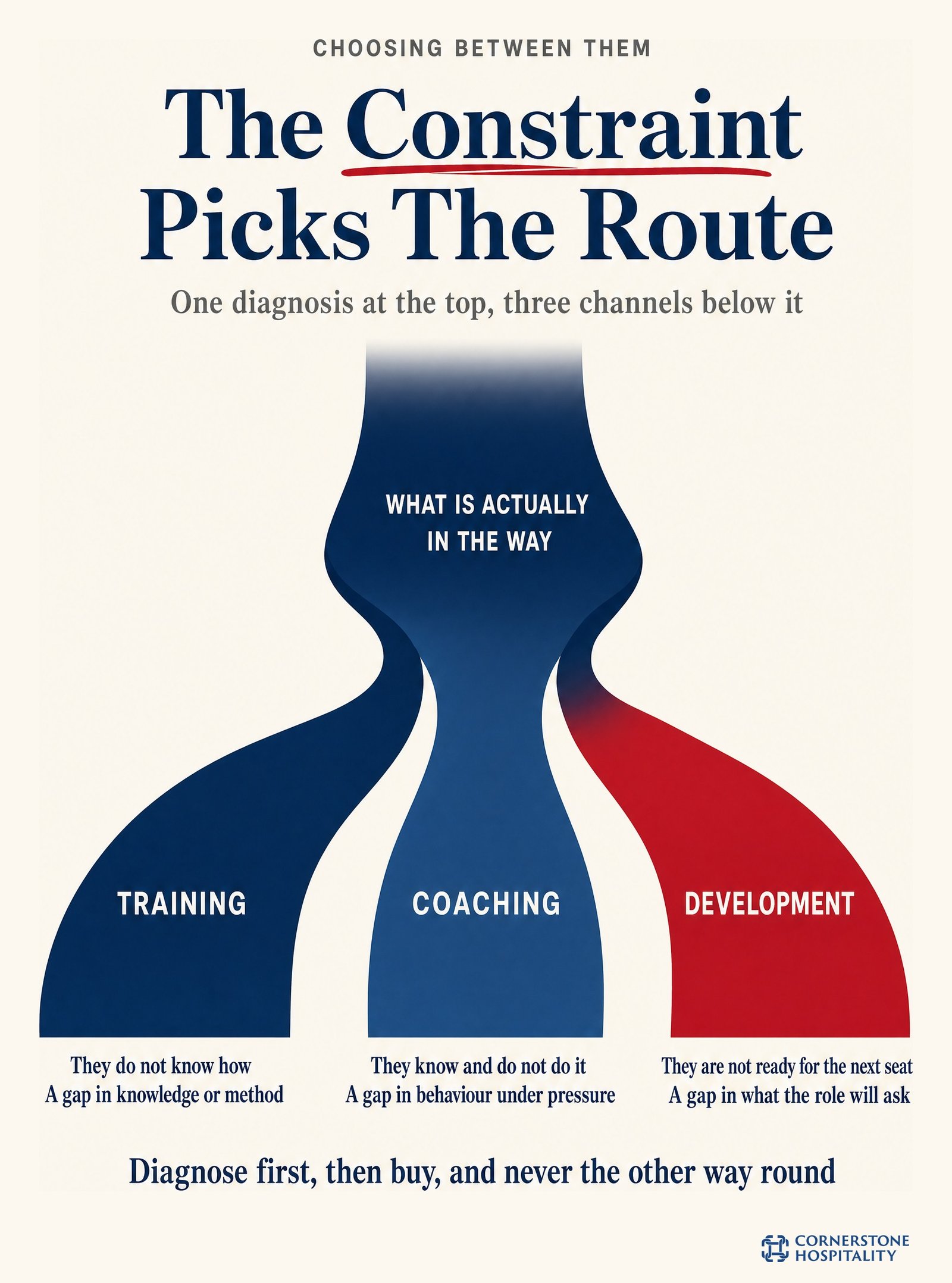
The training vs. coaching diagnosis rule, in four lines:
The decision rule is short. Name what is actually in the way, then read off the answer.
How rarely the diagnosis actually happens first
The diagnosis is worth protecting as a step of its own, because it is the easiest one to compress under time pressure. A third of L&D professionals report being proactive in identifying performance issues before recommending a solution, and a quarter design using evidence-informed principles [2]. Compress the step, and the intervention arrives before anybody has described the problem; people then judge it on whether they enjoyed it.
There is a well-evidenced way to make the diagnosis more reliable, which is to structure it. In the revised operational validity estimates from Sackett and colleagues, structured interviews emerged as the strongest predictors of job performance at .42. Ahead of job knowledge and work sample tests at .40, .38, and .33, with cognitive ability at .31 [12]. The same principle applies to a development diagnosis: a structured read from the people above, beside, and below a leader will tell you which of the three routes is right far more reliably than a conversation with the leader alone.
And the diagnosis has measurable downstream value. Promotions are 1.6X more likely to succeed when assessments inform the selection [9]. The read is not administrative overhead in front of the real work. It is the part that determines whether the real work aims at anything.
What changes for training vs. coaching in hospitality
The three categories are the same everywhere. Their relative economics are not, and hospitality changes them in four specific ways.
The payback window is shorter
Accommodation and food services recorded a monthly quit rate of 4.3% in March 2026, the highest of any industry and nearly double the private-sector average of 2.2%, with layoffs at 1.3%, meaning roughly three quarters of separations are people choosing to leave [13]. Deloitte finds 76% of hospitality workers and 80% of restaurant workers leave their job within a year [14].
That shortens the horizon over which any of the three has to repay. It does not argue for spending nothing, which is the conclusion groups usually draw. It argues for aiming earlier, at the layer where retention effects are largest, and for preferring interventions that show a result inside a year over ones that show a result inside three.
The manager layer carries disproportionate weight
Managers account for at least 70% of the variance in employee engagement scores across business units, from research covering 27 million employees and more than 2.5 million work units [7]. A study, analyzing over 2,700 individuals across 541 teams, finds team climate accounts for up to 31% of the variation in team-level engagement and that the right leadership characteristics can lift engagement scores by up to 42 percentile points [8].
In an industry losing three quarters of its people to voluntary departure, that makes heads of departments and their deputies the highest-return layer for any of the three interventions. It is also the layer that tends to sit between two funded ones. The executive committee gets development, the graduate intake gets training, and the layer in the middle receives a compliance module. Moving the budget one layer down is often the cheapest change available.
Time is genuinely, not rhetorically, scarce
More than half of hotels report being somewhat or severely understaffed, with labor costs a top concern for 65% and workforce shortages named by 42% [15]. Taking a head of department off the floor for three consecutive days is a real operational cost in a property that is short-staffed today. Programs that do not price that cost in are the ones somebody cancels six weeks after they start.
This argues strongly for the coaching and assignment routes over the cohort-training route in this sector specifically. A fortnightly hour is absorbable. A three-day offsite, repeated quarterly, frequently is not.
The alternative to developing is expensive
The comparison that matters is not training against coaching. It is any of the three against the cost of not doing it. Replacing an individual employee costs between one half and two times their annual salary, described by Gallup as a conservative estimate. 52% of voluntarily exiting employees say their manager or organization could have prevented the departure [17]. At the senior level the arithmetic is starker: external hires are paid about 18% to 20% more than comparable internal promotions and need about two years to get up to speed [16].
Set against that, 20% of HR leaders say they have leaders ready to fill their most critical roles, and internal candidates can fill 49% of critical positions immediately [9]. The premium above is what fills the seats nobody can fill internally. The choice between training, coaching, and development is a real one. The choice between doing one of them and doing none is not.
Buying training vs. coaching without wasting the money
Five rules, in order, and each applies to whichever of the three the diagnosis pointed at.
One more, which is less a rule than an observation. The provider who tells you that your diagnosis points at something they do not sell is worth more than the one who finds a way to fit their product to whatever you described. We turn down engagements on this basis regularly. It is not altruism: an engagement aimed at the wrong constraint fails visibly, and the failure attaches to whoever ran it.
Proving it worked
Each of the three has a different honest measure, and using the wrong one is why so many programs report success into a room that does not believe them.
| What you bought | The honest measure | The measure to stop using |
|---|---|---|
| Training | Whether the method is in use ninety days later, observed rather than surveyed | Completion rate and satisfaction score |
| Coaching | Whether the named behaviors changed, read from the same people who gave the baseline | Number of sessions delivered |
| Development | Whether the person took the seat and held it at twelve months | Program attendance and cohort feedback |
The third row is the only one that takes real time to answer. This is why people most often replace it with a proxy. It is also the only one that answers the question the person paying actually asked. A group that can report internal fill rate on critical seats across three rolling years can answer the question that was asked. Cohort satisfaction answers a different one.
It is worth being realistic about attribution here rather than overclaiming. None of these measures isolate the intervention from everything else happening in the business. A clean causal number is not available here, from us or from anyone else. What they do give you is a defensible read on whether the thing you were worried about got better, measured the same way at the start and the end. Most commercial decisions hold themselves to that standard.
Glossary
- Training
- Defined content delivered to a group, aimed at changing what people know. Same syllabus for everyone, with a defined end.
- Coaching
- A structured one-to-one relationship over months, aimed at changing what somebody does under real conditions. No syllabus.
- Leadership development
- Work aimed at a named next seat, containing a real assignment, with somebody accountable for whether the person got there.
- The 70-20-10 pattern
- The finding that development divides roughly into 70% challenging assignments, 20% developmental relationships, and 10% coursework [1].
- Constraint
- The single thing actually preventing the result, written in one sentence. It is what should choose the intervention, and frequently does not.
- Assignment
- A real piece of work with real consequence, slightly beyond current capability, with the risk of a worse result accepted in advance.
Frequently asked questions
What is the difference between training and coaching?
Training changes what somebody knows, and a group receives it as identical content. Coaching changes what somebody does and is built around one person over months. They address different constraints, so one is not a larger version of the other.
Is leadership development just coaching with a bigger budget?
No. Development targets a named next seat and contains a real assignment. This is where roughly 70% of the value sits [1]. Coaching is one of its components rather than a smaller edition of it.
Which one should we buy first?
Whichever the constraint points at. If people do not know how, training. When they know and do not do it, coaching. If they are not ready for a seat that is coming, development. Buying in a fixed order is how you end up purchasing the wrong one.
Does executive coaching actually deliver a return?
Reported returns are strong: 87% of respondents agree coaching has a high return on investment, and a PwC study found an average of seven times the cost of employing a coach [3]. Those are perceptions of value rather than controlled measurement, and the result still depends on the diagnosis being right.
Why does so much training seem to change nothing?
Usually because it targeted a constraint it cannot reach. In a study of more than 20,000 new hires, 89% of failures were attributable to attitudinal factors and 11% to technical skill [5]. Content addresses the 11%.
We have high turnover. Is any of this worth it?
How do we stop buying the wrong one?
Write the constraint in one sentence before contacting any provider and get a structured read from the people around the leader rather than relying on a conversation with the leader alone. Promotions are 1.6X more likely to succeed when assessments inform them [9].
Not sure which of the three you actually need?
A structured read on the constraint takes about four weeks and will tell you which one to buy. No commitment, no charge.
Sources
- Center for Creative Leadership: The 70-20-10 Rule for Leadership Development: sets out the framework that “emerged from over 30 years of our Lessons of Experience research”, in which development divides into “70% challenging experiences and assignments, 20% developmental relationships, 10% coursework and training”. CCL notes the framework is drawn from research spanning China, India, Singapore and the United States and is used across a client base including two thirds of the Fortune 1000: ccl.org/articles/leading-effectively-articles/70-20-10-rule
- CIPD: Learning and skills at work: surveys over 1,200 respondents and finds that “only a third of L&D professionals say they are proactive in identifying performance issues before recommending a solution”, with only a quarter designing learning using evidence-informed principles. It also records around a third of organizations reporting reductions in budgets, learning and development headcount and use of external consultants, only 18% expecting investment to return to pre-pandemic levels, and 72% reporting they can effectively tackle skills gaps: cipd.org/uk/knowledge/reports/learning-skills-work
- International Coaching Federation: Coaching Statistics: The ROI of Coaching in 2024: reports that “87% of survey respondents agreed that executive coaching has a high return on investment” and cites a PricewaterhouseCoopers and Association Resource Center global survey finding “an average ROI of seven times the cost of employing a coach”. It further records 72% of respondents linking coaching to increased employee engagement, with approval of coaching running at 78% among senior executives and 73% among employees: coachingfederation.org/blog/coaching-statistics-the-roi-of-coaching-in-2024
- Training magazine: 2025 Training Industry Report: records that “U.S. training expenditures jumped 4.9 percent to $102.8 billion in 2025” and that “organizations spent $874 per learner this year compared with $774 per learner in 2024”, while average training received fell to “40 hours of training per year vs. 47 hours last year”. Management and supervisory training took 13 percent of the average budget. The survey covers a weighted universe of 152,572 US companies with 100 or more employees: trainingmag.com/2025-training-industry-report
- Leadership IQ: Executive Failure Rates: reports a longitudinal study of more than 20,000 new hires across 312 organizations, evaluated by 5,247 hiring managers at 6, 12, 18 and 24 months, finding that “46% of new hires failed within 18 months; only 19% achieved unequivocal success” and that 89% of failures were attributable to attitudinal factors against 11% for technical skill. The leading drivers were coachability at 26%, emotional intelligence at 23%, motivation at 17% and temperament at 15%: leadershipiq.com/blogs/leadershipiq/executive-failure-rates
- Harvard Business Review: Turning Potential into Success: The Missing Link in Leadership Development: by Claudio Fernández-Aráoz, Andrew Roscoe and Kentaro Aramaki, reports that “66% of companies invest in programs that aim to identify high-potential employees and help them advance” while “only 24% of senior executives at those firms consider the programs to be a success”. It adds that “a mere 13% have confidence in the rising leaders at their firms, down from an already-low 17% just three years ago”, and that at the world’s largest corporations “a full 30% of new CEOs are hired from the outside”: hbr.org/2017/11/turning-potential-into-success-the-missing-link-in-leadership-development
- Gallup: Managers Account for 70% of Variance in Employee Engagement: states that “managers account for at least 70% of the variance in employee engagement scores across business units”, drawn from research measuring the engagement of 27 million employees and more than 2.5 million work units over two decades. It also finds about one in 10 people possess high talent to manage, that companies “miss the mark on high managerial talent in 82% of their hiring decisions”, and that talented managers contribute about 48% higher profit than average managers: news.gallup.com/businessjournal/182792/managers-account-variance-employee-engagement
- Korn Ferry Institute: Stronger Leadership, Stronger Climate, Better Results: analyzes “data from over 2,700 individuals across 541 teams” and finds that “team climate accounted for up to 31% of the variation in team-level engagement”. It reports that the right leadership characteristics and team environment “can lift engagement scores by up to 42 percentile points”, and that leaders scoring high on Presence, Agility and Striving produced team climates “approximately 30 percentile points stronger” than lower-scoring leaders: kornferry.com/institute/stronger-leadership-stronger-climate-better-results
- DDI: Succession Planning Best Practices: How to Close the Leadership Readiness Gap: reports that “only 20% of HR leaders say they have leaders ready to fill their most critical roles” and that “80% of organizations lack confidence in their leadership bench”, while “75% of organizations prioritize internal promotion over external hiring” and internal candidates “can fill only 49% of critical positions immediately”. It also finds promotions are 1.6X more likely to succeed when assessments inform selection, and organizations with strong benches are 2.9X more likely to fill leadership roles internally and 2.8X more likely to outperform financially: ddi.com/blog/succession-planning-best-practices
- DDI: Global Leadership Forecast 2025 Study Signals Looming Leadership Exodus: surveys 10,796 leaders and 2,185 HR professionals across more than 50 countries and 24 industry sectors, reporting 71% of leaders with increased stress, 40% of stressed leaders considering leaving leadership altogether, and trust in immediate managers at “just 29%, a 37% decline since 2022”. It also records high-potential intention to depart rising “from 13% in 2020 to 21% in 2024”, with high-potential talent 3.7X more likely to leave within a year where the manager does not provide regular growth opportunities: ddi.com/about/media/global-leadership-forecast-2025
- The Future Organization, interview with Michael Watkins: The First 90 Days: Strategies for Leaders in Transition: records Watkins stating that “unaided the process for leaders to reach the breakeven point can take up to six months”, the breakeven point being where a leader contributes as much value as they have consumed. He also observes that “most people spend 10 to 15 years in leadership positions before getting any formal leadership training from their organization”, with the average leader in their late thirties or early forties before any training at all: thefutureorganization.com/the-first-90-days-strategies-for-leaders-in-transition
- Society for Industrial and Organizational Psychology: Is Cognitive Ability the Best Predictor of Job Performance? New Research Says It’s Time to Think Again: reports the revised operational validity estimates from Sackett and colleagues, in which “structured interviews emerged as the strongest predictors of job performance” with a mean operational validity of .42, job knowledge and work sample tests follow at .40, .38 and .33, and “cognitive ability rounded out this list with a validity estimate of .31”. The article explains that earlier meta-analytic corrections had systematically inflated these figures: siop.org/tip-article/is-cognitive-ability-the-best-predictor-of-job-performance
- OysterLink analysis of US Bureau of Labor Statistics JOLTS data: Hospitality Workers Quit at a Higher Rate Than Any Other Industry in the U.S.: establishes that “the quit rate for accommodation and food services reached 4.3% in March 2026, the highest among all industries” and “nearly double the private-sector average of 2.2%”. Retail trade, the next highest sector, recorded 3.1%, against healthcare at 1.9%, manufacturing at 1.4% and finance at 1.2%. Layoffs in the sector held at 1.3%, matching the national average, so roughly three-quarters of separations are people choosing to leave: prnewswire.com/news-releases/hospitality-workers-quit-at-a-higher-rate-than-any-other-industry-in-the-us
- Deloitte: Frontline Workforce Trends in Airlines, Hospitality, and Restaurants: reports that “80% of restaurant workers and 76% of hospitality workers leave their job within a year”, and that “66% of executives and managers say most recent hires were not fully prepared, and that lack of experience was the most common failing”. It also finds 82% of workers naming feeling happy and engaged at work as the key driver of productivity, and 75% hoping for greater stability in the face of change: deloitte.com/us/en/Industries/consumer/articles/frontline-workforce-human-capital-trends
- American Hotel & Lodging Association: Rising Cost, Staffing Challenges Persist for Hotels as Travel Demand Expected to Hold Steady: surveys 246 hoteliers in late February 2026 and finds that “more than half of respondents report their properties are somewhat or severely understaffed”, with labor costs a top concern for 65% and workforce shortages named by 42%. Retention incentives in use include higher wages at 70%, flexible scheduling at 54%, hotel discounts at 54% and enhanced benefits at 31%: ahla.com/news/rising-cost-staffing-challenges-persist-hotels
- Knowledge at Wharton: Why External Hires Get Paid More, and Perform Worse, than Internal Staff: reports Matthew Bidwell’s study “Paying More to Get Less: The Effects of External Hiring versus Internal Mobility”, published in Administrative Science Quarterly and drawn from personnel data in a US investment banking division from 2003 to 2009. External hires are paid “about 18% to 20% more” than comparable internal promotions and need “about two years to get up to speed”, and hiring managers confirm they “typically pay 10% or 20% more to pull people out of positions” where they already have security: knowledge.wharton.upenn.edu/article/why-external-hires-get-paid-more-and-perform-worse-than-internal-staff
- Gallup: This Fixable Problem Costs U.S. Businesses $1 Trillion: establishes that “the cost of replacing an individual employee can range from one-half to two times the employee’s annual salary” and describes that as “a conservative estimate”. It also reports that 52% of voluntarily exiting employees say their manager or organization could have prevented their departure, and 51% say that in the three months before leaving, neither their manager nor any other leader spoke with them about job satisfaction or their future: gallup.com/workplace/247391/fixable-problem-costs-businesses-trillion
About the author
Florian leads Cornerstone International Group’s global Hospitality, Travel & Leisure Practice. He brings seventeen years of senior hospitality experience, including Marriott, Hyatt, IHG, Mandarin Oriental, and Shangri-La Hotels & Resorts, and sixteen years in retained executive search. He is bilingual in English and German and works across Europe, the Middle East, the Americas, and Asia-Pacific.