


Reinvent Yourself Between Roles: A Playbook for Hospitality Professionals
You have spent your career reading a room, fixing what broke in real time and making strangers feel taken care of under pressure. The next economy is short on exactly that skill set, and this playbook shows you how to reinvent yourself between roles without starting over.


Hospitality trains people to perform those skills and move on to the next guest. Yet it rarely trains them to describe the skills in a way a hiring manager from another industry recognizes. This article gives you the same structured translation a career coach would walk through with you: a skills translator, a two minute diagnostic, a decision framework for staying or pivoting, a fourteen day launch plan and a map of where hospitality talent is being hired right now.
In this article
A career is a practice, not a single job
For most of the past century, staying at one company for decades was the norm, because organizations were built to survive long enough for loyalty to pay off. Downsizing, restructuring, acquisitions and, for hospitality in particular, demand shocks no property could have hedged against have made job change something almost every professional faces at least once. You are in good company, because everyone arrives at this point a little earlier or a little later than the rest.
Career resilience is also a practice: knowing your skills, knowing the market and staying within one step of both. The years you spent de-escalating an angry guest, rebuilding a broken schedule an hour before doors opened and hitting a revenue target while smiling the whole time rarely show up on a resume line. All of it still counts, because it is what the next role needs. The ability to reinvent yourself between roles is that practice in action.
The skills you already have
Running a property means holding people, operations and revenue in one hand at the same time, under real time pressure, while having no script and no rehearsal. Every one of those responsibilities also has a name in another industry. So the table below gives you the translation.
The same job, through a different door
Before: General Manager of a 240-room hotel.
After: Held full profit and loss accountability for a 240-room operation, leading a department head team of nine, owning pricing and occupancy decisions daily, and carrying the property through a refurbishment without closing a floor.
The two minute diagnostic to reinvent yourself between roles
Before you touch your resume, find out where you are starting from and how ready you are to reinvent yourself between roles. Score yourself honestly on each line, because the result is a map of where to spend your first week.
- I have two or more months of essential expenses covered
- I know my exact monthly survival number
- I have told three or more trusted people I am looking, selectively
- I have a daily rhythm, even without a job
- I have separated who I vent to from who I network with
- I can explain my departure in one calm sentence
- I have a resume that is more than a duty list
- I know three industries where my skills translate
- I know five people who could open a door for me
- I have a system for tracking who I have contacted
Reading your score
- Eight to ten checked: you are ready to run a focused campaign.
- Five to seven checked: spend three or four days closing the gaps before you apply anywhere.
- Under five: start with your financial and emotional footing. A search built on a steady foundation moves faster.
So one thing to do right now: write down three things from your last role that you are genuinely proud of, in plain language.
Stay in hospitality or pivot out
This decision shapes everything after it, yet there is no wrong answer, only an honest one. A job used to be a way to earn a living. Today fit and sustainability matter as well as pay, so you are allowed to weigh both.
You still find satisfaction in hospitality, or in service and operations work broadly, and you want to move up or sideways within it: a bigger property, a corporate role, a different brand. This is the faster path, because you are marketing well proven skills to a market that already understands them. Your campaign leans on your network of former colleagues, vendors and general managers, industry specific job boards and recruiters who specialize in hospitality and service.
The work itself, the hours, the physical toll or the ceiling is what you are ready to leave, even if you loved parts of it. This path takes longer up front, because it starts with exploration rather than applications: informational interviews, research into target industries and, possibly, a skills gap to close. Your campaign leans on the translation table above, conversations with people already in your target field and a resume rebuilt around outcomes rather than duties.
Set the question of education and titles aside for now. First find out whether the work itself pulls you, since you can address credentials once you know the move is worth making. To get started, list three reasons you are leaning toward continuation, or toward change.
Your first fourteen days to reinvent yourself between roles
The first fourteen days are also the quietest and the most consequential of the transition. The plan below has five stages that help you reinvent yourself between roles, each with a fixed window and one defined output, so the next stage can begin cleanly.
- 1Days 1 to 2Calm the narrative. Tell only the people who need to know, and give each of them the same three sentences. The first forty-eight hours are when most reputational damage is done, and the remedy is restraint.
- 2Days 3 to 5Build the narrative. Write the three sentences you will repeat for the next ninety days: what you did, why the role ended and what you are looking for next. Keep each under twenty words, memorize them and use them consistently.
- 3Days 6 to 8Audit your assets. Refresh your resume, align your LinkedIn profile, pre-warm your references and draw your network map. Many leaders skip this week, yet it pays back the most in months three and four.
- 4Days 9 to 11Activate five conversations. Choose five trusted senior contacts and give each one clear ask. Stay surgical rather than broadcast, because the conversations that change a trajectory are almost always with people you already know.
- 5Days 12 to 14Become visible. Publish one piece of thinking and attend one industry event. By day fourteen you are also visibly in motion and available.
The three sentences, worked
“I ran a large city property through the post-pandemic rebuild and took it back to its pre-2020 margin. The role ended when the group restructured and the position was eliminated. I am now looking for an operations or general management seat where that rebuild experience is the point.”
Be positive, get organized and get ready to work hard for yourself the way you worked hard for every shift, because for a few weeks that is exactly the job. For the full stage by stage detail, read The First 14 Days After a Senior Hospitality Exit.
The four paths back to work
Every job search runs through one of four channels. Because hospitality careers are built on relationships more than almost any other field, one of these four should be taking most of your hours.
A referral into a target company, through someone who already trusts your work. Highest yield, lowest volume.
Responding to published openings. Necessary, and the busiest channel, so make it one of several.
Especially those who specialize in hospitality, customer experience or operations placement. Let them work roles in parallel with you.
Contacting target companies before a role is posted. Especially effective if you are pivoting industries.
Why networking works differently for you
Every guest you ever impressed, every vendor representative who admired how you ran a floor and every regional manager who saw your numbers belongs to a live network most job seekers do not have. In practice, the people who watched you perform under pressure are your strongest references for the exact qualities a new industry cannot easily verify from a resume.
Where hospitality talent is being recruited right now
- Revenue management, pricing and capacity planning in travel, airline and retail
- Program and event delivery, and experiential marketing
- Key account and client relationship direction, and private client services
- Risk, business continuity and multi site operations leadership
- People and culture leadership, and workforce engagement
- Transformation and change program management
- Customer experience leadership, quality assurance and escalations
- Brand, communications and reputation management
What structured support looks like at senior level
Everything above you can still run yourself. At senior level many leaders also choose support, for a simple reason: the window is short, the network is small and the first ninety days after an exit set the story that follows you for years.
of leaders with structured transition support land a next role equal to or better than the one they left.
was the average time to secure a new role after a 2024 layoff, while senior timelines typically run longer.
of structured support is how a Cornerstone Hospitality engagement runs, longer if the market is thin.
The figures draw on outplacement data from Right Management, LHH and Korn Ferry, and the 2024 average from Executive Outplacement Services. All are cited in full in our article on executive outplacement for senior hospitality exits.
The three layers, run together
- Emotional. Confidence re-anchored, momentum re-mobilized, the story re-authored in your own words.
- Strategic. Where the next role actually sits: the CV, the LinkedIn profile, the board biography and an honest read of the market.
- Market. Warm introductions, interview preparation and support through offer negotiation.
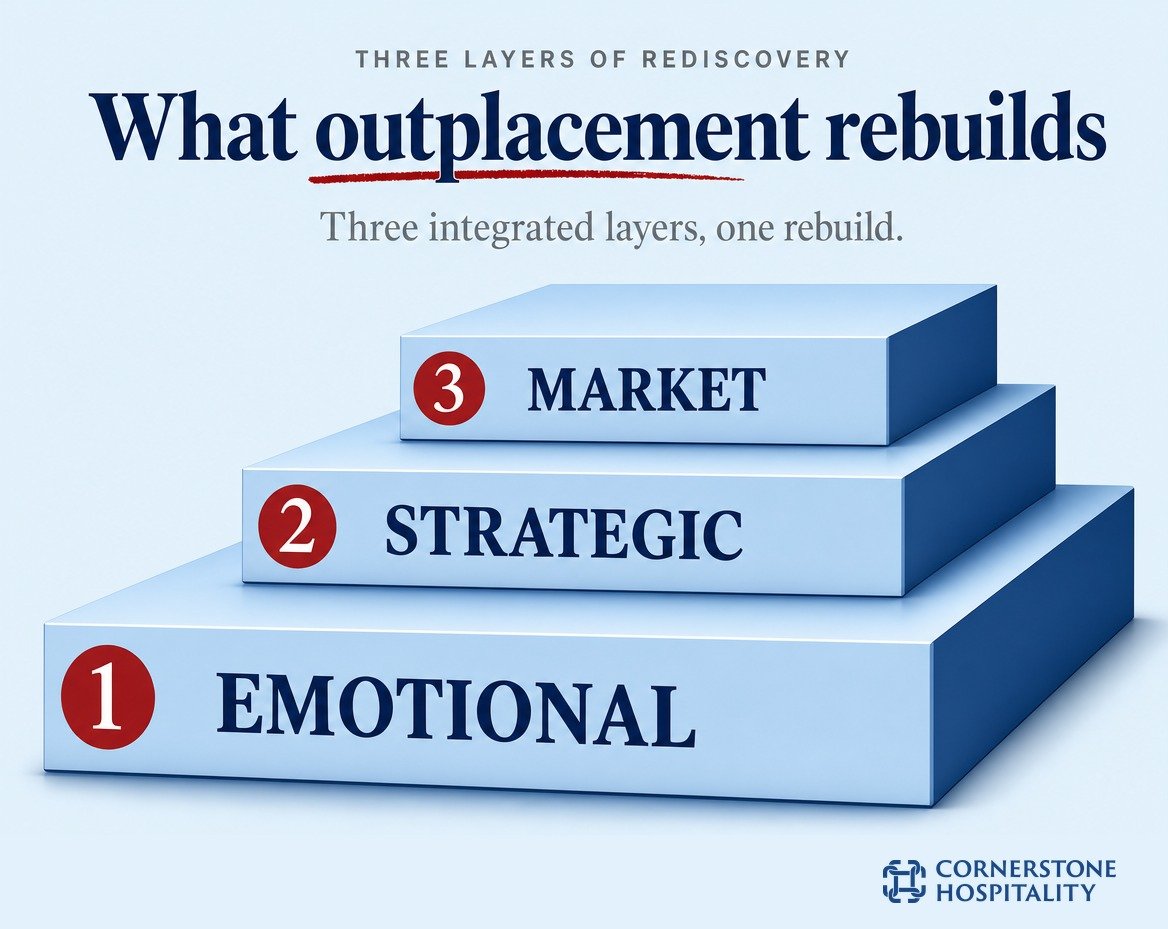
Cornerstone Hospitality runs all three layers together, so you can reinvent yourself between roles at pace. We sit on both sides of this conversation every week: we run retained searches for hotel groups, restaurant portfolios and travel businesses, and we coach the leaders moving between them. That also shows us what a hiring committee responds to and what a strong candidate looks like six weeks after a difficult exit.
If your exit is at director, vice president or C-suite level, the mechanics change. Our article on executive outplacement sets out the twelve week program, the six work streams and the five things to ask any firm before you commit.
Frequently asked questions
What does it take to reinvent yourself between roles?
To reinvent yourself between roles, you start by translating what you already do into the language of the next employer, then choose between continuing in hospitality and changing industry, and then run a focused search through the channels that fit that choice. The deck behind this article also lays that out as a diagnostic, a fourteen day launch plan and a decision framework.
How long does it take to find a new role after a layoff?
The average time to secure a new role after a 2024 layoff was 20.6 weeks, while senior timelines typically run longer. The figure comes from outplacement data summarized in our article on executive outplacement.
Should I stay in hospitality or move to another industry?
Both are sound answers. Career continuation suits you if the work still satisfies you and you want a bigger property, a corporate role or a different brand. Career change suits you if the work itself, the hours, the physical toll or the ceiling is what you are ready to leave. Start with exploration, then address credentials once you know the move is worth making.
Which industries hire hospitality professionals right now?
Revenue management and pricing in travel, airline and retail; program and event delivery; key account and private client services; risk and business continuity; people and culture leadership; transformation and change management; customer experience leadership; and brand, communications and reputation management.
What should I do in the first two weeks after leaving a role?
Work through five stages: calm the narrative in days 1 to 2, write your three sentences in days 3 to 5, audit your assets in days 6 to 8, activate five conversations in days 9 to 11, and become visible in days 12 to 14. Our article on the first fourteen days sets out each stage in detail.
What does structured support look like at senior level?
It runs three layers together: emotional, strategic and market. A Cornerstone Hospitality engagement typically runs twelve weeks, longer if the market is thin.
Start with a conversation, not a CV. Our AI assistant asks seven questions, takes six to eight minutes and sends a personalized read on your next move straight to your inbox.