


Three Patterns a Hospitality Executive Career Transition Takes
Three career transition patterns account for nearly every senior move in hospitality. Each one carries its own timeline, its own risks, and its own way of protecting what a leader has built.


Career transition patterns among senior hospitality executives fall into one of three recognizable shapes. Knowing which one is in front of a leader changes what the next few months should look like.
A move planned well in advance behaves differently from a move forced by a restructuring. Both behave differently again from a shift in the kind of job itself. That shift might be a change from running a property to running a function, or the reverse.
Why career transition patterns raise the stakes for leaders
The stakes in getting this right are not small. Roughly 40% of executives fail in a new role within eighteen months of starting it. That failure costs the hiring organization about $2.7 million on average. That counts search fees, severance, and lost momentum [1]. Meanwhile, trust in immediate managers has fallen to 29%, a 37% decline since 2022 across a global leadership study [2].
As a result, every transition now happens in a wary climate. The people watching a new leader arrive already tend to wait and see. Reading career transition patterns correctly is one of the clearest ways to change those odds. Preparing for what each pattern asks of a leader helps too.
This is a practical guide to the three career transition patterns. For each one, it covers what triggers it, the realistic timeline, the specific risk, and what tends to help.
Key insight
Why the pattern matters more than the move itself
Most advice about changing senior roles treats every transition the same way: update the story, sharpen the pitch, start networking. That advice misses the part that determines how the next few months go. A planned move, a forced exit, and a change in the kind of job are three distinct career transition patterns. Each one runs on its own clock.
A leader who treats a restructure-driven exit like a leisurely lateral search loses time they do not have. Likewise, a leader who treats a corporate move like a straightforward step up underestimates the job. It rewards a different skill set entirely. The pattern sets the plan. Naming it accurately, before reacting to it, is the first decision that matters.
“The pattern sets the plan. Naming it accurately, before reacting to it, is the first decision that matters.”
Treating a planned move, a forced exit and an identity shift as the same kind of event is the most common mistake in how executives approach a transition. The pattern decides the timeline, the risk and what kind of support actually helps, so naming it correctly comes before any other step.

Key insight
Pattern one: the planned lateral or upward move
When most people hear “career move,” this is the pattern they picture. Someone approaches a general manager at a branded urban property about a larger portfolio. A regional director quietly puts the word out that a bigger remit would interest them. The current role is stable, and nothing forced the decision. That leaves the executive in control of the timing from the first conversation to the last.
The current market shows how active this pattern is at the top of the industry right now. The second quarter of 2026 alone brought a run of senior moves. A former Playa Hotels chief operating officer became chief executive of Driftwood Hospitality Management. A former Wyndham executive became president of a major midscale brand group.
Hyatt named a new head of the Americas. Other leadership moves followed across major hotel companies [3]. None of those were emergency appointments. They were the visible result of relationships and reputations built over years, surfacing at the moment the right seat opened.
The cadence of a planned move among career transition patterns
The typical cadence behind this pattern is worth knowing. It sets expectations for how long it is reasonable to wait for the right opportunity. Hotel managers serve in a general manager role for close to six years on average before advancing [4].
As a result, the planned lateral or upward move is usually not an annual event. It is a decision made a few times across a career. Each one is worth doing properly rather than quickly.
The mechanics of this pattern are worth naming plainly. They are what make it fast when a leader runs it well. Hospitality is a small world at the senior level. The same owners, the same brand leadership, and the same handful of regional networks show up on every shortlist.
A leader exploring a lateral or upward move is rarely a stranger to the hiring side. As a result, the search usually moves through a short list of trusted introductions rather than an open posting. That is also why it needs more discretion than an open search, not less. The smaller the world, the faster a careless conversation travels back to the wrong desk.
Weighing a lateral or upward move right now? Talk to us about keeping the search discreet from the first conversation.
The risk: confidentiality slipping, and the counteroffer that follows
The main risk in this pattern is not finding the next role. It is the current one. A leader who is still employed and exploring quietly has the most leverage of the three career transition patterns. That leader also has the most to lose if the quiet search becomes visible before both sides agree on terms.
Word travels fast inside hospitality’s tight regional networks. An owner or a board that learns of a search secondhand tends to react to the discovery, not the departure.
The other version of the same risk shows up at the finish line rather than the start. A counteroffer from the current employer, arriving once a resignation is on the table, can feel like validation.
It rarely changes the underlying reasons the leader began looking in the first place. In addition, the working relationship afterward carries a different weight. Both sides now know the leader tested the door.
A planned move is the safest of the three career transition patterns on paper, because nothing forces the timeline. That safety only holds if the search stays discreet until both sides agree on terms. This is exactly the part a leader cannot manage alone from inside a current role.
Key insight
Pattern two: the restructure-driven exit and re-entry
This second of the career transition patterns starts somewhere else entirely. A management contract changes hands, a brand consolidates a function, or an ownership group restructures its executive team. A secure role a month earlier no longer exists. The decision to leave was never the executive’s to make. That changes almost everything about how to run the search that follows.
Recent public examples of restructure-driven exits
Hospitality is not short of recent, public examples of exactly this. In January 2025, a hotel real estate investment trust eliminated its chief operating officer position. The move was part of a restructuring of its executive team. Other senior leaders absorbed the COO’s responsibilities.
A negotiated exit included severance, accelerated equity, and extended health coverage [5]. That same year, a major hotel franchisor approved a restructuring plan that streamlined its marketing, reservation, and loyalty functions. The plan carried costs tied to 156 affected roles. It included the closure of a call center that alone touched 69 positions [6].
The world’s largest third-party hotel management company reached a 2025 restructuring agreement. It converted more than a billion dollars of debt to equity. The company also lost close to a quarter of its managed properties in the process [7].
Every one of those events put senior people back on the market at the same time. It happened through no decision of their own.
How restructure-driven career transition patterns recover
That scale matters for how an executive should read their own place among career transition patterns. A restructuring is a business decision made several levels above any one leader’s performance, not a verdict on it. The evidence on outplacement support backs this up directly. The average duration of unemployment without structured support runs close to 19 weeks.
With structured support, it runs closer to 12 weeks. Nearly 93% of people who use structured outplacement land an equivalent or better role than the one they left [8]. The pattern is recoverable and quickly. What works is treating it as its own search, not a rushed copy of the planned move above.
The risk: financial pressure and a gap nobody explains for you
The real risk in this pattern is that speed works against the leader rather than for them. Severance has a clock on it. The pressure is highest in the weeks right after an exit the leader did not choose. In that window, the pull is to accept the first credible offer, rather than the right one.
Stopping the clock with a role a level down, or in a weaker property, is difficult to reverse later. This is because the next search then has to explain both the exit and the step down.
The second part of the risk is the employment gap itself, or the fear of one. Hospitality’s staffing pressure has been intense. Turnover in the industry runs at roughly 70% annually. Monthly quit rates in accommodation and food services have sat well above the broader private sector [9].
That backdrop of constant movement at the frontline level can make a senior leader wary. They may assume a gap on their own record will read as a red flag. In a market moving this much, a clearly explained restructuring reads as exactly what it is. It is a business event, not a personal one.
What to do
Treat the first few weeks after a restructuring as the moment to slow down, not speed up. A short, structured search starts from the full career rather than the exit. It almost always lands better than a fast one that starts from anxiety.
How career transition patterns meet the hospitality calendar
There is also a practical timing question worth naming, because hospitality runs on a calendar that most industries do not. A property moving through peak season cannot absorb a leadership change the way an office-based business can. Both sides of a restructure-driven search usually know it. Waiting for the right point in the calendar, rather than the first available opening, often makes the difference. On one side is a hire who gets a fair runway. On the other is a hire who starts under immediate operational pressure, with no time to read the business first.
A restructure-driven exit is the pattern most likely to get rushed, and rushing is exactly what turns a strong career into a step down. Reading the situation as a business event rather than a personal one, and giving the search the same care as a planned move, is what protects the outcome.
Key insight
Pattern three: the property to corporate identity shift
The third of the career transition patterns is different in kind, not just in direction. A general manager moving into a regional or corporate role is not just changing address. The same is true of a corporate leader moving back onto a property. Both are changing what the job actually rewards.
Running a property well rewards visibility, speed, and knowing every guest touchpoint personally. A corporate seat rewards influence without direct authority and comfort with a longer decision cycle. It also rewards results that show up through other people’s work rather than your own.
This shift is large enough to deserve its own close look. We have written about it in detail elsewhere. It covers exactly what changes when a leader crosses that line and how to prepare for it.
This piece stays at the level of the career transition patterns themselves. It covers what triggers this one and how long it realistically takes to settle. Beyond that, it covers the specific risk it carries that the other two patterns do not.
How the six-year cadence shapes the identity shift
The cadence data on hospitality careers is a useful anchor here too. General managers typically spend close to six years in a property role before their next move [4]. So a corporate step is often a leader’s first genuinely different kind of role in a decade or more.
The instincts that made them excellent on property do not automatically transfer. Leaders who move well treat that as a fact to plan around. They do not treat it as a compliment to their record that should carry them through unaided.
The audience a leader is answerable to changes as much as the day-to-day work does. On property, the daily feedback loop is guests and staff, immediate and visible. In a corporate or regional seat, the feedback loop runs through owners, multiple general managers, and a board. Those managers each have their own priorities.
The board reads results in a quarterly cycle rather than a nightly one. A leader who was excellent at reading a room of guests and colleagues needs a new instinct. That instinct is for reading a room of peers and principals. It takes longer to develop than the paperwork of the move itself.
The risk: underestimating how different the job is, not just the title
The specific risk in this pattern is assuming the new role is a bigger version of the old one. It is not. Picture a property general manager who moves into a regional operations seat. Suppose they keep making decisions the way they always have: fast, personally, and visibly. A corporate team tends to read that style as micromanagement rather than leadership.
The reverse move carries its own version of the same risk. A property environment needs same-day decisions. A corporate leader who returns and keeps operating at strategy pace loses the room just as fast.
The timeline for this pattern sits in the middle of the three career transition patterns. The placement itself, getting the offer signed, is often the least difficult part.
What takes longer is the first year in the new kind of job. That year determines whether the move actually holds. This is why a structured plan for that year matters as much as the search that got the leader there.
An identity shift succeeds or fails on what happens after the offer, not during the search. Naming the pattern early makes room to plan for that first year properly. Without that, a leader discovers the gap in month three.
Key insight
Comparing the three patterns side by side
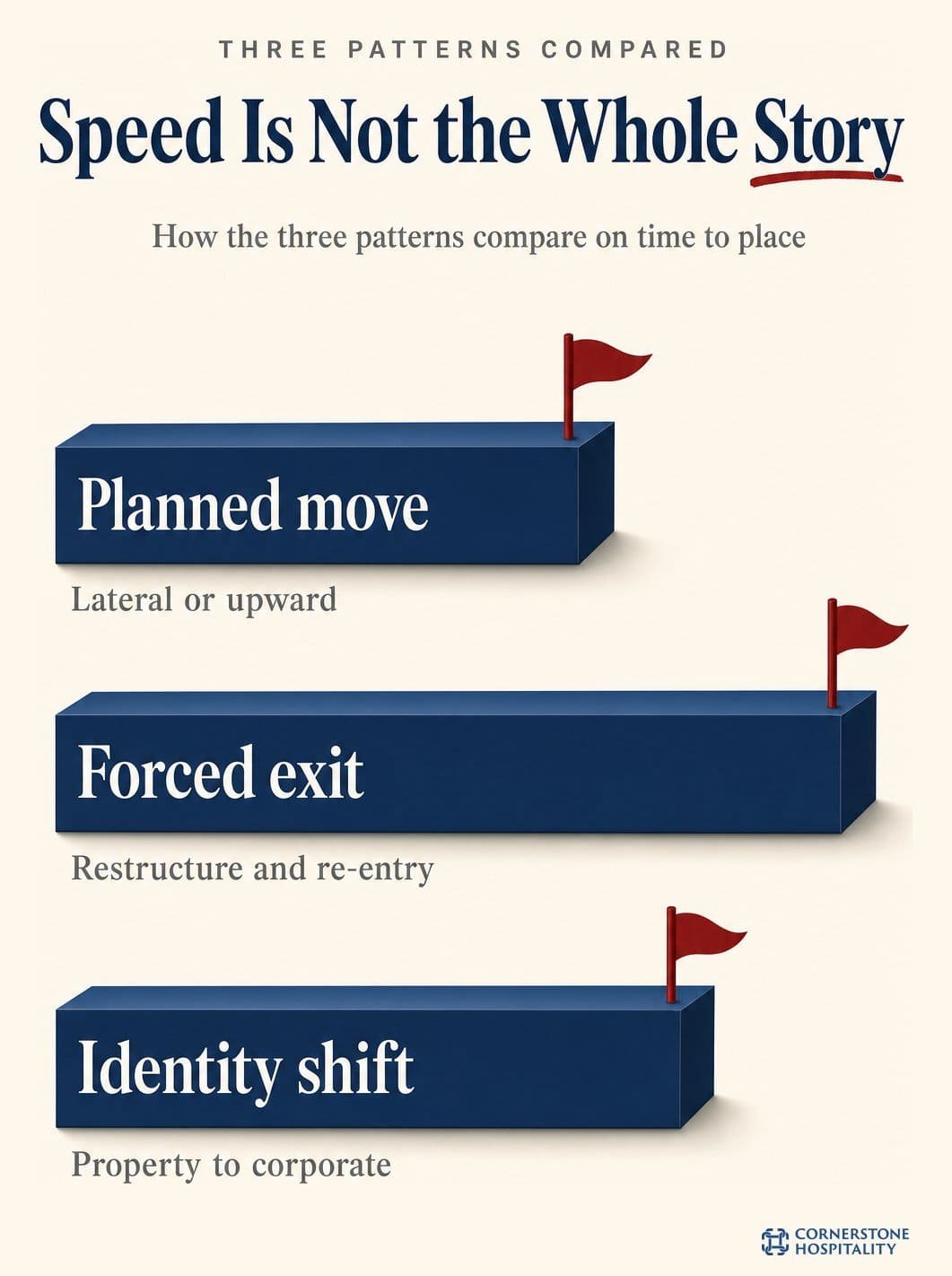
Put next to each other, the three career transition patterns trade speed for stability in different ways. The table below is a starting point for placing a real situation. It is not a substitute for a conversation about the specifics of it.
| Pattern | Typical timeline | Main risk | What helps |
|---|---|---|---|
| Planned lateral or upward move | Usually the fastest of the three once real conversations start | Confidentiality slipping early, or a late counteroffer reopening a decision already made | A discreet, retained search that keeps the current role stable until terms are settled |
| Restructure-driven exit and re-entry | The slowest on average, and the most sensitive to how the first weeks are handled | Financial pressure pushing toward the first offer rather than the right one | Structured support in the first weeks, and a search built from the full career, not just the exit |
| Property to corporate identity shift | Moderate to place, the first year decides whether it actually holds | Underestimating how different the job is, not just the title | Structured assessment before the move, and a deliberate plan for the first year |
None of the three patterns is inherently safer than the others once the right support is in place. The table is a starting point for naming which pattern is actually in front of a leader, not a verdict on how the situation will end.
Key insight
What changes the outcome inside any pattern
The three career transition patterns are different. Yet the thing that improves the odds inside each one is close to the same. It is having someone outside the situation who has run this exact process many times. Most executives run it only one or two times across a whole career.
For the planned move, that means a discreet search. The current employer then learns about the decision on the leader’s terms, not by accident.
For the restructure-driven exit, it means structured support in the first weeks. That support slows the leader down enough to search properly instead of anxiously. At exactly this point, the data shows that support shortens the overall timeline rather than lengthening it [8].
For the identity shift, it means a structured read of the gap between the old role and the new one. That read comes before the move. It also means a first-year plan that treats settling in as seriously as the search that got there.
How Cornerstone supports all three career transition patterns
This is the work Cornerstone does every day across all three career transition patterns. First, retained search serves hospitality leaders who are ready to move. Next, transition support helps leaders navigating an exit they did not choose. Finally, executive assessment and coaching help leaders stepping into a genuinely different kind of role.
“Florian played a pivotal role in my career transition within the hospitality industry, combining deep expertise in executive search with a highly strategic advisory approach. Unlike traditional recruiters, he takes the time to truly understand your long-term ambitions, challenges your assumptions, and positions you for sustainable leadership success.”
Stefan Savic
Hospitality Executive, LinkedIn Recommendation
“Over the years I have worked with Florian and he has continually provided a service second to none. The caliber of individuals he recommends is always spot on, as he ensures that he understands not only the requirements and expectations of a role but also the importance of the success and growth of the business being related to people.”
Daniel Aylmer
Chief Executive Officer, Greater China, InterContinental Hotels Group
None of it replaces the leader’s own judgment. All of it exists to make sure that judgment has the full picture in front of it.
The common thread across all three career transition patterns is a plain one. A leader who has been on property, or in a corporate seat, for years is an expert in that job. They are not necessarily an expert in changing jobs. Most executives do that only a handful of times in a career.
The asymmetry runs the other way for a search practice built around hospitality specifically. We run this process across hundreds of candidates every year. That is the one thing we know better than the leader living through any single move. It is also the only thing worth bringing to the conversation.
What to do
Before reacting to a transition, name the pattern first. Then bring in someone who has run that exact process many times before, rather than navigating it alone with a skill set built for a different job.
Frequently asked questions
Which of the three career transition patterns is most common at senior hospitality level?
The planned lateral or upward move is the one most people picture, and it stays the most common when the market is calm. Restructure-driven exits become far more common during periods of consolidation across hotel management companies and ownership groups, which is a regular feature of the industry rather than a rare event.
Does a restructure-driven exit say anything about an executive’s own performance?
Usually not. A restructuring is a decision made above any single leader’s role, driven by ownership changes, management contract shifts, or a company-wide plan. Treating the exit as a business event rather than a personal one is the first step in running the search that follows well.
How long should a property-to-corporate identity shift actually take to settle in?
The placement itself is often the fastest part. What takes longer is the first year in the new kind of role, since the shift is a change in what the job rewards, not just a change in title or address. A deliberate plan for that first year matters as much as the search that led to it.
Is the planned lateral or upward move really the lowest-risk pattern?
It carries the least financial pressure of the three, but it is not risk-free. The leader is usually still employed while searching, which means confidentiality and timing matter more here than in either of the other two patterns.
How should a leader work out which of the three career transition patterns actually applies to them?
Start with what triggered the situation. A move a leader initiated while still employed is the planned pattern. A role that disappeared through no choice of the leader’s is the restructure pattern. A move into a fundamentally different kind of job, whether from property to corporate or back again, is the identity shift, regardless of which of the other two triggered it.
Can a leader go through more than one of the three career transition patterns at the same time?
Yes, and it is common. A restructuring can force an exit at the same moment a leader is also stepping into a different kind of role, combining the second and third patterns. Naming both parts separately, rather than treating it as one blended event, makes it easier to plan for each.
Naming your career transition patterns early
No two senior careers move through these three career transition patterns in the same order, or at the same pace. Most hospitality leaders will live through more than one of them across a career. What stays constant is that the pattern, not just the destination, decides what the next few months should look like. Naming it early is the decision that makes everything after it easier.
Ready to talk through your own transition?
Information on hospitality leadership and executive career transitions changes frequently, and every situation is different: individual outcomes vary. Please contact us for guidance suited to your exact circumstances.
About this analysis
This piece draws on nine named third-party sources, industry reports and public company filings, cited by number throughout and listed in full below with the publisher and the original claim. Cornerstone did not run a primary survey for this article; the reading of what these patterns mean for a leader is Cornerstone’s own, built on years of retained search and transition work across the hospitality industry.
Sources 1 to 3: executive transition risk and the leadership climate around it
- Korn Ferry: Best Practice Series: Executive Onboarding: reports that “40 percent of executives in new roles fail within the first eighteen months” and cites the cost of losing a single executive at approximately $2.7 million: kornferry.com/insights/this-week-in-leadership/best-practice-series-executive-onboarding
- DDI: Global Leadership Forecast 2025: surveys 10,796 leaders and 2,185 HR professionals across more than 50 countries, reporting trust in immediate managers at “just 29%, a 37% decline since 2022” and that 40% of stressed leaders have considered leaving leadership roles altogether to protect their well-being: ddi.com/about/media/global-leadership-forecast-2025
- Hotel Dive: Top Hospitality Industry Executive Moves of Q2 2026: records a former Playa Hotels chief operating officer, Gregory Maliassas, named chief executive of Driftwood Hospitality Management; a former Wyndham executive, Krishna Paliwal, named president of G6 Hospitality’s midscale extended stay brands; and Adam Rohman named head of Americas at Hyatt, among other senior hospitality leadership changes across the quarter: hoteldive.com/news/top-hospitality-industry-executive-moves-q2-2026
More sources 4 to 6: hospitality career pathways and restructuring inside the industry
- EHL Hospitality Insights: Exploring Career Pathways After Hotel Management: cites Jobtrees data that “hotel managers typically serve in the general manager position for about 5.9 years before advancing” and outlines progression routes into regional and corporate roles including vice president of operations, chief operating officer, and chief executive officer: insights.ehl.edu/career-options-after-hotel-management
- U.S. Securities and Exchange Commission, EDGAR filing, Sunstone Hotel Investors, Inc.: Form 8-K dated 21 January 2025: discloses that the company eliminated the position of chief operating officer “in connection with the restructuring by Sunstone Hotel Investors, Inc. of its executive team,” with the departing officer’s duties assumed by other senior executives and a negotiated separation that included severance, accelerated equity vesting, and extended health coverage: sec.gov/Archives/edgar/data/1295810/000155837025000301/sho-20250121x8k.htm
- U.S. Securities and Exchange Commission, EDGAR filing, Wyndham Hotels & Resorts, Inc.: Form 10-Q for the period ended 30 June 2025: states that “during the second quarter of 2025, the Company approved a restructuring plan focused on streamlining its organizational structure, primarily within its marketing, reservation and loyalty functions,” incurring “$13 million of restructuring expenses… impacting a total of 156 employees,” including “the closure of a leased call center facility in Canada… impacting 69 employees”: sec.gov/Archives/edgar/data/1722684/000172268425000029/wh-20250630.htm
Final sources 7 to 9: industry scale, outplacement support, and workforce churn
- Wikipedia: Aimbridge Hospitality: documents that in 2025 Aimbridge, which manages more than 1,100 hotels globally, entered a restructuring support agreement converting more than $1.1 billion in debt to equity, with lenders taking a majority stake, and that the company lost 23% of its managed properties during the period: en.wikipedia.org/wiki/Aimbridge_Hospitality
- Challenger, Gray & Christmas, Inc.: What Is Outplacement?: reports that “the average duration of unemployment is around 19 weeks” per Bureau of Labor Statistics data, against “closer to 12 weeks” for people using Challenger’s outplacement services, with “nearly 93% of workers” landing an equivalent or better position: challengergray.com/blog/what-is-outplacement
- OysterLink: Hospitality Turnover Rates: Why Staff Are Leaving in 2026: cites an estimated annual hotel staff turnover rate of roughly 70%, and Bureau of Labor Statistics JOLTS data showing a monthly quit rate of 3.8% in accommodation and food services in December 2024: oysterlink.com/spotlight/high-turnover-in-hospitality-2025