


When to Hire a Career Transition Coach (and When to Go It Alone)
Career transition coaching can make a significant difference in four situations. In a fifth, it may add very little. The critical question is not whether you need a coach. It is which situation you are actually facing.


Not Every Senior Mover Needs a Career Transition Coach
None of that means every senior mover needs one. A leader with a clearly defined target, a known level, and a set geography usually does better with a disciplined search process. Additional coaching hours add less for that leader. Before engaging anyone, ask honestly what is actually slowing the search down.New roles are also a well-documented trigger for self-doubt at the top of an organization. In fact, 71% of US CEOs report symptoms of imposter syndrome. Senior executives overall are roughly twice as likely to experience it as early-career professionals [2]. Recognize that pattern in a search, rather than assuming it belongs to market conditions. That is most of what this article is looking at.Why Hospitality Searches Carry an Added Layer
Hospitality searches carry an added layer that most general career advice does not address. A general manager or a regional vice president has usually spent years in front of one audience. That audience was a single owner, a single brand, or a single board. The habits that were built in that setting do not always translate cleanly to a new audience.The leader who gains most from a career transition coach is rarely the one with a thin track record. Instead, it is the leader whose track record is strong. They have not yet rebuilt their story for the room they are about to walk into.Key Insight
When a Career Transition Coach Is Worth the Investment
Coaching is a real and growing profession rather than a niche add-on. The number of practitioners worldwide passed 100,000 for the first time in 2022, up 54% on 2019. Total industry revenue reached 4.564 billion US dollars [3].That scale matters here only for one reason: the question is not whether coaching works in general. It works often enough to support an industry that size. The question is narrower. Does this particular search have the kind of problem a career transition coach actually fixes?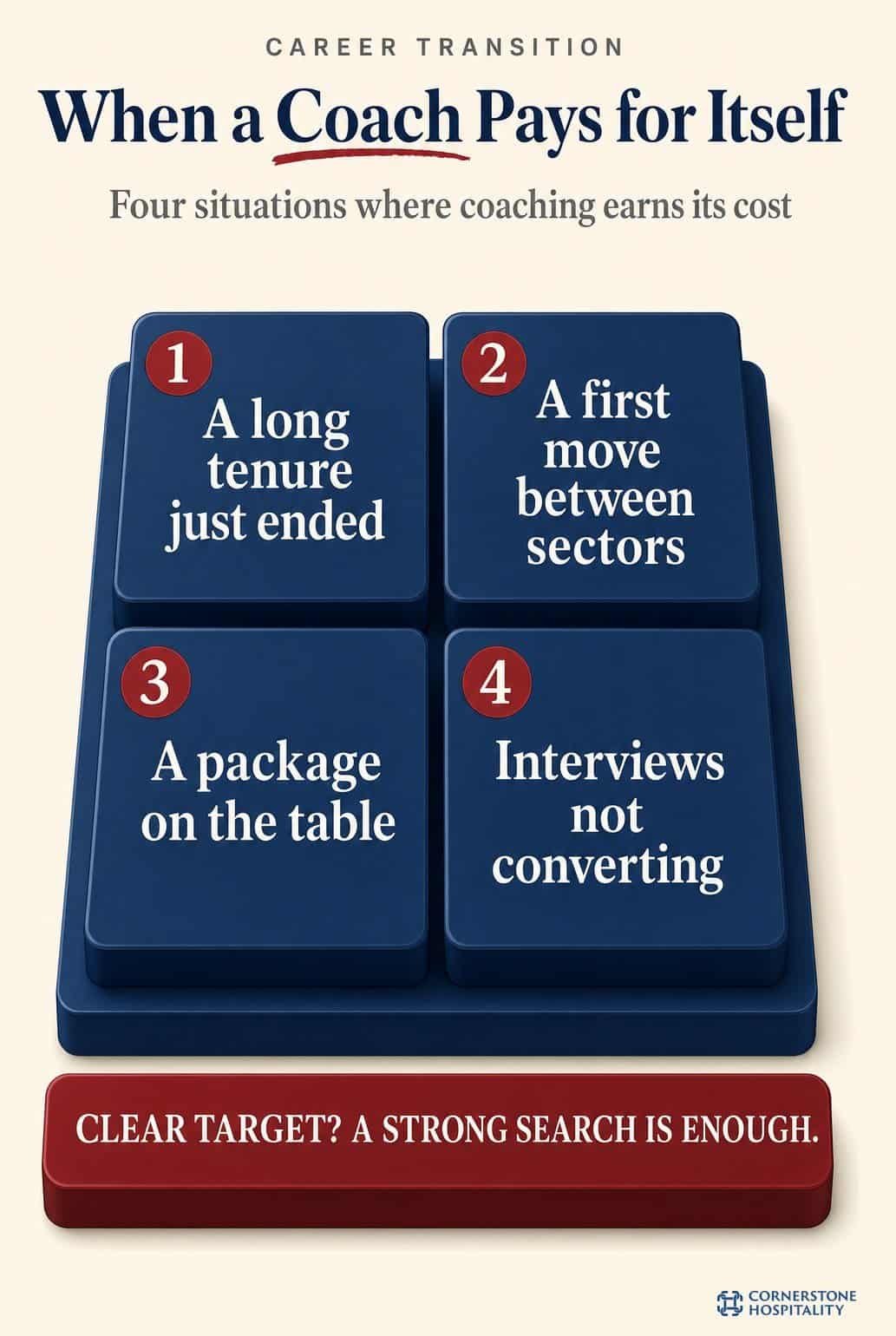
Four Signals That Point to a Career Transition Coach
Four situations come up again and again in senior hospitality searches. Each one has a different mechanism behind it.- Interviews are happening but not converting. If first-round conversations land consistently but offers do not follow, the issue is usually the telling of the story. It is not a question of the candidate’s qualifications. A search that produces conversations already proves the market wants this person. The next problem is a positioning problem, and positioning is coachable.
- The target is genuinely unclear. A search that cannot answer “What are you looking for” in one sentence loses time to conversations that go nowhere. That happens because the person on the other side cannot picture the fit either. An outside, structured conversation narrows this faster than thinking it through alone. It does so largely because it removes the option of avoiding the harder half of the question.
- The exit was difficult, and the narrative needs work. How a leader explains a departure in an interview is frequently the single most coachable moment in a senior search. A leader who lived through a difficult exit has the facts memorized and the framing unresolved. Those are two different problems.
- A package is on the table and needs negotiating. Compensation, notice period, relocation terms, and start date rarely move on their own. Preparing that conversation properly is a distinct skill from doing the job well. Many senior operators have not had to practice it in years.
If a long tenure just ended or a package needs negotiating, that is usually the moment to have a conversation. Talk to us about whether coaching fits, or see how these career transition patterns typically unfold.
The Identity Shift After a Long Tenure
Picture a general manager who has run the same property, or the same brand, for a decade or more. That leader is not only changing employers. They are changing how they describe themselves at the start of every new conversation. They have used the same description for years.Herminia Ibarra researched career transitions. She found that people do not think their way into a new professional identity and then act on it. Instead, they act their way into it, through what she calls “provisional selves.”A provisional self means trying out new activities, new networks, and new ways of explaining the work. People then adjust based on what lands [4].How a Career Transition Coach Runs the Experiment on Purpose
That finding has a direct, practical consequence for a senior hospitality search. Suppose a leader tries to arrive at a finished answer to “Who am I now?” before the first interview. That leader is solving the problem backward. The answer tends to show up partway through the search. It arrives once a few real conversations have tested a few versions of the story.A career transition coach’s job in this situation is less about supplying the answer. It is more about running that experimentation deliberately. The alternative is to let it happen accidentally. It would play out across a string of interviews that the candidate did not know were rehearsals.Ten or fifteen years in one seat build a settled sense of “who I am professionally” in a leader. That sense does not transfer automatically to a new title. Rebuilding it takes deliberate experimentation, and a search moves faster once that work is happening on purpose.
“Coaching does not manufacture an open role. What it does is make sure a strong track record gets told well enough to be believed.”
Florian Kittler, Managing Partner, Cornerstone Hospitality
Small Signs the Identity Gap Is Showing
In practice, this shows up in small ways before it shows up in interview outcomes. A general manager who has spent a decade answering to one owner will often describe their results in that owner’s language. New audiences do not always recognize it.A rooms division leader promoted internally for years may not have had to explain their value from scratch. The last time may have been their first interview at the company. Neither gap is a weakness in the work itself.Both are gaps in how the leader tells the work to somebody meeting it for the first time. Both gaps close faster in a structured conversation with a career transition coach than they do on their own.The First Move Between Sectors
Take a director of operations moving from a resort group into a branded urban portfolio. Or take a food and beverage leader moving from hotels into a standalone restaurant group. Each is making a different kind of move from a lateral change within the same type of business.Research published in the Academy of Management Journal drew on 1,170 executives from S&P 1500 companies between 1999 and 2014. That research found a gap. Executives moving into a higher-status industry earned, on average, about 8% less than those moving to a lower-status one [5].The gap was not about ability. It came from how receiving organizations priced two things. Those were uncertainties about whether the skills would transfer and doubt about whether the move signaled real commitment.Why Hiring Committees Read a First Sector Move Closely
That second point matters more than the compensation figure itself. A hiring committee reading a first cross-sector move is, consciously or not, asking one question. Is this a considered decision or a reaction to something?A related pattern shows up in hiring more broadly. Businesses typically pay external hires 18% to 20% more than internal promotions into the same role. Those hires still need roughly two years to reach full effectiveness [6]. So businesses pay a premium for outside experience and then spend two years finding out whether it transfers.A first-time sector mover can address that doubt directly in the interview itself. The alternative is leaving it for the hiring committee to wonder about privately. Addressing it head-on answers the one question most likely to be working against them.Why Sector Fluency Matters in a Career Transition Coach
This is where sector-specific coaching earns its keep over general career coaching. A coach without hospitality context will not know why a resort general manager’s story differs from a flagship city hotel general manager’s. Nor will that coach know what changes when the move is from operator to owner-side. For a senior hospitality move specifically, sector fluency in the career transition coach matters as much as coaching skill itself does.The moves that come up most often in senior hospitality searches follow a few patterns. One is a resort general manager moving into a city hotel. Another is a branded operator moving to the ownership or asset-management side.A third is an independent luxury property leader moving into a managed portfolio. A fourth is a food and beverage director moving from hotel outlets into a standalone restaurant group. Each of those moves changes what a hiring committee is actually evaluating. That holds even when the title on the search brief looks similar to the title the candidate already holds.A coach who has sat across from all four of those moves before can name the committee’s likely questions in the first conversation. The candidate has not yet had to answer those questions.Negotiating the Package
Most candidates do not negotiate, and the ones who do tend to do better than they expect. Pew Research Center surveyed more than 5,700 US adults. In that survey, 55% said they did not try to negotiate the salary in their most recent hire. Yet 73% called salary the most important factor in accepting a job [7].Among the people who did ask, 28% received exactly what they asked for. A further 38% received more than the original offer, even if less than they had requested. Only 35% of the people who asked ended up with the first number on the table [7].A senior hospitality package is rarely one number. Base salary, bonus structure, relocation, housing where relevant, notice period, and start date all move independently. For the first time in years, a leader may be negotiating a general manager or vice president package. Such a leader is often out of practice with all the terms at once.Coaching here is less about persuasion tactics and more about sequencing. It covers which term to raise first and which to treat as fixed. It also covers which to hold until the offer is close to final.That sequencing is learnable. It is one of the more mechanical parts of the whole process. A candidate can prepare for it apart from the emotional weight of the rest of the transition.What a Career Transition Coach Sees in International Offers
International moves add another layer that is common enough in hospitality to name directly. A leader relocating across a border is often negotiating housing support, schooling allowances, and repatriation terms alongside base compensation. Each of those items has its own market range. That range is easy to misjudge without recent, comparable reference points.A candidate who has not changed employers in years is negotiating blind on several of these terms at once. A career transition coach who works across hospitality searches sees many live offers. That coach knows which terms the employer’s policy fixes and which are simply the first number offered.Confidence Gaps That Show Up in the Interview Room
The imposter syndrome research cited earlier in this guide is worth another look. A confidence gap rarely announces itself as one. It shows up as over-explaining a decision that needed no defense. It also shows up as underselling a result that was genuinely the leader’s own.The same study found that 65% of senior executives show signs of imposter syndrome, against 33% of early-career professionals. In addition, 85% of the CEOs affected still rated themselves as fully competent in the role underneath the self-doubt [2].The gap sits between two things. One is what a leader knows to be true about their own record. The other is what they are willing to say plainly in a room where others evaluate them.That gap is coachable in a way market conditions are not. A coach cannot manufacture an open role. What a coach can do is sit across from a candidate and hear a genuinely strong track record told badly. Then the coach can fix the telling.The distinction is worth stating precisely. It is the one place this whole guide risks overselling coaching if the point stays unclear. Coaching improves how hiring committees read a strong candidate. It does not create demand that is not there.None of the four signals above are about ability. They are about whether the story, the target, or the terms are landing the way the track record deserves. That distinction decides whether the next move is a coaching conversation or more time inside the search itself.
Why This Matters
When a Strong Search Process Matters More Than Coaching
Sometimes the target role, level, and geography are already clear. The story is already well told, and the search simply needs volume and time. In that case, a career transition coach adds less value than a well-run search process itself. Three things usually matter more at this stage than additional coaching hours. They are retained search engagement, live recruiter relationships, and a disciplined outreach cadence.This is also the more common situation in a market where hospitality demand remains strong. More than half of hoteliers surveyed in early 2026 described their properties as somewhat or severely understaffed. Labor costs were a top concern for 65% of respondents [8].A senior leader with a clear target and a clean story is searching into a market that has real openings. As a result, reach and pace are usually the limiting factor, rather than positioning.Signs a Search Is Ready to Run on Its Own
- The target is already specific. The candidate can state the role, level, region, and property type in one sentence. They have said it the same way in the last three conversations.
- The story is already tested. Recent interviews are converting to second rounds and offers at a normal rate for the level the candidate is seeking.
- The exit, if there was one, is already resolved. After enough retellings, the departure narrative no longer needs rehearsing.
- The gap is volume, not clarity. What is missing is more conversations with the right people, not a better answer to any one question.
How to Run a Disciplined Search Without a Career Transition Coach
Going it alone still takes real discipline. It is worth naming what that discipline actually looks like, because “no coach” does not mean “no structure” here. A search that runs well without coaching usually has three habits.First, it has a set cadence of outreach. Second, it has a short list of target organizations rather than an open-ended one. Third, the candidate tracks which conversations have gone quiet. That candidate follows up on a schedule, rather than waiting for others to remember them.None of that requires a coach. All of it requires the same discipline a coach would otherwise help enforce.Check the four signs above against the search as it stands today, not as it stood at the start. A search that is already running on volume and pace mostly needs more time, see how long a senior hospitality transition typically takes, rather than more coaching hours.
What to Do
A Decision Checklist for the Fork in the Road
Most senior hospitality searches sit closer to one side of this fork than the other. That is true even when it does not feel that way from the inside. The table below groups the signals covered above. Leaders can check them against a real search instead of judging them in the abstract.
| Signals a coach likely helps | Signals a strong search process is enough |
|---|---|
| Interviews happening, but offers are not landing | Interviews converting to offers at a normal rate |
| Target role, level, or geography still unclear | Target stated the same way in the last three conversations |
| First move between sectors, or first move in a decade or more | A move within a familiar sector or property type |
| A difficult exit that still needs careful framing | A departure narrative already resolved and tested |
| A package on the table with terms to negotiate | Terms already known and within a comfortable range |
| The gap feels like clarity or positioning | The gap feels like reach, pace, or time |
Three steps
How to use the checklist above on a real search
Go through the six rows above and mark which column fits the search right now, the left side or the right side.
Two or more marks on the left side point toward a focused coaching conversation before the search goes further.
Mostly right column: run the search and revisit coaching only if a specific moment calls for it, such as a final negotiation.
Run the three steps above against a real search this week, rather than judging it from memory. Most searches sit closer to one side than it feels like from the inside.
Key Insight
Where Cornerstone’s Career Transition Support Fits
Cornerstone Hospitality runs retained executive search across hotels, restaurants, travel, and leisure. Career transition support sits alongside that search work rather than apart from it. For a leader already engaged in a search, that proximity has a practical benefit.As a result, one read of the market informs both the coaching conversation and the roles the leader pursues. The alternative is a career coach working from a general framework and a search consultant working from a live one.That support is one option among those covered in this guide, not a default step for every senior mover. A leader whose search matches the right-hand column of the checklist above usually does better moving straight into a disciplined search process.Other leaders recognize several items from the left-hand column. Particularly telling are a long tenure ending, a first move between sectors, or a package that needs proper negotiating. For those leaders, a focused conversation with a career transition coach tends to change the outcome.What a Career Transition Coach Does in Practice
In practical terms, that support looks like a small number of structured conversations rather than an open-ended engagement. One conversation might work through the story a candidate tells about a long tenure or a difficult exit. Another might prepare for a specific negotiation once an offer is close. A third might narrow a target that has stayed vague across several months of searching.The scope follows the actual gap in front of a given search. It is not a blanket step every candidate works through regardless of where their search already stands.What Cornerstone’s Clients and Candidates Say
A career transition often turns on trust built well before the first conversation about coaching. Here is what two people who have worked with Cornerstone have said.
“Florian played a pivotal role in my career transition within the hospitality industry, combining deep expertise in executive search with a highly strategic advisory approach. Unlike traditional recruiters, he takes the time to truly understand your long-term ambitions, challenges your assumptions, and positions you for sustainable leadership success. His network across the global hospitality sector is exceptional, and his commitment to delivering the right long-term fit goes far beyond a transactional placement.
Stefan SavicHospitality Professional · Asset Management, Development & Strategy
“Florian’s experience and in-depth knowledge of the hospitality industry give him the insight most others simply don’t see or understand. He is a strategic thinker and committed to achieving only the best possible. I always look forward to receiving his advice and recommend him as a trusted partner in any business relationship.
Jens BuschOperations Leader, Hospitality & Leisure
Both quotes are verified public LinkedIn recommendations from clients and colleagues who have worked with Florian Kittler.
A career transition coach who also reads the live search market brings one view to both the story and the roles a leader pursues, rather than two views that do not quite agree with each other.
Not sure which side of the fork a specific search sits on? A short conversation usually makes it clear within a few minutes.
Frequently Asked Questions
How much does a career transition coach typically cost?
Can coaching help if the hospitality job market itself is simply slow?
Is outplacement coaching the same as a dedicated career transition coach?
What if only one or two of the signals in the checklist apply?
How long does a career transition coaching engagement typically last?
Can career transition coaching run alongside an active search with Cornerstone?
Is a career transition coach only for people who have already lost a role?
The Bottom Line on Choosing a Career Transition Coach
The honest version of this article is shorter than the marketing version of it usually is. A career transition coach earns its cost in one kind of case. A strong candidate has a problem sitting between them and the right offer. That problem is clarity, positioning, a first-time sector move, or a package worth negotiating properly.It does nothing for a search that is already well aimed and simply needs more time and more conversations. In short, naming which one is true, early and honestly, is most of the work.Read next
Information in hospitality hiring and career transitions changes frequently, and every situation is different: individual timelines, packages, and outcomes vary. Please contact us for guidance suited to your exact circumstances.
About this analysis
The statistics in this guide come from third-party research: coaching-industry surveys, a peer-reviewed study on executive sector moves, labor-market research comparing internal and external hiring, and a hospitality-industry labor survey. Cornerstone did not commission or run any of these studies.
Every figure is attributed inline and listed in full, with its original source, in the sources section below.
Sources 1 to 3: coaching’s return and the size of the profession
- International Coaching Federation: Coaching Statistics: The ROI of Coaching in 2024: reports that “87% of survey respondents agreed that executive coaching has a high return on investment (ROI)”, citing a global PricewaterhouseCoopers and Association Resource Center survey finding “an average ROI of seven times the cost of employing a coach”: coachingfederation.org/blog/coaching-statistics-the-roi-of-coaching-in-2024
- Korn Ferry: 71% of US CEOs Experience Imposter Syndrome, New Korn Ferry Research Finds: drawing on its Workforce 2024 Global Insights Report, a survey of 10,000 professionals across the US, UK, Brazil, the Middle East, Australia and India, finds that senior executives are affected at roughly twice the rate of early-career professionals, at 65% against 33%, and that 85% of affected CEOs still describe themselves as “totally competent” in the role underneath the self-doubt: kornferry.com/about-us/press/71percent-of-us-ceos-experience-imposter-syndrome
- International Coaching Federation: Professional Coaching Continues Global Expansion: reports that the profession passed “the milestone of 100,000 practitioners worldwide” in 2022, representing “54% growth worldwide” since the 2019 study, with total industry revenue reaching “4.564 billion US dollars, a 60% increase since ICF’s 2020 study”: coachingfederation.org/blog/professional-coaching-continues-global-expansion
More sources 4 to 6: identity, sector moves and the price of external hiring
- Herminia Ibarra: Working Identity: Unconventional Strategies for Reinventing Your Career: sets out research with professionals and managers in transition finding that “knowing is the result of doing and experimenting” rather than the reverse, built on three activities she calls working identity: “experimenting with new professional activities, interacting in new networks of people, and making sense of what is happening to us in light of emerging possibilities”: herminiaibarra.com/working-identity-book
- IESE Insight, reporting research by Marta Elvira and Halil Sabanci published in the Academy of Management Journal: Switching Industries May Mean Lower Pay for Executives: studies 1,170 executives from S&P 1500 companies between 1999 and 2014, of whom 538 switched industries, finding that “executives transitioning to higher-status industries, on average, earn approximately 8% less than those moving to lower-status industries”: iese.edu/insight/articles/dream-job-change-industry-salary
- Knowledge at Wharton: Why External Hires Get Paid More, and Perform Worse, than Internal Staff: reports Matthew Bidwell’s study “Paying More to Get Less: The Effects of External Hiring versus Internal Mobility”, published in Administrative Science Quarterly, finding external hires are paid “about 18% to 20% more” than comparable internal promotions and need “about two years to get up to speed”: knowledge.wharton.upenn.edu/article/why-external-hires-get-paid-more-and-perform-worse-than-internal-staff
Final sources 7 and 8: negotiation outcomes and the hospitality labor market
- Pew Research Center: When Negotiating Starting Salaries, Most US Women and Men Don’t Ask for Higher Pay: surveys 5,775 US adults, including 5,188 employed non-self-employed workers, and finds that 55% did not try to negotiate salary at their most recent hire despite 73% calling salary the most important factor in a job decision. Among those who did ask, 28% received exactly what they requested and 38% received more than the original offer, while 35% received only the first offer: pewresearch.org/short-reads/2023/04/05/when-negotiating-starting-salaries
- American Hotel & Lodging Association: Rising Cost, Staffing Challenges Persist for Hotels as Travel Demand Expected to Hold Steady: surveys 246 hoteliers in late February 2026, finding “more than half of respondents report their properties are somewhat or severely understaffed,” with labor costs a top concern for 65% and workforce shortages named by 42%: ahla.com/news/rising-cost-staffing-challenges-persist-hotels
Still weighing coaching against a straight search? We are glad to talk through where a specific situation sits.
Talk to Us