


Succession Planning for Hotel and Restaurant Groups

By Florian Kittler · September 15, 2026
Managing Partner, Cornerstone Hospitality · ~18 min. read

Succession planning for hotel groups turns on incentives more than on lists. Here is what a working plan contains and what quietly works against it.
Succession planning for hotel and restaurant groups is a standing answer to one question. If this seat became vacant on Friday, who takes it, how ready are they, and what are we doing between now and then to close the difference? It is not a document somebody files and forgets.
The part that is hardest to answer quickly is usually the third one. Only 20% of HR leaders say they have leaders ready to fill their most critical roles, and internal candidates can currently fill only 49% of critical positions immediately [1]. That is despite 75% of organizations saying they prioritize internal promotion over external hiring and 80% admitting they lack confidence in their own bench [1]. The intent is nearly universal. The readiness is not.
This piece is about what a succession plan has to actually contain, what hospitality specifically does to the arithmetic, and the structural reason that plans written at a group level usually stop working the moment a property has to run them.
In this article
- What succession planning for hotel groups actually is
- The readiness numbers and what they cost
- Counting the bench honestly in succession planning for hotel groups
- Why the overlap is the part worth paying for
- The incentive that quietly stops succession working
- Building succession planning for hotel groups that holds
- What changes for succession planning across hotel groups
- Glossary
- Frequently asked questions
The readiness gap, in numbers
of HR leaders say they have leaders ready to fill their most critical roles [1]
of critical positions can be filled immediately by an internal candidate [1]
more likely a promotion succeeds when assessments inform the selection [1]
premium paid for an external hire over a comparable internal promotion [2]
Key insight
What succession planning for hotel groups actually is
That word “plan” does a lot of unhelpful work here. It suggests a document somebody writes, approves, and files, and that version rarely changes anything. A succession plan that somebody reviews annually and consults only when people resign is really just a list, and a list on its own does not make anybody ready.
A working plan has four parts, and the fourth is the one worth the most attention.
The critical seats, named
Not the org chart. The seats where a vacancy would cost real money within a quarter, which in a hotel group is usually a shorter list than people expect and almost never includes everyone at a given grade.
The candidates, with a readiness horizon
For each seat, who could take it now, who could take it in one to two years, and who in three to five? A name with no horizon attached is an opinion rather than a plan.
The specific gap for each candidate
Written in one sentence per person. Not “needs more commercial exposure” but the actual thing that would have to be true, stated so that somebody could tell in twelve months whether it happened.
The work that closes the gap, with a date
This is the part that drops out, and dropping it is what turns the plan into a list. A gap identified and not resourced is simply a gap that has now been written down. For a specific gap such as executive presence or making the final call under pressure, that work is usually a run of one to one coaching attached to a real assignment, not a course booked and forgotten.
The test for succession planning for hotel groups is whether the plan changes anybody’s week
One real test is whether the plan changes anybody’s week. If naming somebody as a successor produces no different assignment, no different conversation with their manager, and no different review, then the naming was administrative. The seat still fills reactively when it opens. Somebody updates the plan afterward to record what happened.
Why this matters
The distinction that matters most. A replacement plan answers, “Who could we put in the seat?” A succession plan answers, “Who will be ready for the seat, and what are we doing about it?” The first takes about an hour and returns in about an hour. The second is a standing commitment, and it returns what the seat is worth.
Not sure how deep your own bench really is?
A short, structured conversation is often enough to see where the readiness gaps sit.
Why this matters
The readiness numbers in succession planning for hotel groups
Taking succession seriously is not a sentimental case. It is arithmetic, and the arithmetic is unusually clear.
What being unready costs
When an internal candidate is not ready, the seat goes to an external hire, and external hiring at a senior level carries a measured penalty. Matthew Bidwell’s study of personnel data across a US investment banking division found that external hires are paid about 18% to 20% more than comparable internal promotions. They also need about two years to get up to speed, and hiring managers confirmed they typically pay 10% or 20% more to pull people out of positions where they already have security [2].
That is a higher price for a slower start, and it is before the failure risk. A longitudinal study followed more than 20,000 new hires across 312 organizations. 46% failed within 18 months, and only 19% achieved unequivocal success [11]. Michael Watkins puts the unaided breakeven point, where a leader contributes as much value as they have consumed, at up to six months [14].
Replacement costs compound it. Gallup describes the cost of replacing an individual employee as ranging from one half to two times annual salary and calls that a conservative estimate [5]. At the general manager level, a conservative estimate is still a large number.
What being ready is worth
That same research also finds the upside is measurable rather than theoretical. Organizations with strong leadership benches are 2.9X more likely to fill leadership roles internally, and 2.8X more likely to outperform financially [1]. Promotions are also 1.6X more likely to succeed when assessments inform the selection [1].
| The situation | What the evidence says |
|---|---|
| Internal candidate ready | Fills immediately, at no premium, with the shorter ramp of somebody who already knows the group |
| Internal candidate named but not ready | Fills after a delay, or does not fill, and the seat goes external anyway |
| No internal candidate | External hire at an 18% to 20% premium and about two years to full speed [2] |
| Assessment used in the decision | Promotion 1.6X more likely to succeed [1] |
None of that says never hire externally. There are good reasons to go outside, and the strongest groups do both deliberately. It says the choice should be a real choice, and at present it usually is not. 30% of new CEOs at the world’s largest corporations are hired from outside [3]. A large share of those appointments happened because the bench was not ready, not because a board genuinely preferred an outsider.
Why this matters
A ready internal candidate fills the seat immediately and at no premium. An unready bench forces a costly, slower external hire nearly every time, and the cost shows up whether or not anybody planned for it.
Key insight
Counting the bench honestly in succession planning for hotel groups
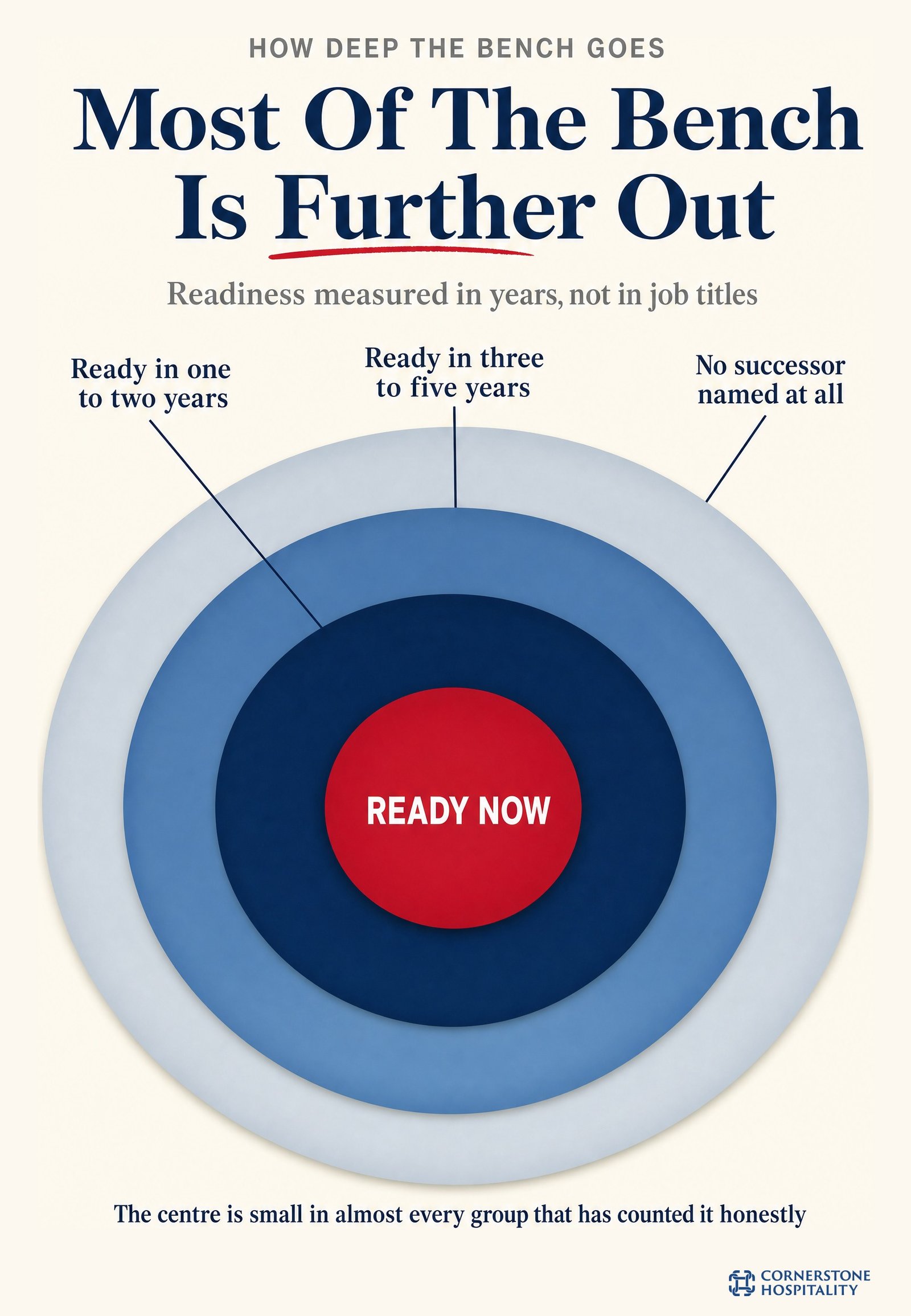
In its first succession review, the most useful thing a group can do is count honestly by horizon rather than by title. The result is almost always uncomfortable, and it is almost always the same shape. There is a small center, a thin second ring, and a large outer band of seats with nobody credible attached to them at all.
That shape is not a failure of the exercise. It is the finding. A group that reports a full bench on first count has usually recorded ambition rather than readiness. It will discover the difference when a seat opens.
Reading the horizons properly
Ready now
Means could take the seat this quarter with normal support and would hold it. It is not could survive it, and it is not is the most senior person available. If the honest answer requires a caveat, the person belongs in the next ring.
Ready in one to two years
Is where most of the useful work sits. The gap is specific, it is closable, and there is time to close it. This is the ring that a development budget should be aimed at. It is frequently the ring that gets the least attention because it is neither urgent nor a crisis.
Ready in three to five years
Is a genuine category, not a polite one. It covers people whose gap is experience that cannot be compressed. The correct action is usually a sequence of assignments rather than a program.
No successor named
Is the ring that should drive the next twelve months.
What an honest horizon reading looks like
Every seat in it is either a seat that will be filled externally when it opens or a seat where somebody has not yet been willing to make a judgment about a person. Both are decisions, and both are better made deliberately.
What makes a succession review honest is not who is on the list. It is this: for each name, what would you tell an owner if that person took the seat next month and it went badly. If the answer is that you would not be surprised, they are not ready now.
Florian Kittler, Managing Partner, Cornerstone Hospitality
It is worth noting where the industry currently sits on the underlying supply. More than half of hotels report being somewhat or severely understaffed [9]. Labor costs are a top concern for 65%, and workforce shortages are named by 42% [9]. A separate survey found 65% still reporting shortages [8], with 71% carrying open positions at an average of six to seven per property [8]. A bench is built out of a workforce, and the workforce is thin.
What to do
Count the bench by horizon, not by title, and treat every seat with no successor named as this year’s priority, not next year’s.
Why this matters
Why the overlap is the part of succession planning for hotel groups worth paying for
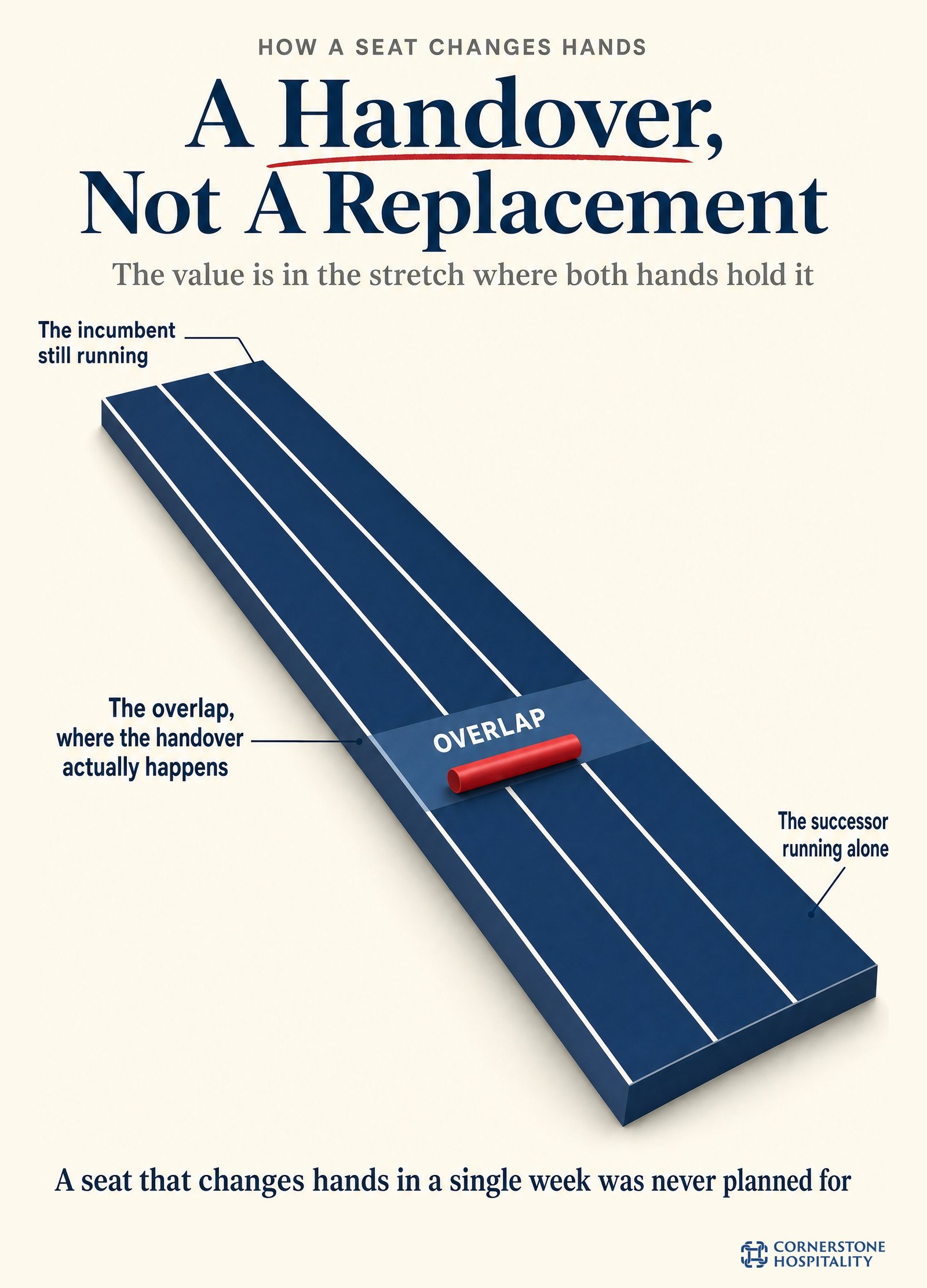
A second structural error, after treating the plan as a list, is treating the transition as an event. A seat becomes vacant, a person is appointed, and the person starts. Everything that mattered about the outgoing leader’s knowledge of the property, the owner, the team, and the local market leaves the building on their last day.
Overlap is where the value sits. It is the part groups cut first because it costs money to have two people paid for one seat. That saving is real, and it is usually smaller than what it buys. Set against a breakeven point of up to six months unaided [14], a four to eight week overlap is cheap.
What a good overlap actually contains
Not shadowing, which produces a well informed observer. The successor should be running something real, with the incumbent available rather than in charge. Owner and key account introductions happen in person and with the incumbent’s endorsement because a relationship transferred by email is not really transferred. And the team should be told clearly and early who is taking over. Because the alternative is that they work it out from signals and draw their own conclusions in the meantime.
The other half of the handover is harder to schedule. It is what the incumbent knows that is not written anywhere. Which owner needs a call before a decision rather than after it, where a supplier relationship is personal, and which member of the team is carrying more than their title suggests? None of that is in a handover document; all of it takes weeks to transfer. Its absence is a large share of why capable successors have poor first quarters.
When the overlap is impossible
Sometimes the incumbent leaves abruptly, and there is no overlap to have. The substitute is a structured debrief with whoever remains in the first fortnight, aimed specifically at relationships and history rather than process. It is worse than an overlap and much better than nothing. It is rarely done because the fortnight after an unplanned departure is the busiest one.
Want a second, external read on your bench?
An outside view on candidates who are close to the group tends to surface what an internal review misses.
Key insight
The incentive that quietly stops succession planning for hotel and restaurant groups working
Every multi property group has the same conversation. Central leadership asks general managers to develop successors. General managers agree in the meeting and do not do it. The behavior is then read as a culture problem, and culture programs are commissioned to address it.
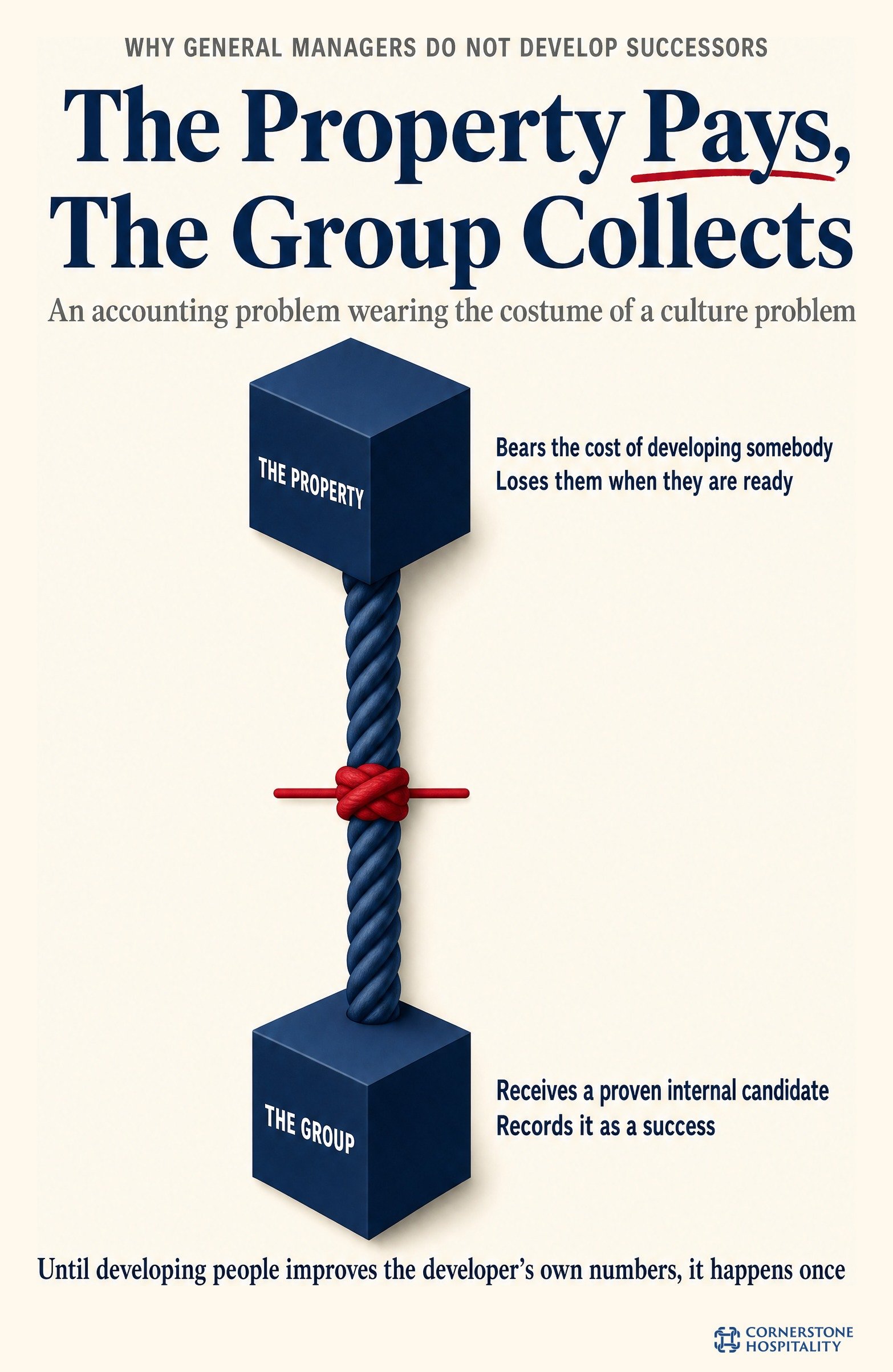
It is not a culture problem. It is an accounting problem, and the general managers are behaving rationally.
A general manager who develops a strong deputy carries the full cost. There is the time, the tolerated mistakes on a stretch assignment, and the slightly worse month while somebody learns. When that deputy is ready, they move to another property, because that is what a group bench is for. The property loses its strongest performer and starts again. Group level reporting records a successful internal fill. The property records a departure.
Under that arrangement, the property level optimum is to develop nobody and to hire ready made people from other properties. If enough general managers reach that conclusion, and some will, the group ends up with a thin bench and a good deal of internal poaching.
What actually changes it
Only one thing, which is to make developing people improve the developer’s own numbers. The mechanisms vary, and the principle does not.
What to do
Count outbound promotions as a property result
A general manager who supplies two people to the group bench in a year has produced something the group values. Their review should say so in the same section as occupancy and margin, not in a paragraph at the end.
Fund the backfill centrally, not from the property
If the property has to absorb both the development cost and the replacement cost, the arithmetic never works. Central funding of the backfill is the single most effective structural change available.
Make the bench visible both ways
A general manager who can see which people from other properties are ready for their own vacancies is participating in a market rather than donating to one.
Say it out loud in the appointment
If developing successors is part of the general manager role, it belongs in the brief at appointment and in the first review, not in an annual reminder from the group.
There is also a personal disincentive worth naming because it goes unspoken. A general manager who builds an obviously ready deputy has created a visible alternative to themselves. Unless the group is explicit that this counts in the manager’s favor rather than against them, some proportion of leaders will quietly decline. No policy will detect it when they do.
What to do
Building succession planning for hotel groups that holds
Six steps, in order. The order matters because each one is unusable without the one before it.
Name the critical seats, and keep the list short
Seats where a vacancy costs real money inside a quarter. Twelve seats reviewed properly beats sixty reviewed nominally. The short list is what makes the rest of the process affordable.
Get an external read on the candidates
Internal judgment is informed, and it is not neutral, because the people making it also manage the people being judged. Structured interviews are the strongest single predictor of job performance at .42, ahead of job knowledge and work sample tests [12]. Promotions are also 1.6X more likely to succeed when assessments inform them [1].
Write one sentence per person
A specific gap, stated in language a sponsor would recognize, is testable in twelve months. If it cannot be written in one sentence, it has not been diagnosed, and whatever gets bought next will be aimed at nothing.
Attach an assignment, not a course
Roughly 70% of development comes from challenging experiences and assignments, 20% from developmental relationships, and 10% from coursework [10]. A plan whose entire response to every gap is a training program has funded the smallest lever available.
Connect each candidate's manager
Managers account for at least 70% of the variance in employee engagement across business units [13], and Korn Ferry finds team climate accounts for up to 31% of the variation in team level engagement [15]. A successor returns from every development conversation into a climate their manager sets.
Review three times a year, not once
Annual review means a plan is stale for eleven months of every twelve, and in an industry with hospitality’s turnover, it is stale much faster than that. Three touches a year is the minimum at which a plan reflects reality.
One addition on the second step, because it is where most plans are weakest. The read has to include the people below the candidate as well as above. A leader who is impressive upwards and difficult downwards is a familiar figure in this industry, and they are invisible to a review that only asks their manager. 89% of new hire failures are attributable to attitudinal factors rather than technical skill [11]. Given that, the view from below is not a courtesy. It is the most predictive input available.
Why this matters
What changes for succession planning for hotel groups
Four things, and each one changes the plan rather than merely making it harder.
The clock runs faster
Accommodation and food services recorded a monthly quit rate of 4.3% in March 2026, the highest of any industry and nearly double the private sector average of 2.2% [6], and Deloitte finds 76% of hospitality workers and 80% of restaurant workers leave their jobs within a year [7]. A plan written against a three year horizon is being written about a population that will substantially have changed.
In practice, this means naming successors earlier and at a lower level than feels comfortable, and accepting that a proportion of the investment walks. That proportion is the cost of having anybody at all on the bench, and groups that refuse to accept it end up with the alternative. This is an external hire at an 18% to 20% premium [2].
Retention is part of the plan, not a separate initiative
High potential intention to depart rose from 13% in 2020 to 21% in 2024. High potential talent is 3.7X more likely to leave within a year when their manager does not provide regular growth opportunities [4]. Gallup finds 52% of voluntarily exiting employees say their manager or organization could have prevented it. 51% say that in the three months before leaving, nobody spoke with them about job satisfaction or their future [5].
That is the same lever twice. Naming somebody as a successor, telling them, and giving them a real assignment is simultaneously a development action and a retention action, and it is close to free. Not telling them, which many groups do deliberately to avoid disappointing the people not named, forfeits both.
The standard has to travel
A single property can hold a standard in one leader’s head. A group cannot, and a bench built property by property will produce successors who are ready for the property they trained in. The work that makes readiness portable is cross property assignment. That is also the assignment most disruptive to run and therefore the one most often replaced with a course.
The sector is growing into the gap
The World Travel and Tourism Council forecasts the sector supporting 376 million jobs worldwide in 2026, one in nine jobs globally. It projects almost 89 million new jobs over the next decade [16]. Demand for capable hospitality leaders is not about to ease. Meanwhile, 66% of executives and managers say their most recent hires were not fully prepared, with lack of experience the most common failing [7]. The US training expenditure of $102.8 billion allocates just 13% of the average budget to management and supervisory training [17].
Growing demand, a thin supply of ready leaders, and a small share of budget aimed at the layer that produces them. Groups that fix the third of those will not have to compete quite so hard on the first two.
Why this matters
A thin, slow moving bench is now competing against faster turnover and a growing sector at the same time. The groups that count the bench honestly and fund development centrally are the ones that will not have to win every hire from outside.
Where to start
Related reading
Related reading
Key insight
Glossary
Critical seat. A role where a vacancy would cost real money within a quarter. The list is deliberately shorter than the org chart.
Readiness horizon. Ready now, ready in one to two years, or ready in three to five. A name without a horizon is an opinion rather than a plan.
Bench strength. The proportion of critical seats with a credible internal successor at a stated horizon. Counted honestly, it is usually thinner than expected.
Overlap. The period where the incumbent and the successor are both in place, the successor running something real. Where most of the handover value sits.
Transfer problem. The structural issue where one property bears the cost of developing somebody and another receives the benefit, making it rational at the property level to develop nobody.
Backfill. The appointment made to replace somebody who has moved up or across. Funding it centrally rather than from the property is the single most effective fix to the transfer problem.
What our clients and candidates say
Florian played a pivotal role in my career transition within the hospitality industry, combining deep expertise in executive search with a highly strategic advisory approach. Unlike traditional recruiters, he takes the time to truly understand your long term ambitions, challenges your assumptions, and positions you for sustainable leadership success.
Stefan Savic, Hospitality Professional, Asset Management, Development & Strategy
Over the years I have worked with Florian and he has continually provided a service second to none. The caliber of individuals he recommends is always spot on, as he ensures that he understands not only the requirements and expectations of a role but also the importance of the success and growth of the business being related to people.
Daniel Aylmer, Chief Executive Officer, Greater China
Ready to build a bench that actually holds?
Bring your critical seats and we will help you count the bench honestly, horizon by horizon.
What to do
Frequently asked questions
Planning and readiness
Process and pitfalls
Want an honest count of your bench?
A structured read across your critical seats takes about four weeks and tells you where the gaps genuinely are. No commitment, no charge.
References
Sources 1 and 2: succession readiness and the cost of external hires
- DDI: Succession Planning Best Practices: How to Close the Leadership Readiness Gap: reports that “only 20% of HR leaders say they have leaders ready to fill their most critical roles” and that “80% of organizations lack confidence in their leadership bench”, while “75% of organizations prioritize internal promotion over external hiring” and internal candidates “can fill only 49% of critical positions immediately”. It also finds promotions are 1.6X more likely to succeed when assessments inform selection, and organizations with strong benches are 2.9X more likely to fill leadership roles internally and 2.8X more likely to outperform financially: ddi.com/blog/succession-planning-best-practices
- Knowledge at Wharton: Why External Hires Get Paid More, and Perform Worse, than Internal Staff: reports Matthew Bidwell’s study “Paying More to Get Less: The Effects of External Hiring versus Internal Mobility”, published in Administrative Science Quarterly and drawn from personnel data in a US investment banking division from 2003 to 2009. External hires are paid “about 18% to 20% more” than comparable internal promotions and need “about two years to get up to speed”, and hiring managers confirm they “typically pay 10% or 20% more to pull people out of positions” where they already have security: knowledge.wharton.upenn.edu/article/why-external-hires-get-paid-more-and-perform-worse-than-internal-staff
References 3 to 5: leadership development, the exodus forecast and replacement cost
- Harvard Business Review: Turning Potential into Success: The Missing Link in Leadership Development: by Claudio Fernández Aráoz, Andrew Roscoe and Kentaro Aramaki, reports that “66% of companies invest in programs that aim to identify high potential employees and help them advance” while “only 24% of senior executives at those firms consider the programs to be a success”. It adds that “a mere 13% have confidence in the rising leaders at their firms, down from an already low 17% just three years ago”, and that at the world’s largest corporations “a full 30% of new CEOs are hired from the outside”: hbr.org/2017/11/turning-potential-into-success-the-missing-link-in-leadership-development
- DDI: Global Leadership Forecast 2025 Study Signals Looming Leadership Exodus: surveys 10,796 leaders and 2,185 HR professionals across more than 50 countries and 24 industry sectors, reporting 71% of leaders with increased stress, 40% of stressed leaders considering leaving leadership altogether, and trust in immediate managers at “just 29%, a 37% decline since 2022”. It also records high potential intention to depart rising “from 13% in 2020 to 21% in 2024”, with high potential talent 3.7X more likely to leave within a year where the manager does not provide regular growth opportunities: ddi.com/about/media/global-leadership-forecast-2025
- Gallup: This Fixable Problem Costs U.S. Businesses $1 Trillion: establishes that “the cost of replacing an individual employee can range from one half to two times the employee’s annual salary” and describes that as “a conservative estimate”. It also reports that 52% of voluntarily exiting employees say their manager or organization could have prevented their departure, and 51% say that in the three months before leaving, neither their manager nor any other leader spoke with them about job satisfaction or their future: gallup.com/workplace/247391/fixable-problem-costs-businesses-trillion
Sources 6 to 8: hospitality turnover and staffing shortages
- OysterLink analysis of US Bureau of Labor Statistics JOLTS data: Hospitality Workers Quit at a Higher Rate Than Any Other Industry in the U.S.: establishes that “the quit rate for accommodation and food services reached 4.3% in March 2026, the highest among all industries” and “nearly double the private sector average of 2.2%”. Retail trade, the next highest sector, recorded 3.1%, against healthcare at 1.9%, manufacturing at 1.4% and finance at 1.2%. Layoffs in the sector held at 1.3%, matching the national average, so roughly three quarters of separations are people choosing to leave: prnewswire.com/news-releases/hospitality-workers-quit-at-a-higher-rate-than-any-other-industry-in-the-us
- Deloitte: Frontline Workforce Trends in Airlines, Hospitality, and Restaurants: reports that “80% of restaurant workers and 76% of hospitality workers leave their job within a year”, and that “66% of executives and managers say most recent hires were not fully prepared, and that lack of experience was the most common failing”. It also finds 82% of workers naming feeling happy and engaged at work as the key driver of productivity, and 75% hoping for greater stability in the face of change: deloitte.com/us/en/Industries/consumer/articles/frontline-workforce-human-capital-trends
- American Hotel & Lodging Association: 65% of surveyed hotels report staffing shortages: surveys 282 hoteliers between 6 December 2024 and 3 January 2025 with Hireology, finding 65% still reporting shortages, 9% describing themselves as “severely understaffed” against 13% in May 2024, hotel employment “nearly 10% below pre pandemic staffing levels”, and 71% carrying open positions at an average of six to seven per property. Housekeeping accounts for 38% of the gaps and front desk 26%, and 72% of respondents say career opportunities in hospitality are better than ever: ahla.com/news/65-surveyed-hotels-report-staffing-shortages
References 9 to 11: staffing costs, development mix and executive failure rates
- American Hotel & Lodging Association: Rising Cost, Staffing Challenges Persist for Hotels as Travel Demand Expected to Hold Steady: surveys 246 hoteliers in late February 2026 and finds that “more than half of respondents report their properties are somewhat or severely understaffed”, with labor costs a top concern for 65% and workforce shortages named by 42%. Retention incentives in use include higher wages at 70%, flexible scheduling at 54%, hotel discounts at 54% and enhanced benefits at 31%: ahla.com/news/rising-cost-staffing-challenges-persist-hotels
- Center for Creative Leadership: The 70-20-10 Rule for Leadership Development: sets out the framework that “emerged from over 30 years of our Lessons of Experience research”, in which development divides into “70% challenging experiences and assignments, 20% developmental relationships, 10% coursework and training”. CCL notes the framework is drawn from research spanning China, India, Singapore and the United States and is used across a client base including two thirds of the Fortune 1000: ccl.org/articles/leading-effectively-articles/70-20-10-rule
- Leadership IQ: Executive Failure Rates: reports a longitudinal study of more than 20,000 new hires across 312 organizations, evaluated by 5,247 hiring managers at 6, 12, 18 and 24 months, finding that “46% of new hires failed within 18 months; only 19% achieved unequivocal success” and that 89% of failures were attributable to attitudinal factors against 11% for technical skill. The leading drivers were coachability at 26%, emotional intelligence at 23%, motivation at 17% and temperament at 15%: leadershipiq.com/blogs/leadershipiq/executive-failure-rates
Sources 12 to 14: assessment validity, manager impact and transition timing
- Society for Industrial and Organizational Psychology: Is Cognitive Ability the Best Predictor of Job Performance? New Research Says It’s Time to Think Again: reports the revised operational validity estimates from Sackett and colleagues, in which “structured interviews emerged as the strongest predictors of job performance” with a mean operational validity of .42, job knowledge and work sample tests follow at .40, .38 and .33, and “cognitive ability rounded out this list with a validity estimate of .31”. The article explains that earlier meta analytic corrections had systematically inflated these figures: siop.org/tip-article/is-cognitive-ability-the-best-predictor-of-job-performance
- Gallup: Managers Account for 70% of Variance in Employee Engagement: states that “managers account for at least 70% of the variance in employee engagement scores across business units”, drawn from research measuring the engagement of 27 million employees and more than 2.5 million work units over two decades. It also finds about one in 10 people possess high talent to manage, that companies “miss the mark on high managerial talent in 82% of their hiring decisions”, and that talented managers contribute about 48% higher profit than average managers: news.gallup.com/businessjournal/182792/managers-account-variance-employee-engagement
- The Future Organization, interview with Michael Watkins: The First 90 Days: Strategies for Leaders in Transition: records Watkins stating that “unaided the process for leaders to reach the breakeven point can take up to six months”, the breakeven point being where a leader contributes as much value as they have consumed. He also observes that “most people spend 10 to 15 years in leadership positions before getting any formal leadership training from their organization”, with the average leader in their late thirties or early forties before any training at all: thefutureorganization.com/the-first-90-days-strategies-for-leaders-in-transition
References 15 to 17: leadership climate, sector growth and training investment
- Korn Ferry Institute: Stronger Leadership, Stronger Climate, Better Results: analyzes “data from over 2,700 individuals across 541 teams” and finds that “team climate accounted for up to 31% of the variation in team level engagement”. It reports that the right leadership characteristics and team environment “can lift engagement scores by up to 42 percentile points”, and that leaders scoring high on Presence, Agility and Striving produced team climates “approximately 30 percentile points stronger” than lower scoring leaders: kornferry.com/institute/stronger-leadership-stronger-climate-better-results
- World Travel & Tourism Council: Global Travel & Tourism Growth to Outpace Wider Economy by 1.5 Times Over the Next Decade: published 12 May 2026 with research partner Oxford Economics, forecasts that the sector will “support 376 million jobs worldwide in 2026, representing one in nine jobs globally” and contribute “$12TN to the world economy, accounting for 9.9% of global GDP”. Over the next decade it projects “almost 89 million new jobs globally, accounting for approximately one third of all new jobs expected” across the wider economy: wttc.org/news/global-travel-tourism-growth-to-outpace-wider-economy-by-1-5-times-over-the-next-decade
- Training magazine: 2025 Training Industry Report: records that “U.S. training expenditures jumped 4.9 percent to $102.8 billion in 2025” and that “organizations spent $874 per learner this year compared with $774 per learner in 2024”, while average training received fell to “40 hours of training per year vs. 47 hours last year”. Management and supervisory training took 13 percent of the average budget. The survey covers a weighted universe of 152,572 US companies with 100 or more employees: trainingmag.com/2025-training-industry-report
About the author
Written by
Florian Kittler, ISHC
Managing Partner, Cornerstone Hospitality, Global Practice Leader, Hospitality, Travel & Leisure
Florian leads Cornerstone International Group’s global Hospitality, Travel & Leisure Practice. He brings seventeen years of senior hospitality experience, including Marriott, Hyatt, IHG, Mandarin Oriental, and Shangri-La Hotels & Resorts, and sixteen years in retained executive search. He is bilingual in English and German and works across Europe, the Middle East, the Americas, and Asia Pacific.