

Corporate Leadership Development for Hotel Groups
Corporate leadership development for hotel groups: one standard across every property, taught by consultants who have held the seats your leaders are moving into.
A hotel group runs the same leadership question in eleven places at once, each property at a slightly different stage. That is what makes development across a group a different job from developing one property well.
Cornerstone Hospitality builds leadership development for multi-property groups: branded and independent, single-country and cross-border. The consultants delivering it ran properties before they ran programs, which is why the work starts from what a general manager’s week actually contains.
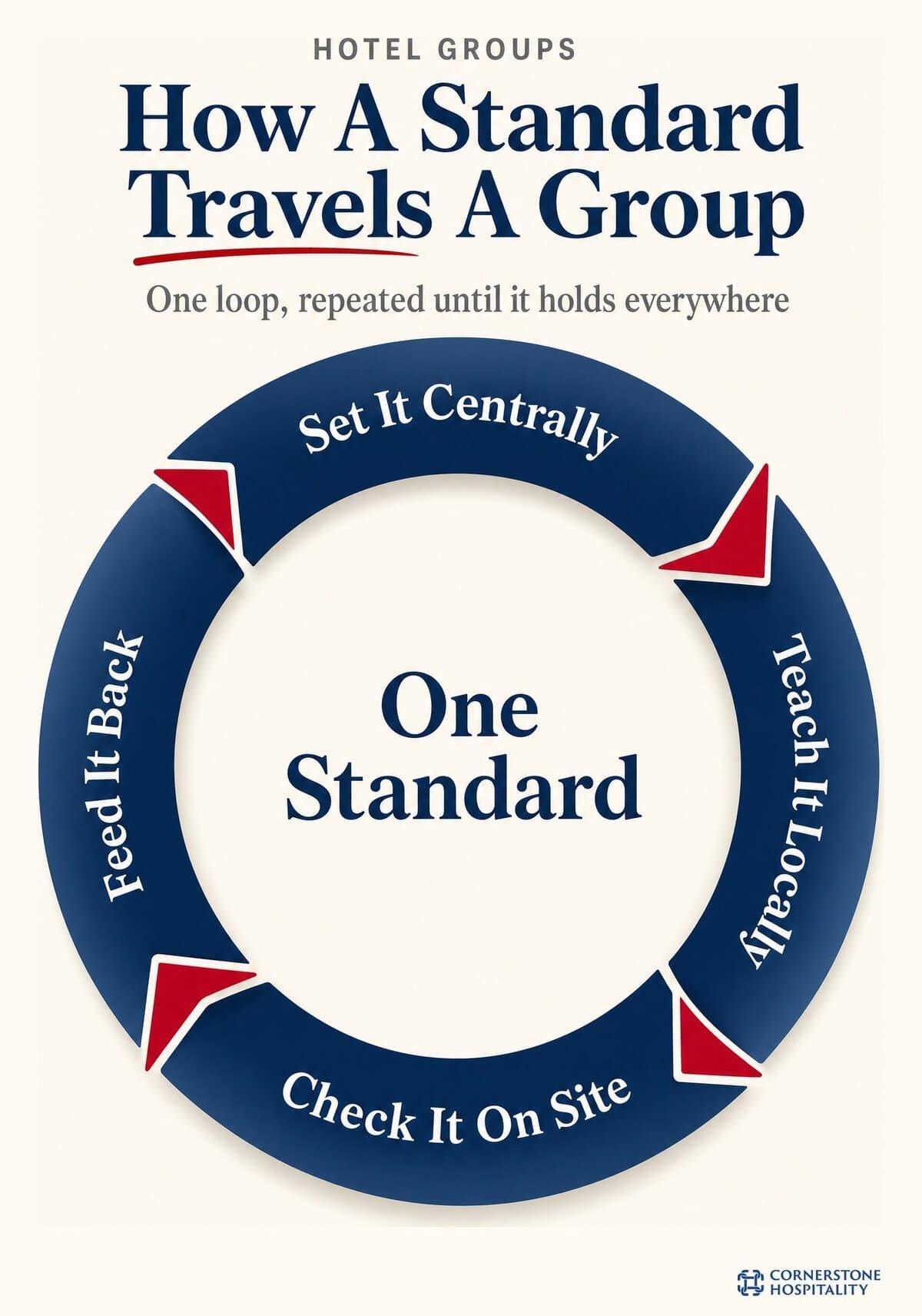
How corporate leadership development travels a group
The standard itself is usually the straightforward part. Holding it in a property nobody from head office has visited this quarter is where the work sits.
The standard is set centrally, because a standard each property writes separately is not one standard. It is then taught locally, by someone who knows that market’s labor pool, notice periods and expectations. That local read is the part a single centrally delivered program tends to miss.
Then it is checked on site, in the operation rather than in a report, because a good deal of what the standard asks for is only visible on the floor. What comes back from those visits shapes the standard set centrally the following year.
One pass through that loop is a training initiative. Repeating it until it holds in every property is what turns it into a group standard.
The same plan, wherever the leader sits
A group program only works if a leader in one country and a leader in another are being held to the same thing.
The partner network means a resident consultant joins the work in each market, so the local read is first hand, while the written plan, the named targets and the milestone reviews stay identical across the group.

Rolling corporate leadership development across a group of properties?
Tell us how many properties, how many markets, and which layer you are trying to strengthen.
What changes when a group builds its own corporate leadership development
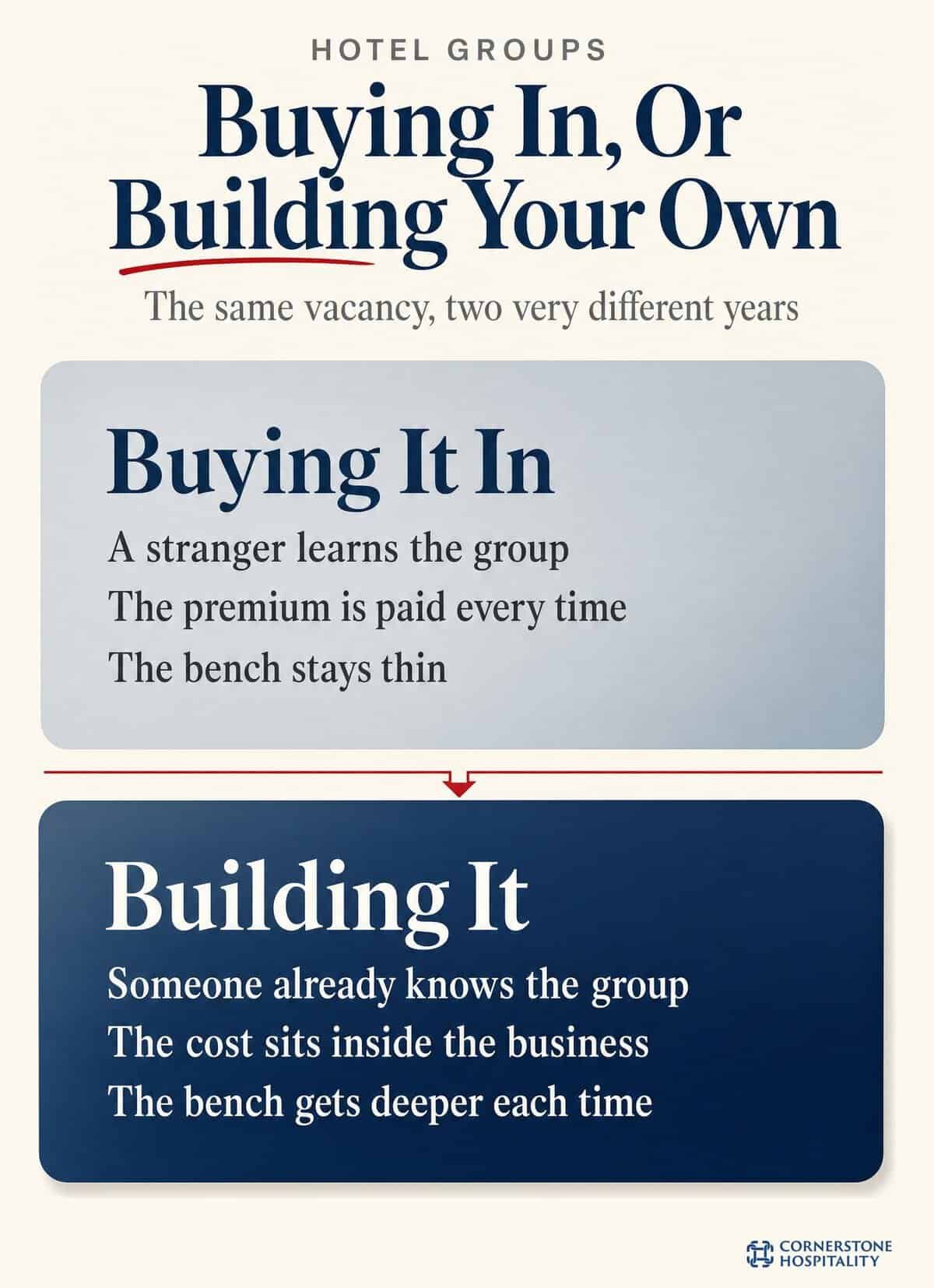
The same vacancy, approached two ways, a year apart.
| Buying it in | Building it | |
|---|---|---|
| Who arrives | A stranger, learning the group | Someone who already knows it |
| Where the money goes | A premium, paid externally, every time | Inside the business, and it compounds |
| Time to effect | Months of orientation first | Effective from the first week |
| The bench afterwards | Unchanged | Deeper than it was |
Neither is wrong, and most groups do both. What matters is whether the first one is a choice or the only option on the table.
Buying corporate leadership development in, or building your own
Every group buys leadership in sometimes, and it is often the right call: a genuinely new capability, a repositioning, a market nobody internally knows.
The question is what happens when it is the only move available. Then the group pays the external premium on every senior vacancy, and pays again in the months a newcomer spends learning how the group actually works.
Building the bench keeps external hiring available and makes it optional. Choosing it rather than needing it is a much cheaper position to negotiate from when the vacancy comes.
It also takes longer to show results, which is why it competes badly against whatever is urgent this quarter. Making that case internally is usually the first piece of work, and it is worth doing properly.
How corporate leadership development is structured across a group
Map the layer
Which seats, in which properties, and who is genuinely ready for the next one.
Set it once, deliver it locally
One written standard, taught in market by a consultant who knows that market.
Review against the plan
Three milestone reviews across the engagement, measured against what was agreed at the start.

Frequently asked questions about corporate leadership development
How do you keep one standard across properties in different countries?
The standard, the written plan and the milestone reviews are set once and stay the same. Delivery is local, through a resident consultant in each market, because pay, notice periods and expectations differ enough that a single central delivery does not survive contact with them.
Does this replace hiring from outside?
No, and it should not. It removes the obligation to hire from outside, which is a different thing. A group that can promote from inside negotiates external appointments from a much stronger position.
How long before a group sees anything?
Individual behavior moves inside a six to twelve month engagement. A visibly deeper bench takes longer, and the honest test is who fills the next vacancy rather than what the closing report says.
Which layer should a group start with?
Usually the one immediately beneath the seats that keep going external. That is where the gap is being paid for, and it is the layer where a program pays back soonest.
Can development and search run together?
Yes, and they inform each other. Many of the leaders we develop were placed by us, and the read from a development engagement makes the next search sharper.
Who delivers it?
Consultants who carried operating responsibility in hospitality, supported by ICF-credentialled coaches across a network of around 60 offices in 40 countries.
Want the next general manager to already work for you?
Start with a conversation about the group, the properties and the layer beneath the seats that keep going external.
For the broader picture this fits into, see our Leadership Development work.
Sources and references
- Center for Creative Leadership, The 70-20-10 Rule for Leadership Development: sets out the framework that “emerged from over 30 years of our Lessons of Experience research”, in which development divides into “70% challenging experiences and assignments, 20% developmental relationships, 10% coursework and training”. CCL notes the framework is drawn from research spanning China, India, Singapore and the United States and is used across a client base including two thirds of the Fortune 1000.
- CIPD, Learning and skills at work: surveys over 1,200 respondents and finds that “only a third of L&D professionals say they are proactive in identifying performance issues before recommending a solution”, with only a quarter designing learning using evidence-informed principles. It also records around a third of organizations reporting reductions in budgets, learning and development headcount and use of external consultants, only 18% expecting investment to return to pre-pandemic levels, and 72% reporting they can effectively tackle skills gaps.