


The 1-6 Month Plan for Re-Entering the Hospitality Job Market

By Florian Kittler · October 27, 2026
Managing Partner, Cornerstone Hospitality · ~11 min. read

Re-entering the hospitality job market at a senior level works best as a six-month plan. Build it in blocks, not a single push in the first week.
Re-entering the hospitality job market at a senior level goes better on a plan measured in months, not weeks. A senior search moves through phases. The phase that belongs in month one is not the phase that belongs in month four. Treating all six months the same way is usually what stretches a search rather than shortens it. In practice, that means applying everywhere at once, from the first week.
The runway is longer than the general labor market suggests. In 2024, landing a new role after a layoff took 20.6 weeks on average across the wider United States workforce. That is about five months. For executives and senior leaders, the same research finds the search routinely runs to twelve months or longer [1].
Retained executive searches average four to six months globally once the mandate is live. These are the searches a hospitality group runs to fill a general manager role or a corporate position. Searches closed in under three months carry a noticeably lower one-year retention rate. By comparison, searches given the full four to six months hold up better [2].
A practical plan for re-entering the hospitality job market
This plan covers the six months after a senior hospitality exit. It shows what belongs in month one and what changes in months two and three. It also shows what months four to six are actually for. Cornerstone’s career transition coaching works alongside candidates through this exact window. The pattern below tends to separate a search that closes in month four from one still open in month nine.
In this article
- Why re-entering the hospitality job market rewards a plan over a single push
- The six-month plan at a glance
- Month 1: position the story and reactivate the network quietly
- Months 2 and 3: structured outreach and the search process
- Months 4 to 6: interview cycles, negotiation, and the decision to accept
- What slows a senior hospitality search down
- If month six arrives and the search is still open
- Frequently asked questions
The six-month plan, in numbers
the average time to land a new role after a layoff across the wider US workforce in 2024, with executives running longer [1]
the average length of a retained executive search once the mandate is live [2]
of workers name a personal or professional connection as what actually got them hired, ahead of job boards and staffing firms [3]
of surveyed hotels still report staffing shortages, a demand backdrop that works in an experienced candidate’s favor [4]
KEY INSIGHT
Why re-entering the hospitality job market rewards a plan over a single push
A senior hospitality exit rarely resolves in a fortnight. Treating the search as one long undifferentiated push is usually what makes it feel that way. Candidates who move fastest at re-entering the hospitality job market treat month one differently from month three. They treat month three differently from month six. Each block has its own job. Running all three at once is usually what stalls things rather than speeding them up.
The instinct after a senior exit is to start applying everywhere immediately. The stronger move assumes the reader’s instincts about the search are mostly right. It adds one refinement: sequence. Suppose a search opens broad on day one, before the candidate has settled on the story and the target. It sends a slightly different pitch to every recruiter it touches. A search firm reads that as a candidate who has not yet decided what they want next.
Why this matters
A retained search, given its full four to six months, keeps a materially higher share of the leader it places past the first year. A search rushed through in under three months does not [2]. That patience helps a search firm place well. It is worth applying to a candidate’s own search too.
Sequencing matters when re-entering the hospitality job market
None of this means slowing down on purpose. It means putting the right activity in the right month. As a result, outreach in month two lands on a settled story rather than a moving target. In month four, the interviews come with a plan built weeks earlier rather than one improvised the night before.
What to do
Decide the sequence before deciding the volume. Positioning comes first, structured outreach second, and the interview cycle third, each given its own month rather than run all at once.
KEY INSIGHT
The six-month plan at a glance
The table below is the plan in outline. Each row gets its own section further down.
| Month | Primary focus | Key actions |
|---|---|---|
| Month 1 | Positioning and quiet network reactivation | Decide level, segment, and geography. Write the exit story. Reconnect with three to four trusted contacts before any public announcement. |
| Month 2 | Structured outreach begins | Open conversations with retained search firms in the target segment. Apply to a short list; not everything is advertised. |
| Month 3 | Volume settles into live processes | First-round interviews land. Early pattern feedback starts to show where the story is landing and where it is not. |
| Months 4 to 5 | Later rounds and closing | Later-round and final interviews. Reference conversations. First offers, and the negotiation that follows one. |
| Month 6 | Decision, or a deliberate widening | Accept against the month one criteria, or widen geography, property type, or reporting level with an honest reset. |
The six-month plan as a decision flow
Month 1: position
Decide level, segment, and geography. Reactivate the network quietly, before any public announcement.
Month 2: outreach opens
Structured conversations with retained search firms begin. A short list, not a broadcast.
Month 3: volume settles
First-round interviews land. Pattern feedback starts to show where the story is working.
Months 4 to 5: closing
Later rounds, references, first offers, and the negotiation that follows one.
Month 6: decide or widen
Accept against the month one criteria, or widen one dimension with an honest reset.
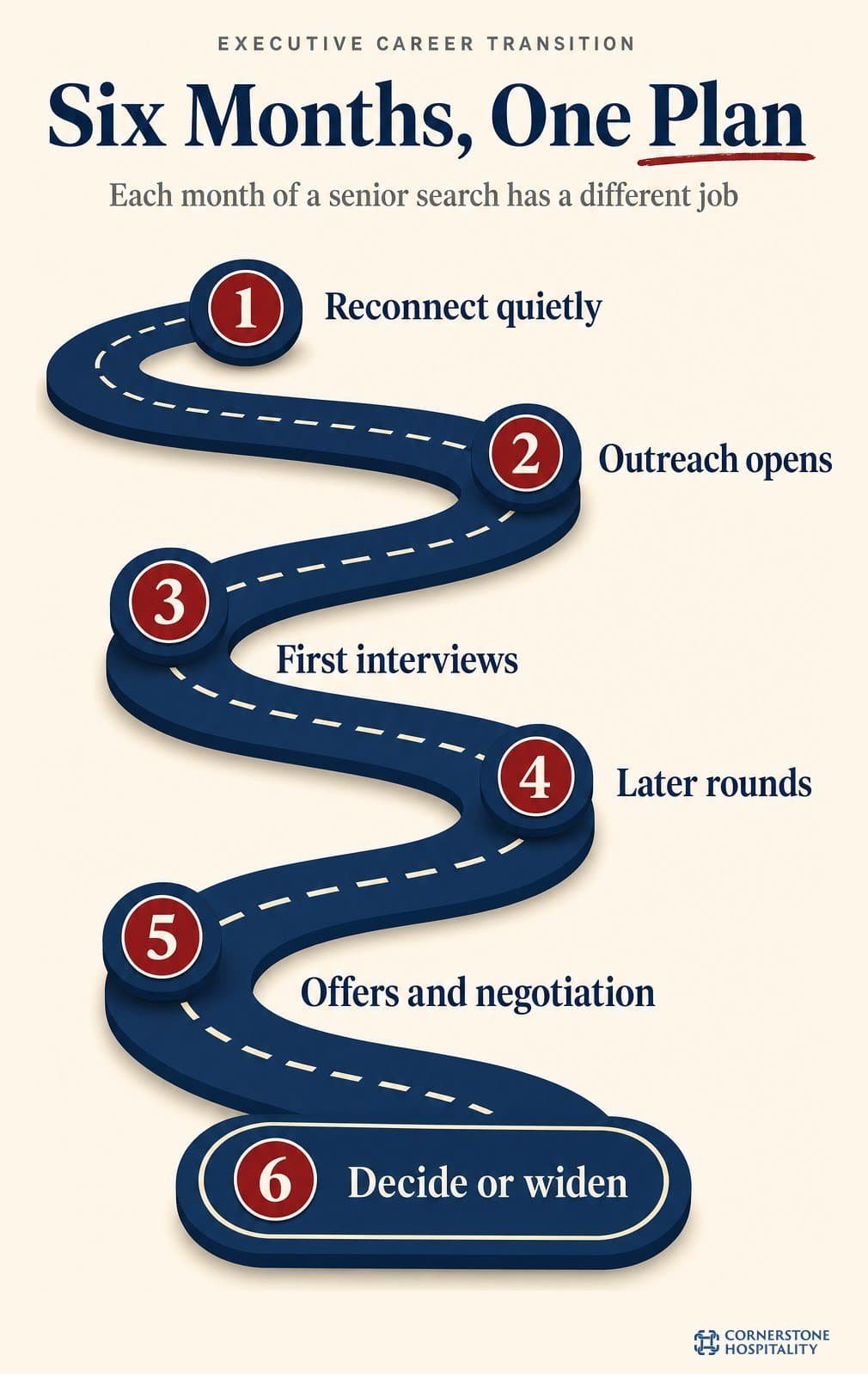
Why this matters
Each month in the table above has one job. The plan only works if months are not run out of order; a month three activity started in month one usually costs more time than it saves.
WHAT TO DO
Month 1: position the story and reactivate the network quietly
Decide the level, segment, and geography before anything else
The instinct after a senior hospitality exit is to start applying immediately. The stronger move spends the first few weeks of re-entering the hospitality job market on three decisions that everything else depends on. First, decide which role level to target next. Second, decide which segments of the industry to consider and which to rule out. Third, decide what geography is realistic given the candidate’s circumstances.
For example, consider a senior general manager who has not decided between another single-property role, a multi-property regional position, or a corporate move. That person sends mixed signals to every recruiter they speak with. A search firm reads mixed signals as a candidate who is not yet ready to be represented.
A search firm reads mixed signals as a candidate who is not yet ready to be represented. Write the target down in one line before the first conversation, and let every later decision test against it.
Florian Kittler, Managing Partner, Cornerstone Hospitality
Write this decision down, in one line, before a single outreach message goes out. Here is a line a contact can act on. “I am targeting a general manager or director of operations role in an upscale or luxury branded property in Southeast Asia or the Gulf.” By contrast, “I am open to most things” is not, however capable the candidate behind it happens to be.
Reactivate the network quietly, before any public announcement
This is also the month to reconnect with the network rather than broadcast the exit. Talk directly with three or four people who know the candidate’s work and know the market. In two weeks, those conversations give more useful information than a public announcement does. They also keep a time-pressure narrative away from the people who will eventually interview the candidate.
More than half of workers name a personal or professional connection as what actually got them their most recent job. That ranks ahead of job boards and staffing firms combined [3]. A senior search draws on the same channel. It simply uses fewer, more targeted conversations rather than a wide broadcast.
What to do
Write the one-line target before the first conversation. Reach three to four trusted contacts directly rather than posting the exit publicly. Then use those conversations to test whether the target holds up against what the market is actually seeing.
Coaching support for re-entering the hospitality job market
Cornerstone’s career transition coaching is built around exactly this month. The work starts by pressure-testing the target. Next, it sharpens the exit story. The story should answer “Why did you leave?” in one settled way, not several different ones. It also maps which of the firm’s retained search relationships match the segment the candidate has chosen. None of that replaces the candidate’s own network. It sits alongside it.
A free Career Clarity conversation is a low-effort way to pressure-test the month one target before committing to it in writing.
Why this matters
A one-line target, written down and tested against three or four trusted contacts, is what lets months two and three run on a settled story instead of a moving one.
WHAT TO DO
Months 2 and 3: structured outreach and the search process
This is when outreach, recruiter conversations, and formal applications properly begin. It is also where most of a search’s actual volume sits. The mistake to avoid is treating every opportunity as equally worth pursuing. A senior search spread across every open role in a region usually produces a string of second-round rejections rather than an offer.
The reason is simple. The story told in interview two has to be sharper than the one told in interview one. That holds across every process running in parallel, and it is difficult to sustain at high volume.
Retained search timelines when re-entering the hospitality job market
Retained search firms run their own timeline. It is longer than most candidates expect. The average retained executive search runs four to six months from a live mandate to a signed offer. The United States runs nearer three to four months, and other regions are frequently longer [2].
A realistic expectation for months two and three, in other words, is several live processes moving in parallel. None of them is finished yet. Pattern feedback also begins to show where interviews are landing and where they are not. For a fuller view of how long the whole process typically runs, see how long a senior hospitality career transition usually takes.
Depth beats breadth once the target is settled
Once the candidate has written down the month one target, the month two to three question changes. The question moves from “how many roles can I apply to” to “which ten to fifteen roles genuinely fit, and which search firms already work that segment.” A shorter, better-matched list is easier to represent consistently across interviews two, three, and four. It is also easier for a search consultant to advocate for internally. The fit is obvious rather than argued for.
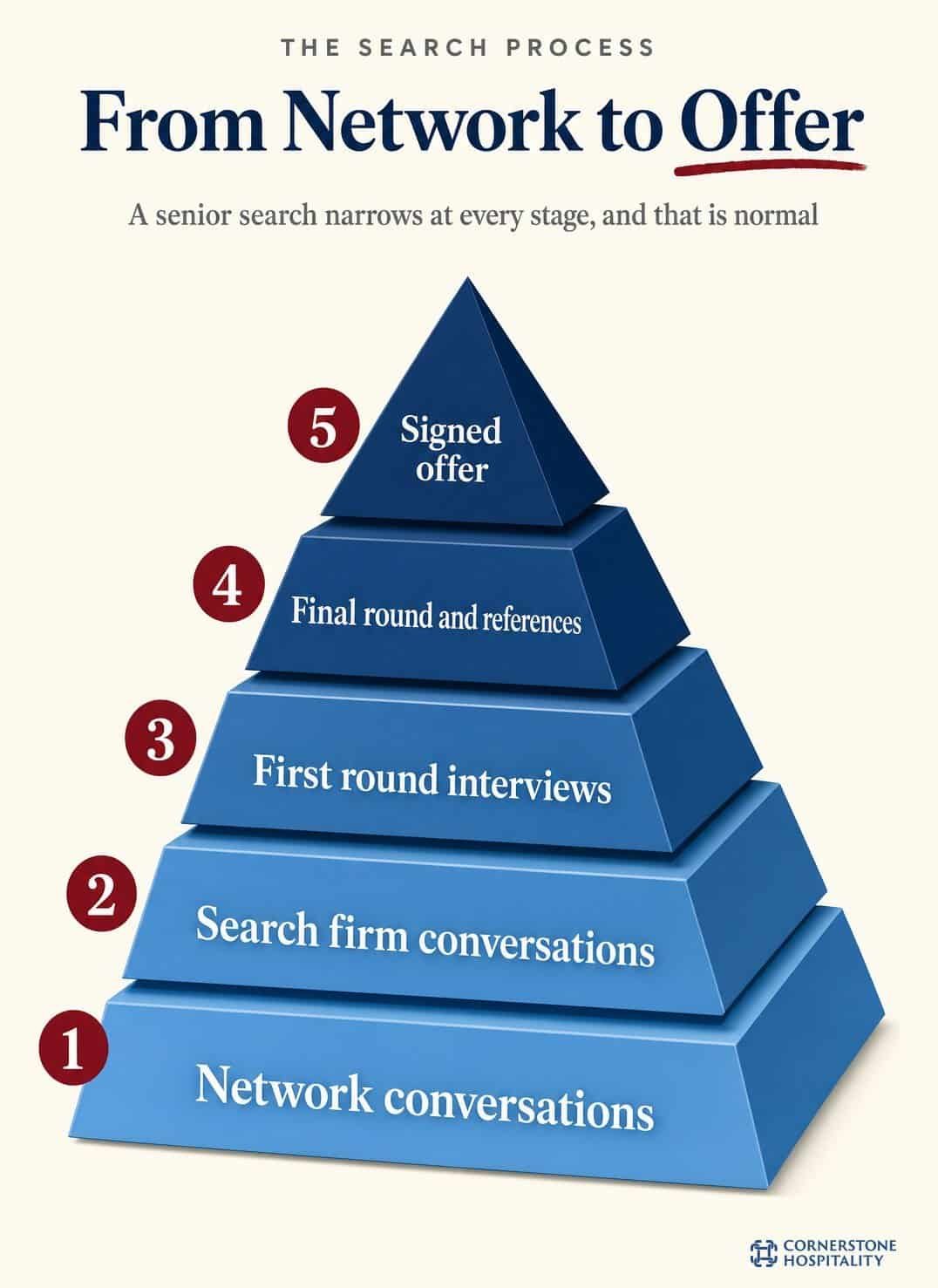
The volume at the base of a senior search is supposed to be wide. Not every conversation becomes an interview, and not every interview becomes a second round. That narrowing is the process working, not a sign the target from month one was wrong. This holds provided the candidate sees some movement at every level. It does not hold when there is volume at the bottom and silence everywhere above it.
Re-entering the market after a senior exit?
Career transition coaching works alongside candidates through positioning, outreach, and the interview cycle, month by month.
Why this matters
A shorter, better-matched list of ten to fifteen roles is easier to represent consistently across interviews than a wide, undifferentiated search, and it is easier for a search consultant to advocate for.
WHY THIS MATTERS
Months 4 to 6: interview cycles, negotiation, and the decision to accept
By month four, reality tests the month one plan for re-entering the hospitality job market. If interviews are landing but not converting, the issue is usually in the close. That means how the candidate answers “Why did you leave?” and “What would you do differently?” not the search itself.
If interviews are not landing at all, the target list from month one was probably too narrow. This is the point to widen geography, property type, or reporting level. Do that rather than keep applying to the same slice of roles.
Negotiation belongs in months four and five, not after acceptance
An offer that arrives in month four or five is the point where the month one target pays off. Suppose a candidate wrote down “director of operations, upscale branded, Southeast Asia” in month one. That candidate has a fast, clear way to judge whether the offer in front of them fits. The alternative is weighing it in the abstract against search fatigue.
It is also the point where negotiating pays off more often than candidates expect. A controlled study of nearly 3,900 job seekers found something useful. Most people who countered an initial offer received at least some of what they asked for. Negotiating also raised total compensation by an average of roughly 12%, equivalent to about $27,000 a year in that sample [9]. For more detail on structuring that conversation, see how to negotiate a career transition package.
The same research found that simply encouraging candidates to counter raised the share who did so from 54% to 61% [9]. That suggests the gap is more often about candidates not asking than about offers with no room in them.
Why this matters
A senior candidate who has already written down the level, segment, and geography they want negotiates from a settled position. This candidate is not negotiating from relief that an offer arrived at all. That is the difference; month one is actually buying.
Weighing an early offer against the month-one plan
An offer that lands in month two or three deserves the same test as one that lands in month five. The question is whether it matches the level, segment, and geography decided at the start. Or does it only look attractive because the search has been running for a while? An early offer that does not fit the original target is usually worth declining. Accepting out of search fatigue is the move to avoid. A candidate who has the month one decision written down has an easier time telling the difference between the two.
Reading an early offer against the month-one target
An offer that fits
Matches the level, segment, and geography written down in month one. Worth a serious, settled look, whatever month it arrives in.
An offer that only looks attractive
Appeals mainly because the search has been running a while. Usually worth declining rather than accepting out of search fatigue.
Why this matters
The test for any offer, early or late, is the same: does it match the month one target, or does it only look good because the search has gone on long enough to feel tiring.
KEY INSIGHT
What slows a senior hospitality search down
Three pressures make re-entering the hospitality job market different from a general executive search in another industry.
The hiring side is often just as slow
A senior hospitality search is not slow only on the candidate’s side. Hospitality trade press has reported cases of a full-service hotel searching for a general manager for close to six months. The hotel used conventional postings and multiple recruiting sources. Then a more targeted, relationship-driven approach produced a shortlist of qualified candidates within about five weeks [5].
The lesson runs both ways. A property that is genuinely serious about a senior hire will usually move faster once it finds the right channel. A candidate whose search feels stalled is often waiting on a process that is itself still finding its footing.
Staffing pressure cuts both ways
More than half of surveyed hotels report being somewhat or severely understaffed. Labor costs are a top concern for 65% of hoteliers, and 42% name workforce shortages [6]. That pressure is real at every level of a property. At the senior level, it tends to work in a candidate’s favor rather than against them. A business that is short on leadership bench strength has more reason to move quickly once it finds the right fit, not less.
Businesses are hiring into a readiness gap
Only 20% of HR leaders say they have leaders ready to fill their most critical roles. Internal candidates can fill only 49% of critical positions immediately [7]. Most senior hospitality appointments, in other words, are arriving into a business that has not built a deep bench. That business is genuinely searching outside rather than settling for whoever is closest to hand.
The World Travel and Tourism Council forecasts that the sector will support 376 million jobs worldwide in 2026. That is one in nine jobs globally, with almost 89 million new jobs projected over the next decade [8]. A capable senior candidate whose search is taking a while is rarely short of a market. The delay is more often about matching to the right property than about scarcity of demand.
What to do
Treat a slow-moving process on the other side as ordinary. It is not a signal about the candidate’s own market position. The readiness gap sits with the hiring business at least as often as it sits with the search.
WHY THIS MATTERS
If month six arrives and the search is still open
A transition still open past month six is not unusual at senior hospitality levels. This is particularly true for general manager roles and above. It does not mean the plan failed. Retained searches alone average four to six months once they are live [2]. A candidate can run several of those in parallel, staggered by a few weeks each. That can easily carry the overall search past the six-month mark, even while every individual process is moving normally.
What it usually means is that the timeline needs an honest reset. The reset asks which of the original three decisions from month one still hold and which need revisiting. A target that was realistic in month one can become too narrow by month six. That is not because the candidate’s standards have dropped. It is because six months of pattern feedback is real information the plan did not have on day one.
Why this matters
Widening the search at month six is a deliberate decision made with six months of evidence, not a concession. The candidates who widen early on purpose usually do better. They do better than those who wait and widen out of necessity in month nine.
A practical reset when re-entering the hospitality job market runs past month six
The practical version of the reset is small. Pick one dimension, such as geography, property type, or reporting level. Widen that one first, rather than loosening everything at once. That keeps the story from month one mostly intact while opening genuinely new conversations. That is easier for a network and a search firm to act on. A candidate who suddenly looks open to everything is harder to act on.
What to do
If month six arrives with the search still open, widen one dimension on purpose rather than loosening everything at once. If the timing is not working for either side, a conversation about when to bring in outside help is worth having; see when to hire a career transition coach, and when to go it alone.
Want a second, settled read on where your search stands?
A short, structured conversation can test whether the month one target still holds, or whether it is time to widen one dimension on purpose.
WHAT TO DO
Frequently asked questions
How long does re-entering the hospitality job market usually take at a senior level?
Should I take the first offer that comes in during month two or three?
Is it a bad sign if the search is still open after six months?
Is it worth negotiating a senior hospitality offer, or does it risk the offer?
What should happen in month one that most candidates skip?
How many search firms should a candidate be talking to at once?
Does a slow hiring process on the employer’s side mean the candidate is a weak fit?
What to do
Work through the plan month by month rather than skipping to the questions that feel most urgent. The sequence is what keeps months four to six building on month one instead of improvising against it.
The bottom line on re-entering the hospitality job market
In short, re-entering the hospitality job market at a senior level is rarely a straight line. It is not meant to be one. The plan is not a guarantee of a faster outcome. It makes sure month four’s activity builds on month one’s decisions rather than improvising against them. It also shows, when month six arrives, whether the search needs patience or a deliberate widening. Both are normal parts of a senior transition. Neither is a verdict on the candidate behind it.
What our clients and candidates say
Florian played a pivotal role in my career transition within the hospitality industry, combining deep expertise in executive search with a highly strategic advisory approach. He takes the time to truly understand your long term ambitions, challenges your assumptions, and positions you for sustainable leadership success.
Stefan Savic, Hospitality Professional, Asset Management, Development & Strategy
Over the years I have worked with Florian and he has continually provided a service second to none. The caliber of individuals he recommends is always spot on, as he ensures that he understands not only the requirements and expectations of a role but also the importance of the success and growth of the business being related to people.
Daniel Aylmer, Chief Executive Officer, Greater China
Ready to put a plan behind the next six months?
Career transition coaching works alongside candidates through positioning, outreach, and the interview cycle, month by month, from the first decision to a signed offer.
Related reading
About this analysis
What the figures draw on: published research on job search duration, executive search timelines, referral hiring and salary negotiation from sources including Right Management, Altios, MyPerfectResume, the American Hotel & Lodging Association, DDI, the World Travel & Tourism Council and academic research from UCLA Anderson, referenced in full below.
The practice behind the guide: drawn from Cornerstone Hospitality’s retained executive search and career transition coaching work with senior hospitality leaders re-entering the market.
References
Sources 1 to 3: how long a senior search takes, and how people actually get hired
- Right Management: Executive Outplacement Services: Crucial Support For Leaders: reports that “in 2024, the average time to secure a new role after a layoff was 20.6 weeks, about five months” across the wider workforce, and that “for executives and senior leaders, who often require longer runways, the time to find a new job can extend up to 12 months or longer”: right.com/insights/executive-outplacement-services
- Altios: Executive Search Process Timeline: The 6-Month Reality No One Wants to Hear: states that “the executive search process timeline averages 4 to 6 months globally, often extending beyond that for expert roles,” with the United States nearer 3 to 4 months and other regions running longer, and that “rushed searches, under 3 months” show roughly 40% retention after one year against “proper searches, 4 to 6 months” at 85% or higher: altios.com/publication/executive-search-process-timeline-the-6-month-reality-no-one-wants-to-hear
- MyPerfectResume: Networking Nation Report, a survey of 1,000 US workers conducted May 2025: finds that “54% of workers report landing a job through a personal or professional connection,” with personal connections cited by 32% and professional connections by 28% as the most helpful tool in their most recent search, “far ahead of job boards, 13%, and staffing firms, 8%,” as reported by CPA Practice Advisor: cpapracticeadvisor.com/2025/08/14/survey-54-of-workers-got-hired-through-a-connection
More sources 4 to 6: hospitality staffing and a hospitality search case study
- American Hotel & Lodging Association: 65% of surveyed hotels report staffing shortages: surveys 282 hoteliers between 6 December 2024 and 3 January 2025 with Hireology, finding 65% still report shortages and hotel employment running “nearly 10% below pre-pandemic staffing levels,” with 71% of properties carrying open positions at an average of six to seven per property: ahla.com/news/65-surveyed-hotels-report-staffing-shortages
- Hospitality Net: Six Months, No General Manager: How a Strategic Search Helped a Hotel Finally Land the Right Leader: reports that “a full-service independent hotel in the Southeast had been searching for a new General Manager for nearly six months” using conventional postings and multiple recruiting sources, before a targeted, relationship-driven approach produced “six highly qualified candidates” within five weeks: hospitalitynet.org/opinion/4131845/six-months-no-general-manager
- American Hotel & Lodging Association: Rising Cost, Staffing Challenges Persist for Hotels as Travel Demand Expected to Hold Steady: surveys 246 hoteliers in late February 2026 and finds that “more than half of respondents report their properties are somewhat or severely understaffed,” with labor costs a top concern for 65% and workforce shortages named by 42%: ahla.com/news/rising-cost-staffing-challenges-persist-hotels
Final sources 7 to 9: leadership readiness, sector demand and the return on negotiating
- DDI: Succession Planning Best Practices: How to Close the Leadership Readiness Gap: reports that “only 20% of HR leaders say they have leaders ready to fill their most critical roles” and that internal candidates “can fill only 49% of critical positions immediately,” with 80% of organizations lacking confidence in their leadership bench: ddi.com/blog/succession-planning-best-practices
- World Travel & Tourism Council: Global Travel & Tourism Growth to Outpace Wider Economy by 1.5 Times Over the Next Decade: published with research partner Oxford Economics, forecasts the sector will “support 376 million jobs worldwide in 2026, representing one in nine jobs globally,” with “almost 89 million new jobs globally” projected over the next decade: wttc.org/news/global-travel-tourism-growth-to-outpace-wider-economy-by-1-5-times-over-the-next-decade
- UCLA Anderson Review, research by Zoe Cullen, Bobak Pakzad-Hurson and Ricardo Perez-Truglia: Most Job Seekers Skip Negotiation, and Pay a High Price: a study of about 3,858 tech job seekers finding that of those who countered an initial offer, “about 85% of them got at least some of what they asked for,” with an average compensation increase of “about 12.45%,” equivalent to roughly $27,000 a year in the study sample, and that simply encouraging candidates to counter raised the share who did so “from 54% to 61%”: anderson-review.ucla.edu/most-job-seekers-skip-negotiation-and-pay-a-high-price