


When Job Rejections Stop Hurting and Start Changing You

By Florian Kittler · October 29, 2026
Managing Partner, Cornerstone Hospitality · ~14 min. read

Have you ever wondered whether job rejection is changing you more than you realize?
At first, you are motivated. You update your resume, refine your LinkedIn profile and add your latest certificate for the world to see. You prepare for interviews, speak to a few recruiters, reach out to your network, and apply for roles that genuinely excite you. You believe your long experience has value. You know what you bring to the table.
Then the rejections begin.
“We’ve decided to move forward with other candidates.”
“You were a strong candidate, but we found someone whose experience more closely matches our requirements.”
“We were impressed, but unfortunately…”
One job rejection is disappointing. Five are frustrating, and many end before the process even began. This can leave you questioning what you once took for granted. Someone should clearly see your value.
And somewhere along the way, something changes. You stop reaching out to people with the same enthusiasm and passion you had on day one. You hesitate before applying for a role. You prepare for interviews, but a part of you already expects the rejection. You start wondering whether there is any point in trying harder.
This is where a job search can become more than a career challenge. It can become a psychological one.
KEY INSIGHT
The Hidden Effect of Repeated Job Rejection
In psychology, learned helplessness describes a phenomenon in which repeated experiences of having little or no control over negative outcomes can lead people to believe that their actions will not make a difference, even when opportunities to influence the outcome later become available. You might have seen the study with the big fish in a tank, separated through glass from his prey, who stopped hunting even when the glass was removed.
The concept was first documented in 1967 by psychologists Martin Seligman and Steven Maier[1], in research still taught in psychology courses today. Dogs who had first experienced a shock they could not escape later failed to attempt an escape even once a clear route out became available, while dogs who had not faced that first inescapable shock escaped easily.
The connection to recruiting is worth reflecting on. You can invest hours in preparing an application, spend days preparing for an interview, and bring years of valuable experience to the table. Yet the final decision may depend on factors you cannot see or influence.
applications a single senior opening can draw, by widely cited hiring-industry estimates, one reason a run of rejections is rarely a verdict on you personally [3]
of applicants are typically invited to interview for a given opening, by those same estimates [3]
the year the original learned helplessness research was first published [1]
the year brain-imaging research found that social rejection activates some of the same regions as physical pain [2]
Figures on application volume, interview rates, and the research behind learned helplessness and the neuroscience of rejection. Sources listed in full at the foot of the article.
But when rejection follows rejection, it becomes easy to draw a different conclusion:
I’m not good enough.
My experience isn’t valued anymore.
I’ll probably be rejected anyway.
What began as a series of individual outcomes can gradually become a belief about yourself. And that belief can influence what you do next.
You apply less. You aim lower. You stop networking. You become less convincing in interviews because you no longer fully believe in your own value. The painful irony is that the very process that has damaged your confidence can begin to affect how you approach future opportunities.

Two Ways a Job Search Can Go After a String of Rejections
Processing it
Each rejection is reviewed on its own terms, folded into what you know about that search, and then set down so the next application starts clean.
Drifting toward helplessness
Rejections start to blur into one running total, each new one treated as more proof of the last, until applying at all starts to feel pointless.
Why this matters
The pattern described here is well documented, and it is also reversible. Knowing that the dip in confidence has a name and a known shape is often the first step in loosening its grip.
WHY THIS MATTERS
The Problem Isn’t That You’ve Lost Your Ability
Let’s be clear: not every job rejection is a lesson, and not every failed application makes you stronger. Sometimes the recruitment process is poorly managed. Sometimes the feedback is inadequate. Sometimes the role was never a realistic opportunity in the first place. And sometimes you really do need to change your approach.
But none of these things automatically means that you have lost your professional value.
What Rejection Can Feel Like, and What’s Actually True
| It can feel like | What’s actually true |
|---|---|
| Nobody wants someone with my experience | The field for a senior opening is often very large, most applicants are never seen by a decision maker at all |
| I must be doing something wrong | The process itself may have been slow, unclear or poorly run, that is a signal about the employer, not about you |
| I’m not performing as well as I used to | Confidence and competence are different things, a dip in one does not mean a drop in the other |
| I should lower my expectations | A mismatch on one role says nothing about the next one, each process is its own comparison |
| There’s no point trying as hard | Effort still changes outcomes, preparation, positioning and follow up all remain within your control |
Why this matters
Your recent results are information about your current job search. They are not a definitive verdict on your worth or potential. That distinction matters.
When confidence declines, we often treat our feelings as evidence. Because we feel less capable, we assume we have become less capable. Yet feeling less confident and being less competent are not the same thing.
Working Through a Stretch Between Roles?
A short, structured conversation can help you see your search with a clearer eye than you can manage on your own right now.
WHAT TO DO
How to Regain a Sense of Control
If repeated rejection has started to affect your confidence, the answer isn’t simply to tell yourself to stay positive or send out more applications. It is to rebuild the connection between your actions and the outcomes you can influence.
1. Separate What You Control From What You Don’t
You cannot control whether a hiring manager chooses you. You can control how well you prepare, how clearly you communicate your value, how selectively you apply, and whether you ask for feedback. Measure your progress against those actions, not just the final decision.
2. Replace Assumptions With Evidence
You are a business expert. Treat the search process in the same way as you would a sales pipeline. Instead of concluding, “Nobody wants someone with my background,” examine what is actually happening.
- Are you getting interviews but not progressing? Your positioning or interview approach may need attention.
- Are you rarely getting interviews? Your target roles, resume, or access to decision makers may need a closer look.
- Are you reaching final rounds but losing out? You may already be competitive, and the reasons for the final decision deserve a more specific assessment.
Different problems require different solutions. A blanket conclusion about your own inadequacy solves none of them.
3. Make Your Next Step Smaller
When confidence is low, another ambitious application can feel overwhelming. Start with one meaningful action: reconnect with a former colleague, ask someone in your target industry for a conversation, practice answering a difficult interview question, or approach one carefully selected opportunity. Reaching out to a few recruiters you have built trust with over the years can help as well, since they might know about a company you are speaking with or have dealt with the hiring manager before and can offer a useful pointer.
A commonly used framework behind this idea is self-efficacy, first described by psychologist Albert Bandura in 1977[4]: confidence tends to follow a track record of small, completed actions, not the other way around. The objective is not to secure an offer tomorrow. It is to regain momentum and remind yourself that you can still take purposeful action.
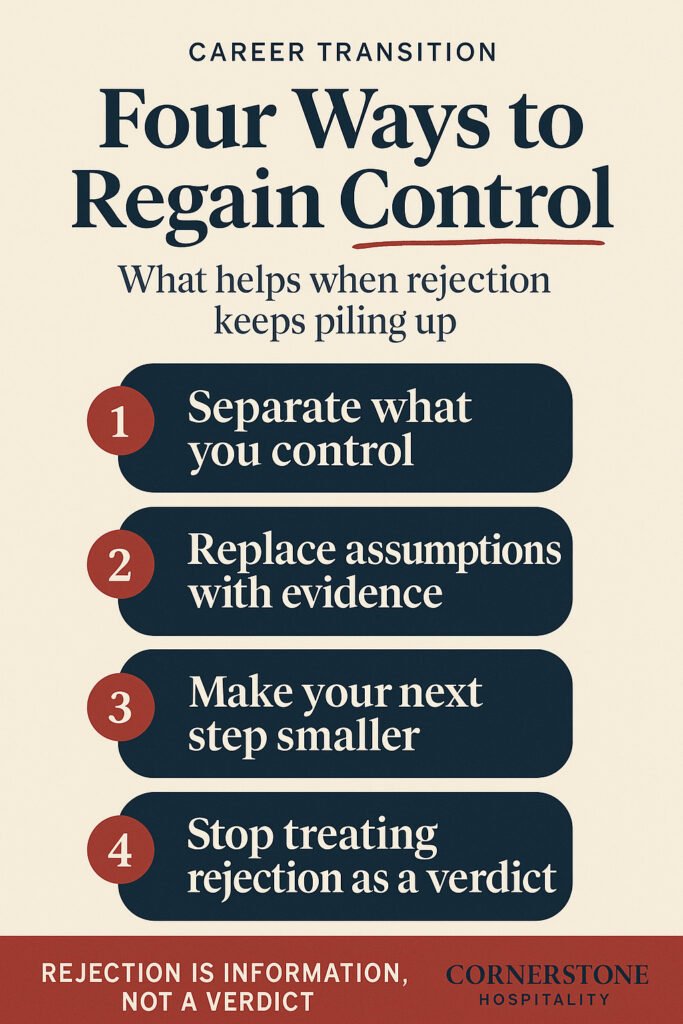
4. Stop Treating Every Rejection as a Personal Evaluation
Recruitment decisions are comparative, contextual, and often influenced by factors candidates never see. You can be an excellent executive and still not be the person selected for a particular position.
Learn what you can from each process. Then let the outcome remain what it is: a decision about a specific opportunity at a specific moment. Not a definition of who you are.
Separate
Note what you controlled in this search, preparation, positioning and follow up, apart from the final decision itself.
Verify
Replace the general assumption with a specific read on where in the process things are actually stalling.
Shrink
Choose one small, concrete action for today rather than a big push for tomorrow.
Depersonalize
Take what the process offers to learn, then let the decision stay what it is, about one role, not about you.
What to do
Pick one of the four steps above and apply it to your search this week. Momentum tends to return through action, rarely through waiting for confidence to come back on its own.
Rejection is data about one decision. It is not a verdict on your value.
Florian Kittler, Managing Partner, Cornerstone Hospitality
WHY THIS MATTERS
A Final Thought
If you have been searching for a role for months, perhaps even longer, and your confidence has taken a hit, recognize what is happening without judging yourself for it.
You are navigating a process in which effort and reward are not always connected in obvious ways. It is understandable that this can wear you down. But be careful not to let a difficult chapter convince you that you have no influence over the next one.
You don’t need to feel completely confident to take the next step. Sometimes confidence returns only after you begin taking action again. And if you find yourself struggling to regain momentum, you don’t have to do it alone. A trusted colleague, mentor, recruiter, or career coach can help you see patterns that are difficult to recognize when you are in the middle of them.
The goal isn’t to convince yourself that every opportunity will work out. It’s to stop assuming that none of them will.
Because your last job rejection may tell you something about the role, the market, or your approach. It does not get to decide what you do next.
What Clients and Colleagues Say
Florian played a pivotal role in my career transition within the hospitality industry, combining deep expertise in executive search with a highly strategic advisory approach. Unlike traditional recruiters, he takes the time to truly understand your long term ambitions, challenges your assumptions, and positions you for sustainable leadership success.
Stefan Savic, Hospitality Professional, Asset Management, Development & Strategy
Over the years I have worked with Florian and he has continually provided a service second to none. The caliber of individuals he recommends is always spot on, as he ensures that he understands not only the requirements and expectations of a role but also the importance of the success and growth of the business being related to people.
Daniel Aylmer, Chief Executive Officer, Greater China
“Have you ever experienced a point in your career when repeated rejection began to affect your confidence? What helped you regain your sense of control?”

About this analysis
What the ideas draw on: foundational psychological research on learned helplessness (Seligman and Maier) and self-efficacy (Bandura), neuroscience research on the experience of social rejection (Eisenberger, Lieberman and Williams), and widely cited hiring-industry estimates on application and interview volume, referenced in full below.
The practice behind the guide: drawn from Cornerstone Hospitality’s work supporting senior hospitality leaders through career transitions and the job searches that come with them.
Why this matters
A difficult stretch of job searching is real, and so is the way back from it. The two things that help most, naming the pattern and taking one small purposeful step, are both available to you right now.
A Confidence Gap Caused by Repeated Job Rejection Is Coachable
We work with senior hospitality leaders through exactly this stretch of a career transition.
WHAT TO DO
Frequently Asked Questions
Understanding the pattern
Is it normal for job rejection to affect my confidence this much?
Yes. A string of rejections removes the usual link between effort and outcome, which is exactly the condition that produces learned helplessness, a well documented psychological pattern first described in 1967. Recognizing the pattern is often enough to start loosening its hold.
What is learned helplessness, in plain terms?
It is the belief, built up through repeated experiences of not controlling an outcome, that your actions no longer matter, even once they do. In a job search, that shows up as applying less, aiming lower, and expecting rejection before it happens.
Taking action
How do I know if the problem is my approach or just the market?
Look at where in the process things are stalling. Rarely getting interviews points to your positioning, resume or network reach. Getting interviews but not progressing points to how you present in the room. Reaching final rounds but losing out usually means you are already competitive and the decision came down to a narrower, specific factor.
What is one small step I can take if I feel stuck?
Pick a single, concrete action rather than a big push: reconnect with one former colleague, ask one person in your target industry for a conversation, or approach one carefully chosen opportunity. The goal is to rebuild momentum, not to land an offer immediately.
Should I keep applying at the same pace even after several rejections?
Pace matters less than quality of targeting. If rejections are piling up, it is worth pausing briefly to review your positioning and the roles you are choosing, then resuming with a more selective, better prepared approach rather than simply applying faster.
Getting support
When is it worth bringing in outside help, like a career coach?
When you notice yourself applying less, expecting rejection before it happens, or struggling to see your own experience clearly. A coach, mentor or trusted colleague can often see patterns in your search that are hard to recognize from inside it.
Does executive-level experience make job rejection easier to handle?
Not automatically. Senior leaders often hold themselves to a higher bar precisely because of their track record, which can make a run of rejections feel more personal, not less. Experience helps with perspective once the initial sting has settled, but it does not remove the sting.
Written by
Florian Kittler, ISHC
Managing Partner, Cornerstone Hospitality · Global Practice Leader, Hospitality, Travel & Leisure
Florian leads Cornerstone International Group’s global Hospitality, Travel & Leisure Practice. He brings seventeen years of senior hospitality experience, including Marriott, Hyatt, IHG, Mandarin Oriental and Shangri-La Hotels & Resorts, and sixteen years in retained executive search and career transition support. He is bilingual in English and German and works across Europe, the Middle East, the Americas and Asia-Pacific.
Related Reading
Where to start
Related reading
Related reading
References
Sources 1 to 2: how rejection registers, psychologically and neurologically
- Seligman, M.E.P. and Maier, S.F.: the original 1967 learned helplessness research, now part of the standard psychology curriculum, summarized by the American Psychological Association: apa.org
- Eisenberger, Lieberman and Williams: brain imaging research published in 2003 finding that social rejection activates some of the same neural regions as physical pain, indexed via the National Library of Medicine: pubmed.ncbi.nlm.nih.gov
Sources 3 to 5: confidence, momentum and the numbers behind a search
- Glassdoor: widely cited hiring-industry estimates on the number of applications a single corporate opening typically draws, and the share invited to interview: glassdoor.com
- Bandura, A.: Self-Efficacy, Toward a Unifying Theory of Behavioral Change, the 1977 paper underpinning why small, completed actions rebuild confidence, summarized by Verywell Mind: verywellmind.com
- LHH (Lee Hecht Harrison): global career transition and outplacement coaching practice, for context on structured support during a search: lhh.com
Want to talk about a job search that has stopped feeling like progress?