


12-Month Succession Mapping Across a Whole Leadership Layer


Succession mapping looks across a whole leadership layer, on a twelve-month horizon. It shows a hospitality group things that planning one seat at a time cannot. For example, it shows where the same one or two people are quietly backing up several different roles at once.
Succession mapping usually starts with one seat. An owner asks who could step in if the general manager left. Or a board wants a named backup for the finance director. Then the team builds the plan for that single role, one incumbent and one successor. After that, the team reviews it on its own timeline and files it until someone needs it.
That is a reasonable place to start. In practice, most hospitality groups that plan for succession at all still work this way.
Consider SHRM’s 2025 benchmarking of talent management executives. In fact, just 22% of HR leaders say their organization has a formal succession plan of any kind [1]. Adoption tracks company size closely, with 16% of smaller organizations against 44% of the largest ones. Where a plan exists, it nearly always covers one seat at a time.
What succession mapping adds to single-seat plans
Succession mapping across a whole leadership layer adds a second layer of information. The layer covers every general manager, every regional director and every department head at one level, on the same twelve-month horizon. However, single-seat planning does not produce that view on its own.
The map shows how the individual plans interact. First, it shows whether two different roles quietly lean on the same one or two people. Second, it shows whether one region carries three ready successors while another carries none. Third, it shows whether the year ahead has more vacancies pending than the organization has ready replacements for.
The readiness gap that succession mapping brings into view
The readiness gap gives that pattern room to hide. For example, only 20% of HR leaders say they have leaders ready now for their most critical roles, and 80% describe themselves as lacking confidence in their leadership bench [2].
Internal candidates can fill only 49% of critical positions immediately [2]. That means roughly half of every senior vacancy across a layer already starts from outside the building. Seen one seat at a time, that gap looks evenly spread across the organization. However, mapped across the layer, it usually is not.
This article is a practical look at succession mapping. Here is what changes when planning moves from a single seat to a whole layer. First, it covers what a twelve-month layer map actually surfaces.
Next, it explains why twelve months is the useful window. Then it covers what goes into building one. Finally, it shows what hospitality adds to the risk that a generic succession framework does not account for.
Figures throughout this article are drawn from the sources list at the end.
Succession mapping: the limit of single-seat planning
Planning succession for one role at a time answers a narrow question well. Who is ready for this seat, and how ready are they? It is a useful question, and worth asking for every senior role in the business.
The limit is not in how the plan answers that question. The limit is in what it cannot see. That is because teams build and review each single-seat plan on its own. Each one sits in isolation from every other single-seat plan in the same filing system.
Where concentration risk hides in single-seat plans
That isolation is where concentration risk hides. A regional director and a general manager can each have a named, credible, ready-now successor on paper. Reviewed on its own, each plan looks sound.
If both plans point to the same person, the organization does not have two ready successors. It has one. As a result, both roles depend on that one person being available, willing and still with the company when either seat opens.
In short, nothing in either single-seat plan reveals that. Neither plan looks sideways at the other, by design.
What single-seat planning shows
Whether one named role has a ready, credible successor. Each plan is reviewed and filed on its own, with no view of the other plans around it.
What succession mapping shows
Whether that same successor is also backing up a second or third seat, whether one region has no ready option at all, and whether several seats are likely to open in the same window.
Why this matters
A single-seat plan can be well built and still miss the risk that matters most. The gap is not in the quality of any one plan. Instead, no single-seat plan checks itself against the others. Our own article on succession planning fundamentals covers how to get the single-seat version right before layering a map on top of it.
Planning succession for more than one seat this year?
A twelve-month layer map builds on the individual assessments already in place. It shows where the whole picture, not any one seat, needs attention.
Boards feel this gap directly
Only 35% of directors believe their board has ample time to complete succession planning properly. Boards with genuinely stronger succession practices are far more likely to have identified their internal candidates in the first place. At those boards, 100% say they have, against 72% at boards with weaker practices.
Also, 93% have had firsthand interaction with those successors, against 72% elsewhere [3]. However, even boards doing this well typically look at one seat, the chief executive’s, rather than the layer beneath it.
What a twelve-month layer map actually shows
Succession mapping takes every single-seat plan for one level of the organization. That level might be the general managers, the regional directors, or the department heads reporting into a single executive. It lays them next to each other on one twelve-month timeline.
The individual readiness assessments do not change. What changes is that teams now read them together rather than in separate files. As a result, three things become visible that were not visible before.
Concentration risk and readiness gaps in succession mapping
Concentration risk is the first and usually the largest. It means the same one or two people show up as the ready successor for more than one seat. Sometimes that happens by accident of good talent. Sometimes nobody has checked.
A layer map with four roles and only two distinct names in the successor column is not four separate risks. It is one risk sized at two people.
On concentration risk
Readiness gaps come second. A single-seat plan will often report a name in the successor field. That name may not be genuinely ready within the window that matters.
Laid against the other roles in the layer, a gap that looked isolated can look very different. It can turn out to be the only role with no credible internal option inside twelve months. That changes how urgently the role needs external search support rather than internal development.
Sequencing conflicts that succession mapping catches
Sequencing conflicts are the third. They are the ones single-seat planning is least equipped to catch. Two roles can each have a distinct, credible, ready successor. Even so, the map can still show a problem if both incumbents are likely to move within the same few months.
Two vacancies that open close together are a different planning problem than two vacancies spaced a year apart. For example, they may draw on overlapping talent pools or the same hiring and onboarding capacity. That holds even when every individual plan looks identical on paper.
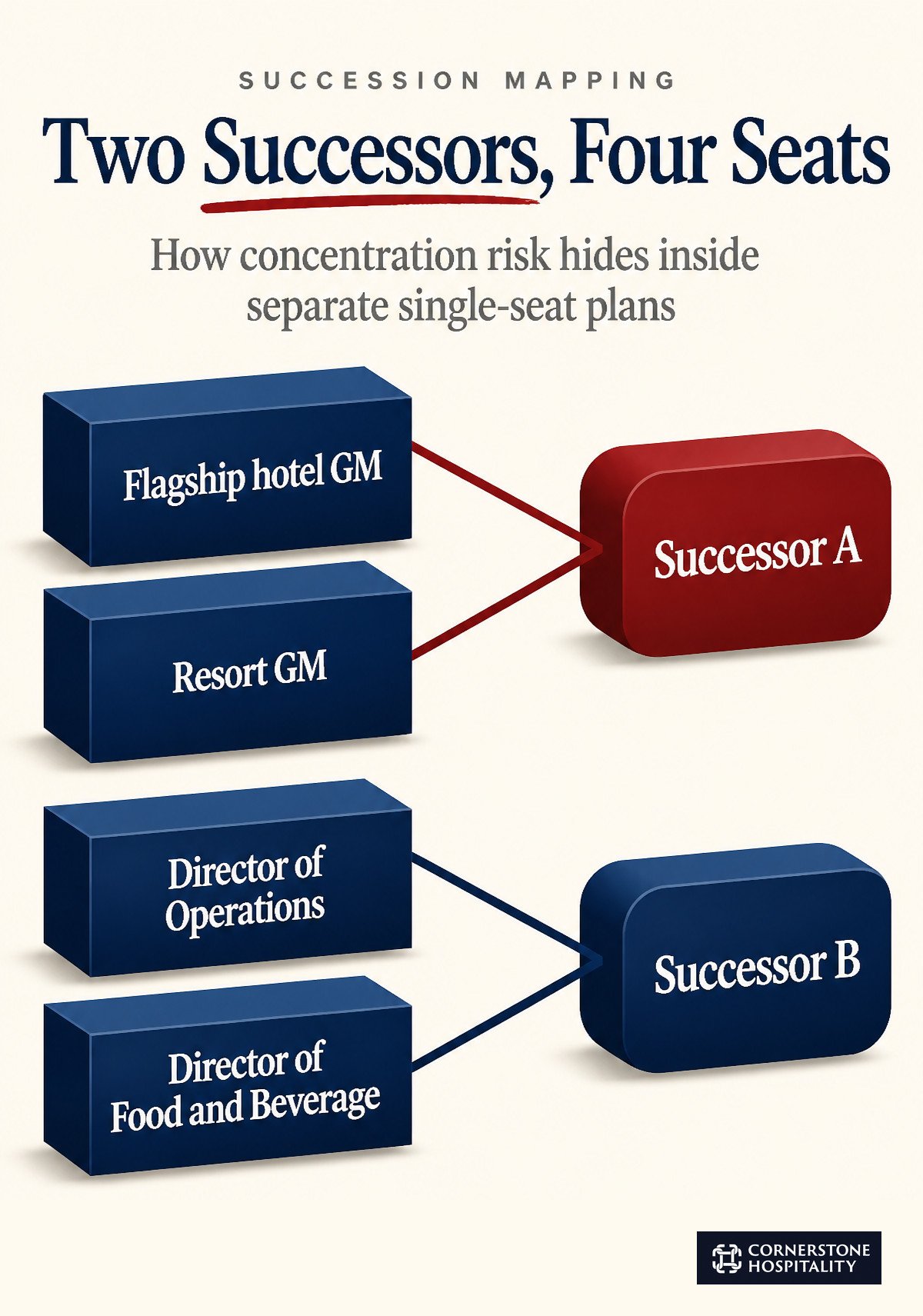
A simplified succession mapping grid
A single round of succession mapping, run honestly, tends to surface a version of this table. It is a simplified illustration of the kind of grid a first review produces. It is not a record of any real organization.
Still, the pattern it shows is the one that recurs. A small pool of names carries more than its share of the layer.
| Role | Incumbent status | Successor readiness | Risk flag |
|---|---|---|---|
| General Manager, Flagship Property | Expected to move into a regional role within the year | Successor A, ready now | Concentration risk: Successor A is also named for the Regional Resort seat below |
| General Manager, Regional Resort | Stable, no planned move | Same successor as the Flagship GM seat (Successor A), ready in 6 to 12 months | Concentration risk |
| Director of Operations | Stable, no planned move | Successor B, ready now | Concentration risk: Successor B is also named for the Food and Beverage seat below |
| Director of Food and Beverage | Retiring within 18 months | Same successor as the Director of Operations seat (Successor B), ready in 12 to 18 months | Concentration risk, plus a sequencing conflict if both seats open in the same window |
Reviewed role by role, every row in that table looks acceptable on its own. All four roles report a named successor. Only reading down the successor column across the whole layer shows the same two names repeating, each covering two seats. In short, a layer with mostly filled-in boxes carries less real coverage than it appears to on paper.
Why this matters
Reading the successor column across the whole layer is the step single-seat planning cannot do by design. It is also usually the fastest part of succession mapping to complete, once the individual readiness assessments already exist.
Why twelve months is the useful horizon
A shorter window does not give a genuine readiness gap enough time to close. Development turns a credible successor into a ready one. It might be a stretch assignment, a rotation into a different property, or structured coaching against a specific gap. Any of these takes months to show results.
So a three or six month map mostly restates who is or is not ready today. It leaves no room to change that.
Why a longer window turns speculative
A much longer window runs into a different problem. It becomes speculative rather than actionable. Roles that will not turn over for two or three years still matter.
However, planning them on the same cycle as roles that could turn over this year spreads attention thin. It also makes the near-term risk harder to see clearly.
For succession mapping, twelve months is generally long enough to close a real gap through targeted development. It is also short enough that the map still reflects the organization as it actually stands today. It is not a guess about where the organization will be.
Why succession mapping fits the planning calendar
There is a practical reason too. A year lines up with a normal planning and budget cycle. That makes a layer map something the business can act on. It is not a document that sits beside the annual planning calendar without touching it.
Review the map on the same rhythm as everything else the leadership team already reviews. That is most of what keeps it current rather than filed and forgotten.
What to do
Set the layer map on a twelve-month cycle tied to the existing planning calendar. Treat a shorter window as a check-in on progress against the twelve-month map rather than a separate exercise.
Building the map: what a layer-wide review includes
Succession mapping is not a new assessment process laid on top of the individual succession plans that already exist. It brings those plans together on one page and reads them as a set. Building a map well has four parts.
1. Define the layer
Pick one level, general managers, regional directors or department heads, and keep it clean rather than mixing levels.
2. Bring the data together
Take each seat’s existing readiness assessment and enter it against the same set of fields.
3. Read the column across
Check every repeated name and every empty seat across the whole layer, not role by role.
4. Review on a fixed cadence
Revisit quarterly, with a full remap at the year mark, and the right people in the room.
Define the layer before starting
A layer is one level of the organization. It can be every general manager, or every regional director, or every department head reporting to the same executive. Mixing levels, such as a general manager next to a regional vice president, muddies the comparison.
That is because the two roles carry different readiness timelines and different successor pools. A clean layer is the unit the rest of the exercise depends on.
Bring the individual readiness data together
Take each seat’s existing readiness assessment, however the team produced it. Enter it against the same set of fields: incumbent status, named successor or successors, readiness timeline, and any development already underway.
This step is mostly assembly rather than new work. That is why a layer map costs far less to build than it might sound like it should. This holds once the underlying assessments already exist.
Read the successor column across the whole layer
This is the step single-seat planning skips by design. Every name that repeats in the successor column across the layer is a concentration risk until proven otherwise. Likewise, every seat with no name at all is a readiness gap the layer cannot quietly absorb.
Check sequencing the same way. Next, ask which incumbents are likely to move inside the same window. Then ask what that means for the successors and the business if more than one seat opens at once.
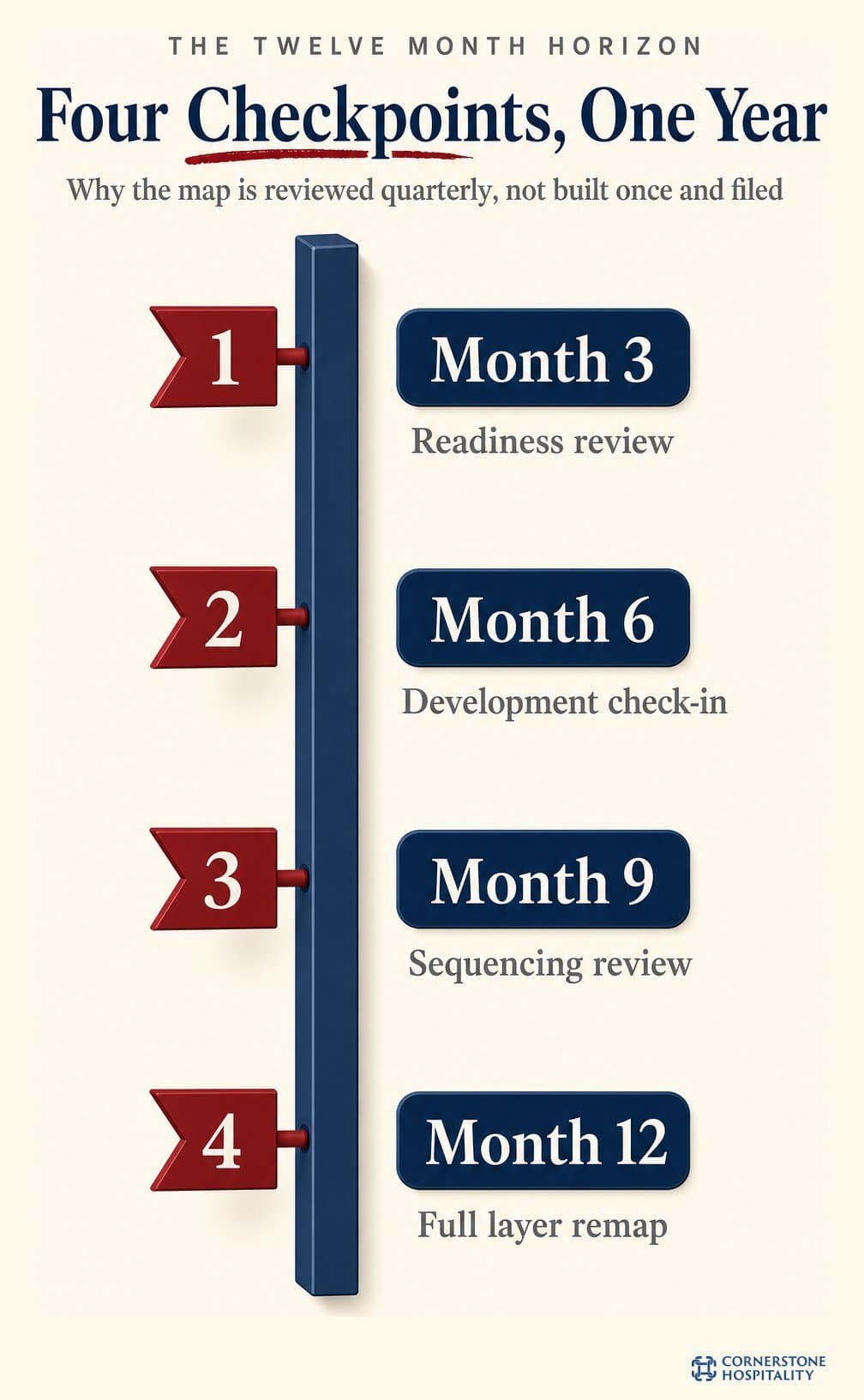
Review it on a fixed cadence, with the right people in the room
A map built once and never revisited decays the moment somebody’s circumstances change. A quarterly check against the twelve-month view, with a full remap at the year mark, keeps it current. Who needs to be in the room matters as much as the cadence.
The pattern among boards with stronger succession practices holds at the layer level too. Targeted coaching for named successors is far more common in one situation. That is where the reviewing group actually has firsthand interaction with the people on the map. The figures are 93% against 72% where it does not [3].
A layer map reviewed only by HR tends to stay theoretical. That is true when the executives who work with these people day to day are not in the room.
How an outside read supports succession mapping
An outside read helps here. It is where Cornerstone’s own succession planning assessment work sits most naturally against this process. First, individual executive assessment gives each seat’s readiness rating some rigor beyond a manager’s impression.
Second, a search partner who already knows the external market for a given role can also help. That partner can tell a business quickly whether a readiness gap is worth closing internally. Or the gap may be better covered by keeping a live external option in view.
What to do
Run the four steps in order: define the layer, assemble the readiness data that already exists, read the successor column across the whole set, then put a fixed review cadence on the calendar with the people who actually know the candidates, not HR alone.
What hospitality adds to the risk
Two things make concentration risk and readiness gaps sharper in hospitality than the generic succession planning literature usually assumes.
Staffing pressure eats the diagnostic time
More than half of hoteliers report their properties are somewhat or severely understaffed. Labor costs are a top concern for 65% of them [4]. Understaffed properties tend to lean on whoever is closest and available.
That is precisely how a successor named for one role quietly ends up covering another. It happens informally, long before any plan says they should. Succession mapping catches that drift before it becomes the default arrangement.
Trust in leadership is not a given right now
Trust in immediate managers has fallen to 29%, a 37% decline since 2022. The study covered 10,796 leaders and 2,185 HR professionals [5]. In addition, high-potential intention to leave has risen from 13% in 2020 to 21% in 2024 over the same period [5].
A named, ready successor in a layer map today can be a departure risk. It can arrive within the same twelve months the map is meant to cover. That is one more reason a single review at the start of the year is not enough on its own.
Why this matters
Staffing pressure quietly reassigns successors. Flight risk is rising among the people most likely to become successors. Both argue for reviewing the layer map more often than once, not less. If that sounds like your own team right now, talk to us about where to start.
The cost of mapping one seat at a time
The value of the layer view shows up most clearly in what strong benches actually deliver. Organizations with genuine bench strength are 2.9 times more likely to successfully fill leadership roles internally when a seat opens. They are also 2.8 times more likely to outperform financially [2].
Also, promotions supported by structured assessment succeed 1.6 times more often than promotions made on impression alone [2]. None of that advantage depends on planning any single seat perfectly. It depends on the pattern across the whole layer being visible and managed. Succession mapping makes that pattern visible. Single-seat planning, done role by role in isolation, cannot do that.
None of this replaces individual readiness assessment. A layer map is only as good as the seat-level plans that feed it. A poorly assessed successor does not become a good one by appearing on a wider chart.
The map adds a second, different kind of visibility on top of that work. It looks past whether any one person is ready. It shows whether readiness, taken as a whole, is spread across enough people to survive the year the map covers.
Succession mapping turns separate answers into one picture
Mapping succession one seat at a time will keep answering a real question well. Does this particular role have a credible backup? It will not answer the question a leadership layer actually needs answered.
The question is where the organization’s readiness sits across every seat at that level. Does a handful of people carry it? Or is it spread widely enough to survive a normal year of departures, promotions and surprises?
A twelve-month layer map does not replace the individual work. It turns a set of separate answers into one picture the business can actually act on.
Why this matters
None of this depends on getting any single seat perfectly right. It depends on whether readiness is spread across enough people, not concentrated in one or two, to survive a normal year of departures and promotions.
Start a confidential conversation about your own leadership layer
Tell us which layer you are looking at, general managers, regional directors or department heads, and we will help you turn the individual plans you already have into one picture.
What clients and candidates say
Florian played a pivotal role in my career transition within the hospitality industry, combining deep expertise in executive search with a highly strategic advisory approach. He takes the time to truly understand your long term ambitions and positions you for sustainable leadership success. His network across the global hospitality sector is exceptional.
Stefan Savic, Hospitality Professional, Asset Management, Development and Strategy
Over the years I have worked with Florian and he has continually provided a service second to none. The caliber of individuals he recommends is always spot on, as he ensures he understands not only the requirements of a role but the importance of the business behind it.
Daniel Aylmer, Chief Executive Officer, Greater China
Both are verified public LinkedIn recommendations.
About this analysis
What the figures draw on: published research and industry reporting on succession planning, board governance and hospitality staffing from sources including SHRM, DDI, the Harvard Law School Forum on Corporate Governance and the American Hotel and Lodging Association, referenced in full below.
The practice behind the guide: drawn from Cornerstone Hospitality’s executive search and executive assessment work with hospitality groups mapping readiness across leadership layers, boards and ownership groups.
Frequently asked questions
Related reading
Want a second set of eyes on your own leadership layer?
Share which roles you are looking at. We will tell you where the concentration risk and the readiness gaps are most likely sitting.
Information in hospitality leadership and executive assessment changes frequently, and every organization is different, individual results vary. Please contact us for guidance suited to your exact situation.
Written by
Sources
- SHRM: What HR Leaders Need to Know About Succession Planning in 2026: reports from SHRM’s 2025 Talent Management Executives Benchmarking research that “just 22% of HR leaders reported that their organization had a formal succession plan,” with adoption tracking company size: “16% of smaller organizations reported having a succession plan, compared to 44% of extra-large organizations”: shrm.org/executive-network/insights/what-hr-leaders-need-to-know-about-succession-planning-2026
- DDI: Succession Planning Best Practices: How to Close the Leadership Readiness Gap: finds that “only 20% of HR leaders say they have leaders ready to fill their most critical roles” and “80% of organizations lack confidence in their leadership bench,” with internal candidates able to “fill only 49% of critical positions immediately.” Organizations with strong benches are reported as up to 2.9X more likely to successfully fill leadership roles internally and 2.8X more likely to outperform financially, and promotions are 1.6X more likely to succeed when assessments inform selection: ddi.com/blog/succession-planning-best-practices
- Harvard Law School Forum on Corporate Governance, by Ani Huang and Anthony Nyberg: CEO Succession: 10 Pitfalls Boards Must Avoid, and the CHRO Practices That Help (9 July 2025): reports that “just 35% of directors believe their board has ample time to complete CEO succession planning,” and that boards with stronger succession practices identify their internal candidates at “100% agree vs. 72%,” with firsthand interaction with successors at “93% vs. 72%” and clear transition plans in place at “42% vs. 12%”: corpgov.law.harvard.edu/2025/07/09/ceo-succession-10-pitfalls-boards-must-avoid-and-the-chro-practices-that-help
- American Hotel & Lodging Association: Rising Cost, Staffing Challenges Persist for Hotels as Travel Demand Expected to Hold Steady: surveys 246 hoteliers and finds that “more than half of respondents report their properties are somewhat or severely understaffed,” with labor costs a top concern for 65%: ahla.com/news/rising-cost-staffing-challenges-persist-hotels-travel-demand-expected-hold-steady
- DDI: Global Leadership Forecast 2025 Study Signals Looming Leadership Exodus: surveys 10,796 leaders and 2,185 HR professionals and reports trust in immediate managers at “just 29%, a 37% decline since 2022,” with high-potential intention to depart rising “from 13% in 2020 to 21% in 2024”: ddi.com/about/media/global-leadership-forecast-2025
This sits inside our executive assessment work, which covers the fuller picture beyond this one piece.