

Succession Planning Assessment for Hospitality Groups
Succession planning assessment that reads a whole leadership layer, months before anybody resigns.
A succession planning assessment reads an entire leadership layer against the seats above it, so a group knows who is genuinely ready long before the week a resignation lands on the desk.
Most hospitality groups have a succession plan in the sense that somebody has written names in boxes. Very few have evidence behind those names. Cornerstone Hospitality assesses the whole tier through Chartered Psychologists, so the plan rests on measured readiness rather than on who is currently visible to the executive committee.

Succession Planning Assessment: A Road, Not a List
A list of names is a snapshot of opinion. A succession planning assessment is a sequence that produces evidence and then acts on it, closer to the pattern SHRM’s own research on succession readiness keeps pointing back to: intent is common, evidence is not.
It starts by mapping who is genuinely in scope, which is usually a wider group than the obvious two. It reads that whole tier on the same instruments, so comparisons mean something. It names the gaps specifically rather than generally. It closes them through coaching aimed at the actual evidence. Finally it produces a named successor who has been tested rather than assumed.
Twelve months is a comfortable run for that sequence. Consequently the groups that start it in the week the resignation arrives are not doing succession planning at all, they are recruiting under time pressure.
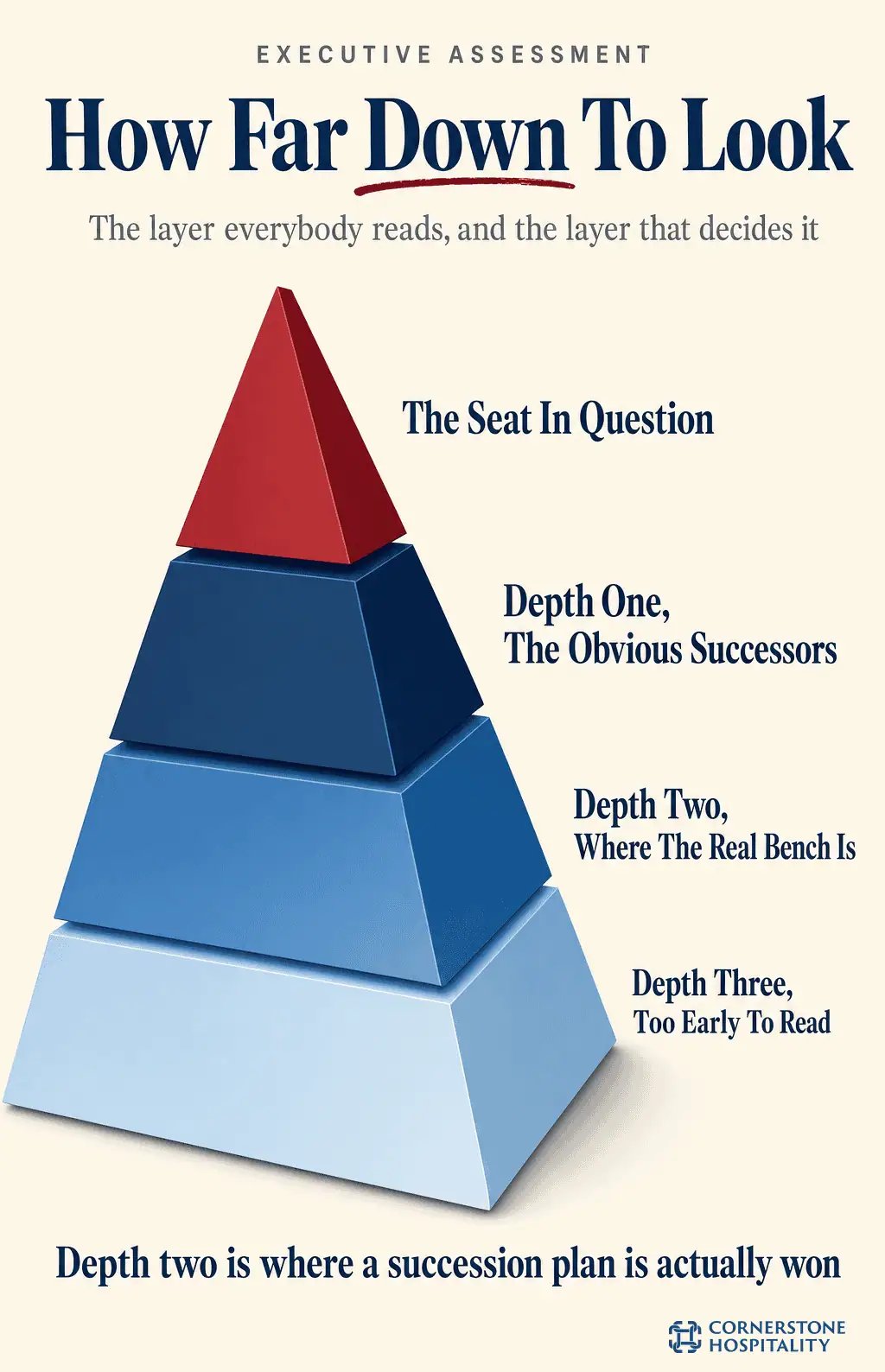
How far down a succession planning assessment should look
The obvious layer, and the layer that actually decides it

Closing the gaps the assessment finds
An assessment that names gaps and stops has done half a job. The point of reading early is that there is still time to act.
Most gaps at this level are behavioral rather than technical, which is why they respond to executive coaching aimed at the specific evidence rather than to general development. A coach working from an assessment starts in the right place immediately.
Where the gaps sit across a whole team rather than in individuals, team coaching is usually the better instrument, because a shared blind spot is not an individual development problem.
Which seats would hurt most to lose?
Start there. Tell us the two or three roles that would be genuinely difficult to fill, and we will tell you what reading the layer beneath them would involve.
What the assessment produces
| Output | What a group does with it |
|---|---|
| A readiness view per person, against named seats | Replaces opinion in the succession grid with measured evidence |
| A specific gap per person, not a generic one | Turns development from a course into a targeted piece of work |
| A realistic timescale to readiness | Tells the board whether the plan covers the next two years or does not |
| The people nobody had flagged | Depth two routinely surfaces one or two genuine candidates |
| Where the bench is genuinely thin | Identifies the seats that need external hiring, early enough to do it calmly |
The uncomfortable output is usually the most valuable one: a clear statement that a given seat has no internal successor inside the planning horizon.
Depth two is where the bench really sits
Almost every group reads depth one, the obvious successors sitting directly beneath the seat. That layer is small, well known, and already visible to everybody.
Depth two is where a succession plan is won or lost. It is large enough to contain genuine range, far enough from the executive committee that reputation has not yet hardened, and early enough that two years of development will actually land. It is also the layer where a group most often discovers somebody it had not been watching.
Depth three is usually too early to read meaningfully, and reading it tends to create expectations a group cannot honor.

Common questions
Do the people being assessed know it is about succession?
They know they are being assessed and they receive feedback. How a group frames the wider exercise is its own call, and we will advise on it, because the framing affects how candidly people engage.
Does this create expectations we cannot meet?
Handled carelessly it can. Handled properly it does the opposite, because people receive a specific picture of where they stand instead of guessing, and that tends to reduce quiet attrition rather than increase it.
How many people is a typical tier?
Commonly between eight and twenty. Larger groups usually run it by division rather than attempting an entire estate at once.
How often should we repeat it?
Every two to three years for a full tier, with individual reads in between as people move. Annual reassessment of the same people rarely tells you anything new.
What if the honest answer is that nobody is ready?
Then you have learned it with time to hire externally in a considered way, rather than in the fortnight after a resignation. That is the single most valuable result this work produces.
Related executive assessment pages
- Our Executive Assessment service — the full overview
- Executive Assessment for Hospitality Leadership
- Assessing Leadership Potential Before You Promote
- C-Suite Assessment for Hospitality Boards
- Executive Assessment Services for Hotel Owners
- Board Effectiveness Review
- What an Executive Assessment Report Actually Contains
Before the seat falls vacant
Succession is only planning if it happens before the vacancy. Tell us which seats matter and we will map what reading the layer beneath them takes.
Start the conversation