

Hospitality Leadership Development & Coaching: How Senior Leaders Get From Good to Great
Hospitality leadership development and coaching is the work that takes a senior hospitality leader from good to great. The difference between a capable operator delivering against the job description and a leader unlocking the next chapter of their career, their team, and their property. By the time someone has earned the GM seat, the regional title, or the C-suite chair, the technical capability is already there. What changes the trajectory from here is something else, and it is rarely something a course teaches.
The good-to-great move is what coaching is for. Not remediation. Not training, not a corporate-development box-tick. A confidential, structured partnership between a senior leader and a coach who knows the hospitality terrain. One that surfaces the limiting thoughts and beliefs, sharpens the operating disciplines, builds the executive presence, and holds the leader accountable to the changes they have decided to make.
The evidence that this work pays back is overwhelming, both in the dollars-and-cents return for the organization and in the kind of leader who emerges from the engagement. This is how Cornerstone Hospitality runs hospitality leadership development and coaching, what the work actually looks like behind the room door, and what separates a strong engagement from a tick-box one.
The Stakes, What The Research Says
Industry data on coaching ROI, behavioral change outcomes, and the hospitality talent gap that makes leadership development a strategic priority. Sources listed in full at the foot of the article.
The Journey
The good-to-great move, what changes at the senior level
Senior hospitality leaders almost never seek coaching to fix something broken. By the time someone is sitting in a GM, VP or C-suite seat in this industry, the operational chops are already proven. They have delivered against the budget, navigated the ownership conversation, run the property through a refurbishment, hired and rebuilt the leadership team. The CV is unimpeachable. The board sees a capable operator.
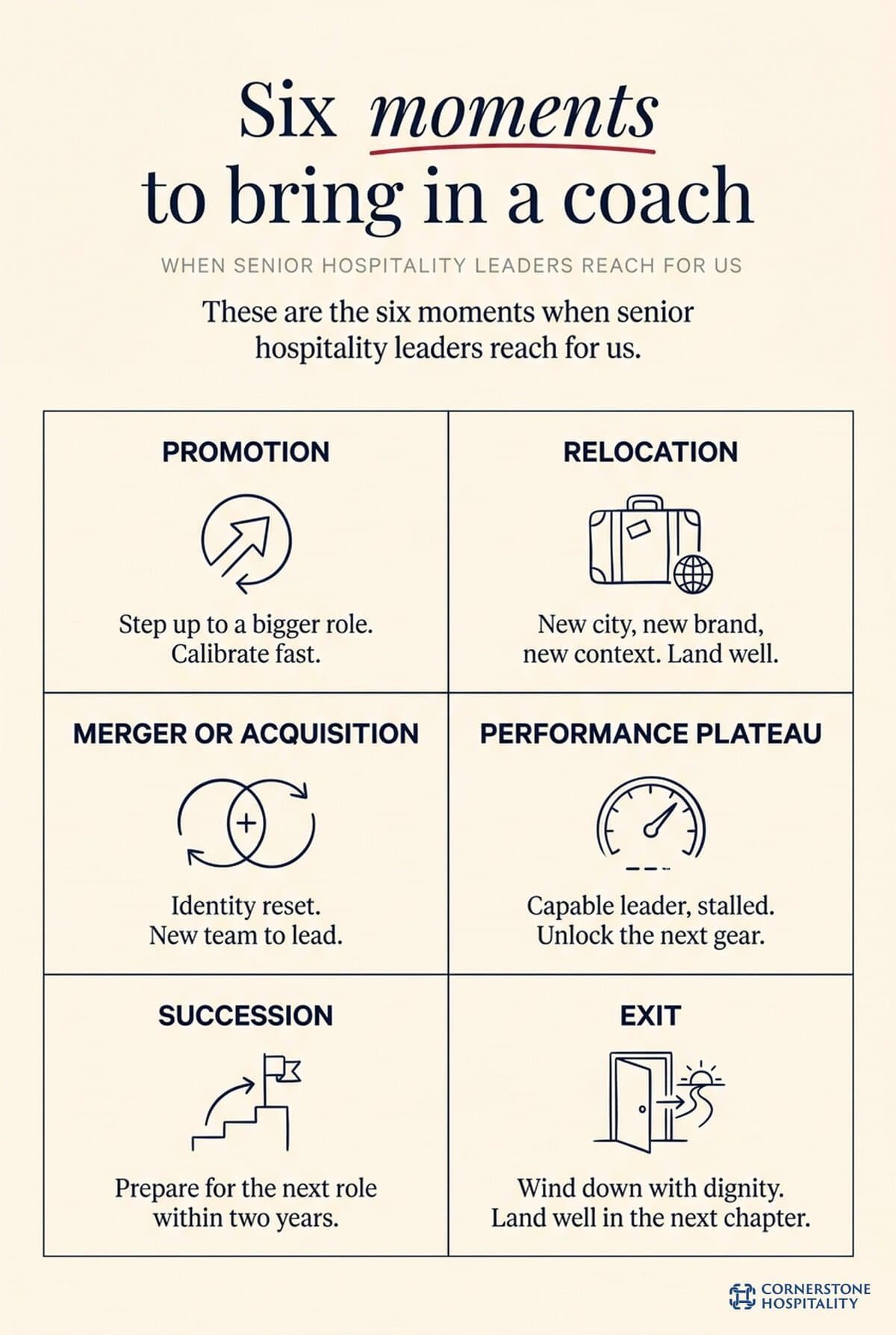
What they reach for in coaching is something else, the move from good to great. The leader who is performing at eight out of ten, and wants to know what nine looks like. The newly-promoted regional VP who has done the job in one market and now has to do it across five. The GM who has been quietly carrying a limiting belief about delegation for fifteen years and is ready to put it down. The C-suite hire entering a new culture who wants the first ninety days to land cleanly. These are the engagements where hospitality leadership development and coaching does its most consequential work.
Why “good” is the harder starting point than “broken”
A leader who is failing usually knows it. The signals are loud, the board conversation, the team turnover, the missed numbers. A leader who is performing well has no such signals. Everything is fine. The property is hitting the plan. The team is steady. The owner is satisfied. The only person who notices the ceiling is the leader themselves, the quiet sense that there is another version of how they could be operating, and they cannot quite reach it on their own.
That quiet sense is the most common reason senior hospitality leaders engage a coach for their own development. It is also the reason coaching at this level is so often deeply confidential. The leader is not in crisis. They are reaching for something, the edge that seperates them from second best. The conversation needs the space to surface things that the boardroom, the team meeting and the owner call do not have room for.
Why this matters
Michael Jordan, Steve Jobs and some of the most successful people in their fields have coaches. The principle applies as cleanly at the GM and C-suite level as it does on the basketball court; the very best performers in any field are the ones who keep a coach in their corner, as a guide, a sparring partner, a mirror. The work compounds. A leader who unlocks one limiting belief about delegation runs their property differently for the next decade; a senior team that learns to surface disagreement productively makes better strategic decisions for years. The dollar return on the engagement is real, the broader literature puts median company ROI at around seven times the cost [5], but the longer arc is what makes the work strategic.
The hospitality lens on senior development
Generic executive coaching exists. It can be excellent. What it cannot do is meet a senior hospitality leader inside the operating reality of the property, the brand-tier, the owner relationship and the regional context. Hospitality leadership development and coaching at the senior level demands a coach who can sit with a GM and a regional VP and understand the difference between a luxury operating cadence and a select-service one without having it explained. The leader does not have to spend their time translating.
That contextual fluency is the difference between a coach who is helpful and a coach who is consequential. The work moves faster, and into deeper territory, when the leader is not spending the first six sessions explaining the industry. The hospitality-specific framing is the precondition for the senior-level depth.
What to do
- Frame the engagement around what you are reaching for, not what you are trying to fix, the work goes further when the starting point is honest about that.
- Insist on hospitality fluency in the coach. The industry context shapes which limiting beliefs are real and which are just industry noise.
- Block the calendar properly. A senior leader who treats coaching sessions like the first thing to be moved when something else comes up gets a fraction of the value.
The Comparison
Where hospitality leadership development and coaching sits next to training, mentoring and therapy
Coaching is one of four developmental modalities a senior leader can engage with. Each has its place. The mistake organizations and individuals most often make is reaching for the wrong one for the work in front of them, or assuming the four are interchangeable. They are not. Set side by side, the differences are the point.
| Modality | What it delivers | When it is the right choice |
|---|---|---|
| Coaching | A confidential, structured partnership that surfaces what the leader already knows, challenges the patterns they have fallen into, and holds them accountable to the changes they have decided to make. | When the goal is good-to-great, a successful transition, or sustained behavioral change. |
| Training | A structured curriculum that delivers new knowledge, models or skills, from a trainer to a group. | When a specific competency gap can be closed by content, finance fluency, a new system, a leadership framework. |
| Mentoring | A more senior peer sharing experience, judgment and network access with a less senior leader. | When the leader needs the pattern-recognition of someone who has walked the road already, usually inside the same industry. |
| Therapy | Clinical work with a licensed practitioner addressing mental-health or psychological challenges. | When the work is clinical, anxiety, depression, trauma, addiction. Coaching is not a substitute for therapy and never should be. |
A leader can hold all four relationships at once and the four will reinforce each other. The error is collapsing them, expecting a coach to deliver training content, or a mentor to do the work of a therapist. The good-to-great move sits squarely in the coaching column, and the work moves faster when everyone involved is clear about that.
Why this matters
When an organization books a coaching engagement and gets a training program, the leader walks away with a binder. When the same organization books training and gets coaching, the group walks away frustrated. The modality fits the work or it does not. At the senior hospitality level, the work is almost always behavioral, identity-level and forward-looking, which is coaching’s territory, not training’s.
The Framework
Where’s your career going? Let’s find out together.
Talk it through with our AI assistant. Seven questions, six to eight minutes, and a personalized summary lands in your inbox.
Six pillars of a senior hospitality leader’s development arc
Cornerstone Hospitality structures the development arc of every senior coaching engagement around six pillars. They are not delivered sequentially, the work moves between them as the leader’s focus shifts, but every consequential engagement touches all six over its lifespan. The pillars are chosen because each names a place where senior hospitality leaders most often have the most growth available to them.
An honest read of where the leader actually is, work, family, finance, health, energy, so the work has truthful ground to start from.
The unspoken stories the leader has been carrying about themselves, identified, named, and rebuilt on more honest foundations.
How the leader shows up in board meetings, ownership conversations, team interactions, the deliberate craft of senior presence.
The practical disciplines that let a senior leader sustain at the level the role demands, calendar, focus, recovery, family.
Structured support through the early months of a new role, the highest-leverage moment in any senior leader’s career.
Regular sessions that hold the leader to the changes they have decided to make, the difference between insight and behavior change.
The pillars are universal across senior hospitality leaders, but the weighting shifts dramatically by engagement. A newly-appointed regional VP entering five new markets will live in Pillar 5 for the first quarter, then in Pillar 3 as the role settles. A GM who has been in seat for seven years and is reaching for the next thing will live in Pillars 1 and 2 for most of the engagement. The framework stays constant; the work itself is bespoke. The third-party literature backs the breadth of what the work touches, coached executives report meaningful gains in working relationships (77%), teamwork (67%), peer relationships (63%) and job satisfaction (61%) [6], alongside organizational gains in productivity, quality and retention.
“If you can optimize your leaders and take them from good to better, or from better to great, the outcome is a multiplier of what you invested. Once they have moved past whatever was holding them back, they can perform freely, without barriers, and they can do things they simply could not before.”
Florian Kittler, Managing Partner, Cornerstone Hospitality
The Output
What a Cornerstone twelve-month engagement contains
Most Cornerstone Hospitality coaching engagements run between six and twelve months. Shorter engagements work for specific work, first-90-days support for a new hire, a focused piece of work before a board presentation, a structured run-up to a particular transition. Longer engagements are where the deeper development arc plays out. The twelve-month engagement is the typical shape, and the standard deliverable looks like this.
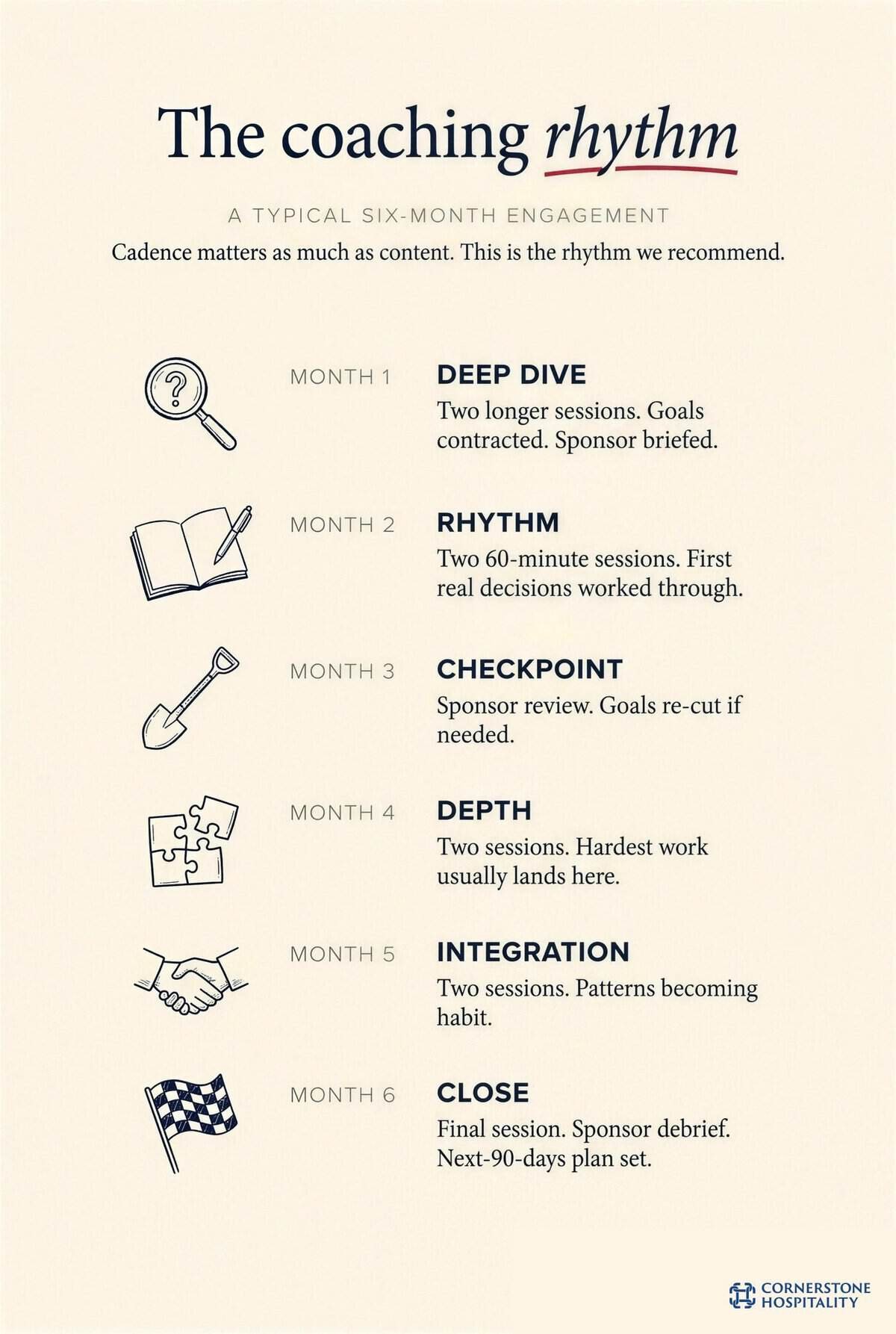
- ✓Chemistry session: an open 60-minute conversation. We listen, the leader shares, and both sides decide if the fit is right. The work begins only if it is.
- ✓Diagnostic phase: wheel-of-life mapping, structured psychometric assessment, and a focused conversation about where the leader is now and where they want to be in twelve months.
- ✓Goal contract: three to five named outcomes the leader is committing to, with the success markers we will use to measure them. When hired by the company, agreed with the sponsoring CEO or CHRO and align the goals; when hired by the individual, owned by the leader alone.
- ✓Coaching cadence: typically, one 60 to 90-minute session every two to three weeks, plus access to the coach between sessions when something live calls for it.
- ✓Mid-engagement review: at month six, a structured stocktake. What has shifted, what has not, what the remainder of the engagement should focus on.
- ✓Close-out and runway plan: at month twelve, a written reflection of what changed, what the leader is taking forward, and the disciplines they will hold to themselves after the engagement ends.
About this approach
Scope: B2C engagements (leader engages us directly); B2B engagements (organization sponsors the work); team coaching for intact hospitality leadership groups.
Confidentiality: The coaching content stays in the coaching room. In B2B engagements, what is reported back to the sponsor is agreed at the start, usually progress against the goal contract, attendance, and any structural issues the organization needs to know about. Private reflections never leave the room.
Cadence: Most engagements run six to twelve months, with sessions every two to three weeks. Each engagement has its individual rhythm.
Industry context: All coaches are drawn from inside the global Hospitality, Travel & Leisure Practice, 60+ offices across 40+ countries, every coach with deep first-hand hospitality experience.
Why this matters
Coaching only returns on the investment when the structure is right. The chemistry session is not a sales call, it is the most important filter in the whole engagement. The goal contract is not paperwork, it is what gives both the leader and the sponsor something honest to come back to in month six. Engagements that skip the structure tend to drift; engagements that hold the structure produce the kind of multi-year compound returns the literature describes, the wider field of more than 120,000 coach practitioners worldwide [5] is built on this same architecture for a reason.
Considering a coaching engagement for yourself, for a leader you have promoted, or for an executive team going through change? The conversation begins with what you are reaching for, not with our process.
Book your chemistry session →What to do
Thinking about your next senior move?
Cornerstone works with senior hospitality leaders on exactly these decisions. Let us help you think it through.
Talk to usFive tells of a leader ready for coaching
Coaching does its best work when the timing is right. Engagements that begin at the wrong moment, before the leader is genuinely curious, or in the middle of a fire they need to put out first, tend to underperform. These are the five tells that a senior hospitality leader is at a point where hospitality leadership development and coaching will land. The signals are quiet, but they are real.
-
They can name the thing they are reaching for.
Not in detail, usually just a sentence or two. “I want the next twelve months to look different.” “I think I am holding something back.” “I have one more big role in me and I want to give it the best run.” That naming is the work’s starting point.
-
They have the calendar headroom to commit.
A senior leader who cannot protect ninety minutes every two weeks gets a fraction of the value. The engagement is short enough not to be a burden, but it needs the headroom or the work stalls.
-
The honesty is already on the table.
Leaders who arrive with a polished CV-style answer to the question “what is the work?” tend to spend the first three months getting past it. Leaders who arrive honest about where they actually are start the work immediately.
-
The chemistry session feels different from a job interview.
The good ones leave the leader thinking about themselves, not about the coach. If the leader leaves the chemistry session impressed by the coach’s CV but no clearer about their own situation, that is the wrong fit.
-
They are not in the middle of a five-alarm fire.
A leader navigating an acute crisis, a takeover, a regulatory issue, a personal-health event, usually needs the crisis behind them before deep coaching can take hold. The work waits. The leader returns when the ground is steadier.
What to do next
If three or more of the five tells are already true for you, or for a leader you are considering investing coaching in, book the chemistry session. The conversation tells you more in sixty minutes than a deck ever will.
Glossary
- Executive coaching
- A confidential, structured partnership between a senior leader and a trained coach, focused on the leader’s development goals over a defined engagement period.
- B2C coaching
- An engagement where the individual leader is the buyer, they engage and pay for the coaching directly. Deeply confidential by design.
- B2B coaching
- An engagement sponsored by an organization for one of its senior leaders. Confidentiality still holds inside the coaching room; what is reported back to the sponsor is agreed at the start.
- Wheel of life
- A diagnostic tool that maps the leader’s honest current state across the major domains of their life, work, family, finance, health, energy, runway, so the work has truthful ground to start from.
- Goal contract
- A short written agreement at the start of an engagement that names the three to five outcomes the leader is committing to, with the success markers used to measure them.
- Chemistry session
- The initial 60-minute conversation between leader and coach, used to assess fit on both sides. The engagement begins only if both sides are confident the fit is there.
Frequently asked questions
Who is hospitality leadership development and coaching at Cornerstone for?
Senior hospitality leaders engaging us directly for their own development (B2C), and hospitality organizations investing in coaching for senior people through promotions, mergers, new-hire onboarding or strategic change (B2B). We also run team coaching for intact hospitality leadership groups.
How long does a typical engagement run?
Most engagements run between six and twelve months, with sessions every two to three weeks. Shorter engagements suit a specific piece of work (first-90-days support, a focused transition); longer engagements suit sustained leadership development. The timeline is agreed at the chemistry session based on the leader’s goals.
Is the coaching confidential when the organization is paying for it?
Yes. In B2B engagements, the coaching content stays in the coaching room. What we report back to the sponsoring organization is agreed at the start of the engagement, usually progress against the goal contract, attendance and engagement, and any structural issues the organization needs to know about. The leader’s private reflections never leave the room.
What is the difference between coaching and training?
Training delivers new knowledge or skills through structured content from a trainer to a group. Coaching surfaces what the leader already knows, challenges the patterns they have fallen into, and supports the changes they have decided to make. The two complement each other; our practice focuses exclusively on the coaching side.
What kind of return does an organization get from sponsoring an executive coaching engagement?
The independent literature is consistent: median company ROI in the broader executive coaching field is around seven times the cost of the engagement [5], with a widely-cited Fortune-1000 study putting the average at 5.7 times invested [6]. In hospitality specifically, the strategic return is the compounding effect, a coached GM who unlocks a limiting belief about delegation runs their property differently for the next decade; a senior team that learns to surface disagreement productively makes better decisions for years.
Do you only work with leaders inside hospitality?
Our practice is hospitality, travel and leisure. The coaching craft transfers across industries, but the depth of context we bring, brand-tier landscape, owner-relationship dynamics, regional operating realities, the path from property to corporate, is hospitality-specific. Most engagements are with leaders in the hospitality sector, supported by coaches with deep first-hand industry experience.
How does the first coaching conversation work?
An open conversation, usually 60 minutes. We listen more than we speak. The goal is to understand where the leader is, what they are reaching for, and whether the chemistry feels right on both sides. The engagement begins only if both sides are confident the fit is there.
Read next
Sources
- PrimeGenesis: 40% of executives pushed out, fail, or quit within 18 months (citing Heidrick & Struggles internal study of 20,000 searches; CEO Kevin Kelly interview, Financial Times, 30 March 2009): primegenesis.com/2009/04/40-percent-of-execs-pushed-out-fail-or-quit-within-18-months
- Leadership IQ: Executive Failure Rates (study of 20,000+ new hires across 312 organizations): “46% of newly hired employees failed within 18 months while only 19% achieved unequivocal success. Attitudes drive 89% of hiring failures while technical skills account for only 11%.”: leadershipiq.com/blogs/leadershipiq/executive-failure-rates
- Plum: Schmidt & Hunter (1998) Meta-Analysis Explained: structured interview r =.51, cognitive ability r =.51, composite validity of structured interview + cognitive ability >.60: plum.io/blog/schmidt-hunter-meta-analysis
- Kapable: Statistics On Leadership In The Hospitality Industry: 82% of surveyed hotels report a staffing shortage; 73% annual U.S. hospitality turnover: kapable.club/blog/statistics/statistics-on-leadership-in-hospitality-industry
- International Coaching Federation: Coaching Statistics: The ROI of Coaching (citing the ICF / PricewaterhouseCoopers Global Coaching Client Study): 87% of survey respondents agreed that executive coaching has a high return on investment; average ROI of seven times the cost of employing a coach (PwC / Association Resource Center survey): coachingfederation.org/blog/coaching-statistics-the-roi-of-coaching-in-2024. Field size: 122,974 coach practitioners worldwide; industry revenue $5.34 billion USD (2025 ICF Global Coaching Study): coachingfederation.org/resources/research/global-coaching-study
- Manchester Inc.: Maximizing the Impact of Executive Coaching, The Manchester Review, 2001, Volume 6, Number 1 (McGovern et al.). Study of 100 executives, mostly Fortune 1000: average ROI of 5.7 times the initial investment; intangible benefits included improved working relationships with direct reports (77%), with immediate supervisors (71%), teamwork (67%), peer relationships (63%) and job satisfaction (61%): donnaschilder.com/manchester-study
Florian leads Cornerstone International Group’s global Hospitality, Travel & Leisure Practice. He brings seventeen years of senior hospitality experience, including Marriott, Hyatt, IHG, Mandarin Oriental and Shangri-La Hotels & Resorts, and sixteen years in retained executive search. He is bilingual in English and German and works across Europe, the Middle East, the Americas and Asia-Pacific.
Connect with Florian on LinkedIn →