

Leadership Assessment for Hotel and Travel Groups
Leadership assessment calibrated to the format you actually operate, from a single resort to a multi country travel group.
Leadership assessment works on the same instruments everywhere. What changes between a resort, a restaurant group and a travel operator is the calibration, and a generic read gets that wrong in ways nobody notices until month three.
Cornerstone Hospitality assesses senior leaders across every format in the sector. Consequently the method stays constant while the weighting shifts, because a regional director in a travel business and a resort general manager are not solving the same problem even when their titles rhyme. The work sits alongside executive search and runs equally well on its own.
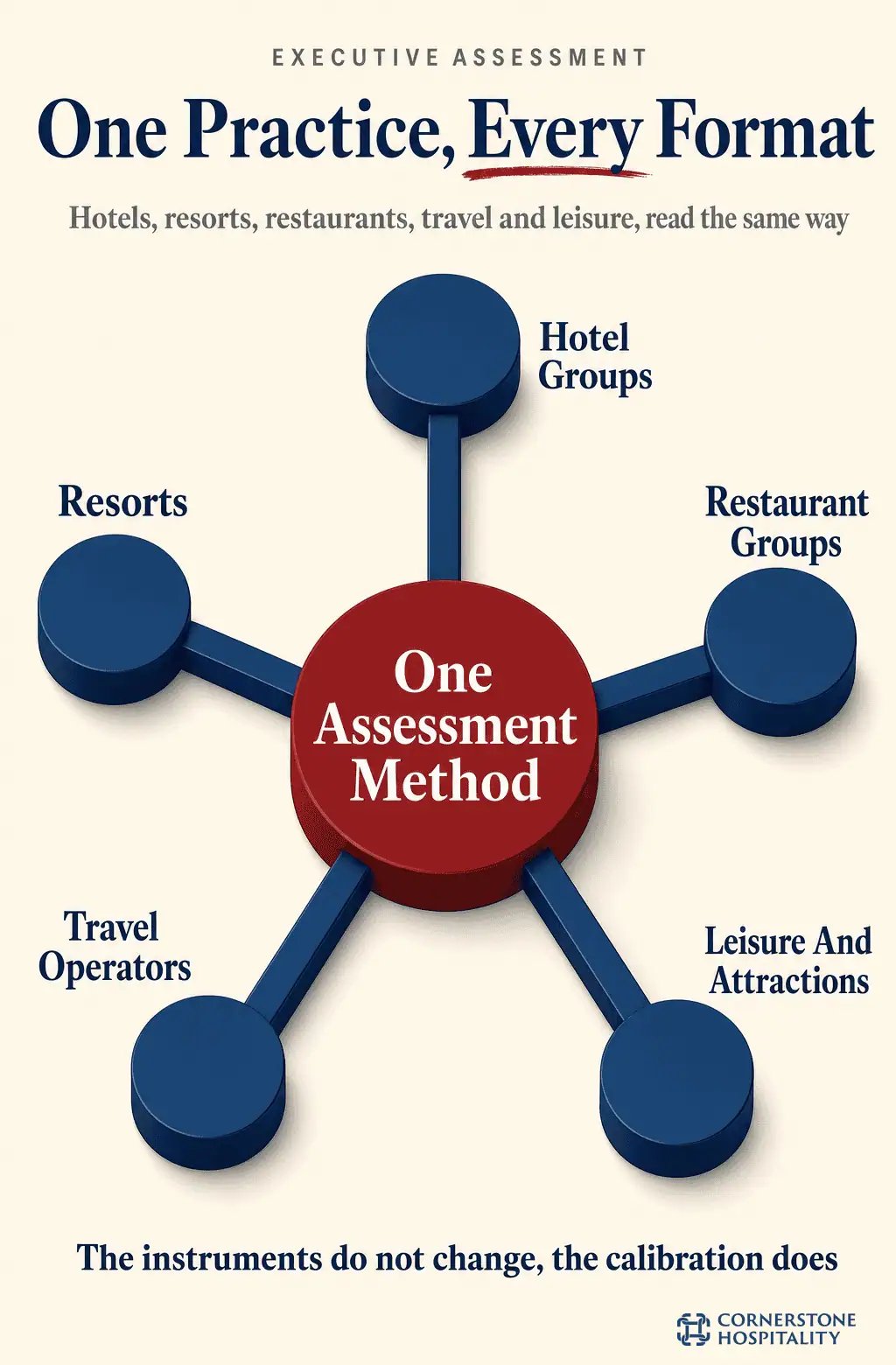
One practice, every format
A hotel group, a resort operator, a restaurant group, a travel operator and a leisure business all hire senior leaders, and all of them read those leaders with broadly the same tools. That much is common ground.
What differs is which signals matter. A resort leader carries an isolated operation with a thin bench and limited relief, so resilience and self direction weigh heavily. A restaurant group leader runs many small units at speed, where delegation and standard setting dominate. A travel operator leader works across borders and time zones, where the ability to hold a thread without daily contact becomes the whole job.
Because the weighting differs, a single template applied across all five produces confident readings that are quietly wrong. Therefore we calibrate the instruments to the format before anybody sits down.
Where the leadership assessment read differs by format
The same person, weighted differently depending on what they are running
Hotel groups
Span of control and owner facing judgment carry the most weight. A group leader spends as much time managing an ownership relationship as an operation, and those two jobs reward different temperaments.
Resorts
Isolation changes everything. A resort leader cannot borrow depth from a neighbouring property on a bad week, so resilience, self direction and the ability to build a bench locally matter far more than they would in a city.
Restaurant groups
Speed and repetition dominate. Many small units, thin margins and constant turnover mean the question is whether somebody can set a standard once and have it hold without standing over it.
Travel and leisure operators
Distance is the constraint. Leaders work across borders, languages and time zones, so we look hardest at whether they hold a long thread when nobody is in the room to remind them of it.

Reading a whole leadership team
Groups increasingly ask us to read a leadership team rather than an individual, particularly after an acquisition or before a restructure.
A team read looks at how the profiles interact. Which strengths genuinely overlap, where two people share the same blind spot rather than one covering it, and which frictions are structural rather than personal. Those answers change what you do next, because a structural gap needs a hire and a personal friction needs a conversation.
Most groups then use the result as the starting point for team coaching, which moves considerably faster when the pattern is already on the table.
Tell us what you actually operate
Give us the format, the seat and the shortlist. We will tell you which dimensions carry weight for that specific role, and whether a read will change your decision.
What stays the same across every format
| Constant | Why it does not vary |
|---|---|
| A Chartered Psychologist runs the read | Independence from the hiring pressure matters identically everywhere |
| Validated instruments, not personality quizzes | The evidence base does not change because the building does |
| A structured interview, considerably longer than a hiring conversation | Depth comes from structure and time, and both are format neutral |
| A written report that names risks plainly | A group that cannot act on the report has bought a document, not a decision |
| Feedback to the candidate, every time | Strong candidates judge a group by how it handles this moment |
The instruments and the discipline hold constant. Only the weighting moves.
What a generic template gets wrong
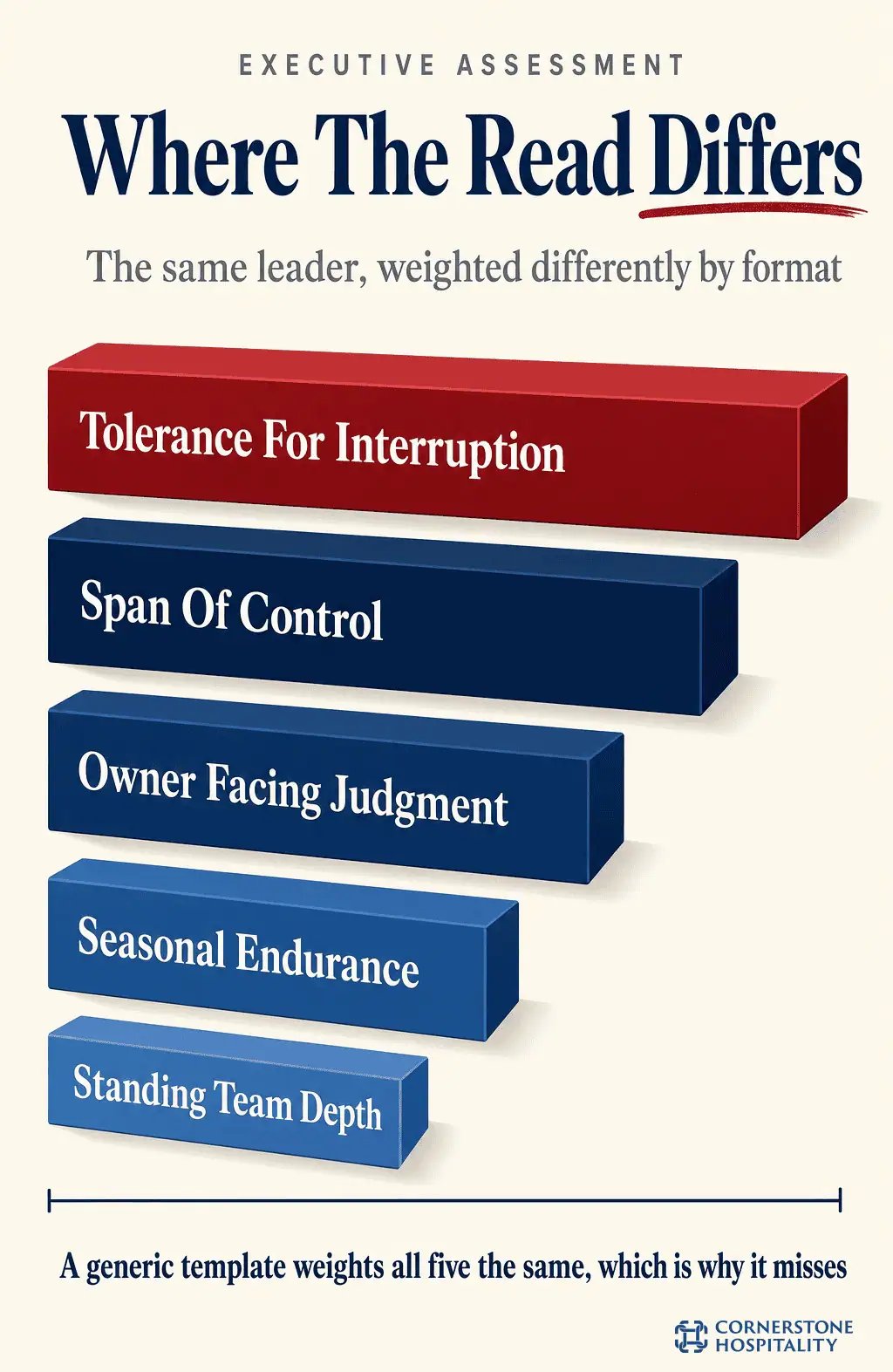
Off the shelf leadership assessment weights every dimension equally, which sounds neutral and is not. Equal weighting quietly assumes the sector rewards every trait the same amount, and hospitality does not.
Tolerance for interruption, for instance, is close to essential in an operating role and close to irrelevant in a corporate seat. Rate both candidates on the same flat scale and you will promote the wrong one about as often as you promote the right one.
Furthermore the shadow side of each trait goes unread. The decisive floor operator who rates well on drive may also struggle to delegate, and a template that never asks the question will never surface it.

Common questions
Do you use different instruments for different formats?
No. The instruments stay the same, which is what makes results comparable across a group. What changes is how we weight and interpret them against the specific role.
We operate hotels and restaurants under one group. Can you read both?
Yes, and mixed estate groups are common clients. We calibrate per seat rather than per company, so a restaurant divisional lead and a hotel general manager in the same group get reads tuned to what each job actually demands.
Can you assess in languages other than English?
Yes. Cornerstone works from 60 offices worldwide, so we can place a Chartered Psychologist and validated instruments in most major markets.
How many people can you assess at once?
Whole leadership tiers are routine. Scheduling drives the timeline rather than capacity, and a full tier usually runs over two to three weeks.
Does this replace our interview process?
No, and it works best when it does not. Interviews test capability well. Assessment adds the dimensions interviews cannot reach, so the two together beat either one alone.
Calibrated to what you run
Tell us the format and the seat. We will tell you honestly whether a leadership assessment will change your decision, and what it would involve.
Start the conversationFor the broader picture this fits into, see our Executive Assessment work.