

Career Change Coach for Senior Hospitality Leaders
A career change coach for the general manager, regional director or corporate executive weighing a different kind of role rather than the same seat somewhere else.
A career change coach works with a senior hospitality leader whose next move is a different kind of role, not the same role in a different building.
Cornerstone Hospitality does this work for general managers, executive committee members, regional directors and corporate executives across hotels, restaurants, travel and leisure. Our consultants run these searches every week, so the read comes from watching how the appointments are actually decided rather than from a general theory of changing careers.
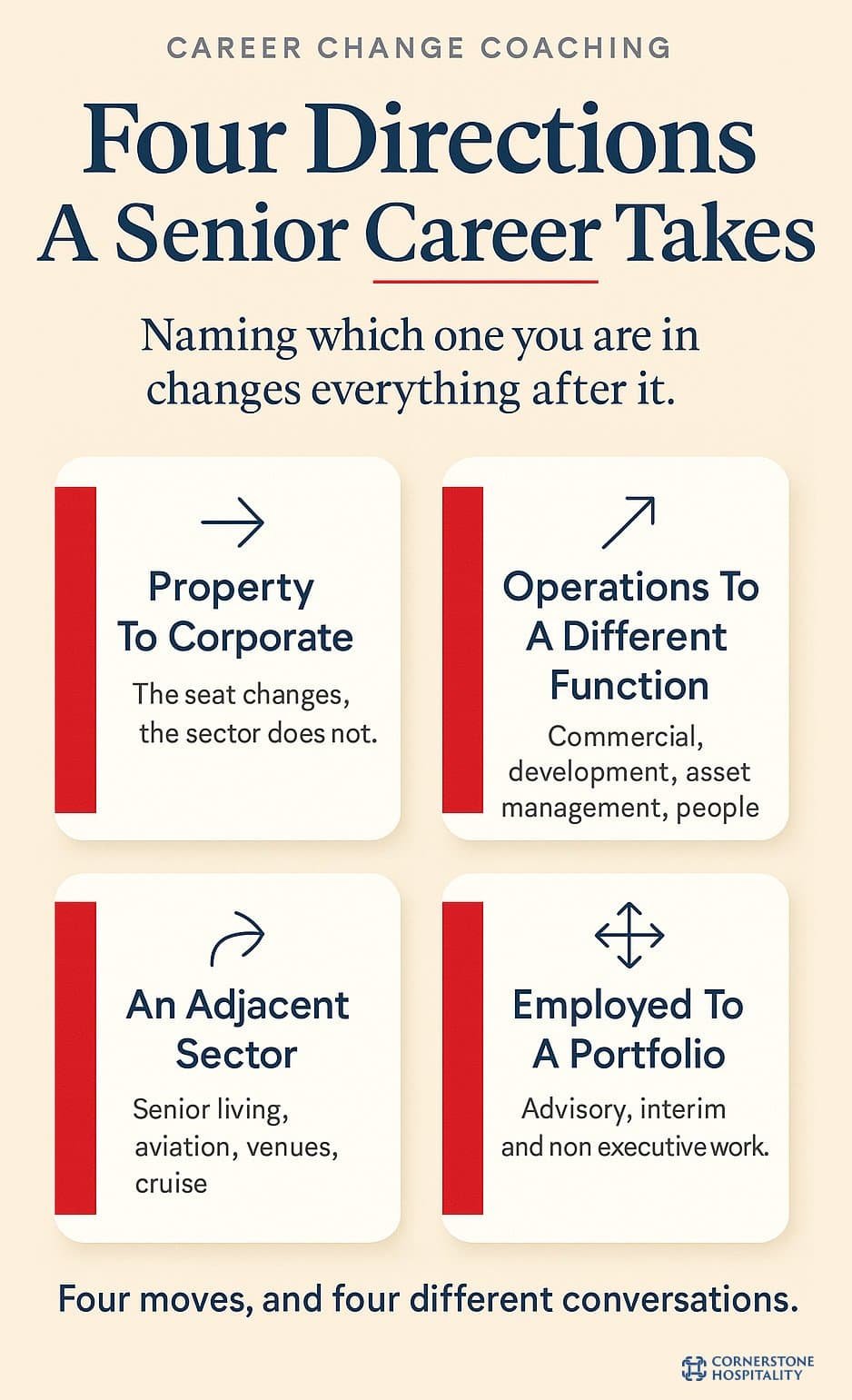
Four directions, and each one is a different conversation
Most senior leaders considering a change are considering one of four moves, and the first useful thing a career change coach does is name which one. They are not four versions of the same decision.
Property to corporate is the most common. A general manager moves to a regional, brand or head office seat, and the daily proof of competence stops being an occupancy figure and becomes influence over people who do not report to you. We wrote about that particular move in the identity shift it asks for.
Operations to a different function is the next one: commercial, development, asset management, or people. The operating knowledge is genuinely valuable there. The part that has to be built is the technical language of the function itself.
Hospitality to an adjacent sector covers senior living, healthcare, aviation, stadiums and venues, cruise, and branded residential. Each of them runs a service operation at scale, and each hires from hospitality more often than hospitality notices.
Employed to a portfolio is the fourth: advisory, interim, and non executive work. It is a change in the shape of an income as much as a change of role, and it usually begins about eighteen months before it looks like it began.
The move turns on what transfers, and you are not the best judge of that
Senior hospitality leaders carry more transferable capability than they can describe and describe a narrower version of it than the market would credit.
The reason is that the language is internal. Fifteen years of running properties gets summarized as running properties. When what a corporate group is actually buying is someone who has held a profit and loss line through real seasonal volatility, carried a union relationship, opened a building, and kept forty people through a bad year.
Much of what a career change coach does is find the version of your own history that is both true and legible outside the room it happened in. It is not a rewrite. It is a change of emphasis, and it is very difficult to do for yourself.

Weighing a different kind of role?
A first conversation is confidential and costs nothing, whether or not you take it any further.
What a group outside your current world reads differently
The same facts, weighted another way.
| What you would say | What it has to answer |
|---|---|
| Ran a 340-room property | What the profit and loss actually was and which part of it you moved rather than inherited |
| Twenty years in hotels | Whether that is more than one operating model or one operating model twenty times |
| Pre-opening experience | Whether you can work before a system exists, which is usually the reason you are being considered |
| Multi-site regional role | How did you get a result through general managers who did not want to change |
| Owner-operator background | Whether you can work inside brand standards without reading them as interference |
| Strong team retention | What you did that a successor could repeat without you in the building |
None of these are trick questions. They are simply the second question, and most preparation stops at the first.
How far a change can travel in one step
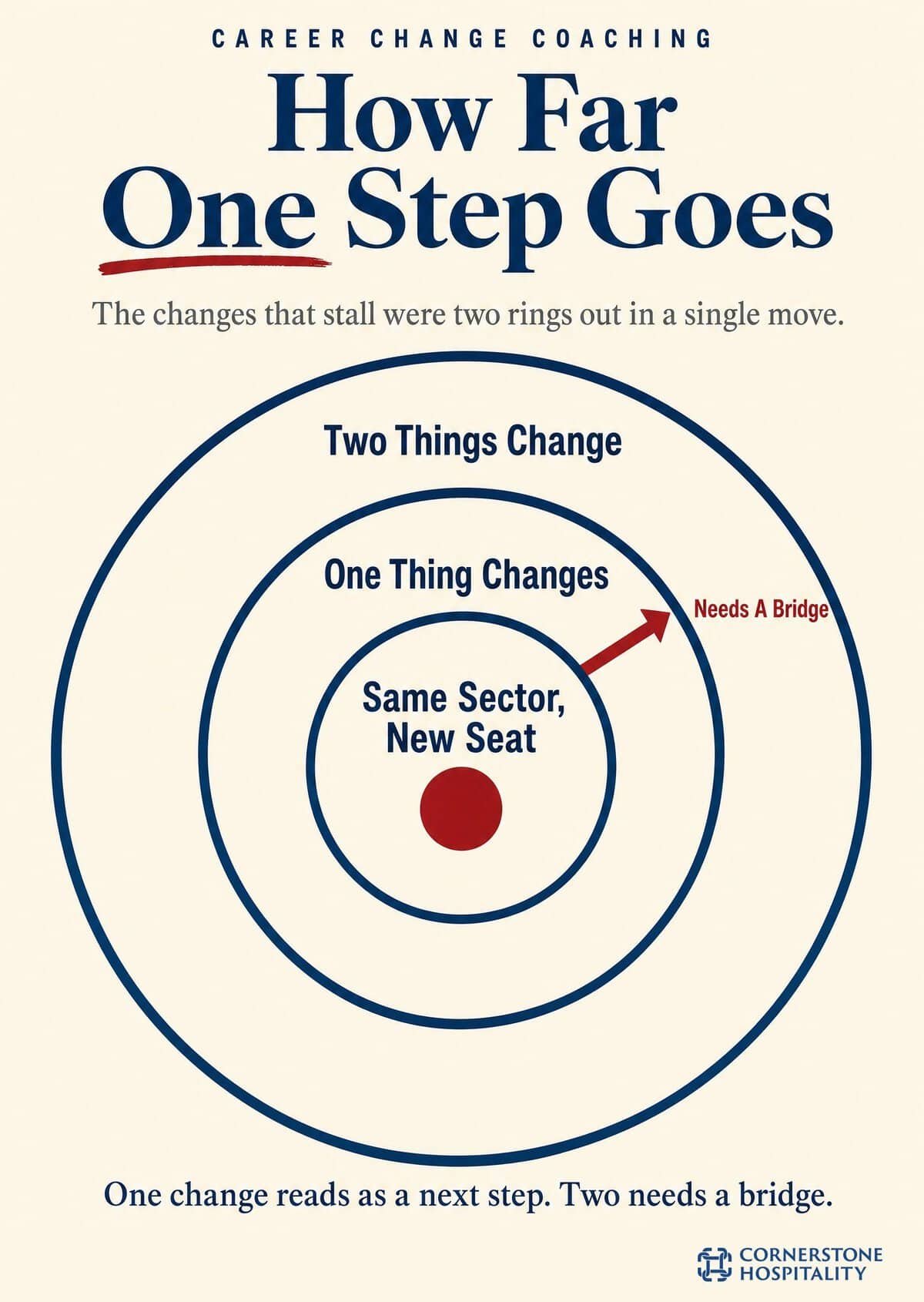
There is a practical limit to how far a senior move goes in a single step, and it is worth knowing where yours sits before you start.
A move that changes one thing reads as a natural next step. A general manager going regional changes the seat but not the sector. A hotel commercial director going into a travel group changes the sector but not the function. Either one is a short sentence to explain, and short sentences get shortlisted.
A move that changes two things at once, sector and function together, happens regularly and works well. It simply needs a bridge, and the bridge is usually one of four things: a project, a board or committee seat, a qualification, or a first role chosen deliberately to make the second one obvious.
The changes that stall are almost always the two-step move attempted in one, by someone who was a single well-selected intermediate role away from it being easy.
How working with a career change coach runs
The honest read
Your history, what genuinely transfers, and which of the four directions actually fits. Said plainly rather than politely.
The bridge
Where the move you want is two steps away, the specific role, project, or credential that turns it into one.
Into the market
A named list of groups and people, how to open each conversation, and preparation through interview, offer, and the decision at the end.

Frequently asked questions about career change coaching
What does a career change coach do?
Works with you on which direction actually fits, on what your history proves to somebody outside hospitality, on the bridge if the move is two steps away, and on the approach, the interviews, and the decision. It is direction and honest feedback rather than CV formatting.
How is this different from a career transition coach?
Emphasis. A career transition coach is usually working on the next role in the same broad direction. This work starts a step earlier, with whether the direction itself should change. Plenty of engagements begin here and end in a hospitality role, better chosen.
Can I do this while I am still in post?
Yes, and most people do. It is entirely confidential, which matters in an industry where the senior population is small and word travels quickly.
Will you place me in the new role?
Coaching and search are separate. If a live mandate genuinely fits you, we will say so, but a coaching engagement is not a route onto our shortlists, and we will not suggest otherwise.
How long does it take?
Three to six months for most people, at around two sessions a month. Where the move needs a bridge, it runs longer because the bridge is the work.
What if I decide to stay in hospitality?
That is a normal outcome and a good one. Knowing what the wider market would actually offer you is what decides to stay a decision rather than a default. Some of those conversations end in a renegotiation where the person already is.
Considering a change of direction?
Start with a confidential conversation about what actually transfers, and how far it can travel in one move. No commitment, no charge, and no obligation to carry on with a career change coach afterward.
For the broader picture this fits into, see our Career Transition work.