

Executive Job Coach for Hospitality Leaders
An executive job coach for senior people running a search of their own. The market you can see is the smallest part of it, and how you come across is not what you think.
An executive job coach is for the senior hospitality leader running their own search, and doing it for the first time in a decade or more, against a market that no longer works the way it did when they last moved.
Cornerstone Hospitality does this work for general managers, executive committee members, regional directors and corporate executives. Our consultants sit on the other side of these searches every week, which means the advice comes from watching how these appointments are actually decided rather than from a general theory of job hunting.

Five ways in, and one queue
Most senior leaders run their search almost entirely through one channel, and it is the most crowded one available to them.
Advertised roles are visible, which is exactly the problem. By the time a senior hospitality position is posted, it has usually been open internally for weeks, a recruiter has usually already mapped the market, and the applicant is arriving after the shortlist has begun forming in someone’s head.
The other four routes are quieter. A direct approach to a group you have chosen deliberately. A relationship with recruiters who actually work your level. Your own network, worked properly rather than announced to. An owner or operator who already knows what you can do.
None of them is a trick. They are simply where senior appointments come from, and the coaching is largely about learning to work all five instead of refreshing one.
An executive job coach is not outplacement, and not a CV service
Outplacement is paid for by a company parting with someone. Job coaching is paid for by the leader, often while still employed and often years before a move.
And a CV is a document. Coaching is about the twenty minutes of conversation the document is only ever trying to buy you.

Thinking about your own next move with an executive job coach?
A first conversation is confidential and costs nothing, whether or not you go further.
What an executive job coach actually works on
In roughly the order these matter to an outcome.
| The work | What changes |
|---|---|
| Positioning | The one sentence that says what you are for, before anyone asks about your last role |
| Target list | Twenty named groups and owners, chosen deliberately, rather than whatever appears |
| The approach | How to open a conversation with someone who is not advertising anything |
| Interview read | What a panel is actually testing, which is rarely what they are asking about |
| The package | What is genuinely negotiable at your level, and what asking for it signals |
| The decision | Whether the offer in front of you is the right one, or just the first one |
Most people arrive wanting help with the last two. The first two are where the outcome is decided.
The gap between told and heard
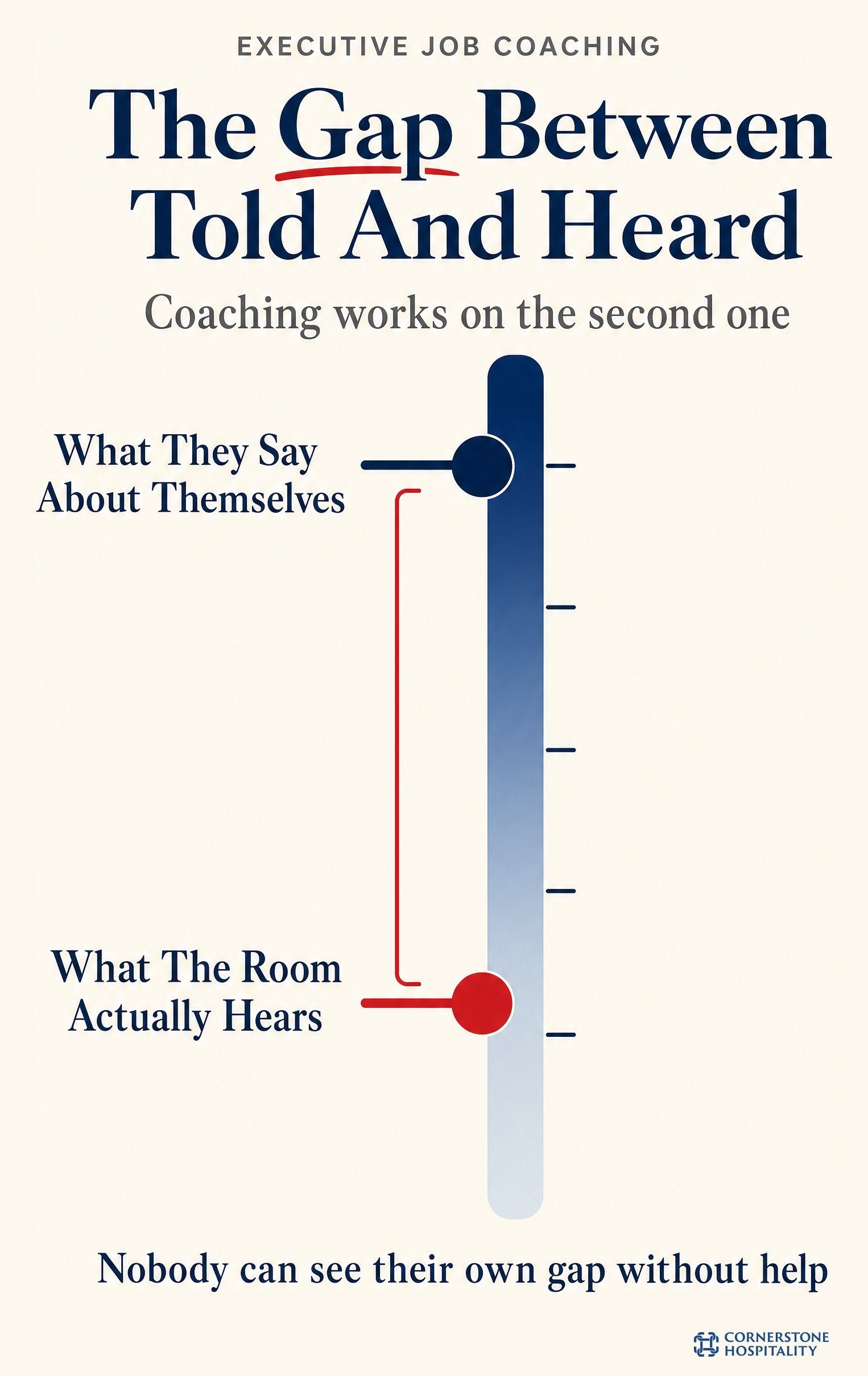
Every senior leader has a story they tell about their career. Almost none of them know how it lands.
The gap is rarely about honesty. It is about emphasis. A leader who turned around a difficult property will describe the turnaround, while the room hears someone who has only ever operated in crisis and may be restless in a stable business.
A leader who spent nine years in one group hears loyalty and depth. The room sometimes hears a person who has only seen one way of doing things. Both readings are available from the same facts, and which one arrives depends entirely on how it is told.
Nobody can see this in their own account, which is the whole reason the work exists. You cannot hear yourself the way a stranger hears you, and a friend will not tell you. The single most useful hour we spend with most people is simply telling them plainly what a room actually hears when they talk about themselves, and then rebuilding the account until the two line up.
How working with an executive job coach runs
The honest read
Your history, your positioning and how it currently lands, said plainly rather than politely.
Target and approach
A named list of groups and owners, and the specific way you will open each conversation.
Through to the offer
Preparation before each stage, a read afterwards, and support through the negotiation and the decision.

Frequently asked questions about executive job coaching
What does an executive job coach do?
Works with a senior leader on positioning, on which parts of the market to approach and how, on what interview panels are really testing, and on the negotiation and the decision at the end. It is strategy and honest feedback, not CV formatting.
Is this the same as outplacement?
No. Outplacement is bought by an employer for someone leaving. Job coaching is bought by the leader, frequently while still in post and sometimes a year or two ahead of any move.
Can I use it while still employed?
Yes, and most of our clients do. It is entirely confidential, which matters a great deal in an industry where the senior population is small and word travels.
Will you place me in a role?
Coaching and search are separate. If a live mandate genuinely fits you we will say so, but a coaching engagement is not a route into our shortlists and we will not pretend otherwise.
How long does it take?
Three to six months for most people, at around two sessions a month. Some engagements run longer because the leader is preparing deliberately rather than moving now, which is usually the stronger position to search from.
What if I am not sure I want to move?
That is a reasonable place to start. A number of engagements end with the leader staying, having renegotiated something where they are. Knowing what the market would actually offer you is what makes that conversation possible.
One-on-one coaching is one way to work with us. For engagements built around a fuller program, structured around five pillars from self-awareness through to hospitality-specific leadership, see our executive coaching page, or compare how different firms approach this in Executive Coaching Firms: What to Expect From a Firm-Level Partner and Executive Coaching Services.
Planning your own next move?
Whether you are moving now or preparing for a step in a year, start with a confidential conversation. No commitment, no charge.
Start a confidential conversationSources and references
- International Coaching Federation, Coaching Statistics: The ROI of Coaching in 2024: reports that “87% of survey respondents agreed that executive coaching has a high return on investment” and cites a PricewaterhouseCoopers and Association Resource Center global survey finding “an average ROI of seven times the cost of employing a coach”. It further records 72% of respondents linking coaching to increased employee engagement, with approval of coaching running at 78% among senior executives and 73% among employees.
- Gallup, This Fixable Problem Costs U.S. Businesses $1 Trillion: establishes that “the cost of replacing an individual employee can range from one-half to two times the employee’s annual salary” and describes that as “a conservative estimate”. It also reports that 52% of voluntarily exiting employees say their manager or organization could have prevented their departure, and 51% say that in the three months before leaving, neither their manager nor any other leader spoke with them about job satisfaction or their future.