

Leadership Development in Hospitality
Leadership development in hospitality is the umbrella term for coaching work delivered at executive level. Some of it a group buys for its leaders, and some of it a leader buys directly. This page sets out what that work covers.
Leadership development in hospitality is not a course, and it is not a shortlist to pick from. It is a set of coaching services delivered at senior level, and the shape of the work changes with the person and the situation in front of it.
Cornerstone Hospitality runs that work for senior people in hotels, resorts, restaurant groups and travel operators. Because the term covers several different things, the useful starting point is scope. What sits underneath it, who buys it, and how an engagement is actually built.
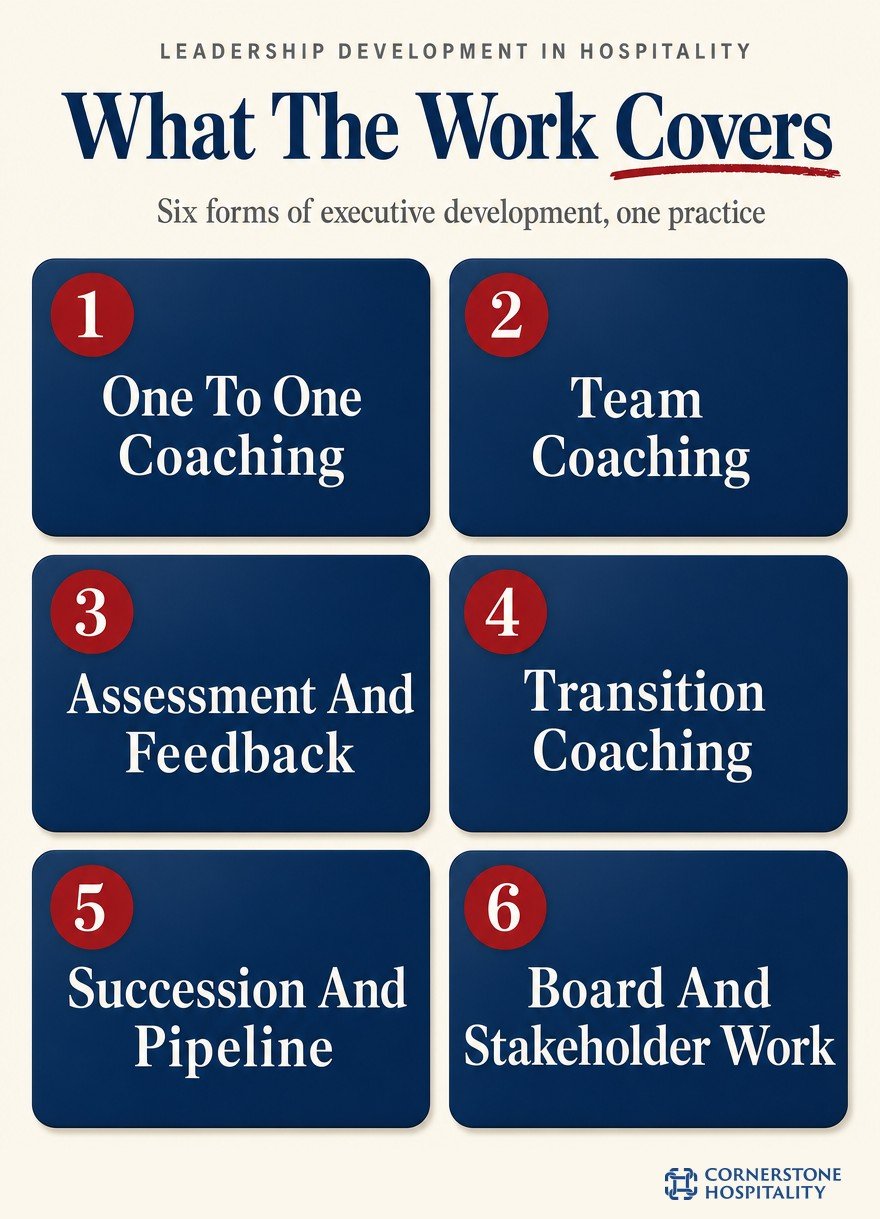
What leadership development in hospitality covers
The term is an umbrella. Underneath it sit six distinct kinds of work, and although they share a method, each one answers a different question.
One to one coaching for a single leader is the best known of the six. It pairs a single leader with a coach over a defined period, and it is the form most people picture when the subject comes up. Team coaching works on a leadership team as a unit instead, because the constraint frequently sits between people rather than inside any one of them.
Assessment and feedback gives a structured read on capability, usually against a role someone is being considered for. Transition coaching then supports a leader through a move, either into a bigger seat or out of one. Succession and pipeline work looks further ahead, while board and stakeholder work deals with the relationships a senior leader has to manage upward.
So the honest answer to what the discipline covers is rather more than coaching alone.
Who buys leadership development in hospitality
Two quite different buyers use the same practice, and it helps to be clear about which one you are.
In the first case a group buys the work for its leaders. A chief executive, an owner or an HR director sponsors it, the objective is usually written down, and somebody other than the participant expects to see progress. Governance matters here, because the sponsor is accountable for the spend.
In the second case a leader buys it for themselves. There is no sponsor, the conversation stays confidential, and the objective belongs to the individual. General managers weighing a corporate move often arrive this way, and so do executives who have recently left a role.
The method is the same either way. What changes is who sets the objective and who sees the result.

Not sure which form of this work fits your situation?
The six forms of leadership development in hospitality
One practice, six different questions.
| Form of the work | What it is for |
|---|---|
| One to one coaching | A single leader, a defined period, and the one or two things that genuinely have to change |
| Team coaching | A leadership team whose constraint sits between its members rather than inside any of them |
| Assessment and feedback | A structured read on capability, usually against a role under consideration |
| Transition coaching | A move into a larger seat, or a clean exit from one |
| Succession and pipeline | The bench two and three years out, before a gap becomes urgent |
| Board and stakeholder work | The relationships a senior leader has to manage upward |
Most engagements draw on more than one of the six.
How an engagement is built
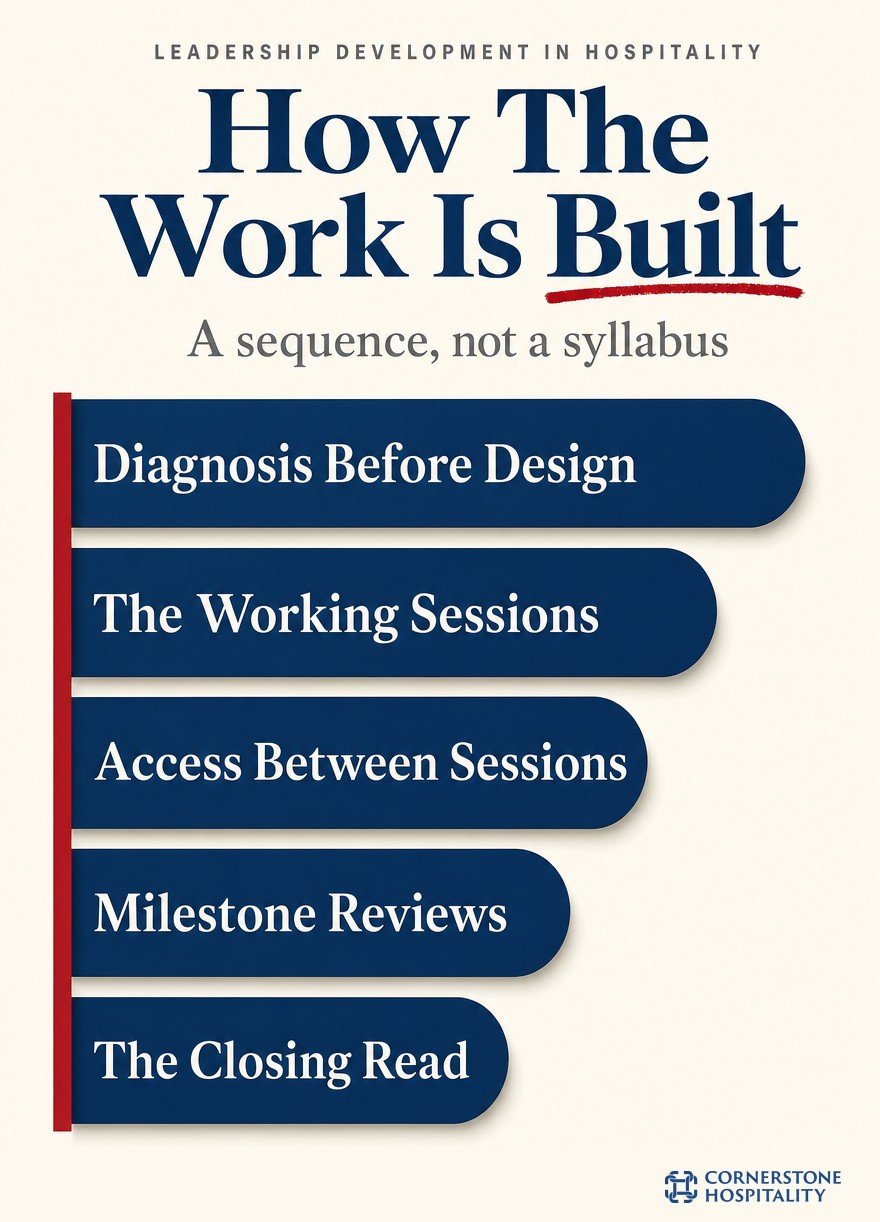
Whichever form the work takes, the sequence rarely changes.
In practice it starts with diagnosis rather than design. That means a stakeholder baseline, a read on the operating context, and an argument about what the real constraint is. Get that part right and everything afterward is aimed at the correct problem.
The working sessions then follow. Between them sits something buyers rarely account for, which is access. The moments that most need a second opinion tend to arrive on a Tuesday afternoon in the middle of an operational mess, rather than in a scheduled slot two weeks away.
Milestone reviews come next, and they exist so that a comfortable engagement cannot drift pleasantly for a year. Finally the closing read finishes the work, and it reports what did not move as well as what did.
Three levels the work operates at
The same discipline, applied at a different altitude.
The individual
One leader, one context, and the specific behavior that has to change. This is where coaching starts, and for many engagements it is also where it ends. We have written separately on what that work returns.
The team
A group that performs below the sum of its people. Here the work is on how decisions get made between them, because that is usually the actual constraint.
The organization
Succession, pipeline and the standard applied across properties. Consequently the work is measured in who is ready, not in who attended.

Frequently asked questions about leadership development in hospitality
What is leadership development in hospitality?
It is the umbrella term for coaching services delivered at executive level in the industry. In practice it covers six forms of work, from one to one coaching through to succession and board relationships.
Is it the same as training?
No. Training transfers a skill to a room of people, whereas development works on one leader or one team against a specific constraint. Both have their place, although only one of them is built around the individual.
Who normally pays for it?
Either a company or the leader. When a group sponsors the work there is usually a written objective and a reporting line, while a leader who commissions it privately keeps the objective and the conversation to themselves.
How long does an engagement run?
Six to twelve months for individual work. Anything materially shorter is an event, and behavior rarely changes at an event.
Does sector experience really matter?
In hospitality it does. A leader speaks more openly to someone who has held a comparable seat, and the read on whether they are ready for a bigger one comes from having made that step rather than from a framework.
What happens if the work is not landing?
That should surface at a milestone review rather than at the end. Indeed it is the reason the reviews exist, and a coach who never raises it is not looking hard enough.
Talk to us about leadership development in hospitality
Tell us who the leader is and what has to change. We will tell you which form of the work fits, and we will say so plainly if the honest answer is somebody else.
Sources and references
- Harvard Business Review, Turning Potential into Success: The Missing Link in Leadership Development: by Claudio Fernández-Aráoz, Andrew Roscoe and Kentaro Aramaki, reports that “66% of companies invest in programs that aim to identify high-potential employees and help them advance” while “only 24% of senior executives at those firms consider the programs to be a success”. It adds that “a mere 13% have confidence in the rising leaders at their firms, down from an already-low 17% just three years ago”, and that at the world’s largest corporations “a full 30% of new CEOs are hired from the outside”.
- CIPD, Learning and skills at work: surveys over 1,200 respondents and finds that “only a third of L&D professionals say they are proactive in identifying performance issues before recommending a solution”, with only a quarter designing learning using evidence-informed principles. It also records around a third of organizations reporting reductions in budgets, learning and development headcount and use of external consultants, only 18% expecting investment to return to pre-pandemic levels, and 72% reporting they can effectively tackle skills gaps.