

Executive Team Assessment Before a Restructure
An executive team assessment reads your people against the shape you are moving to, before the chart is announced.
An executive team assessment before a restructure answers the question the new organization chart quietly assumes: that the people you have will fit the boxes you are about to draw.
Restructures move boxes and lines. They do not move capability, and they frequently create two or three seats that nobody in the business has been read for. Cornerstone Hospitality assesses the executive team against the proposed shape, through Chartered Psychologists, before the announcement rather than during the fallout.
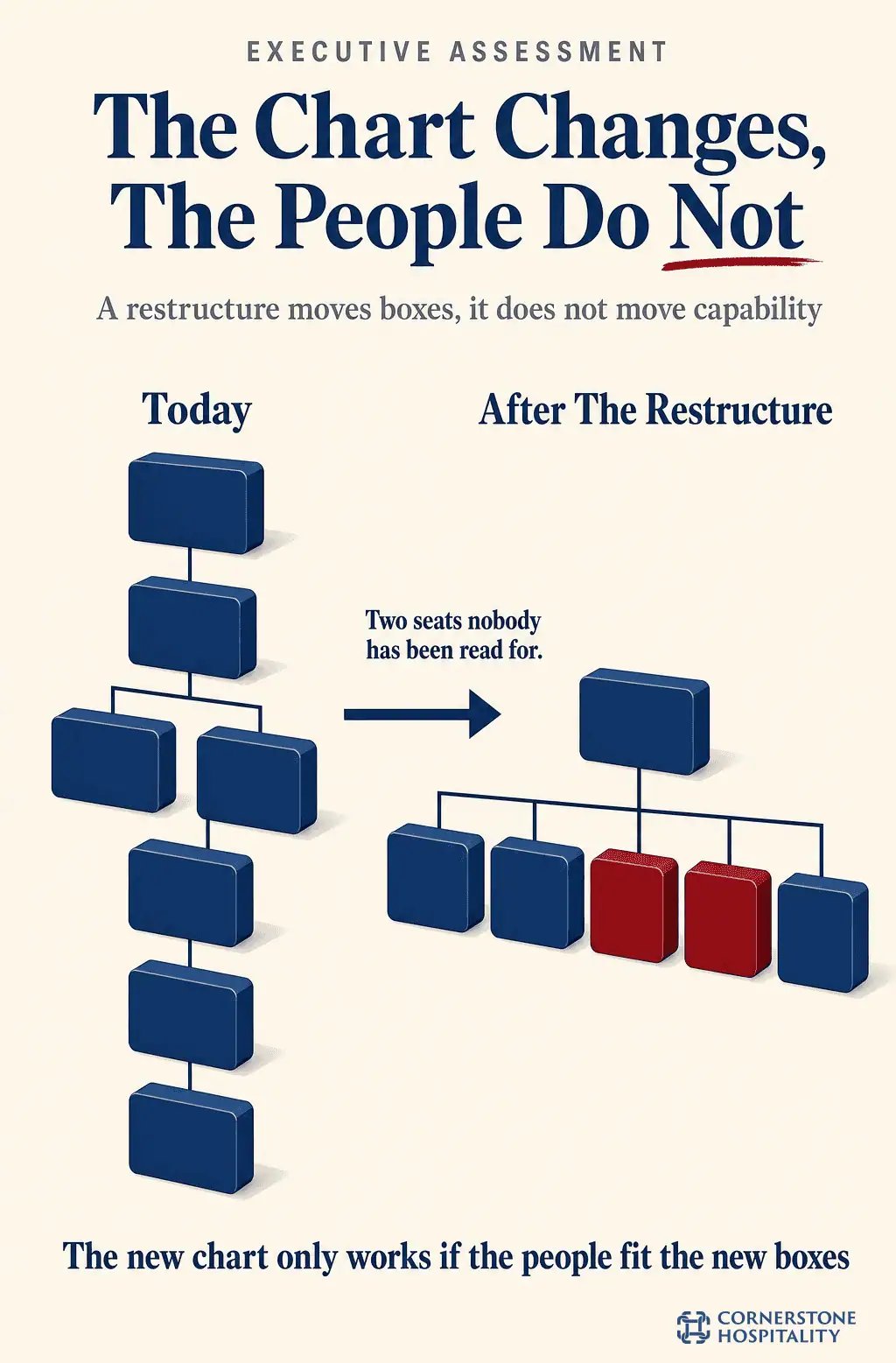
The chart changes, the people do not
A restructure is usually designed on paper, from the business problem backward. That is the right way to design it. The risk arrives at the point where names get dropped into the new boxes, because that step almost always happens on familiarity.
A tall narrow structure flattening into a wide one is the common hospitality case. It looks like the same people doing broadly the same work with fewer layers. In practice it creates two or three genuinely different jobs, usually with a much wider span and considerably less support beneath them.
Nobody in the business has held those jobs, so nobody’s record is evidence for them. Therefore the appointments get made on who is trusted, which is a reasonable instinct and a poor predictor.
What an executive team assessment establishes first
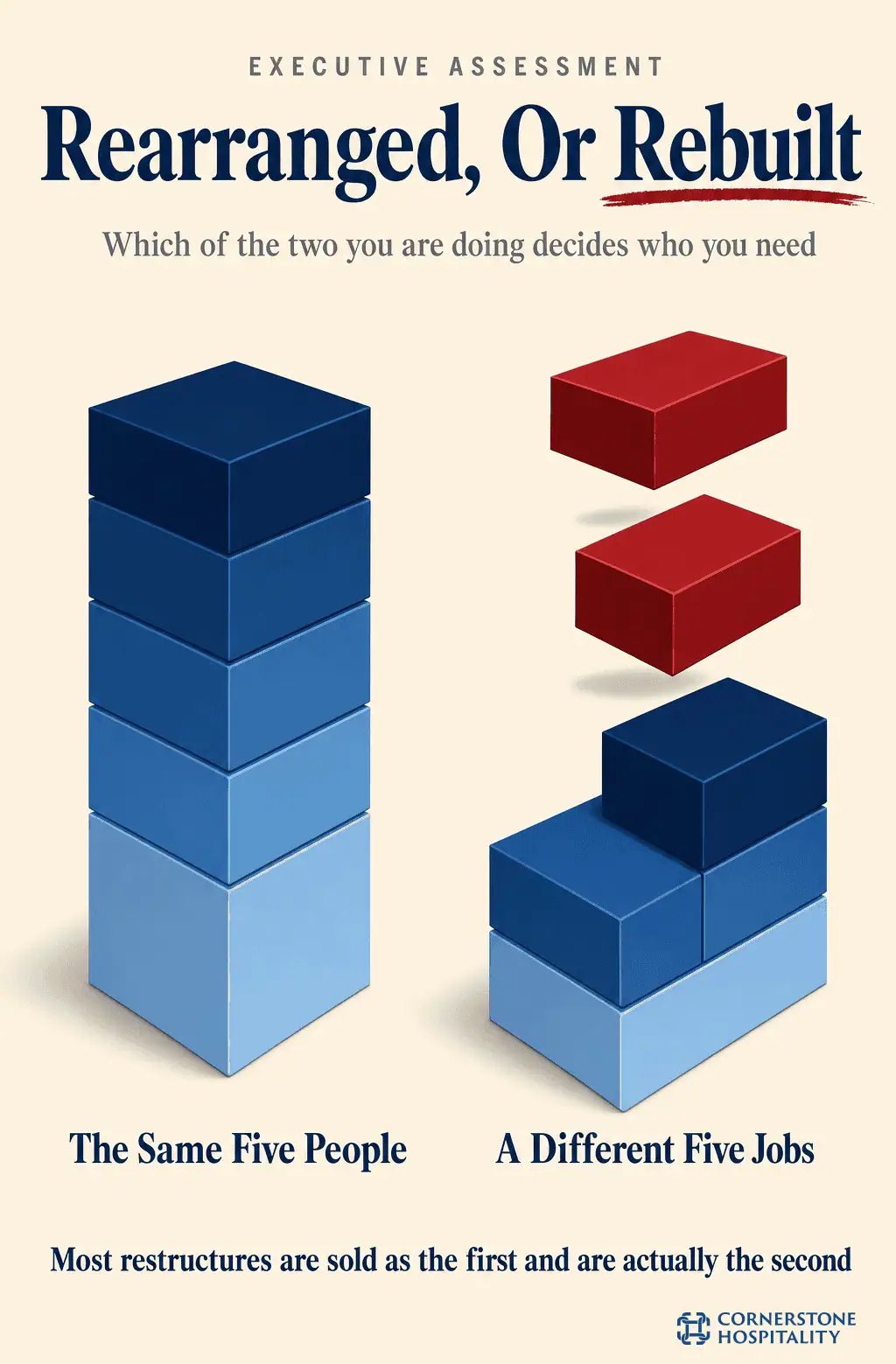
Whether you are rearranging the same jobs, or creating different ones

What the group gets
A read on each executive against the seat they would hold in the new structure, rather than against the one they hold now.
A view on the team as a whole under the proposed shape, because flattening a structure changes how the group works together as much as it changes any individual job. Furthermore the report names which of the new seats has no credible internal candidate, which is usually the finding that alters the plan.
Where people need support into a materially bigger job, most groups run that through executive coaching timed to start before the new structure goes live.
A restructure on the table
Send us the proposed shape and the current team. We will tell you which seats are genuinely new and which people have no evidence behind them yet.
Why the timing matters more than the method
| Before the announcement | After the announcement |
|---|---|
| Placements can change without anybody losing face | Moving somebody reads publicly as a demotion |
| A gap can be filled externally, calmly | External hiring now looks like a correction |
| Development can start before the job does | Support arrives once somebody is visibly struggling |
| The team hears one clear message | The team hears a second message that contradicts the first |
| Departures happen by design | Departures happen by surprise, usually the wrong ones |
The same assessment produces the same findings either way. Only the options available to act on them change, and they narrow sharply once the chart is public.
Rearranged, or rebuilt
Most restructures are presented internally as a rearrangement. The same team, organized more sensibly. That framing calms people, which is why it is used.
It is also frequently untrue. If a role gains a function it has never carried, doubles its span, or starts reporting to an owner instead of an operator, that is a different job wearing an old title. The distinction matters because a rearrangement needs communication, whereas a rebuild needs evidence about who can do the new work.
An executive team assessment settles which of the two you are actually doing, before the announcement makes the answer expensive.

Common questions
Can we do this without telling the team a restructure is coming?
You can assess without naming the restructure, and groups often do. We will advise on framing, because a team that later discovers the real purpose tends to trust the outcome less.
Is this used to justify redundancies?
It should not be, and we will say so. An assessment reads capability against a future role. Using it as retrospective evidence for a decision already made is both professionally improper and plainly visible to everybody involved.
What if somebody fits no seat in the new structure?
Then you have learned it early, with time to handle it properly. Where an exit follows, career transition support is usually the right accompaniment.
How does this fit with the restructure timetable?
Comfortably, if it starts before the shape is finalized. Four to six weeks ahead of announcement is the usual window.
Do you assess the incoming structure or the current one?
The incoming one. Reading people against the jobs they already hold tells you nothing you did not know.
Before the chart goes out
The new structure assumes the people fit it. Tell us the shape you are moving to and we will tell you where that assumption is untested.
Start the conversationSee our Executive Assessment work for how this connects to the wider engagement.