

Management Audit for Hospitality Leadership Teams
A management audit reads a hospitality leadership team as a working mechanism, not as a set of separate appraisals.
A management audit reads a whole leadership team at once, because the question that matters is rarely whether each person is capable. It is whether the team, as it is currently composed, can deliver the plan it has been given.
Individual appraisals answer individual questions. They cannot tell an owner or a board why a competent team keeps missing, because the answer usually sits between people rather than inside any of them. Cornerstone Hospitality runs the audit through Chartered Psychologists, reading every member on the same instruments and then reading how the profiles interact.
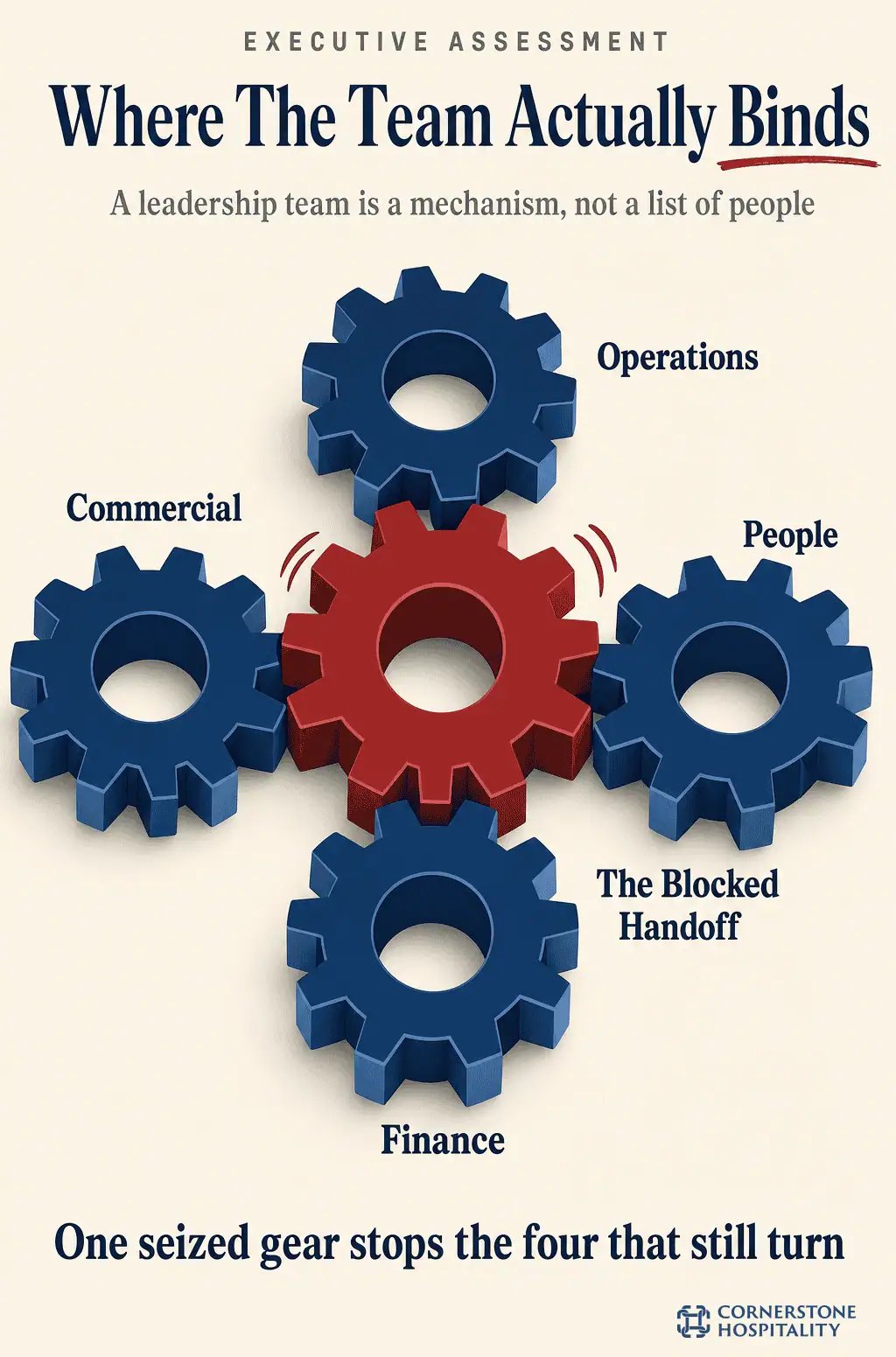
A team is a mechanism
Five capable people do not automatically make a capable team. Each seat drives the next, and a single blocked handoff stops the four that are still turning.
In hospitality that block is usually predictable. Commercial and operations disagree about what the property is for. People and finance never quite share a timescale. One seat carries a standard the others have stopped defending. None of those is an individual performance problem, and none of them shows up in an appraisal.
A management audit finds the blocked handoff, names it, and says whether it is structural or personal, because the two need completely different responses.
What a management audit finds that appraisals miss
Not who is weak, but where nobody is strong

What a management audit delivers
A written report covering each individual, plus the part most reports omit entirely: a read on the team as a unit.
That section names where strengths overlap wastefully, where a gap sits across every seat, and which frictions are built into the composition rather than into the personalities. Moreover it says what would change if one seat were filled differently.
Most groups then work the findings through team coaching, because a structural finding needs a structural conversation and rarely responds to individual development alone.
A capable team that keeps missing
That pattern usually has a structural explanation. Tell us about the team and the plan it is not delivering, and we will tell you what an audit would look at.
When groups commission one
| Trigger | What the audit is really answering |
|---|---|
| After an acquisition | Which of the two leadership teams can actually run the combined business |
| Before a restructure | Whether the people fit the shape being proposed, or only the old one |
| A new chief executive arrives | An independent read on an inherited team, faster than eighteen months of watching |
| Performance is flat and nobody can say why | Where the mechanism is blocked, when every individual looks competent |
| Preparing for a sale or refinancing | Whether the management team is an asset or a risk in the eyes of a buyer |
In every one of these, the underlying question is the same: can this team, as composed, deliver what is being asked of it.
Shared blind spots
A blind spot in one person is a development conversation. The same blind spot in everybody is a structural risk, and it is invisible from inside the team because nobody in the room notices what nobody in the room is doing.
Long horizon planning is the classic example in hospitality. An operating team selected for decisiveness and presence will frequently be thin on it across every seat, and the group will read the resulting drift as a strategy problem rather than as a composition problem.
Therefore the audit maps strength across the whole team rather than down each individual, which is what makes the shared gaps visible at all.


Common questions
Is this a performance review by another name?
No. A review judges past delivery against objectives. An audit reads capability and composition against a future plan, and the two frequently disagree.
Will the team see it as a threat?
That depends almost entirely on how a group introduces it. Framed as a read on the team rather than on individuals, and with feedback to everybody, it is usually welcomed, because most teams already sense where the block is.
Does everybody get feedback?
Yes, every participant does, without exception. It is a condition of the work.
Can you audit a team you also helped recruit?
Yes, and the psychologist running the audit is independent of any search team involved, for the same reason the original reads were.
How long does it take?
For a team of five to eight, about three weeks from first session to the presented report, with scheduling driving most of that.
Read the team, not just the people
If a capable group keeps missing, the explanation is usually structural. Tell us about the team and we will tell you what an audit would surface.
Start the conversationThis sits inside our Executive Assessment work, which covers the fuller picture beyond this one piece.